
NEW
Font size
S
M
L
XL
 Worksheets
Unit 3 EOC Review Most Missed
Total questions: 11
Worksheet time: 6mins
Name
Class
Date
1.
The human pancreas is an organ that plays an important role in the process of digestion. The pancreas secretes (releases) trypsin. Trypsin is an enzyme that breaks down proteins. Which statement BEST describes what occurs to the enzyme trypsin AFTER it digests (breaks down) a protein?
a)
The trypsin molecule is not chemically altered by the reaction and may be used again.
b)
After binding to a protein molecule, the trypsin molecule is destroyed and must be replaced.
c)
After binding to the protein molecule, trypsin is converted to a lipid and used for energy storage.
d)
The combined trypsin and protein molecule is utilized for energy to power cellular functions.
2.

Identify the monomer pictured below.
a)
nucleotide
b)
fatty acid chain
c)
monosaccharide
d)
amino acid
3.
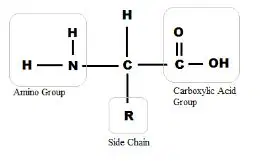
Identify the monomer pictured below.
a)
nucleotide
b)
fatty acid chain
c)
monosaccharide
d)
amino acid
4.
DNA plays a major role in heredity, composing the genes that are passed down from parent to offspring. It also plays a major role in the everyday workings of your cells. It does this by creating molecules, such as enzymes, that regulate cell functions. These enzymes belong to a larger class of molecules known as...
a)
RNA
b)
Proteins
c)
Ion Pumps
d)
Amino Acids
5.

What macromolecule is shown?
a)
Proteins
b)
Nucleic Acids
c)
Lipids
d)
Carbohydrates
6.
Why is the active site of an enzyme important to enzyme activity?
a)
It raises the activation energy of a reaction.
b)
It allows the enzyme to interact with a large variety of substrates.
c)
It allows an endothermic reaction to run as an exothermic reaction.
d)
It allows the enzyme to catalyze very specific reactions.
7.
When reading the nutrition facts on food packaging total fats is a measure of...
a)
Carbohydrate
b)
Lipids
c)
Water
d)
Protein
8.
Which of the following statements best explains how carbon, hydrogen, and oxygen from sugar molecules may combine with other elements to form amino acids and other large carbon-based molecules?
a)
Carbon, hydrogen, and oxygen can form bonds with other atoms, allowing them to combine into larger molecules.
b)
Carbon, hydrogen, and oxygen can form a mixture, allowing them to combine into larger molecules.
c)
Carbon, hydrogen, and oxygen can change phases from gas to liquid, allowing them to combine into larger molecules.
d)
Carbon, hydrogen, and oxygen cannot form bonds with other atoms, and therefore cannot combine into larger molecules.
9.
Insulin, hemoglobin, and enzymes are examples of which macromolecule group?
a)
carbohydrates
b)
lipids
c)
nucleic acids
d)
proteins
10.
Some macromolecules are formed from one or two _________ or small molecular fragments that repeat.
a)
Amino acid
b)
Monomer
c)
Polymer
d)
String
11.

What macromolecule is shown?
a)
Nucleic Acids
b)
Lipids
c)
Proteins
d)
Carbohydrates
Reset

