
Font size
 Worksheets
VA Biology SOL Review (Part 2)
Total questions: 22
Worksheet time: 26mins

What is a likely event that occurred between fossil layers B and D?
explosion of new species
mass extinction
can not tell from the image
small changes to the environment
Which domain of life is primarily responsible for playing a crucial role in human health, including aiding digestion, synthesizing essential vitamins, and protecting against harmful pathogens?
Archaea
Bacteria
Eukarya
Fungi
Which metabolic process is primarily responsible for converting light energy into chemical energy in autotrophic organisms?
Glycolysis
Fermentation
Photosynthesis
Krebs cycle
What are the steps of the lytic cycle in order from first to last?
Attachment, Injection, Synthesis, Assembly, Lysis
Injection, Attachment, Synthesis, Assembly, Lysis
Synthesis, Assembly, Lysis, Attachment, Injection
Attachment, Synthesis, Injection, Assembly, Lysis
Which of the following statements best reflects the concept of inferring relationships based on structural similarities?
Organisms with similar habitats are likely to be closely related.
Species with different behaviors are more likely to share a common ancestor.
Morphologically similar structures in different organisms suggest a common evolutionary origin.
Organisms with similar genetic codes always exhibit similar physical appearances.
Which taxonomic rank in the modern classification system is used to group organisms based on shared physical characteristics and evolutionary relationships?
Domain
Family
Genus
Species
Which domain of life is characterized by single-celled organisms that lack a nucleus and are commonly found in extreme environments such as hot springs and deep-sea vents?
Archaea
Bacteria
Eukarya
Fungi
Which domain of life includes organisms that play crucial roles in fermentation processes, nitrogen fixation, and the decomposition of organic matter?
Archaea
Bacteria
Eukarya
Viruses
Which domain of life is least commonly associated with human infectious diseases according to the principles of germ theory?
Archaea
Bacteria
Eukarya
None of the above
Avery, Mia, and Ava are studying biology and discussing different methods of classification. Which method groups organisms based on observable physical characteristics and overall similarities?
Phylogenetics
Cladistics
Linnaean taxonomy
Molecular taxonomy
Which statement accurately distinguishes the reproductive methods of viruses and bacteria
Bacteria reproduce through binary fission, while viruses replicate through a process involving the integration of their genetic material into the host cell's genome.
Both bacteria and viruses reproduce through binary fission.
Bacteria replicate by releasing spores, while viruses replicate by invading host cells and using their machinery to replicate.
Viruses replicate by binary fission, similar to bacteria, but at a much slower rate.
Which characteristic distinguishes viruses from organisms?
Viruses are composed of cells, while organisms are not.
Viruses possess a nucleus, while organisms do not.
Viruses require a host cell to reproduce, while organisms can reproduce independently.
Viruses have a complex internal structure, while organisms do not.
Which cellular structure is responsible for storing genetic information and controlling cellular activities?
Ribosome
Mitochondria
Nucleus
Endoplasmic reticulum
Which statement best reflects the inference of relationships based on developmental stages?
Organisms with similar developmental stages must share a recent common ancestor.
Organisms with distinct developmental stages are not likely to be closely related.
Developmental stages of organisms are not indicative of evolutionary relationships.
The complexity of developmental stages directly correlates with the organism's position in the evolutionary tree
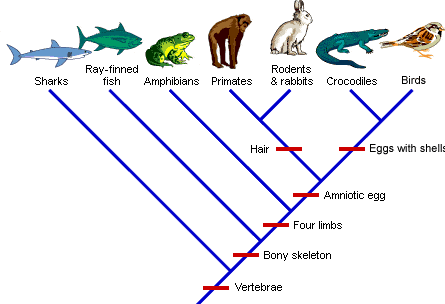
According to this cladogram, primates are most closely related to - (a)

According to this cladogram, birds are LEAST related to - (a)
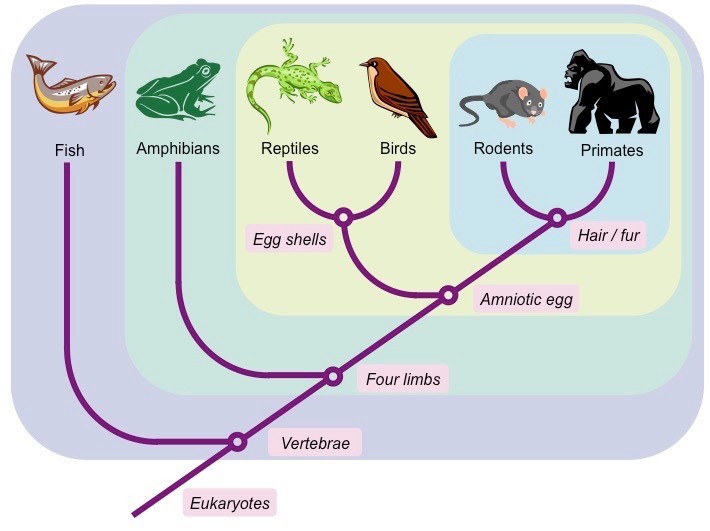
What characteristic distinguishes amphibians from birds and reptiles?
Amniotic egg
Egg shells
Vertebrae
Hair/fur

In a biology class, Mason is asked to compare the wing of a butterfly and the wing of a bat. How would he describe these structures?
Homologous structure
Analogous structure
Structural adaption
Functional adaption


