wayground logo

Free Printable Worksheets

Font size

S
M
L
XL
Worksheets

Civil War Unit Review

Total questions: 56

Worksheet time: 30mins

Name
Class
Date
1.

Where did Robert E. Lee surrender to the Union Army and end the Civil War?

a)

Bull Run

b)

Appomattox

c)

Gettysburg

d)

Antietam

2.

Which event was the immediate cause of the secession of several Southern states from the Union in 1860?

a)

The Dred Scott decision by the U.S. Supreme Court

b)

The election of President Abraham LIncoln

c)

The enactment of the Missouri Compromise

d)

The raid on the arsenal at Harpers Ferry by John Brown

3.

To break away from a group

a)

state's rights

b)

slavery

c)

Gettysburg

d)

secede

4.

Lincoln’s Emancipation Proclamation declared that

a)

slaves in U.S. territories were free.

b)

slaves throughout the world were free.

c)

slaves in Confederate states were free.

d)

slaves in Union slave states were free.

5.

What was the Emancipation Proclamation?

a)

A speech by Lincoln in 1863 in memory of the soldiers that died there

b)

An order issued by President Lincoln declared slaves in the south to be set free

c)

The right of an accused person to appear in court so a judge can determine whether they were imprisoned lawfully

d)

The 11 states that seceded from the Union

6.

What was a major economic difference between the North and the South that contributed to the causes of the American Civil War?

a)

The North relied more on manufacturing while the South had an economy based on agriculture.

b)

Both the North and the South were primarily agricultural.

c)

The South had a more technologically advanced manufacturing sector.

d)

The North focused on trade with Europe, whereas the South did not engage in international trade.

7.

Which event marked the beginning of the American Civil War?

a)

The signing of the Emancipation Proclamation.

b)

The Battle of Gettysburg.

c)

The firing on Fort Sumter.

d)

The election of Abraham Lincoln.

8.

What was the significance of the Battle of Gettysburg?

a)

It was the final battle of the Civil War.

b)

It marked the beginning of the Civil War.

c)

It was a turning point in the war, favoring the Union.

d)

It led directly to the signing of the Emancipation Proclamation.

9.

Which battle is considered the first major battle of the American Civil War?

a)

Battle of Fort Sumter.

b)

Battle of Bull Run.

c)

Battle of Antietam.

d)

Battle of Shiloh.

10.

Which amendment abolished slavery throughout the United States?

a)

The 13th Amendment.

b)

The 14th Amendment.

c)

The 15th Amendment.

d)

The 12th Amendment.

11.

Which of the following was NOT a result of the Emancipation Proclamation?

a)

It encouraged more slaves to escape to the North.

b)

It allowed African Americans to serve in the Union Army.

c)

It ended slavery in all states immediately.

d)

It changed the focus of the war to include the moral issue of slavery.

12.

Famous for a march to the sea, and the Battle for Atlanta.

a)

General Lee

b)

Ulysses S Grant

c)

General Meade

d)

William T Sherman

13.

Where did the majority of the Civil War's epic battles take place?

a)

North

b)

South

c)

West

d)

Border States

14.

Grant won this battle by taking control of Mississippi River and laying siege to the city of (a)  

15.

What battle was the single, bloodiest day in the Civil War?

a)

Bull Run

b)

Antietam

c)

Gettysburg

d)

Manassas

16.

What battle was the deadliest battle of the Civil War, as well as in American History?

a)

Antietam

b)

Bull Run

c)

Gettysburg

d)

Appomattox

17.
The bloodiest single day in American military history ended in a draw, but the Confederate retreat gave Abraham Lincoln the “victory” he desired before issuing the
a)
Declaration of Independence.
b)
13th Amendment.
c)
Gettysburg Address.
d)
Emancipation Proclamation.
18.
Who won the Civil War?
a)
Union
b)
Confederates
19.

The Kansas Nebraska act overturned which piece of legislation?

a)

The Missouri Compromise

b)

The Compromise of 1850

c)

The Dred Scott Decision

d)

The Emancipation Proclamation

20.
Who developed and wanted the ten percent plan?
a)
Lee
b)
Lincoln
c)
Johnson
d)
Grant
21.
Who had greater industrial capacity at the beginning of the Civil War?
a)
The North
b)
The South 
c)
The Confederacy
d)
Mexico
22.
Who had better Generals throughout the Civil War?
a)
The Union
b)
Lincoln
c)
The South
d)
Canada
23.
Who had greater manpower in the Civil War?
a)
The North
b)
The South
c)
The West
d)
American Indians
24.
The Union strategy at the beginning of the Civil War was called the...
a)
Defense First plan
b)
Anaconda Plan
c)
King Cotton
d)
Try to Compromise Plan
25.
Which battle helped both sides that the war would not be won quickly or easily.
a)
Ft. Sumter
b)
Bull Run
c)
Saratoga
d)
Yorktown
26.
The Gettysburg Address claimed that...
a)
the war was about "a new birth of freedom"
b)
the war was about Cotton
c)
the war was for oil
d)
the war was about States Rights
27.
What does the term "Total War" mean?
a)
Every country is at war
b)
War is fought totally between soldiers
c)
War is taken to everyone, soldiers, men, women, children, etc.
28.
What is the best example of "total War"?
a)
Francis Marion in the Revolutionary War
b)
William Sherman's March to the Sea
c)
Wade Hamptons fighting style in Virginia
29.
What was the main purpose of Sherman's March to the Sea?
a)
To disrupt the South's fighting style
b)
Destroy the South's strategic and economic capacity to fight
c)
Destroy the supplies that the confederate army had stored
30.

What was a major advantage of the North during the Civil War?

a)

Larger population and more industrial resources

b)

Superior military leadership

c)

Stronger motivation to win the war

d)

Better knowledge of the southern terrain

31.

What was a significant disadvantage faced by the South during the Civil War?

a)

Greater access to transportation resources

b)

Weaker military strategy

c)

Inferior weaponry and technology

d)

Smaller population and fewer resources

32.

What was the main theme of the Gettysburg Address?

a)

Celebrating a Union victory

b)

Honoring fallen soldiers

c)

Criticizing Confederate leadership

d)

Promoting states' rights

33.

What initial law caused northerners to create these types of announcements?

a)
The Underground Railroad
b)

Fugitive Slave Act

c)
Freedmen's Bureau
d)
Black Codes
34.
What was one effect of the Fugitive Slave Act of 1850?
a)
The Republican Party lost influence in the federal legislature.
b)
The Missouri Compromise was deemed unconstitutional by federal courts.
c)
Tensions among the populations of northern and southern states increased.
d)
Immigrants were forced to relocate from eastern cities to western territories.
35.
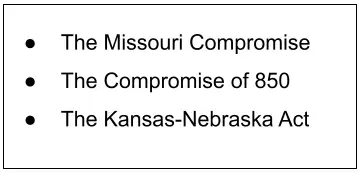
What was the fundamental question addressed in each of these congressional acts?
a)
Should slave labor be allowed in new states?
b)
Should states be allowed to nullify federal laws?
c)
Should the U.S. expand westward?
d)
Should states be able to secede from the Union?
36.
The two shaded states on this map were admitted to the Union under the terms of a compromise involving the—
a)
resolution of a boundary dispute with Great Britain
b)
expansion of slavery into western territories
c)
relocation of American Indians to western territories
d)
counting of the slave population for purposes of representation
37.
These headlines refer to the decision in which Supreme Court case?
a)
McCulloch v. Maryland
b)
Gibbons v. Ogden
c)
Worcester v. Georgia
d)
Dred Scott v. Sandford
38.
Which location on the map was the site of the fighting that broke out between pro-slavery and anti-slavery groups?
a)
A
b)
B
c)
C
d)
D
39.
What was the purpose of the Underground Railroad?
a)
to move goods more quickly than the above ground railroad
b)
to help slaves escape slavery by moving North
c)
to make money
d)
to move soldiers to the west
40.
The Kansas-Nebraska Act led to people flooding into these territories from the North and South to vote on slavery. This led to what event?
a)
Runaway Slave Act
b)
Southern Property Act
c)
Fort Sumter Act
d)
Bleeding Kansas
41.
First state to secede from the Union was________.
a)
Texas
b)
North Carolina
c)
Tennessee
d)
South Carolina
42.
This allowed California to enter the Union as a free state, it opened Utah and New Mexico territory to slavery, and allowed for a Fugitive Slave law.
a)
Runaway Slave Act
b)
Southern Property Act
c)
Fort Sumter Act
d)
Compromise of 1850
43.
What did John Brown hope to achieve by his raid at Harpers Ferry?
a)
reveal the horrors of slavery
b)
to create a slave rebellion that would bring an end to slavery
c)
help slaves escape on the Underground Railroad
d)
help catch runaway slaves or be sent to jail
44.

Who was the President of the United States during the Civil War?

a)

Ulysses S. Grant

b)

Abraham Lincoln

c)

Jefferson Davis

d)

Andrew Johnson

45.

Jefferson Davis served as the President of which entity during the Civil War?

a)

The United States of America

b)

The Confederate States of America

c)

The Union Army

d)

The Confederate Army

46.

Robert E. Lee was a general for which side during the Civil War?

a)

The Union

b)

The Confederacy

c)

Both, at different times

d)

Neither, he was a diplomat

47.

Harriet Tubman is known for her role in what underground network?

a)

The Underground Railroad

b)

The Metropolitan Railway

c)

The Confederate Secret Service

d)

The Union Intelligence Service

48.

Which of the Reconstruction Amendments addressed the right of African-American males to vote?

a)

13th Amendment

b)

14th Amendment

c)

15th Amendment

d)

16th Amendment

49.

This amendment gave citizenship to all people born in the U.S. even if they were previously a slave.

a)

13th

b)

14th

c)

15th

d)

4th

50.
Lincoln said our country was conceived in liberty.  What did he mean? 
a)
Founded for justice
b)
Founded for fairness
c)
Founded for equality
d)
Founded for freedom
51.
Lincoln states that "we here highly resolve that these dead shall not have died in vain", what does he mean? 
a)
They deserved to die
b)
It was God's will that they died
c)
We should fight for freedom in their honor
d)
All Confederate soldiers should die
52.
Lincoln ends his speech by stating "that government of the people, by the people, for the people shall not perish from earth." What idea is he describing?
a)
democracy
b)
justice
c)
liberty
d)
equality
53.

What was the impact of sharecropping on the South?

a)
Sharecropping encouraged self-sufficiency and independence among farmers in the South.
b)
Sharecropping resulted in the abolition of racial segregation in the South.
c)
Sharecropping perpetuated poverty and economic dependence among farmers in the South.
d)
Sharecropping led to increased wealth and prosperity for farmers in the South.
54.

What was the purpose of literacy tests, poll taxes and grandfather clauses?

a)
To simplify the voting process for all citizens
b)

To prevent African Americans and other minority groups from voting.

c)
To encourage voter turnout among all demographics
d)
To promote equality and fairness in voting
55.

People who worked to end slavery were called:

a)

abolitionists

b)

southerners

c)

cartridges

d)

blockades

56.

How was popular sovereignty used in debates on the expansion of slavery into new territories?

a)
Only slave owners were allowed to vote on the issue
b)
Popular sovereignty was not a factor in the debates
c)
Residents of new territories could vote on whether to allow slavery or not.
d)
Slavery was decided by the federal government