
 Worksheets
Ch 16/17 Test Review
Total questions: 36
Worksheet time: 23mins
Why are Earth's oceans salty?
Rain washed salts into them
They contain a lot of water vapor
Algal blooms in the ocean produced salt
Which description best characterizes the seafloor?
mostly flat
full of life-forms
similar to the continents
Ocean waves move water
to form tides
long distances
in a circular motion
Ocean surface currents are caused by
wind
gravity
density
Density currents move ocean water
upward
downward
horizontally
Which situation describes a point-source ocean pollutant?
nitrates in runoff
volcanic eruption
oil spills from multiple ships
What causes coral bleaching?
change in water temperature
increase in carbon dioxide
strong winds that blow for long times
Upwelling brings deep ____ ocean water to the surface.
cold
warm
Surface waves have ____ wavelengths.
long
short
Spring tides occur when the moon is
new or full
1/4 or 3/4
Tsunamis are large, circular system of ocean currents
true
false
Neap tides occur when Earth, Moon, and the Sun
form a right angle
are aligned
Don't forget to look at the Diagrams on p. 569 in the book!
A rise in sea level can result when
sea ice melts
glaciers melt
ice sheets form
Many scientists hypothesize that ____ have caused glaciers to melt.
lower sea levels
higher global temperatures
higher levels of oxygen in the air
A body of water that flows within a channel is called a ____
lake
glacier
stream
A ____ is an area of land that drains runoff from a stream.
wetland
watershed
headwater
Water that has soaked into soil and has been absorbed by rock and sediment is called
runoff
groundwater
precipitation
A ____ is an area of land that is saturated with water for part or all of the year.
wetland
headwater
water table
Match the following
water from rain or melting snow that does not soak into the soil or evaporate
runoff
layer between warm and cold water in a deep lake
thermocline
water many people use for drinking, washing, and cooking
groundwater
the amount of water an aquifer can hold depends on its
porosity
where water table meets land's surface this can form
stream
Which is formed from runoff and precipitation, is rich in nutrients, and has grasses and shrubs
marsh
swamp
bog
Which is formed from runoff and precipitation, is rich in nutrients, and has trees and shrubs
marsh
swamp
bog
Which is formed from runoff, is poor in nutrients, and has mosses and wildflowers
marsh
swamp
bog
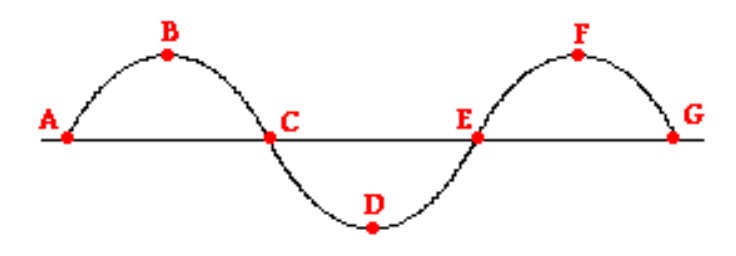
Which letter(s) represent the trough of the wave? (a)

What does point C represent?
Amplitude
Trough
Crest
Wavelength

An estuary is made up of what kind of water?
Saltwater only
Freshwater only
Salt & Fresh water
What is H20 even mean?

A semi-enclosed area where fresh water from a river meets salty water from the sea.
Watershed
Groundwater
Estuary
Ocean
Wells are usually drilled into ____
wetlands
aquifers
watersheds
Regions near warm-water currents are usually...
warmer and wetter
warmer and drier
colder and wetter
colder and drier
Regions near cold-water currents are usually...
warmer and wetter
warmer and drier
colder and wetter
colder and drier
If the moon were closer to Earth, the force it applies via gravity would be...
greater
smaller
What happens to surface temperature when snow melts off a snow-covered field?
It increases
It decreases
Snow and ice reflect ____ sunlight than water or land.
more
less


