
Font size
 Worksheets
Physics ICGSE Revision List
Total questions: 500
Worksheet time: 9hrs 58mins
What is the formula for Average Speed?
(a)
How to caculate Average Velocity?
(a)
How to caculate acceleration using change in velocity?
(a)
How to caculate Weight using Mass?
(a)
State the relationship between Force, Mass and Acceleration?
(a)
How to caculate Density using Mass?
(a)
State Hooke's Law
(a)
How to caculate Pressure?
(a)
How to caculate Fluid Pressure?
(a)
How to caculate Work Done?
(a)
How to caculate Power?
(a)
Caculate K.E?
(a)
G.P.E?
(a)
Efficiency?
(a)
Moment of Force?
(a)
Momentum
(a)
Impulse
(a)
Centripetal Force?
(a)
Orbital Period?
(a)
Boyle's Law
(a)
Q =?
(a)
Energy Transferred (Heat)
(a)
Current (Relating to Charge)
(a)
Voltage (Relating to Charge)
(a)
Ohm Law
(a)
Power (Relating to Voltage)
(a)
Energy Transferred? (Relates to Voltage)
(a)
Rtotal (In Series)
(a)
Total Resistance (Parallel)
(a)
Is Voltage and Number of Turns directly or inversely proportional to each other
(a)
Is the relationships for Voltage and Current in a Transformer directly or inversely proportional to each other?
(a)
Wave Speed?
(a)
Relationship between Period and Frequency
(a)
Refractive Index involving angles?
(a)
Refractive Index involving speed
(a)
Refractive Index with Critical Angle?
(a)
What is Alpha Particle?
Electron (0;-1)
Helium Atom (4;2)
rays
Fundamental particle of our world, which is very important for the building of atoms in general
What is Beta particle?
Electron (0;-1)
Helium atom (4;2)
rays
Particle that made up our cells, and our lungs, its very common in our body in general
What is gamma radiation?
Electrons (0;-1)
Helium atom (4;2)
rays
it hurts.
How many milliliters are in a 2 liter?
2
20
200
2000
How many grams are in 5 kilograms?
5
50
500
5000
2000 mg = ? g
5
2
8
6
21 min = _______ sec
Which is the unit according to the SI of measurement for temperature.
Kelvin
Celsius
Fahrenheit
Candela
.003m is the same as to
3mm
3nm
3cm
3km
How many kelvin have in -26F
240.92 K
270.15K
-256.12K
-240.92 K
1 μm is the same as
x10−3m
x10−6m
x10−9m
x10−12m

What is the resultant force?
40 N left
0 N Balalnced
400 N right
40 N right


What is the resultant/ net force?
30 N left
25 N right
5 N left
55 N right
Which could be an example of an unbalanced force?
A plate sitting on a dining table
A ball at the top of a hill that is not moving
Earth orbiting the Sun
A football that has been thrown to the goal post.

What is the resultant/ net force?
400 N Up
400 N Down
- 400 N Down
800 N Down
A balanced force is only an object that is not moving.
True
False


The ability to do work or cause change.
work
force
motion
energy
An object's change in position relative to a reference point.
work
force
motion
energy
Force exerted on an object that causes it to move
work
force
motion
energy
A push or a pull.
work
force
motion
energy
Resistance to change.
power
force
inertia
energy
The rate at which work is done.
power
force
inertia
energy

What does letter A represent
object providing force
object receiving force
gravity
friction
What does letter C represent
object providing force
object receiving force
gravity
friction
What does letter B represent
object providing force
object receiving force
gravity
friction
What does letter D represent
object providing force
unbalanced force
gravity
friction
Which physical quantities appear in the formula for work. Choose more than one
force
time
distance
speed
According to Newton's second law of motion, a/an ________ force will cause an object to move in the direction of the force.
balanced
unbalanced
equal
Yoda
Just after she jumps out of the plane (before the parachute opens). The relative forces will be
Balanced
Unbalanced
Just after she jumps out of the plane (before the parachute opens). The relative forces will be
Weight force is equal to the friction force
Friction force is constant
Weight force is greater that the friction force
Friction force is greater than the weight force
Just after she jumps out of the plane (before the parachute opens). The net force will be
zero
upward
downward
Just after she jumps out of the plane (before the parachute opens). The sky diver will have
a constant speed
a constant acceleration
a constant velocity
After the 60 seconds, the parachutist pulls the cord and opens her parachute.
Explain how the parachute reduces the speed of the parachutist when it is just opened.
The friction force decreases
The weight force decreases
The weight force increases
The friction force increases


The graph shows the vertical speed of a parachutist. At which point did they open the parachute?
A
B
C
D
If a skydiver changes from a vertical to a horizontal position during freefall:
His terminal speed would increase
His terminal speed would decrease
His terminal speed would stay the same
When a parachute canopy is opened more drag is created because:
It has a large mass
It has a large surface area
It is travelling at terminal speed
The person is now vertical

If this graph were to show a parachutist jumping from a plane, how would you describe the forces acting at point B.
His weight is bigger than air resistance
Air resistance is bigger than his weight.
His weight and air resistance are balanced.

Identify true statements:
The parachutist has just left the plane
Weight is increasing
There is no drag
Weight is constant
Deceleration

Identify true statements:
Drag is increasing
Velocity is increasing
There is no drag
Weight is increasing
Deceleration

Identify true statements:
Drag is increasing
Velocity is increasing
Terminal velocity
Acceleration
Maximum drag

Identify true statements:
The parachutist opens their parachute
Deceleration
Terminal velocity
Weight is increasing
Drag is constant

Identify true statements:
Drag is decreasing
Velocity is increasing
Drag is increasing
Velocity is decreasing
Weight is constant

Identify true statements:
Drag is increasing
Velocity is increasing
Terminal velocity
Acceleration
Drag is constant

Terminal velocity.
Select the force arrows that apply:


_________ is the unit of Spring Constant
N
N/m
m
If the original length of a spring is 20m and its extended length is 30m. What is the extension?
20m
12m
75m
45m
10m
A bungee rope has a spring constant of 5N/m. How much a person must weighs in Newton if we want it to extend (stretch) 10m?
20N
22cm
50N
50cm
21N
What is the spring constant of a bungee rope in N/m if a person weighs 100 N if we want it to extend (stretch) 20m?
5N/m
5N/cm
5N
10N
10N/m

What is the best description of the relationship shown in this graph?
In this graph, the relationship between force and extension is linear.
In this graph, the relationship between force and extension is non-linear.
In this graph, the relationship between force and extension is directly proportional.
In this graph, there is no relationship between force and extension.

An unstretched spring becomes longer when a force is applied to it. Which word describes the additional length of the spring gains?
Expansion
Extension
Stretched

Select a logical prediction for the investigation.
As the force applied to the spring increases, the extension of the spring will decrease.
As the force applied to the spring increases, the extension of the spring will stay the same
As the force applied to the spring increases, the extension of the spring will also increase.

In the diagram, a force is used to stretch a spring. The spring is temporarily deformed when the force is applied. When the force is removed, the spring . . .
returns to its original length.
stays the same length.

For this spring, as the force increases, the extension increases proportionally. What would you expect to happen to the extension if the force was doubled?
The extension would stay the same.
The extension would double
The extension would halve
What happens when the stretching force on an elastic material is released?
The material breaks.
The material remains stretched out.
It does nothing
The material snaps back to its original shape.

At point P, _______.
the force applied to the spring is equal to its elongation
Hooke's Law ceases to be valid
the spring is can be stretched but still springs back into shape reversibly
the spring constant increases

When comparing spring A to B,
both experience the same maximum force
both experience the same elongation
both store the same amount of elastic potential energy
both have identical spring constants
When comparing spring A to B,
A has a larger spring constant than B so A is a stiffer spring
B has a larger spring constant than A so A is a stiffer spring
A has a larger spring constant than B so B is a stiffer spring
B has a larger spring constant than A so B is a stiffer spring
Elasticity is the property of material that enables an object to return to its original ___________ after the force applied on it is removed.
shape and size
colour and size
type and shape
height and weight
the extension of a spring is ___________ to the force applied on the spring.
directly proportional
inversely proportional
A nut can be loosened more easily with
a short spanner because a larger turning effect can be produced.
a long spanner because a larger turning effect can be produced.
a long spanner because a larger force can be produced.
a short spanner because a larger force can be produced.
Jack has a weight of 300 N and sits 2.0 m from the pivot of see-saw. Jill has a weight of 450 N and sits 1.5 m from pivot. Who will move down?
Jack
Jill
Both of them
None of them
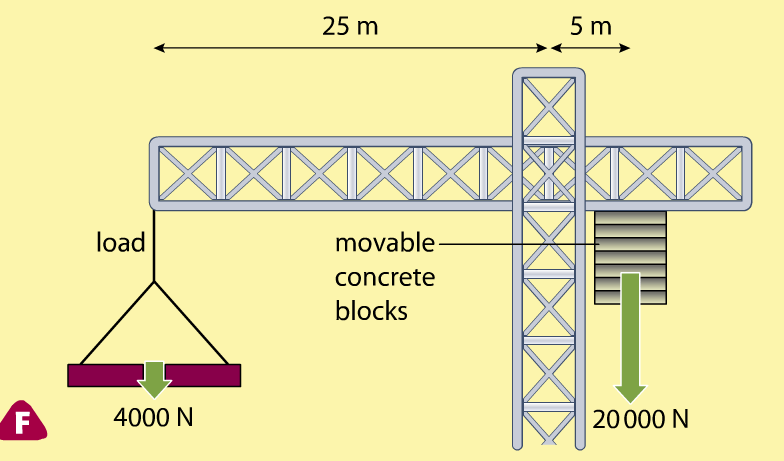

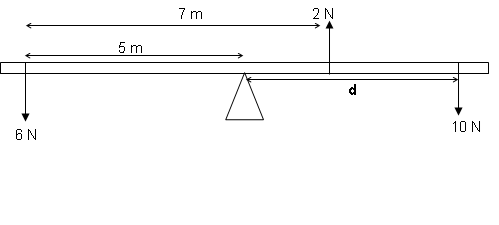
Assuming the system is in equilibrium, calculate the missing distance d
3.4 m
2.8 m
4.4 m
1.6 m
How are weight, mass and g related
W=mg
m=Wg
g=Wm
m=W/g
Which equation relates force, acceleration and mass?
Tick all that are correct
F=ma
F=am
a=mF
a=Fm
What is the equation for moments?
Moment = force x perpendicular distance from pivot
Moment = mass x velocity
Moment = force x distance
Moment = force x parallel distance from pivot
When an object is in equilibrium, which equation is true?
Clockwise moment = anticlockwise moment
Clockwise moment + anticlockwise moment = 0
Clockwise moment / anticlockwise moment = 0
Clockwise moment + anticlockwise moment = resultant force

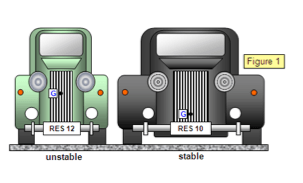

A simple method to find centre of gravity of a body is usage of
stop watch
plumbline
pendulum
gauge
If we suspend lamina at different positions, its center of gravity will still lie along the
Plumb line
Line of force
Line of weight
Gravity line
Center of gravity is usually located where
more weight is concentrated
less weight is concentrated
less mass is concentrated
more mass is concentrated


The diagram shows a beam. Without any weights, the beam balances at its centre.
Three weights are hung as shown.
At which point does a load of 2 N balance the beam?
A
B
C
D

The figure below shows a man lifting a heavy rock using a steel bar. He pushes downwards on the end of the bar with a force F.
Which pivot positions allows the force F to be as small as possible?
A
B
C
D

What is something that prevents heat, electricity, sound, light...to pass through it?
insulator
conduction
heat transfer
conductor
What is something that readily conducts heat, electricity, sound...
insulator
conduction
thermal equilibrium
conductor
the transfer of heat in a fluid (gas or liquid) by means of up & down movements called convection currents
conduction
convection
radiation
the transfer of heat through a vacuum (empty space)
conduction
convection
radiation
the transfer of heat through a medium (material) by direct contact of molecules
conduction
convection
radiation
What is the total energy of particles in a substance; more particles=more energy?
conductor
radiator
thermal energy
heat transfer
How does heat move?
from cold to hot
from hot to cold
What is the concept in which two objects in contact with each other transfer heat until they are equal?
thermal equilibrium
thermal energy
thermal equality
thermal heat
What is a measure of the average kinetic energy of the individual particles in an object?
heat
volume
kineticism
temperature
What is energy caused by the internal movement of molecules; measured in joules?
conduction
heat
radiation
insulator
Sunbathing is an example of...
conduction
convection
radiation
Burning your feet on the hot sand is an example of...
conduction
convection
radiation
Feeling the warm breeze from the ocean is an example of...
conduction
convection
radiation
Cooking pizza in the microwave is an example of...
conduction
convection
radiation
Steam rising from hot soup is an example of...
conduction
convection
radiation
Cooking pancakes on a griddle is an example of...
conduction
convection
radiation
There are four main processes in changing of phase, and they are
Melting
Boiling
Condensation
All the above
Latent heat is
the heat absorbed or released at a boiling process during a change of phase
the heat absorbed or released at a constant temperature during a change of phase
the heat absorbed or released at a constant temperature during a change of phase of 1 kg object
the heat absorbed or released by an object to increase or decrease its temperature by 1 degree Celcius
the symbol for specific latent heat is
c
L
Q
m
Water molecules have the greatest kinetic energy in
Ice at 0 ⁰C
Water at 90 ⁰C
Water at 373 K
Steam at 150 ⁰C
How much energy is needed to raise the temperature of 5.0 grams of lead from 25°C to 35°C? [specific heat (c) = 0.129 J/(g•°C)]
6.45 J/(g•°C)
6.45 J
16.1 J/(g•°C)
d.16.1 J
Which of the following best explains why the sand at the beach is hotter than the water?
Sand has a higher specific heat than water.
Sand has a lower specific heat than water.
There is more water than sand at the beach.
There is more sand than water at the beach.


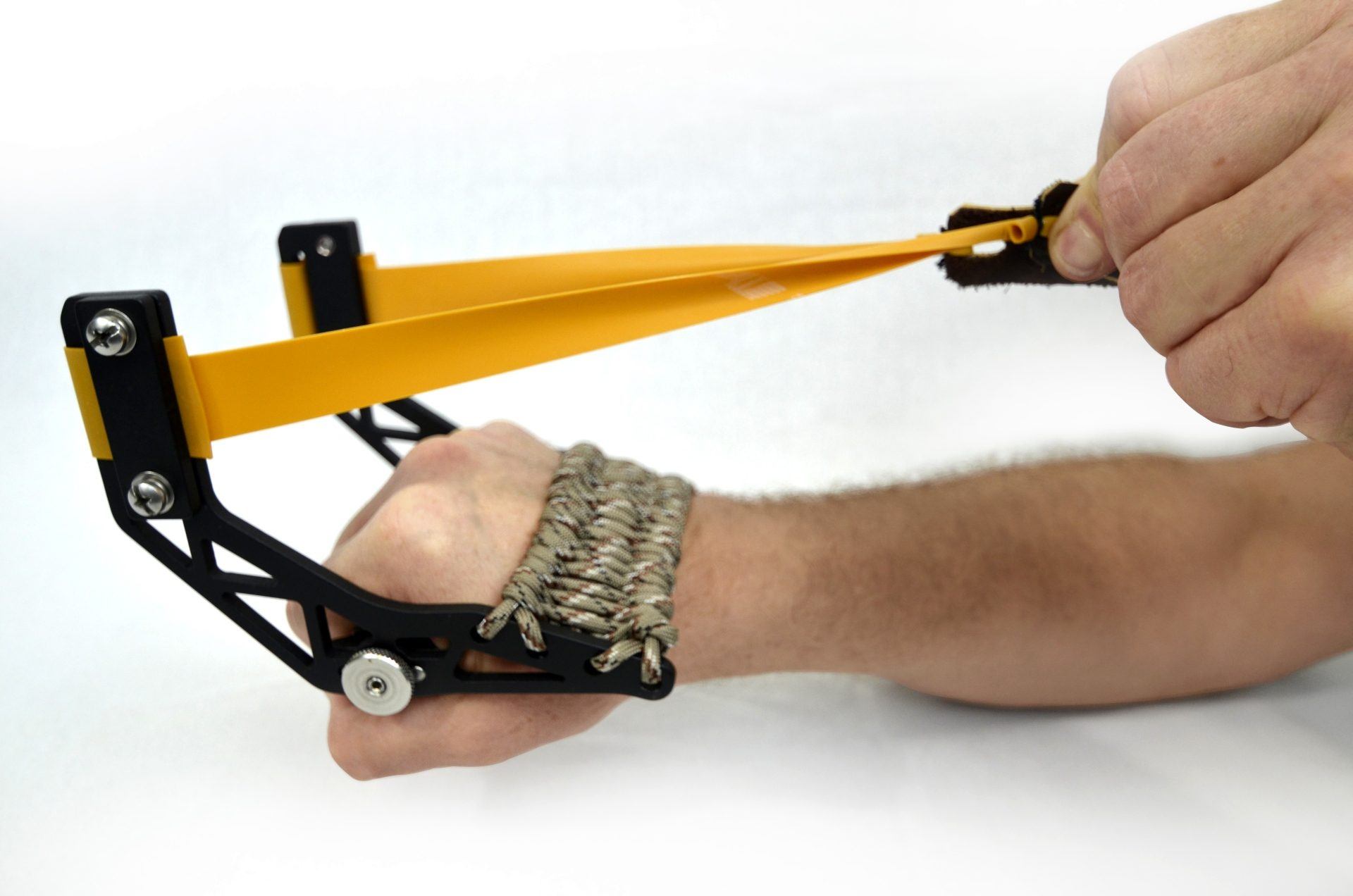







What kind of energy is in a stretched rubber band?
Elastic Potential
Kinetic
Gravitational Potential

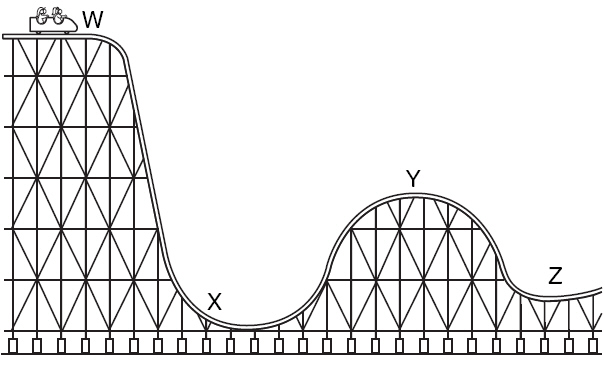
At which position does the child on the swing have the most gravitational potential energy?
W
X
Y
Z
If the temperature change in an aluminum cylinder is 2oC, when a bottle falls 1 m., what would be the temperature if it fell 3 times higher?
it would be the same
6oC
9oC
30oC
If the temperature change in an aluminum cylinder is 2oC when it is used to stopped a spinning wheel, what would be the change in temperature if the wheel were spinning twice as fast?
it would be the same
4oC
8oC
16oC
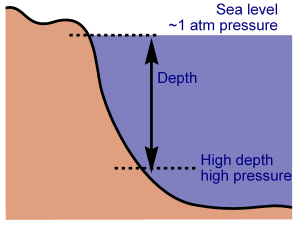
When you increase your depth under water, the water pressure on your body
increases
decreases
stays the same
How do you Calculate Pressure
Force(N)/Area(m2)
Force(kg)/Area(mi2)
Area(m2)/Force(N)
Why won't you sink in mud if you wear boots?
Because the surface area is larger creating less pressure.
Has air in it to keep you floating.
Because the mud won't want you.

Diagram shows the design of a dam. Why does the thickness of the dam increase with its depth?
The design of this structure is stronger.
Water pressure increases with depth.
The cost of construction is lower.
Water pressure acts uniformly in all directions.
What is pressure?
The amount of force exerted on a surface
The surface area of an object
The weight of an object


what is the product of force and displacement?
work
power
energy
what is the unit of work?
Newton
Joule
Watt
meter
what is the formula needed to solve for work?
W=F Δ x
W=F/undefined x
F=Wundefined x
if you push a cart with a force of 60 N for 2 m... how much work have you done
120 J
30 J
120 N
30 N
If 40N of force is applied to Rollo Koster's 10 kg cart over a distance of 50 meters, how much work is done?
8000J
8000N
4000J
2000J

Ahmed is out with his friends. Misfortune occurs and Ahmed and his friends find themselves getting a workout. They apply a cumulative force of 1000 N to push the car 200 m out of the sand. Determine the work done on the car.
2 x 10⁵ J
2.70 x 10⁴ J
3.2 x 10⁻⁴ J
3.54 x 10⁵ J
Two people push on a wall with 100 N. The wall doesn’t move. How much work is done?
100J
100N
0J
0N

A student lifts 100 N of books 1 m to his shoulder. He walks forward 10 m to the stairs and goes up 3 m. He walks 20 m forwards to class. How much work has been done to the books?
No work is done
100J
300J
400J
Two people lift a heavy box a distance of 15 m. They use ropes, each of which make an angle of 15 degrees with the vertical. Each person exerts a force of 225 N. How much work is done by the ropes
3.29 x 10³ J
6.5 x 10³ J
4.0 x 10⁴ N
2.45 x 10² J
An airplane passenger carries a 215-N suitcase up the stairs , a displacement of 4.20 m vertically and 4.60 m horizontally. How much work does the passenger do on the suitcase.
903 J
989 J
976 J
945 J
A sailor pulls a boat a distance of 30.0 m along a dock using a rope that makes a 25 degree angle with the horizontal. How much work does the rope do on the boat if its tension is 255 N?
7.65 x 10³ J
6.93 x 10³ J
7.65 x 10³ N
5.23 x 10³ J
A mover loads a 185-kg refrigerator into a moving van by pushing it at a constant speed up a 10.0 m , friction free ramp at an angle of inclination of 11 degrees. How much work is done by the mover on the refrigerator?
1.86 x 10³ J
3.45 x 10² J
3.46 x 10³ J
1.78 x 10⁴ J
What is the common formula for work?
W=F v cos (angle between the direction of motion and the force)
W=F d cos (angle between the direction of motion and the force)
W=F m cos (angle between the direction of motion and the force)
W=F t cos (angle between the direction of motion and the force)

In which case is work being done?
A
B
C
D

What is the work done on a 0.90 kg model airplane moves at a constant speed of 19 m/s on a circle that is 1 m off the ground?
8.82 J
162 J
8.82 J
0 J

Joel and Jerry push against a car that has stalled, trying unsuccessfully to get it moving. Jerry stops after 10 min, while Joel is able to push for 5.0 min longer. Compare the work they do on the car.
Joel does 75% more work than Jerry.
Joel does 50% more work than Jerry.
Jerry does 50% more work than Joel.
Joel does 25% more work than Jerry.
Neither of them does any work.

ln the Empire State Building Run-Up, competitors race up the 1576 steps (86 flights) of the Empire State Building, climbing a total vertical distance of 320 m. How much work does a m 74 kg racer do?
2.321 × 10⁵ Joules
2.326 × 10⁵ Joules
2.318 × 10⁵ Joules
2.317 × 10⁵ Joules
If a 74 kg racer took 798 s to climb the 320 m, how power did she developed?
291 Watts
281 Watts
317 Watts
313 Watts
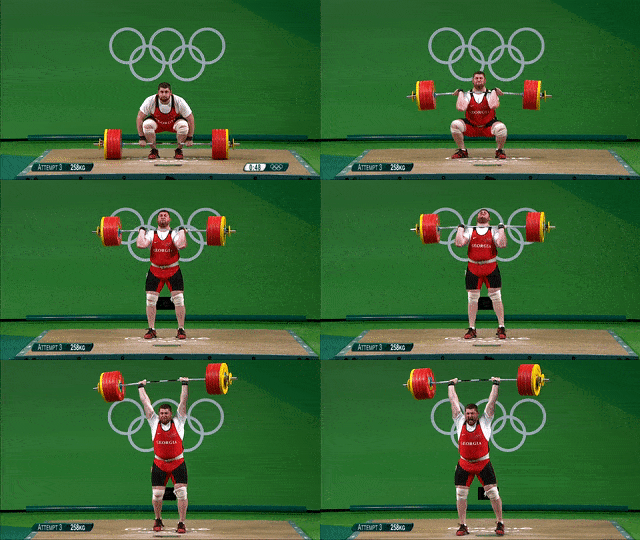
This weight lifter raised 105 kg to a height of approximately 2.31 m in 9 seconds. How much power did he developed?
264 Watts
1029 Watts
2,377 Watts
4,009 Watts

Three cars (car F, car G, and car H) are moving with the same speed and slam on their brakes. The most massive car is car F, and the least massive is car H. If the tires of all three cars have identical coefficients of kinetic friction with the road surface, which car travels the longest distance to skid to a stop?
They all travel the same distance in stopping.
Car F
Car G
Car H

A construction worker uses a pulley and a rope to raise an 85 kg person to a height of 2 m in 6 s. How much did he do?
1,670 J
833 J
278 J
417 J
A construction worker uses a pulley and a rope to raise an 85 kg person to a height of 2 m in 6 s. How much power is he supplying?
1,670 W
833 W
278 W
417 W

Two people are lifting the same weight as shown in the animation. If they both do 10 reps, who will do the most work?
Bro A
Bro B
They both will do the same work
Can't tell without knowing the weight they are lifting
Two people are lifting the same weight as shown in the animation. If they both do 10 reps, who will supply the most power?
Bro A
Bro B
They both will do the same work
Can't tell without knowing the weight they are lifting

Two movers applied a total force of 350 N to push chest up a ramp into a truck. If the work that they did 1,400 J, calculate the height of the ramp?
4 m
3 m
2 m
1 m

The same force F pushes in three different ways on a box moving with a velocity v, as the drawings show. Rank the work done by the force F in ascending order (smallest first):
A, B, C
A, C, B
B, A, C
C, B, A
C, A, B

A person and an elevator are lifted at a constant velocity for by a cable to a height of 35 m and does 412,000 J of work in the process. What is the tension in the cable?
11,800 N
12,000 N
42,000 N
9,800 N

750 J of work is done on a car jack to raise a car by 0.15 m. Calculate the upward exerted on the car.
5,000 N
113 N
50 N
11,300 N

If this person supplies 81.2 W of power and does 637 J of work to do 5 reps, how much time does he take to do 5 reps?
7.8 s
8.0 s
9.0 s
5.8 s

A motor produces 500.0 W of power in 15 s. How
much work is done?
7,500 J
33 J
765 J
8,000 J

What is the maximum mass a crane can lift to a height of 10.5 m in 120 s, if the crane’s motor produces 3,500 W of power?
4,080 kg
2,700 kg
3,123 kg
3,000 kg

If he weighs 700 N and climbs at a constant speed to the top of an 8 m vertical rope in 10 s. The average power expended by the him to overcome gravity is most nearly
1.1 Watts
87.5 Watts
560 Watts
875 Watts
5,600 Watts
Units of Power include which of the following?
I. Watt
II. Joule per second
III. Kilowatt-hour
I only
III only
I and II only
II and III only
I, II, and III
What makes electromagnets different from regular magnets?
they can be switched off and on
they use less energy
they are more user-friendly
they do not pollute the environment

What is the device shown?
Solenoid
Electromagnet
Generator
Motor
What happens when a compass is moved near a strong magnet?
it points north
it points toward the magnet
it spins in circles
it doesn't move
The Right Hand Rule says that if you hold a wire in your right hand and point your thumb in the direction of the ______ current, the direction that your fingers curl is the direction of the _______.
Positive, Magnetic Field
Positive, Current
Negative, Magnetic Field
Negative, Current
Does adding loops of wire to a solenoid increase or decrease its strength?
Increase
Decrease
Both
Neither
___, ____, and ____ are magnetic metals.
Iron, Nickel, Cobalt
Copper, Chromium, Gadolinium
Aluminum, Iron, Copper
Cobalt, Mercury, Sodium

What is the device shown?
Electromagnet
Solenoid
Generator
Motor

Which kind of circuit only has one path for electricity to flow?
Series
Parallel
Series and Parallel

Which kind of circuit has more than one path for electricity to flow?
Series
Parallel
Series and Parallel
If a bulb is not working in a series circuit, what happens to the other bulbs?
none will work
the rest will work
If a bulb is not working in a parallel circuit, what happens to the other bulbs?
none will work
the rest will work
When a current flows through a wire, it creates a _______ around the wire.
magnetic field
magnetic pole
compass
attraction
Which would NOT increase the strength of the magnetic field around a solenoid?
Adding more coils of wire
Adding an iron core
Connecting it to a battery
Reversing its orientation
Which three materials would allow you to build an electromagnet?
Battery, Wire, Nail
Battery, Tape, Paper
Wire, Nail, Paper Clip
Sandpaper, Tape, Wire
All of the following would cause a series circuit to stop working EXCEPT _______.
Open switch
Burned out bulb
A cut wire
Closed switch
An electric current does NOT exist in ______ circuit.
a closed
a series
a parallel
an open
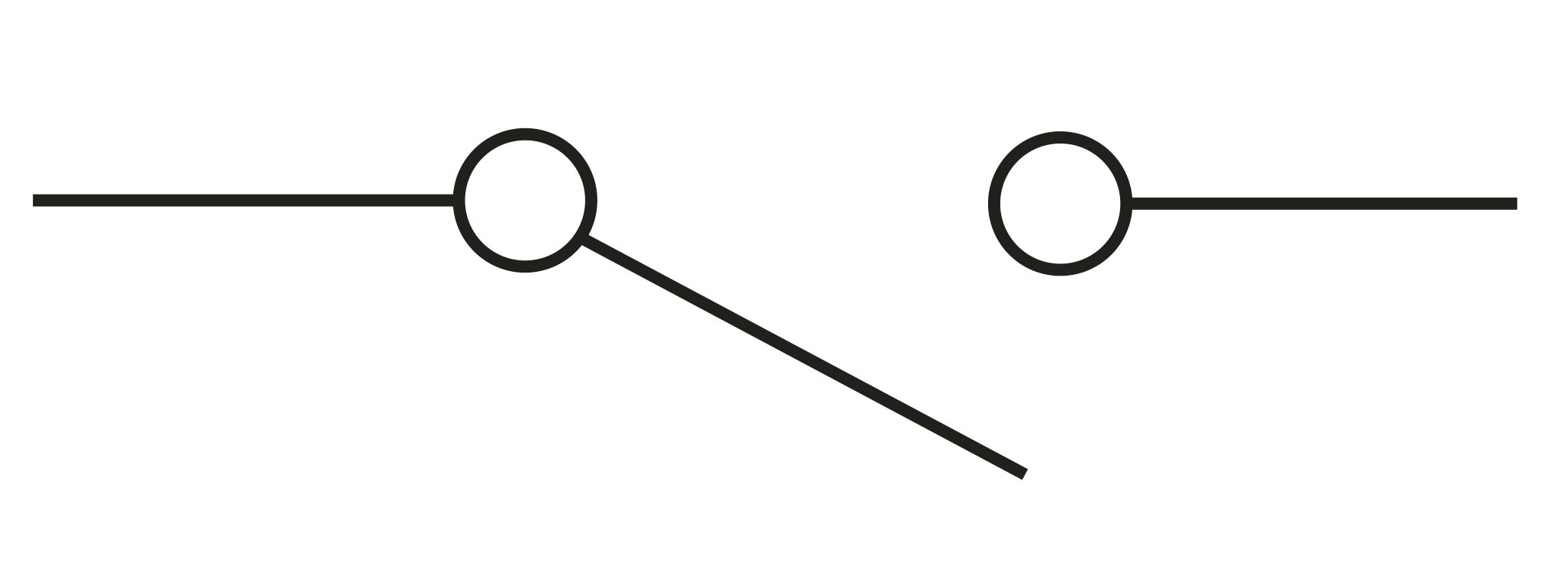

What is this symbol?
Ammeter
Wire
Bulb
Voltmeter


What is this symbol?
Closed Switch
Resistor
Cell
Battery

1. Which switch or switches must be closed to make the lamps light?
Only switch a
Only switch b
Switches a and b
Switches a , b and c

What is this symbol?
Wire
Bulb
Buzzer
Ammeter

If L2 is unscrewed from its holder, what will happen to L1?
It will stay lit
It will go out
It will get dimmer
It will disappear

What is this Symbol?
Motor
Voltmeter
Ammeter
Buzzer

Is this a Series or Parallel Circuit?
Series
Parallel
Current is...
how fast the electrons are moving
the flow of electrical charge
the power source
the amount of energy gained/lost across two points
Voltage is...
the power
the flow of electrical charge
the amount of energy gained or lost across two points
what opposes the flow of current
Every circuit MUST have...
A Power Source, Energy User and a Switch
An Energy User, Switch and a Conducting Pathway
A Power Source, Conducting Pathway and a Bulb
A Power Source, Conducting Pathway and an Energy User
In a Series Circuit the Current...
is the same at every point
is shared between the energy users
In a Series circuit the Voltage is...
the same at every point
split between the energy users
In a Parallel circuit the current is
the same at every point
split between the branches
In a parallel circuit the voltage...
remains the same
is shared between the branches
What is an equation for electrical Equation for Power?
Power = Potential Difference x Current (P=IV)
Power = Potential Difference / Current (P=V/I)
Power = Current / Potential Difference (P=I/V)
How much charge flows through a wire in 80s if the current is a constant 5.4A?
432C
360C
524C
344C

What is this circuit symbol for?
Thermistor
Ammeter
Variable Resistor
Piece of wire
Potential difference is the same as...?
Voltage
Current
Power
Coulombs
What does voltage mean?
The amount of energy per unit charge
The amount of power per unit charge
The amount of electrons per second
The amount of seconds per charge
What is the equation for energy transferred in a circuit?
E=IVt
E=tVI
E=tIV
E=IVt
State the equation that links power current and resistance
power = current x resistance
resistance = power / current
power = (current)2 x resistance
power = current x (resistance)2
State the equation that links change, potential difference and energy
Potential difference = energy x charge
charge = potential difference x change
energy = potential difference / charge
energy = potential difference x charge
State the equation that links charge , current and time
Charge = current x time
charge = current / time
current = charge x time
current = time / charge
State the equation that links potential difference, current and resistance
resistance = current / potential difference
current = resistance x potential difference
potential difference = current x resistance
potential difference = current / potential difference
State the units of energy
Joules
Watts
Ohms
Coulombs
State the units of charge
Coulombs
Ohms
Watts
Joules
What is the resistance of a bulb if a current of 0.5 A flows through it when there is a voltage of 12 V across it?
24 Ω
6 Ω
24 A
6 A
State the SI units of time
watts
minutes
hours
seconds
What is a beta particle made of?
One proton
A helium particle
One electron
One proton and one neutron
Which of these processes describes a nuclear fusion reaction?
A nucleus absorbs energy to produce lighter nuclei.
A nucleus splits to produce energy and lighter nuclei
Two nuclei bind together to produce energy and heavier nuclei.
Two nuclei bind together to produce energy and a lighter nuclei.
Of the main types of radiation emitted from naturally radioactive isotopes, which is the hardest to block?
Alpha deca
Gamma Decay
Beta decay
They are all blocked using the same method
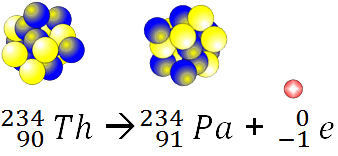
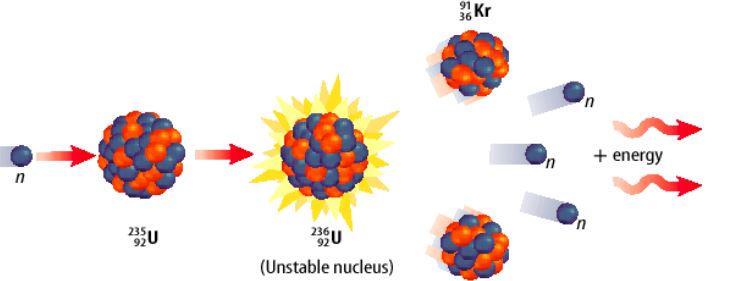
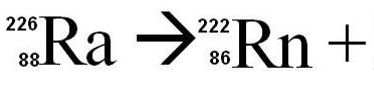

Neutrons ......
has positive electric charge with equal magnitude to that of an electron.
has no net electric charge.
has negative electric charge.
orbiting the nucleus.
What kind of force holds the nucleus together?
Strong Nuclear Force
Weak Nuclear Force
Gravitational Force
Electromagnetic Force

What is the number of neutrons in Cesium?
55 neutrons
76 neutrons
84 neutrons
106 neutrons
139 neutrons
The atomic number of a given element is
equivalent to which of the following?
Proton number in the nucleus
Neutron number in the nucleus
Sum of the protons and neutrons in the
nucleus
Sum of the protons, neutrons and electrons
If there are 146 neutrons in 238U, how many neutrons
are found in the nucleus of 235U?
141
143
145
147

The force of gravity on Jupiter is a little more than 2 times the gravitational force on Earth.
If an object has a mass of 10 kg and a weight of 100 N on Earth, what would be the object's approximate mass and weight on Jupiter?
10 kg and 100 N
20 kg and 200 N
100 kg and 1000 N
10 kg and 200 N

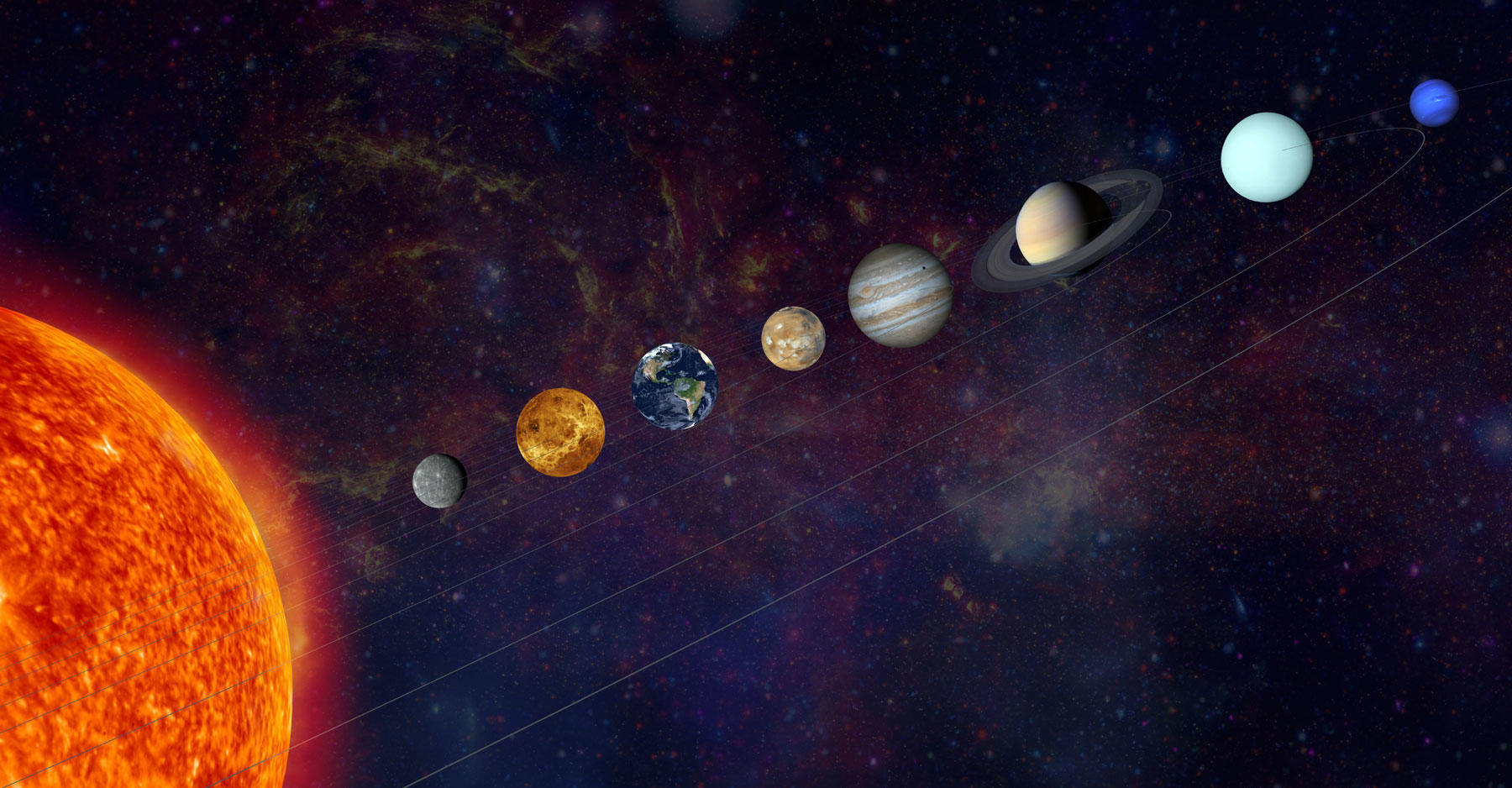
The planets are all equally distanced from each other.
The distance light can travel in one year is ______________
15,000 kilometers
1 light-year
15 Astronomical Units
6,000 miles
What unit of measurement is used to calculate distance in our universe?
astronomical units
kilometers
light years
parsecs
True or False: The universe is expanding.
True
False


If an object mass =20 Kg on the Earth, what would be it's weight on Earth given that the gravitational field strength on Earth is 10N/kg?
20N
200 kg
0.2 kg
200 N
In A.C generator,by increasing the no. of turns in the coil,
Decrease the Electromotive force (EMF)
Electromotive force (EMF) remains the same
Increases the Electromotive force (EMF)
Electromotive force (EMF) becomes zero
If the coil is placed perpendicular to field lines then the number of lines passing through the coil is:
Minimum
Maximum
Zero
May be maximum or minimum
AC generator converts:
Mechanical energy to electrical energy
Electrical energy to mechanical energy
Heat energy to mechanical energy
Chemical energy to electrical energy
The direction of induced emf or current is indicated by:
Fleming’s left-hand rule
Fleming’s right-hand rule
Faraday’s law of electromagnetic induction
Ampere’s swimming rule
In an a.c. generator, a coil with N turns, all of the same area A and total resistance R, rotates with frequency ω in a magnetic field B the maximum value of emf generated in the coil is:
NABR
NABω
NABRω
NAB
When a coil is held stationary in magnetic field, the induced current in it:
continuously changes
randomly changes
remains zero
becomes maximum
What is true of AC GENERATOR?
It works on the principle of electromagnetic induction
The mechanical energy of the rotation is converted into electrical energy
A pair of slip rings are used in the AC generator
All the above
What determines the frequency of a.c. produced by a generator?
Speed of rotation of coil
The number of rotations of coil in one-second
Both speed of rotation and number of rotation of coil in one-second
None of these
What does the index finger show you in the Fleming’s right-hand rule?
Direction of current
Motion of wire
Direction of electric field
Direction of magnetic field
The Fleming's right-hand rule is used when ....
motion causes current
current causes motion
current causes potential difference
motion causes magnetic field

In the picture shown, what will be the direction of the current in wire MN?
Upward
Downward
Into the paper
Out of the paper
In a generator armature makes one full revolution, it goes through ………….. degrees of mechanical rotation.
0
90
270
360
The AC voltage waveform is in the positive direction for some period of time and in the negative direction for some period of time. What is the name given to this waveform?
Alternating wave
Inverted wave
Hertz wave
sine wave

In the diagram shown ,if the coil is moving anti-clockwise, mention the direction of the current on the left wire.
Upward
Downward
Into the paper
Out of the paper
In an AC generator, the contacts are made from a soft but highly conductive material, usually carbon, and are called....
Coils
Armatures
Slip Rings
Brushes
The electricity generated from the power plant is ……
Alternating Current
Direct Current
Delayed Current
Eddy Current
Super-heated steam is used to turn ………..
Transformer
Battery
Turbine
Toothed Gear
What is the name of the effect caused by the wire when it is moved across a magnetic field?
Induced magnetism
Electromagnetic induction
Electromagnetism
Turning effect of coil
Electric current from a generating plant is:
direct current transmitted at high voltages, but usually used at low voltages
alternating current transmitted at low voltages, but usually used at high voltages.
alternating current transmitted at high voltages, but usually used at low voltages.
direct current transmitted at low voltages, but usually used at high voltages.
In an AC generator, the wire loop which is mounted so that it rotates within a magnetic field is called the.......
Coil
Armature
Slip Rings
Brushes
Which of the following is the basic SI unit for electric charge?
ampere
coulomb
ohm
volt
There is a current of 0.24 A through a lamp for 40 minutes.
How much charge passes through the lamp?
576 C
9.6 C
0.60 C
0.01 C
When a resistor is connected across a battery of 2.8 V there is a current of 0.35 A.
What is the resistance of the resistor?
8.00 Ω
1.02 Ω
0.98 Ω
0.13 Ω
A car headlamp when connected to a 12 V battery converts energy at a rate of 50 W.
How much energy is converted when it is switched on for 5 minutes?
2 J
120 J
300 J
15 000 J
A current of 2.0 A passes through a component of resistance 24 Ω.
What is the rate of energy transfer?
6 W
12 W
48 W
96 W

The diagram shows part of a circuit.
What is the current X ?
0.6 A
2.0 A
4.8 A
6.2 A

The diagram shows a junction in a circuit.
What is the current Y ?
+ 0.2 A
- 0.2 A
+ 1.8 A
- 1.8 A

The diagram shows a circuit. The current in the circuit is 0.8 A. What is the e.m.f of the cell E2?
0.56 V
0.80 V
2.80 V
4.80 V

A student is to measure the resistance of a lamp. Which circuit should he use?
A
B
C
D

The diagram shows a network of resistors. What is the total resistance between points P and Q?
1.8 Ω
4.0 Ω
8.7 Ω
18.0 Ω

flint glass n=1.70
barium glass n=1.60
crown glass n=1.523
water n=1.33
diamond n=2.45
What we call the final ray coming out of the glass slab?
Incident ray
Refracted Ray
Reflected ray
Emergent Ray
Which colour bends the maximum in the prism?
Violet
Indigo
Red
Green
Optical fibre based on the principle of
total internal reflection.
total internal refraction.
diffraction.
interference.
A ray of light approaches a jar of honey at an angle of 30°. If the angle of refraction is 19.5°,what is the refractive index of honey?
1.49
1.50
1.05
1.51

A student placed a pencil in a cup of water. The pencil appears broken because light-
light travelling from water to air bends away from the normal making the pencil under water look closer to the surface
light travelling from water to air bends towards the normal making the pencil under water look further away
light travelling from air to water bends towards the normal making the pencil under water look higher up
light travelling from air to water bends away from the normal making the pencil under water look closer to the surface
What is the unit of force?
Meter
Newton
Newton meter
Centimeter
Moment is a measure of the turning effect of a force.
True
False
Pivot is the point about which a force is turned by an object.
True
False
Principle of moments states that an object is balanced when clockwise moments are equal to anticlockwise moments.
True
False
Moment = force / distance from pivot
True
False
The greater the force, the greater its turning effect.
True
False
The further the force is from the pivot, the greater its turning effect.
True
False
The bigger the moment of a force, the smaller its turning effect.
True
False

What is the moment acting on the left side of the pivot?
2 Nm
20 Nm
200 Nm
0.2 Nm

What is the moment acting on the right side of the pivot?
2 Nm
20 Nm
200 Nm
0.2 Nm

The beam is balanced.
True
False
A force of 4 N acts on a lever 2 m from the pivot. What is the moment?
8 Nm
6 Nm
2 Nm
3 Nm
One way to increase the turning force on a spanner is to:
Use a shorter spanner
Use a longer pivot
Use a longer spanner

James weighs 200 N and sits 1 m from the pivot. Jane weighs 100 N. How far from the pivot must Jane be to balance the beam?
0.5 m
1 m
2 m
4 m

A cat weighing 50 N is 1 m from the pivot. How far away does a mouse weighing 0.5 N have to be to balance the beam?
1 m
10 m
100 m
1000 m

A force exerts a moment of 2 Nm. What is the distance of the force from the pivot?
2 m
4 m
1 m
0.5 m

A force exerts a moment of 2 Nm. What is the distance of the force from the pivot?
1 m
0.5 m
0.2 m
0.25 m

A car moves along a level road.
The diagram shows all of the horizontal forces acting on the car.
Which statement is correct?
The car is slowing down.
The car is speeding up.
The car is moving at a constant speed.
The car is moving backwards.
Which force and distance produce the smallest moment about a pivot?
a 6.0 N force at a perpendicular distance of 4.0m from the pivot
a 7.0 N force at a perpendicular distance of 6.0 m from the pivot.
a 10 N force at a perpendicular distance of 4.0 m from the pivot
a 12 N force at a perpendicular distance of 3.0 m from the pivot.
A resultant force of 4.0N acts on an object of mass 0.50 kg for 3.0 seconds.
What is the change in velocity caused by this force?
4.0 m / s
6.0 m / s
12 m / s
24 m / s

The diagram shows a tug-of-war between team X and team Y. The arrows show the forces exerted by the teams on the rope.
What is the size of the resultant force on the rope and in which direction does the resultant force act?
size of resultant force = 75 N; direction of resultant force = to the left
size of resultant force = 75 N; direction of resultant force = to the right.
size of resultant force = 725 N; direction of resultant force = to the left
size of resultant force = 725 N; direction of resultant force = to the right.
Which property of an object cannot be changed by a force?
mass
motion
shape
size

An unstretched spring obeys Hooke’s law and has a length of 10 cm. A load with a mass of 2.0 kg is hung from it, and its length becomes 14 cm.
The load is now increased to 6.0 kg, and the new length of the spring is Y. The limit of proportionality is not reached.
What is Y?
22 cm
26 cm
30 cm
42 cm

A spring is suspended from a stand. Loads are added and the extensions are measured.
Which graph shows the result of plotting extension against load?


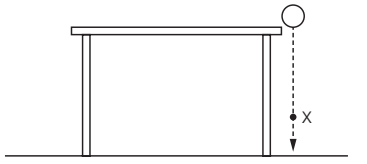
A ball is dropped from a table-top. Air resistance may be ignored.
Which row describes the velocity and the acceleration of the ball at point X
acceleration = constant; velocity = constant
acceleration = constant; velocity = increasing
acceleration = increasing; velocity = constant
acceleration = increasing; velocity = increasing
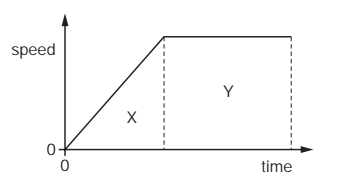
The diagram shows the speed-time graph for a car.
Which area represents the distance travelled while the car is accelerating?
X
X + Y
Y
Y - X
A wooden bar is pivoted at its centre so that it can rotate freely. Two equal forces F are applied to the bar.
In which diagram is the turning effect greatest?


A hole is drilled in a square tile. The diagram shows the tile hanging freely on a nail.
Where is the centre of mass of the tile?
A
B
C
D

A balloon and a mass are attached to a rod that is pivoted at P.
The balloon is filled with helium, a gas less dense than air, so that it applies an upward force on the rod.
The rod is horizontal and stationary.
Which action causes the rod to rotate clockwise?
Move both the balloon and mass 10 cm to the left.
Move both the balloon and mass 10 cm to the right.
Move both the balloon and mass to the 25 cm mark
Move the balloon to the 20 cm mark and the mass to the 30 cm mark.
Link between moment, force and (perdindicular) distance (to pivot)
moment = force x distance
moment = force / distance
moment = distance / force
moment = force / moment
momentum = forks x distant ants

A ball of mass 0.50 kg falls and hits the floor at 10 m / s.
It rebounds at speed 8.0 m / s, as shown.
The collision between the ball and the floor lasts for 0.50 s.
What is the average force acting on the ball during the collision?
2.0 N upwards
2.0 N downwards
18 N upwards
18 N downwards

A gas molecule strikes the wall of a container. The molecule rebounds with the same speed.
What happens to the kinetic energy and what happens to the momentum of the molecule?
Kinetic energy changes; momentum changes
Kinetic energy changes; momentum stays the same.
Kinetic energy stays the same; momentum changes
Kinetic energy stays the same; momentum stays the same.

A tennis ball of mass 0.060 kg travels horizontally at a speed of 25 m/s. The ball hits a tennis racket and rebounds
horizontally at a speed of 40 m/s.
The ball is in contact with the racket for 50 ms.
What force does the racket exert on the ball?
0.018 N
0.078 N
18 N
78 N

Six wavefronts are shown in the diagram. What is the wavelength of the wave?
5 cm
6 cm
7.5 cm
30 cm

What is the reflected wave of the incident wave below?


Which of the following quantities of the wave will be changed during reflection? (Can choose more than one answer)
Wave speed
Frequency
Wavelength
Period
Travelling direction
Which of the following quantities of the wave MUST be changed during refraction? (Can choose more than one answer)
Wave speed
Frequency
Wavelength
Period
Travelling direction
Which of the following quantities of the wave MUST keep the same during refraction? (Can choose more than one answer)
Wave speed
Frequency
Wavelength
Period
Travelling direction

Water waves below travels from deep region to shallow region. What is the refracted waves of the water waves?


Diffraction occurs if the water waves travels through __________.
Shallow region
A gap between barriers
A floating ball on the water surface

The diagram shows the diffraction of water waves. If the gap becomes smaller, which diagram correctly shows the new diffracted waves?


The diagram shows the diffraction of water waves. If the more water is added to the water tank, which diagram correctly shows the new diffracted waves?


This mug is __________________
opaque because light can pass through it.
transparent because light cannot pass through it.
opaque because light cannot pass through it.
transparent because light can pass through it.

This glass is __________________ .
opaque because light can pass through it.
transparent because light cannot pass through it
opaque because light cannot pass through it
transparent because light can pass through it
Choose which of the following is refraction of wave?


During refraction, which of the properties will change?
Frequency
Wavelength
Amplitude
Waves equation relates which properties?
speed
wavelength
frequency
Amplitude
Which is term corresponds to a surface that travels with a wave and is perpendicular to the direction in which the wave travels?
transverse
wavefront
rays
Sound waves of frequency 2.0kHz travel through a substance at a speed of 800m/s. What is the wavelength of the waves?
0.40m
2.5m
400m
1600m
The frequency of a wave is doubled. The speed of the wave does not change. What happens to the wavelength of the wave?
It becomes four times as large.
It does not change.
It doubles.
It halves.
What is the number of wavefronts per second that pass a fixed point?
the amplitude of the wave
the frequency of the wave
the speed of the wave
the wavelength of thewave
What is the frequency of a wave?
the distance that a wavefront travels every second
the distance from one wavefront to the next
the number of wavefronts produced per second
the time taken for a wavefront to pass a certain point
Light enters a glass block at an angle of incidence of 46°. The light refracts at an angle of refraction of 26°. What is the refractive index of the glass?
0.57
0.61
1.64
1.77
A plane mirror is fitted to a wall. Which statement about the image formed by the mirror is correct?
The image is real.
The image is left to right (laterally inverted).
The image is smaller than the object.
The image is upside down.
Which group contains only electromagnetic waves?
light waves, radio waves, γ-rays
light waves, radio waves, sound waves
light waves, sound waves, γ-rays
radio waves, sound waves, γ-rays
How do infra-red waves differ from ultraviolet waves?
Infra-red waves are longitudinal.
Infra-red waves have a lower speed in vacuo (in a vacuum).
Infra-red waves have lower frequencies.
Infra-red waves have smaller wavelengths.
Which list shows electromagnetic waves in order of increasing frequency?
visible light, X-rays, γ-rays
visible light, γ-rays, X-rays
X-rays, γ-rays, visible light
γ-rays, X-rays, visible light
Which statement about ultraviolet waves is correct?
They are used in television remote controllers.
They can be detected by the human eye.
They travel as longitudinal waves.
They have the same speed in a vacuum as radio waves.

The diagrams show water waves that move more slowly after passing into shallow water. Which diagram shows what happens to the waves?
A
B
C
D

The wave reaches point P. What is the name of the effect that causes the wave to reach point P?
diffraction
dispersion
reflection
refraction

The diagram represents circular wavefronts coming from point S. The wavefronts strike a barrier and are reflected so that they appear to come from point S1.


A water wave moves quickly in deep water. The wave now enters shallow water and its speed decreases. Which row shows what happens to the frequency of the wave, and what happens to thewavelength of the wave?
Frequency: decreases. Wavelength: decreases.
Frequency: decreases. Wavelength: does not change.
Frequency: does not change. Wavelength: decreases.
Frequency: does not change. Wavelength: does not change.

The diagram shows a water wave passing through a gap in a harbour wall. The wavefronts curveround the wall and reach a small boat in the harbour. What is the name of this curving effect, and how can the gap be changed so that the wavefronts do not reach the boat?
name of effect: diffraction. change to the gap: make the gap slightly bigger.
name of effect: diffraction. change to the gap: make the gap slightly smaller.
name of effect: refraction. change to the gap: make the gap slightly bigger.
name of effect: refraction. change to the gap: make the gap slightly smaller.

Which waves are longitudinal?
A
B
C
D

Waves travel more quickly on the surface of water when the water is deep. A stone is dropped at point X into a pool of varying depth. The diagram shows the first wavefront on the surface of the pool. The region between X and which labelled point is likely to be the deepest?
A
B
C
D

The diagram shows the surface of water in a ripple tank. A wave travels in the direction of the arrow towards a gap in a barrier. What happens to the wave as it passes through the gap, and what happens to the shape of the wavefronts after passing through the gap?
what happens at the gap: diffraction. shape after passing through the gap: curved.
what happens at the gap: diffraction. shape after passing through the gap: straight.
what happens at the gap: refraction. shape after passing through the gap: curved.
what happens at the gap: refraction. shape after passing through the gap: straight.
A boy throws a small stone into a pond. Waves spread out from where the stone hits the waterand travel to the side of the pond. The boy notices that eight waves reach the side of the pond in a time of 5.0s. What is the frequency of the waves?
0.20Hz
0.63Hz
1.6Hz
40Hz

Water waves can be used to show reflection, refraction and diffraction. For each of these, which row shows whether or not the speed of the water waves changes?
A
B
C
D

A vertical stick is dipped up and down in water at P. In two seconds, three wave crests are produced on the surface of the water. Which statement is correct?
Distance X is the amplitude of the waves.
Distance Y is the wavelength of the waves.
Each circle represents a wavefront
The frequency of the waves is 3Hz.
Sound waves of frequency 2.0kHz travel through a substance at a speed of 800m/ s. What is the wavelength of the waves?
0.40m
2.5m
400m
1600m

A student investigates a radioactive source that emits only alpha-particles. Without any source
nearby, the detector shows a low reading. The source and thick cardboard are placed near the detector, as shown:
What is the reading on the detector now, and why?
A
B
C
D

