
Font size
 Worksheets
IGCSE 1 & 3
Total questions: 499
Worksheet time: 11hrs 23mins

-
A
B
C
D
Which of the following measuring tools is used to measure capacity?


What unit of measurement is used in measuring weight?
Kilogram and gram
Liter and mililiter
Meter and centimeter
What unit of measurement is used in measuring length?
Liter and milliliter
Meter and centimeter
Kilogram and gram
What unit of measurement is used in measuring capacity?
Kilogram and gram
Meter and centimeter
Liter and milliliter

the volume of a soda bottle
how many liters is 1000 mL?
1
10
100
1000
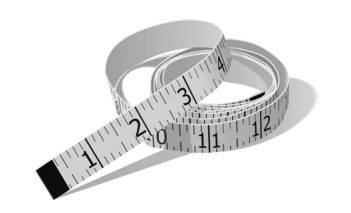
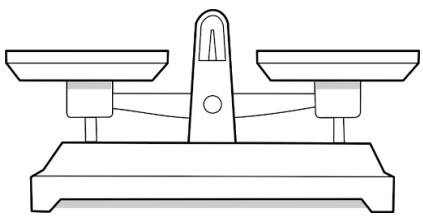
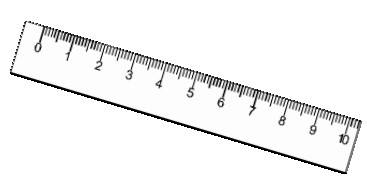
Choose ALL of the tools that you could use to measure weight.
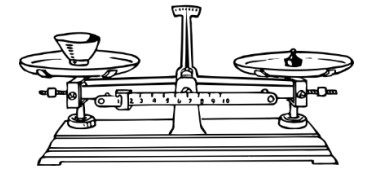
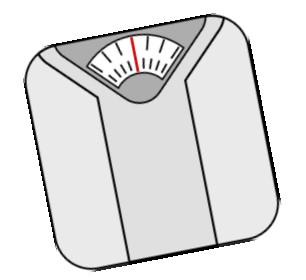

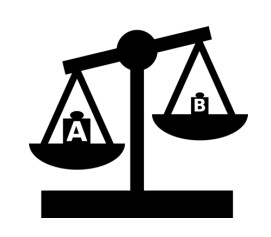
Choose the TWO tools that you could use to measure length.
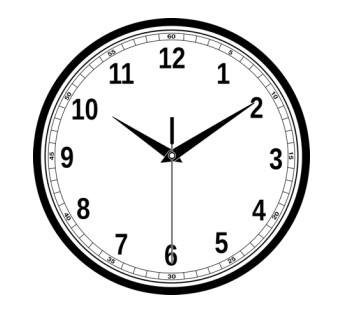

A
B
C
D

A
B
C
D

A
B
C
D

A
B
C
D
Four students measure a time interval that is known to be 1.734 s.The measurement recorded by each student is shown.Which measurement is the most accurate?
1 s
1.7 s
1.83 s
1.604 s
A student intends to measure accurately the diameter of a wire (known to be approximately 1 mm) and the internal diameter of a pipe (known to be approximately 2 cm).
What are the most appropriate instruments for the student to use to make these measurements [(i) wire, (ii) pipe]?
(i) calipers, (ii) calipers
(i) calipers, (ii) micrometer
(i) micrometer, (ii) calipers
(i) micrometer, (ii) micrometer

What does this image measure
volume
mass
length
density
Which of the following equation represent error in measurement?
Error = Measured Value - True Value
Error = 1 - True Value
Error = True Value + Measured Value
Error = 1 - Measured Value
Which of the following shows a precise but not accurate data?


The imperfection in experimental technique or procedure is an example of .....
Environmental error
Parallax error
Random error
Systematic error
Which of the following shows an accurate but not precise data


The S.I. unit for time is
minute
seconds
hours
days
The S.I. unit for current is
volt
ohms
ampere
watt
The S.I. unit for light intensity is
joule
watt
candela
kelvin
The S.I. unit for length is
yard
meter
foot
inches
The physical quantities other than base quantities are termed as
professional quantities
energetic quantities
dependent quantities
derived quantities
Which of the following is a scalar quantity?
displacement
velocity
force
mass
Which of the following is a vector quantity
pressure
force
speed
distance
The S.I. prefix μ indicates
10−3
10−2
10+6
10−6
The S.I. prefix centi indicates x 10−2 . Which option below correctly indicates the prefixes milli and giga
10−3 and 109
103 and 106
10−9 and 109
10−9 and 106
Which pair of units are both S.I. base units?
meter, degree celsius
newton, kilogram
ampere, kelvin
joule, seconds
The S.I. prefix hecto indicates x 102 . Which option below correctly indicates the prefixes mega and nano
106 and 109
10−6 and 103
106 and 10−9
103 and 10−9
What is the least count of a metre scale?
1.0 cm
0.1 cm
0.01 cm
0.001 cm
A vernier calipers can be used to measure a certain quantity. Which quantity can it measure?
temperature
length
pressure
density
A student uses a measuring cylinder to measure the volume of quantity of water.
Which of the following procedures would make her measurement less accurate?
reading the level from the bottom of the meniscus
using the largest measuring cylinder possible
keeping her eyes level with the water surface
making sure the cylinder is perfectly vertical

The diagram shows four identical spheres placed between two wooden blocks on a ruler.
What is the diameter of one sphere?
1.0 cm
2.0 cm
3.0 cm
4.0 cm
A pendulum is swinging. Five students each measure the time it takes to swing through ten complete swings.
Three students measure the time as17.2 s. Another student measures it as 16.9 s, and the fifth student measures it as 17.0 s.
What is the average period of the pendulum?
1.69 s
1.70 s
1.71 s
1.72 s
A student has a stack of 20 identical coins. The figure shows the student measuring the height of the stack using a ruler.
The student correctly determines the height of the stack as 7.7 cm.
Calculate the average thickness of one coin.
15.4 cm
3.85 cm
0.77 cm
0.39 cm
A student has been told to find the density of some liquid paraffin by measuring its mass and its volume.
Which piece of laboratory equipment should she use to measure the volume of the liquid paraffin?
Beaker
Stopwatch
Metre rule
Measuring cylinder
A student has been told to find the density of some liquid paraffin by measuring its mass and its volume.
Which piece of laboratory equipment should she use to find the mass of the liquid paraffin?
Top pan balance
Measuring cylinder
Metre rule
Stopwatch
What is the most accurate and precise method to measure the thickness of a coin?
Use a top pan balance.
Use a micrometer screw gauge.
Use a ruler and look at the scale perpendicularly.
Use the displacement method with water in a measuring cylinder.

The diagram shows the height of a stack of identical coins.
What is the thickness of one coin?
0.20 mm
2.0 mm
0.24 cm
2.0 cm

A student is asked to find the volume of a small irregularly-shaped piece of rock.
He has the following apparatus available.
Which apparatus must the student use to find the volume of the small piece of rock?
balance and rule
rule only
balance and measuring cylinder
measuring cylinder only
Which instrument is used to measure accurately the diameter of a thin metal wire?
30 cm ruler
measuring tape
metre rule
micrometer screw gauge

Water drips from a tap into a measuring cylinder.
The table shows the volume of water in the cylinder every minute for four minutes.
What is the average volume of water collected in the cylinder each minute?
22 cm3
28 cm3
56 cm3
57 cm3
What is the typical accuracy of a metre rule?
0.1 cm
0.01 cm
0.001 cm
0.01 mm
What instrument is used to measure small distances of a few centimeters?
Measuring cylinder
Trundle wheel
Ruler
Tape measure
Which of the following is a vector quantity?
Volume
Weight
Energy
Mass
What is the standard human reaction time for an alert person?
0.1 s
0.25 s
0.5 s
1 s
Which device is typically used to measure the volume of liquids?
Trundle wheel
Tape measure
Ruler
Measuring cylinder
What is the difference between distance and displacement?
Distance has direction, displacement does not
Distance is always greater than displacement
Both are vectors
Distance is a scalar, displacement is a vector
Which of the following is a scalar quantity?
Acceleration
Weight
Speed
Displacement
What is the formula to calculate the total time taken in a stopwatch measurement?
Total time = start time / finish time
Total time = finish time - start time
Total time = finish time + start time
Total time = finish time * start time
What is the purpose of taking multiple readings in physics?
To reduce the impact of measurement errors
To make calculations easier
To increase the time taken
To confuse the results
Which of the following describes speed?
Velocity with magnitude only
Distance per unit time with direction
Distance per unit time without direction
Displacement per unit time
What is the resultant vector of a 60 N force to the right and a 100 N force upward?
117 N at 59° from the horizontal
60 N at 30° from the horizontal
160 N at 45° from the horizontal
100 N at 60° from the vertical
What is the primary use of a trundle wheel?
Measuring time
Measuring small distances
Measuring large distances
Measuring volume
Which of the following is true about mass?
It is a vector quantity
It has only magnitude
It changes with location
It is measured in Newtons
What is the correct method to calculate the diameter of a ball-bearing?
Total length divided by the number of ball-bearings
Total length multiplied by the number of ball-bearings
Total length plus the number of ball-bearings
Total length minus the number of ball-bearings
Which of the following is NOT a method for measuring time intervals?
Timer
Stopwatch
Stop-clock
Measuring cylinder

A
B
C
D
A tunnel has a length of 50 km. A car takes 20 min to travel between the two ends of the tunnel. What is the average speed of the car?
2.5 km / h
16.6 km / h
150 km / h
1000 km / h

pole 1 and pole 2.
pole 2 and pole 3.
pole 3 and pole 4.
pole 4 and pole 5.

A
B
C
D

A
B
C
D
A small steel ball is dropped from a low balcony. Ignoring air resistance, which statement describes its motion?
It falls with decreasing acceleration.
It falls with constant acceleration.
It falls with decreasing speed.
It falls with constant speed.

Which speed/ time graph applies to an object at rest?
A
B
C
D

A
B
C
D

10 m
20 m
100 m
200 m

150 m
300 m
600 m
1200 m

4.0 s
6.0 s
10 s
16 s

A
B
C
D

A
B
C
D

A
B
C
D

A
B
C
D

A
B
C
D

A
B
C
D

A
B
C
D

A
B
C
D

A
B
C
D
Scott travels north 5 miles and then goes west 3 miles before coming straight back south 2 miles. What is his distance?
10 miles
7 miles
8 miles
6 miles
Billy runs 400 meters to Andy's house, turns around, and runs 400 meters back home. What is Billy's displacement?
0 meters
400 meters
800 meters
1600 meters
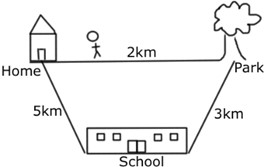
Jerry walked from home to school, then from the school to the park. What is his total distance?
2 km
5 km
8 km
10 km
Jerry walked from home to school, then from the school to the park. What is his total displacement?
2 km
5 km
8 km
10 km

The standard (SI) unit for measuring distance is the ________ .
mile
foot
kilometer
meter

From the figure, what is the displacement?
20 meters
25 meters
15 meters
25 meters NE
The change in an objects position from the final position to initial position.
displacement
distance
motion
reference point


What is speed with a specific direction?
Average Speed
Velocity
Vectors
Time
A measure of how fast something moves in a given amount of time.
Speed
Distance
Time
Velocity
Which of these choices is the formula for average speed?


Which formula is used to find average velocity?
v=2vf−vo
v=2vf+vo
v=vf+vo
v=vf+vo
A bike starting at rest reaches a final velocity of 8.0 m/s. What is the cyclist's average velocity?
0 m/s
16 m/s
2.0 m/s
4.0 m/s

A car travels at a constant speed of 15.0m/s for 20.0 seconds. How far does it travel?
300. m
35.0 m
5.0 m
500 m
A bicyclist averages 4m/s, as she steadily slows to a stop. What was her initial velocity?
0 m/s
8 m/s
2.0 m/s
4.0 m/s


A car moves along a level road.
The diagram shows all of the horizontal forces acting on the car.
Which statement is correct?
The car is slowing down.
The car is speeding up.
The car is moving at a constant speed.
The car is moving backwards.
Which force and distance produce the smallest moment about a pivot?
a 6.0 N force at a perpendicular distance of 4.0m from the pivot
a 7.0 N force at a perpendicular distance of 6.0 m from the pivot.
a 10 N force at a perpendicular distance of 4.0 m from the pivot
a 12 N force at a perpendicular distance of 3.0 m from the pivot.

The diagram shows a tug-of-war between team X and team Y. The arrows show the forces exerted by the teams on the rope.
What is the size of the resultant force on the rope and in which direction does the resultant force act?
size of resultant force = 75 N; direction of resultant force = to the left
size of resultant force = 75 N; direction of resultant force = to the right.
size of resultant force = 725 N; direction of resultant force = to the left
size of resultant force = 725 N; direction of resultant force = to the right.
An object of mass 50 kg accelerates from a velocity of 2 m/s to a velocity of 10 m/s in the same direction. What is the impulse provided to cause this acceleration?
250 Ns
400 Ns
850 Ns
2500 Ns

A T-shaped girder is placed on the ground in position X. it is then turned over to position Y. What happens to the force on the ground and what happens to the pressure on the ground?
force increases, pressure increases
force increases, pressure remains the same
force remains the same, pressure increases
force remains the same, pressure remains the same
A cyclist travels down a hill from rest at point X, without pedalling. The cyclist applies his breaks and the cycle stops at point Y. which energy changes have taken place between X and Y?
Gravitational potential -> kinetic -> thermal (heat)
Gravitational potential -> thermal (heat) -> kinetic
kinetic -> gravitational potential -> thermal (heat)
kinetic -> thermal (heat) -> gravitational potential
A skier walks from the bottom of a ski slope to the top and gains 10,000J of gravitational potential energy. She skis down the slope. At the bottom of the slope, her kinetic energy is 2000J. How much energy is dissipated in overcoming friction and air resistance as the skier moves down the slope?
2000J
8000J
10,000J
12,000J
Which energy source is one that is used to boil water to make steam in power stations?
energy from tides
energy from waves
hydroelectric energy
nuclear energy
Which energy source is renewable and reliably available at all times?
coal
geothermal
nuclear
wind

The diagram shows a ball hanging on a string. The ball swings from point W to point Z and back to point W.
Which statement about the ball is correct?
The kinetic energy of the ball is greatest at point W.
The kinetic energy of the ball is greatest at point X
The kinetic energy of the ball is greatest at point Y.
The kinetic energy of the ball is the same at all points of the swing.

Diagram 1 shows a measuring cylinder containing water.
Five identical steel balls are now lowered into the measuring cylinder. Diagram 2 shows the new water level in the cylinder.
What is the volume of each steel ball?
6 cm3
14 cm3
30 cm3
70 cm3
A
B
C
D
A
B
C
D

A
B
C
D

A solar panel is used to recharge a battery. The solar panel produces 0.80 W of electrical power.
The panel is 20% efficient.
What is the power input of the sunlight onto the solar panel?
0.16 W
4.0 W
8.0 W
16 W
Weight is _________.
the quantity of matter in an object.
the measure of an object's inertia.
the force exerted by gravity on an object's mass.
equal to the mass of an object.
Weight is constant.
True
False
You have a ball with a weight of 76N. What is the mass of the ball?
76N
76kg
7.6kg
7.6N
What would be the weight of a 10 kg object on earth?
1 N
10 N
0.1 N
100 N

is an absolute or primary reference or measurement.
Volume
Standard
Precise
Immerse
When several readings are close together when measuring the same value.
Precise
Volume
Displace
Immerse
Should agree closely with a standard or agrees when a correction has been applied.
Standard
Immerse
Calibrated
Meniscus
The space occupied by an object.
Meniscus
Precise
Standard
Volume
Curved upper surface of a liquid.
Standard
Calibrated
Volume
Meniscus
Moving something to another place so water is moved out of the way (upwards) when an object is lowered into it.
Displace
Immerse
Meniscus
Volume
To cover something in a fluid (usually water) so that the object is submerged.
Volume
Displace
Immerse
Standard
The quantity of matter a body is composed of.
Mass
Plumb bob
Weight
Digital
The ratio of mass to volume for a substance.
Mass
Density
Weight
Period
The downward force of gravity that acts on an object because of its mass.
Mass
Density
Weight
Period
Display has hands (or a needle) and is often not very precise.
Digital
Plumb bob
Period
Analogue
Display shows numbers and is often precise.
Analogue
Digital
Plumb Bob
Period
A mass (usually led) hanging from a string to define a vertical line.
Analogue
Digital
Plumb Bob
Period
The time for one complete oscillation or wave; the time it takes an object to return to its original position.
Analogue
Digital
Plumb Bob
Period
Which statement BEST describes the relationship between the weight and mass of an object?
If mass increases, weight will decrease.
Doubling mass reduces weight by half.
An increase in mass will not affect weight.
If mass increases, weight will increase.
A spring scale is used to measure weight. Which of the following does it measure?
The force of gravity on an object.
The amount of matter in an object.
The composition of an object.
The average density of an object.
What happens to the mass and weight of an object that is launched into space, where the pull of gravity is less?
The mass decreases while the weight stays constant.
The mass stays constant while the weight decreases.
The mass stays constant while the weight increases.
The mass increases while the weight decreases.
Nick is preparing a solution and needs to measure the mass of some copper sulfate. Which one of the objects should he use to measure MASS?
Electric Scale
Ruler
Triple Beam Balance
Graduated Cylinder
Jen is explaining the difference between weight and mass to her sister. In comparing the two, which of the following could Jen use to CORRECTLY describe the weight of an object?
Weight is the same everywhere in space.
Weight is how much matter is in an object.
Weight is the amount of gravitational pull on an object.
Weight is not impacted by the force of gravity.

15 cm3
50 cm3
150 cm3
180 cm3
Density is a physical property of matter and can be used to classify substances. Density is calculated by which of the following?
d=v/m
d=m/v
d=w/v
d=m/w

303.4 g
370.4 g
373.0 g
373.4 g

2.5 g/cm3
25 g/cm3
250 g/cm3
2,500 g/cm3
Based on the data for the four samples, determine which of the following substances has the greatest density.
Sample 1: volume = 15 cm3, mass =30 g
Sample 2: volume = 20 cm3, mass = 66 g
Sample 3: volume = 3 cm3, mass = 12 g
Sample 4: volume = 48 cm3, mass = 100 g

7. The diagram shows a measuring cylinder used to measure the volume of a small stone. What is the volume of the stone?
(A) 8 cm3
(B) 9 cm3
(C) 14 cm3
(D) 26 cm3

The diagram shows four identical spheres placed between two wooden blocks on a ruler.
What is the diameter of one sphere?
1.0 cm
2.0 cm
3.0 cm
4.0 cm
A cube of aluminum has a volume of 9cm3 and weighs 81 g. What is its density?
9 g/ cm3
.11 g/cm3
729 g/cm3
Acceleration: is the rate of change in
velocity
speed
displacement
direction
As the ball falls towards the ground, its velocity
zero
decreases
at rest
increases
Which of the following objects is accelerating?
A car driving in a northwest at a constant speed of 35 mph.
A car driving southwest at a constant speed of 35 mph.
A car driving in a circle at a constant speed of 35 mph.
Back
A car driving south at a constant speed of 45 mph.
The SI unit for acceleration is
mph
ft/sec
m/s2
m/s
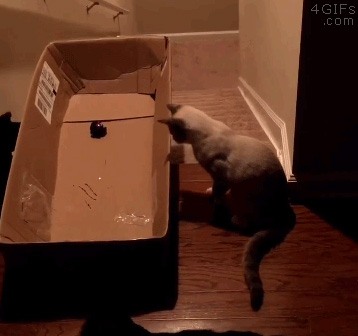
A box sliding down an inclined plane attains a speed of 27 m/s in 3 seconds from rest. Find the acceleration.

Describe the motion in the graph:
Constant Speed (positive slope)
Stopped (at rest)
Acceleration (increasing speed)
Return Home (negative slope)


The graph shows the distance a student walks down a hall over time. During which time interval was the student moving the fastest?
A
B
C
D
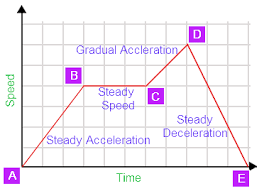
At what point is the speed the greatest?
C-D
B-C
A-B
D-E
After the 60 seconds, the parachutist pulls the cord and opens her parachute.
Explain how the parachute reduces the speed of the parachutist when it is just opened.
The friction force decreases
The weight force decreases
The weight force increases
The friction force increases

The graph shows the vertical speed of a parachutist. At which point did they open the parachute?
A
B
C
D
A parachutist of mass 75 kg jumps from a plane at a height of 4 000 m above sea level.
The parachutist falls through a distance of 2 400 m during the first 60 seconds. Calculate the average speed of the parachutist during this time.
20 ms-1
40 ms-1
67 ms-1
80 ms-1
Explain why the skydiver will eventually stop accelerating
The air resistance continues to increase as long as the velocity increases. When the air resistance reaches the same value as the weight there will be no resultant force, hence no acceleration (F=ma)
The air resistance continues to decrease as long as the velocity increases. When the air resistance is larger than the weight there will be no resultant force, hence no acceleration (F=ma)
The air resistance stays the same so the velocity increases. There will be no resultant force, hence no acceleration (F=ma)
The air resistance continues to increase as long as the velocity increases. When the air resistance reaches the same value as the weight there will be an increase in acceleration

If a 10 kilogram object accelerates suddenly at 15 m/s2, how much force was applied to the object?
150 Newtons
15 Newtons
150 kilograms
100 kilograms
What is the unit for force?
kg
N
m/s^2
N/m

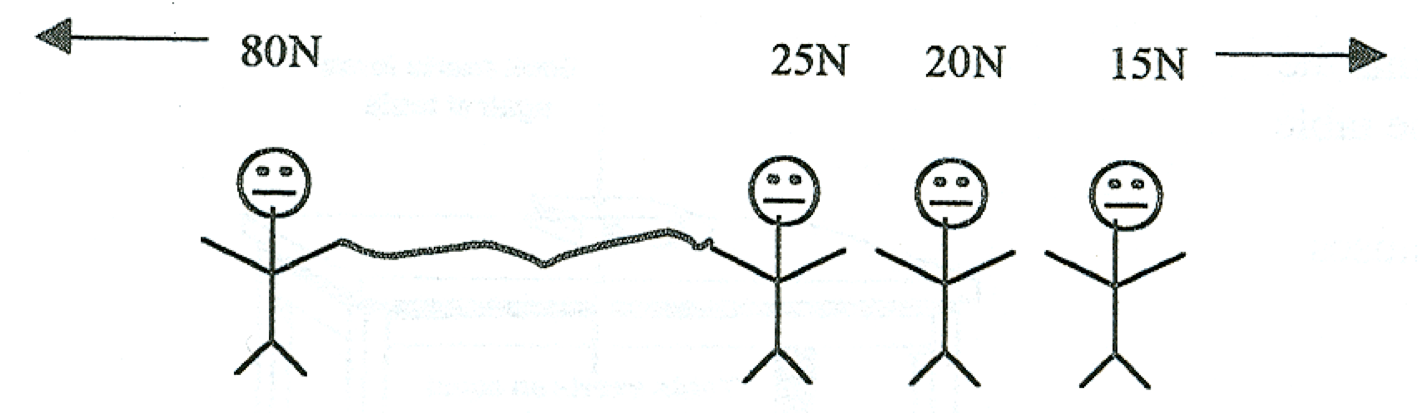
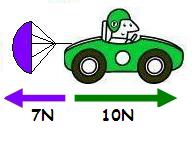
What is the net force?
3 N
3 N, right
17 N, right
3 N, left
What is the unit to MEASURE force?
Kilogram
Meter
Pounds
Newton
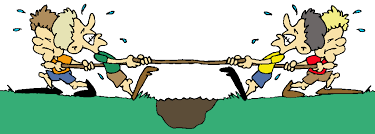
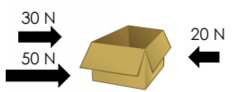

If both forces are going in the same direction you should______ those forces
Add
Subtract
Divide
Multiply
When forces are going in the opposite direction of each other you should do what do find the net force
Subtract
Add
Divide
Multiply


Calculate the net force
5
10
15
0

calculate the force applied to a 5 kg shopping cart if it accelerates at 3 m/s2
15
1.67
0.6
1.57
The acceleration due to gravity near the surface of Earth is equal to
9.8 m/s
9.8 kg x m/s
9.8 N
9.8 m/s2
A negative acceleration means that your object is
constant
speeding up
at rest
slowing down
Which statement correctly describes the effects of placing a heavy load in a car?
It is easier to accelerate the car and easier to bring the car to rest.
It is easier to accelerate the car but more difficult to bring the car to rest.
It is more difficult to accelerate the car and more difficult to bring the car to rest.
It is more difficult to accelerate the car but easier to bring the car to rest.
A mass of 6.0 kg rests on the surface of a planet. On this planet, g = 20 N/kg.
What is the weight of the object?
0.30 N
0.60 N
60 N
120 N
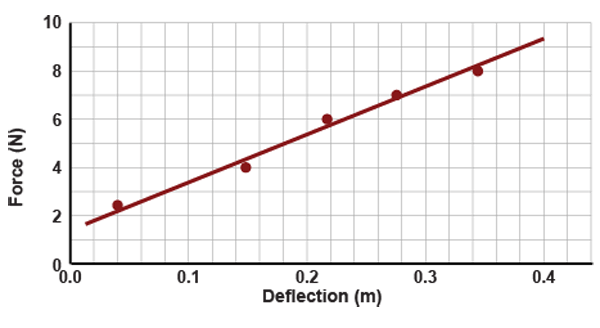
A mass of 6.0 kg rests on the surface of a planet. On this planet, g = 20 N/kg.
What is the weight of the object?
0.30 N
0.60 N
60 N
120 N
Which choice describes speed and velocity?
Speed: scalar | Velocity: scalar
Speed: scalar | Velocity: vector
Speed: vector | Velocity: scalar
Speed: vector | Velocity: vector
An object is on the surface of the Earth. Which statement describes the weight of the object?
the quantity of material that the object contains
the quantity of space that the object takes up
the gravitational force acting on the object
the object's resistance to a change in its motion
A resultant force of 4.0N acts on an object of mass 0.50 kg for 3.0 seconds.
What is the change in velocity caused by this force?
4.0 m / s
6.0 m / s
12 m / s
24 m / s
Which property of an object cannot be changed by a force?
mass
motion
shape
size
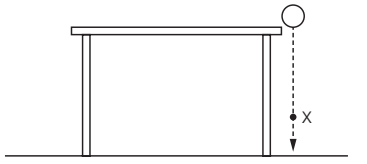
A ball is dropped from a table-top. Air resistance may be ignored.
Which row describes the velocity and the acceleration of the ball at point X
acceleration = constant; velocity = constant
acceleration = constant; velocity = increasing
acceleration = increasing; velocity = constant
acceleration = increasing; velocity = increasing

When the velocity of the car is constant, the force of friction on it is
zero
greater than the driving force
smaller than the driving force
the same size as the driving force
Which are the units for acceleration
m/s
m/s2
s/m
m/s3
The cyclist accelerates at 1.4 m/s2.
The mass of the cyclist and bicycle is 60 kg.
Calculate the resultant force.
(a)

The unit of force is...
m/s
m
N
kg
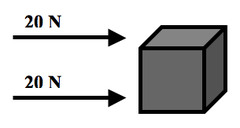
What is the resultant force?
40 N, Left
0 N, Balanced
400 N, Right
40 N, Right

What is the resultant force?
400 N, Up
400 N, Down
800 N, Up
800 N, Down

What is the resultant force?
17 N, Left
6N, Right
11N , Left
12N, Left

What is the resultant force?
40N, Left
40N, Right
0N, Balanced
75N, Right
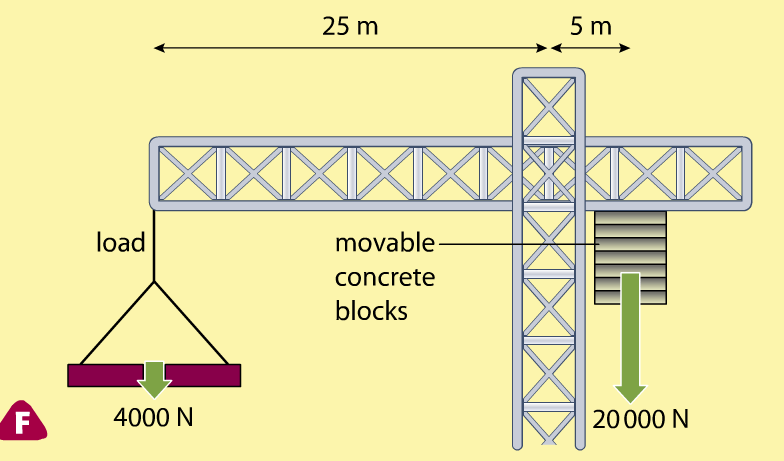

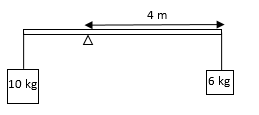
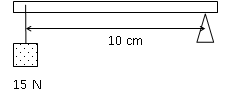
Two masses of mass 10.0 and 6.0 kg are hung from massless strings at the end of a light rod. The rod is virtually weightless. A pivot (fulcrum) is placed off center and the system is free to rotate. If the 6.0 kg mass is 4.0 m away from the pivot, how far away is the 10.0 kg mass if the system is not rotating?
0.42 m
2.4 m
4.8 m
4.2 m
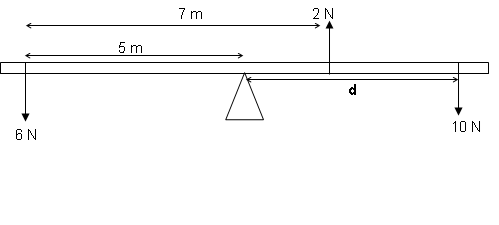
Assuming the system is in equilibrium, calculate the missing distance d
3.4 m
2.8 m
4.4 m
1.6 m

The diagram shows a beam. Without any weights, the beam balances at its centre.
Three weights are hung as shown.
At which point does a load of 2 N balance the beam?
A
B
C
D
A nut can be loosened more easily with
a short spanner because a larger turning effect can be produced.
a long spanner because a larger turning effect can be produced.
a long spanner because a larger force can be produced.
a short spanner because a larger force can be produced.

The figure below shows a man lifting a heavy rock using a steel bar. He pushes downwards on the end of the bar with a force F.
Which pivot positions allows the force F to be as small as possible?
A
B
C
D
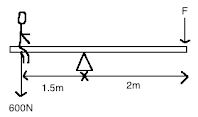
A boy of weight 600N sits on the see-saw as shown at a distance of 1.5m from the pivot. What is the force F required at the other end to balance the see-saw?
450 N
350 N
4.5 N
200 N
What is the unit of moment f force?
N
m
Nm
N/m
What condition must be met if an object is to be in equilibrium?
force on it must be balanced
force on it mus be unbalanced
resultant force more than 10 N
resultant turning effect more than 10

Calculate the unknown force X!
4.0 N
6.0 N
10 N
12 N

At what distance should a 2N load placed from the pivot so that the see saw won't move?
0.2m
0.5m
0.45m
0.42m
State the principle of moments.
When a system is in equilibrium, the sum of the total clockwise moment is equal to the sum of the total anti-clockwise moment about the same pivot.
When a system is in equilibrium, the sum of the total clockwise moment is greater the sum of the total anti-clockwise moment about the same pivot.
When a system is in equilibrium, the sum of the total clockwise moment is less than the sum of the total anti-clockwise moment about the same pivot.
When a system is in equilibrium, the sum of the total clockwise moment is equal to the sum of the total anti-clockwise moment about the different pivot.
What is the unit of force?
Meter
Newton
Newton meter
Centimeter
Moment is a measure of the turning effect of a force.
True
False
Pivot is the point about which a force is turned by an object.
True
False
Principle of moments states that an object is balanced when clockwise moments are equal to anticlockwise moments.
True
False
Moment = force / distance from pivot
True
False
The greater the force, the greater its turning effect.
True
False
The further the force is from the pivot, the greater its turning effect.
True
False
The bigger the moment of a force, the smaller its turning effect.
True
False

What is the moment acting on the left side of the pivot?
2 Nm
20 Nm
200 Nm
0.2 Nm

What is the moment acting on the right side of the pivot?
2 Nm
20 Nm
200 Nm
0.2 Nm

The beam is balanced.
True
False
A force of 4 N acts on a lever 2 m from the pivot. What is the moment?
8 Nm
6 Nm
2 Nm
3 Nm
One way to increase the turning force on a spanner is to:
Use a shorter spanner
Use a longer pivot
Use a longer spanner

James weighs 200 N and sits 1 m from the pivot. Jane weighs 100 N. How far from the pivot must Jane be to balance the beam?
0.5 m
1 m
2 m
4 m

A cat weighing 50 N is 1 m from the pivot. How far away does a mouse weighing 0.5 N have to be to balance the beam?
1 m
10 m
100 m
1000 m

A force exerts a moment of 2 Nm. What is the distance of the force from the pivot?
2 m
4 m
1 m
0.5 m

A force exerts a moment of 2 Nm. What is the distance of the force from the pivot?
1 m
0.5 m
0.2 m
0.25 m


Two skaters begin at rest. Skater 1 has a smaller mass than Skater 2. After they push off each other,...
Skater 1 experiences a greater change in momentum
Skater 2 experiences a greater change in momentum
Skater 1 has a greater speed than Skater 2
Skater 1 experiences a greater force
Which of the following has the MOST momentum?
rolling ping-pong ball
rolling bowling ball
rolling soccer ball
rolling basketball
If an object has a momentum of 40 kgm/s and a mass of 60 kg, what is it's velocity?
2400 m/s
1.5 m/s
240 m/s
.67 m/s
A 5 N force is applied to a 3 kg ball to change its velocity from +9 m/s to +3 m/s. The impulse on the ball is ______ N s.
-2.5
-10
-18
-45
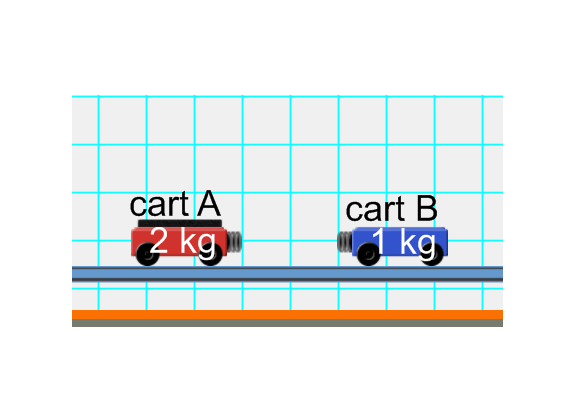
Calculate the impulse on the ball.
In an isolated system, the net ____ on that system is zero.
external force
internal force
time interval
displacement
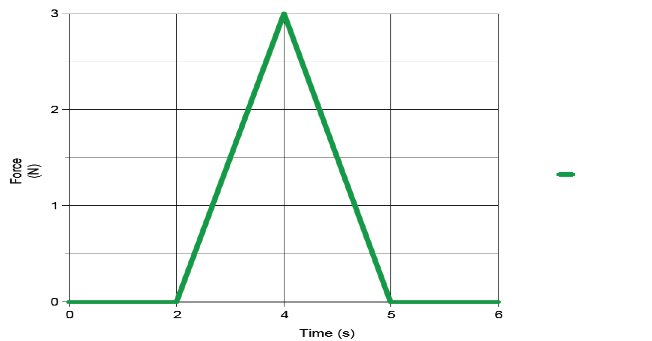
What is the magnitude of the impulse on the object?
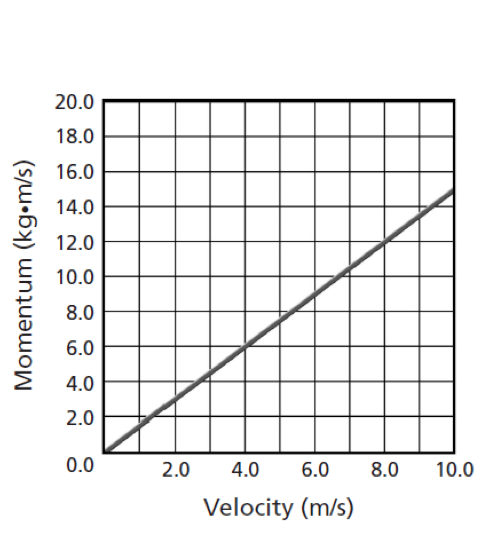
can a bullet have the same momentum as a truck?
yes
no
What is kinetic energy?
moving energy
potential energy
stored energy
renewable energy
The energy in which store increases as a car moves faster?
Gravitational Potential Energy
Kinetic Energy
Thermal Energy
Kinetic Energy
The energy in which store decreases as a candle burns?
Chemical energy store
Kinetic energy store
Nuclear energy store
The energy in which store increases as an elastic band is stretched?
Gravitational Potential
Chemical
Elastic
Kinetic
_________________ is when energy is transferred because a force moves an object through a distance.
Elastic
Mechanically
By radiation
By heating
_______________ is when energy is transferred due to charge flowing around a circuit.
Electrically
Kinetic
Mechanically
By radiation
________ is when energy is transferred between areas that have different temperatures.
By radiation
By heating
Mechanically
Nuclear
When you eat fruits and vegetables, the energy is stored as ...
a. thermal energy
b. food energy
c. electrical energy
d. chemical energy


Food, fuels and batteries have energy in this energy store
Chemical
Thermal
Gravitational Potential
Elastic

A stretched rubber band has energy in this energy store
Magnetic
Electrostatic
Elastic
Nuclear

Two negatively charged particles which are close together have energy in this energy store
Electrostatic
Magnetic
Nuclear
Elastic

Energy which is transferred by a force moving an object through a distance
Mechanically
Electrically
By Radiation
By Heating

Energy which is transferred by charges moving due to a potential difference (voltage)
Mechanically
Electrically
By Radiation
By Heating

Shooting an arrow from a bow converts ____ into kinetic energy.
Elastic potential energy
Chemical energy
Gravitational potential energy
Thermal energy
A ____ converts chemical energy into kinetic energy?


Which statement is correct
Energy cannot be created or destroyed
Energy can be destroyed but not created
Energy is always created but never destroyed
Energy cannot be created but never destroyed
4 m.

An arrow in a bow had 70J of PE. Assuming no loss of energy to heat, how much KE will it have after it has been shot?
0J
35J
50J
70J
The formula for power is
power = force × time
power = timechange energy
power = distancechange speed
power = 21mv2
Unit for power is
Watts (W)
Joules
Amperes
voltage
Equation for kinetic energy
Kinetic energy = 21mv2
Kinetic energy = 21mv3
Kinetic energy = 21mv
Kinetic energy = mv2
Equation for gravitational potential energy (GPE)
GPE = m×g×Δh
GPE = m×Δg×h
GPE =Δm ×g×h
GPE=F×g×h
Link between energy transferred and work done
energy transferred = work done
energy transferrred = 1/2 work done
energy transferred = work done2
energy transferred = 1 / work done
energy transferred = 4/3 π x work done3
The unit of work is
watt
hertz
joule
pascal

Each of the boxes shown is pulled for 10 m across a level, frictionless floor by the force given. Which box experiences the greatest change in its kinetic energy?
A
B
C
D
E

Starting from rest, a marble first rolls down a steeper hill, then down a less steep hill of the same height. Ignoring friction, for which is it going faster at the bottom?
Faster at the bottom of the steeper hill
Faster at the bottom of the less steep hill
Same speed at the bottom of both hills
Can’t say without knowing the mass of the marble

Four students run up the stairs in the time shown. Which student has the largest power output?
A
B
C
D
A major league pitcher can throw a baseball with a kinetic energy of 150 J. How much work must the pitcher do to the ball to give it that much KE?
150 J
0
Can’t tell without knowing the mass of the ball
A rock has 10 J of potential energy on top of a roof. If it is dropped and lands with only 8 joules of kinetic energy, how much work did air resistance do on the rock?
-18 J
-10 J
-8 J
-2 J
In the equation PE = mgh, what does the “g” mean?
Acceleration due to gravity
Force of gravity
Weight of the object
What is the unit for power?
what
watt
joule
Jewel-Osco
Which requires more work – a person walking up stairs or a person running up stairs?
walking
running
they require equal work
no work is required for either because the movement is vertical
Which requires more power – a person walking up stairs or a person running up stairs?
walking
running
they require equal power output
no power is required at all
How much work is done on a 200-kg crate that is hoisted 2 m in a time of 4 s?
400 J
1000 J
1600 J
4000 J
How much power is required to raise a 200-kg crate a vertical distance of 2 m in a time of 4 s?
400 W
1000 W
1600 W
4000 W
A
B
C
D

A
B
C
D

A
B
C
D

A
B
C
D
Electricity can be obtained from different energy resources. Which energy resource is used to obtain electricity without producing heat to boil water?
coal
geothermal
hydroelectric
nuclear

If the mass of the cart is 15kg, how much is the potential energy of the cart?
0J
1.2J
6J
58.8J
What are fossil fuels?
energy producers that comes from radioactive elements
a natural product that can be changed into other energy forms to do work
energy resources that formed from buried plants and animals that lived a very long time ago
resources that are replaced faster than they are used
All of the following are fossil fuels EXCEPT
oil
water
coal
natural gas
Where does nuclear energy come from?
Electric generators
radioactive elements
fossil fuels
geothermal energy
Which of these originally got their energy from the sun? Choose all that are correct.
Coal
Nuclear power
Tidal
Wave
HEP
Which of these energy resources is the most reliable?
Coal power
Solar
Wave
Wind
The law of conservation of energy states:
Choose 2
Energy cannot be created or destroyed
Only transformed from one type to another
Energy can be created but not destroyed
Energy cannot be transformed
I throw my pen vertically up with 15J of kinetic energy. How much gravitational potential energy does it have at the top?
Assume no air resistance.
0J
15J
0 - 15J
Impossible to calculate
Which of these is the best answer to "state a disadvantage of coal energy"?
Makes pollution
Produces carbon dioxide which causes global warming
Ugly to look at
Expensive to run, lots of jobs
Is "expensive" enough detail for an answer?
No - be specific
Yes - give me the mark
Around Tongariro, there is a large HEP network that produces 4% of NZ's electricity.
Which of these are disadvantages of using HEP?
Causes land to be flooded
Can affect river levels and wildlife on rivers e.g. Whio ducks
Expensive
Ugly
Produces carbon dioxide

The roller coaster car has a mass of 500 kg. It is pulled from position 1 to 2 (30 m) by a motor. At the top of the ride the vertical distance top to bottom is 20 m. The motor pulls the car with a 4000 N force. Calculate the work done getting the car to the top of the ride.
100 000J
120 000J
800 000J
90 000J

Bob (80 kg) uses 180 N of force to get him up the slope. The vertical distance is 2 m and the diagonal is 10 m. Calculate the work he does.
1600 J
160 J
3600 J
1800 J
On a force versus change in position graph, the area under the curve is a representation of:
force
position
KE
PE
Work
A waiter carries a tray full of meals above his head by one arm straight across the room at constant speed.
An 80 N rope tension force is used to slowly pull a wagon 50 m up a hill. Calculate the work done by the rope if it pulls parallel to the hill
-4000 J
4000 J


What type of energy transformation takes place when you plug in a lamp and turn it on?
electrical to radiant
electrical to mechanical
chemical to radiant
mechanical to thermal
Energy Efficiency is calculated by useful energy (Energy Out) divided by energy consumed (Energy In) , expressed as a percentage
False
True
The SI Unit for Energy is
Joule
Newton
Calorie
Watt
What percent energy is wasted by a machine if the energy input is 262 J and the energy output is 131 J?
5%
50%
100 J
What is the work output of a machine that has a work input of 2,800 Joules and an efficiency of 90%?
25200 J
2520 J
0.0082J
A weight-lifter raises a 2000N weight through a vertical height of 2.0m in 0.80s. What useful power does he develop in doing this?
800 W
700W
4000W
5000W
select two correct answers that show:
Average speed?
s = d/t
v = s/t
speed = distance/time
velocity = speed/time
Acceleration?
a = (v-u)/t
d = s/t
v = s/t
F= m/a
v = Δϰ/Δt?
average speed
force needed
average velocity
acceleration
Which formulae shows the relationship between Force, mass and acceleration?
W = mxg
F = mxa
p=mxv
ρ=mxV
Which formulae shows the rate in change of mometum?
F= mxa
F= mxv - mxu / t
F= mxg
F= Fxχ
Formula for Power?
ΔE = Fxd
KE = 1/2mxv2
W = ΔE/t
GPE = mxgxh
ΔE = Fxd?
work = force x distance
Power = Work/ time
Pressure = height x density x gravity
Kinetic energy = 1/2 mass x velocity²
Which is the correct formula for energy efficiency?
Efficiency = total input energy / useful energy output x 100
Efficiency = total input energy / useful energy output / 100
Efficiency = total input energy / useful energy output / 100
Efficiency = useful energy output / total input energy. x100
Select the two that show Refractive index of a material
Refractive index = speed of light in vacuum x speed of light in material
Refractive index = speed of light in vacuum / speed of light in material
n = v1 / v2
n = v1 x v2
Select the two that show the relationship between wave speed, frequency and wavelength
c = f x λ
Wave speed = frequency x wavelength
Wave speed = frequency / wavelength
c = f / λ
Two formulae that show the relationship between Current, charge and time
Current = charge x time
current = charge / time
I = Q x t
I = Q / t
Which will calculate the Power (W) in a circuit?
V = I x R
P = I x V
ΔE = I x V x t
I = Q / t
Which is the correct formula for Energy Transferred in a circuit?
ΔE = I x V x t
ΔE = I / V x t
ΔE = I x V / t
ΔE = I x V

Is this..........
Alpha decay
Beta decay

Is this ......
Alpha decay
Beta decay
Which formulae shows Hooke's Law?
F= mg
F= ma
F = kx
GPE = mgh
What does the relationship between mass, gravity and height show?
Resistance in a circuit
Current in a circuit
Gravitational Potential Energy
Extension of a spring
What is the unit of Work?
Newtons
Joules
Metres
Kg
What is the relationship between moment, force and distance? SELECT TWO CORRECT ANSWERS
M = F x d
M = F / d
d = M x F
F = M/d
What do ohms measure?
Current
potential difference
resistance
power
What is the definition for the word amplitude?
The number of complete waves that pass per second
The distance from the peak of one wave to the peak of an adjacent wave.
The distance from the equilibrium position of a peak plus the same distance from a trough.
The maximum distance from the equilibrium position of any point on a wave

what is the name given to the effect that allows wavefronts to reach point X, shown in the diagram?
(a)

Which 2 points on the wave are exactly one wavelength apart?
P and S
Q and R
Q and S
P and R
Water waves travel from deeper water to more shallow water. This causes them to refract.
Which property always remains the same when refraction occurs?
Wavelength
Frequency
Amplitude
Speed

A
B
C
D
What is the unit for wavelength?
(a)
What is the unit for frequency?
(a)
What is the unit for velocity?
(a)
what is the formula for finding the wavelength of a wave?
v = f λ
λ / v = f
v f = λ
λ / f = v

A
B
C
D
Sound waves travel at a speed of 1500m/s through a substance. Their wavelength is 5.0 cm. What is their frequency?
(a)

It doubles
It halves
It remains the same
It becomes four times as large

The speed of wave increases.
The speed of wave decreases.
The frequency increases.
The frequency decreases.

Decrease the speed of waves (but keep the wavelength the same).
Increase the speed of the waves (but keep the wavelength the same).
Make the gap smaller
Make the gap bigger
What is a frequency?
the number of wave crests passing a point in one second.
the numbers of waves in total.
the height of the waves times each second.
the speed of waves over time.
Velocity = (a) x lambda
What is the wavelength?
The distance from one wave peak to another
number of wave crests passing a point in one second
the height of the wave peak
the energy that the waves carry
Sound waves are (a) waves
light waves are (a) waves
the vibrations of longitudinal waves are (a) to the direction in which the waves are travelling.
the vibrations of transverse waves are (a) to the direction in which the waves are travelling.

what is the arrow pointing to?
compression
rarefaction
when plane waves reflect from a straight barrier, the angle of each reflected wave is (a) to the angle of each incident wave to the barrier.
Diffracted waves spread out ______ if the gap is wider.
more
less
the same
The narrower the gap, the ____ the diffracted waves are spread out.
more
less
The word diffraction means...
dispersing of waves
reflecting of waves
refraction of waves
spreading of waves

The speed of light in air is 3.0 x 10^8 m/s. The critical angle for light in a transparent plastic material placed in air is 37°. What is the speed of light in the plastic material?
A sound wave travels from air into water. Which row describes what happens to the frequency and the wavelength of the wave?
Frequency: decreases; Wavelength: increases
Frequency: decreases; Wavelength: stays the same
Frequency: stays the same; Wavelength: decreases
Frequency: stays the same; Wavelength: increases
The horn of a ship makes a sound. The captain on the ship hears an echo from a cliff 4.0 s later. When the speed of sound is 340m/s, what's the distance between the cliff and the ship?
170 m
340 m
680 m
1360 m
The diagrams represent water waves in a tank. Which diagram represents a wave that changes speed?

A

C

D

A tank contains water. Ripples are produced on the surface of the water. Refraction is observed. What causes the ripples to refract?
The cold water in the tank is replaced by warm water
The ripples change speed as they move from deep to shallow water
The ripples hit the wall of the tank
The ripples pass through a narrow gap
Infrared radiation from the Sun disappears before visible light and ultraviolet radiation.
Ultraviolet radiation from the Sun disappears before visible light and infrared radiation.
Visible light from the Sun disappears before ultraviolet radiation and infrared radiation
Infrared radiation, ultraviolet radiation and visible light from the Sun all disappear at the same moment.
What is the frequency of a wave?
The number of waves passing a fixed point per second.
The number of peaks added to the number of troughs passing a fixed point per second.
The time taken for one wave to pass a fixed point.
The time taken for the displacement to change from maximum to minimum.
What is meant by the term wave front?
the distance between successive peaks of a wave
the distance between the trough and the peak of a wave
a line joining points along the peak of a wave
a line joining the trough and the peak of a wave

A ripple tank is used to demonstrate refraction of plane water waves.
Waves in deep water have a wavelength of 1.2 cm and a speed of 9.6 cm / s.
The wavelength of the waves in shallow water is 0.8 cm.
What is the speed of the waves in the shallow water?
6.4 cm / s
8.0 cm / s
9.6 cm / s
14.4 cm / s

The diagram shows waves travelling on the sea.
Which points are one wavelength apart?
P and R
Q and S
Q and T
S and T

The diagram shows the variation of the displacement of a wave with distance from the source.
What is the amplitude of the wave?
2.0 cm
4.0 cm
20 cm
40cm

The diagram shows a wave moving into shallower water.
The wavelength of the waves is reduced because
both the frequency and the speed decrease.
both the frequency and the speed increase.
only the frequency increases.
only the speed decreases.

The diagram shows a water wave in a ripple tank.
The wave has a speed of 12 cm / s at R.
The wave crosses a boundary PQ where the distance between crests changes from 3.0 cm to 1.5 cm.
What is the speed of the wave at S?
3.0 cm / s
6.0 cm / s
12 cm / s
24 cm / s

Which diagram correctly represents water waves travelling from deep water to shallow water?
A
B
C
D

The diagram shows part of a spring that is shaken from side to side to produce a wave.
The distance between successive peaks is 0.60 m and the frequency is 2.5 Hz.
How long does it take for a wave to travel 3.0 m along the spring?
0.20 s
0.50 s
2.0 s
5.0 s

The dipper in a ripple tank vibrates at a frequency of 4.0 Hz and the resulting wave pattern is photographed.
The distance between the two crests shown is 20 cm.
What is the speed of the wave?
4 cm / s
5 cm / s
16 cm / s
20 cm / s

