
 Worksheets
U4 Review G5 Final Review
Total questions: 100
Worksheet time: 1hrs 20mins
Following the 1860 election, South Carolina and six other Southern states decided to
secede. What does it mean for a state to secede?
The state cancels a law from the federal government
The state leaves the country
The state declares war on other states
The state stops following the First Amendment
Who did representatives from the seceded states choose to be president of the Confederacy?
Robert E. Lee
James Garfield
Jefferson Davis
Stephen Douglas

How did the South react to Abraham Lincoln’s election as President in 1860?
Seven Southern states seceded and formed the Confederate States of America.
What was the first state to secede from the United States?
New York
Missouri
Texas
South Carolina
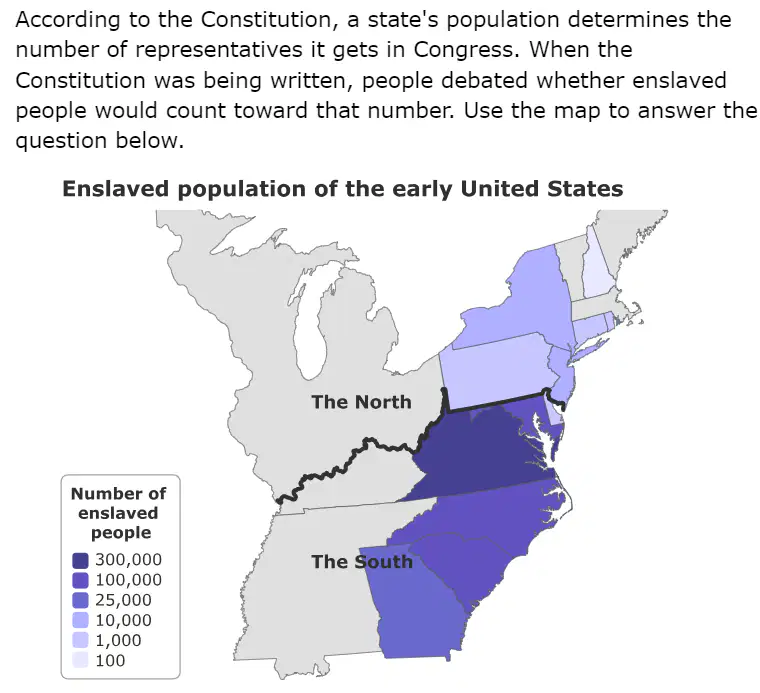
Each state wanted as many representatives as possible. Which region would have gained more congressional representation if enslaved people were counted?
The South
The North
By the 1820s (before the civil war), many Americans wanted to have an equal number of senators from the free states and the slave states. To achieve that, what would need to be true?
There would need to be equal populations in free states and slave states
The president would have to be from a free state
There would need to be an equal number of free states and slave states
The Supreme court would need to end slavery in all the states


14. What was a very large farm that used enslaved labor for profit?
farm
plantation
business
fields
Who were abolitionists?
People who fought to keep slavery alive
People who owned slaves
People who fought to end slavery
No one
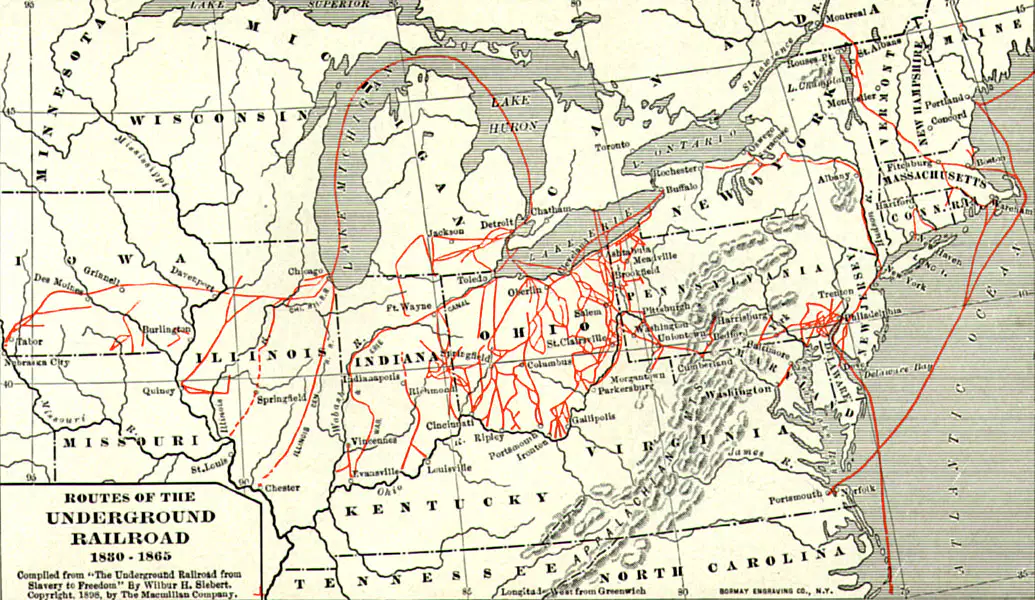
What was the Underground Railroad?
A series of trains and underground tunnels that helped transport slaves to freedom
A set of maps that showed how much work slaves did each day
The name of a famous slave ship
An organized, secret system set up to help enslaved people escape from the South to freedom in the North

How did cotton relate to slavery?
The desire to grow cotton led to increased slavery
It did not relate to slavery
All slaves were required to grow cotton
Cotton was traded for slaves in Africa
Why were Africans captured and forced to work in the Americas?
To spread Christianity
To give them diseases
To share riches and wealth with them
To provide more workers for plantations
What did the North rely on?
Agricultural
Farming
Industry and Factories
Fishing
How did enslaved people fight against slavery?
Refused to do any work
Break their tools on purpose
Pretended to be sick
All of the above
Why was the South against California entering the union?
California would be a free state and upset the balance of slave and free states.
California wanted to be a slave state
California was the scene of violence and bloodshed
The addition of California would balance the power between free and slave states.
As part of the agreement in the Compromise of 1850, how would slavery in the remaining territory of Utah and New Mexico from the Mexican Cession be decided?
The Senate would vote
The House of Representatives would vote
The President would decide
Popular sovereignty- the people in the territory would vote
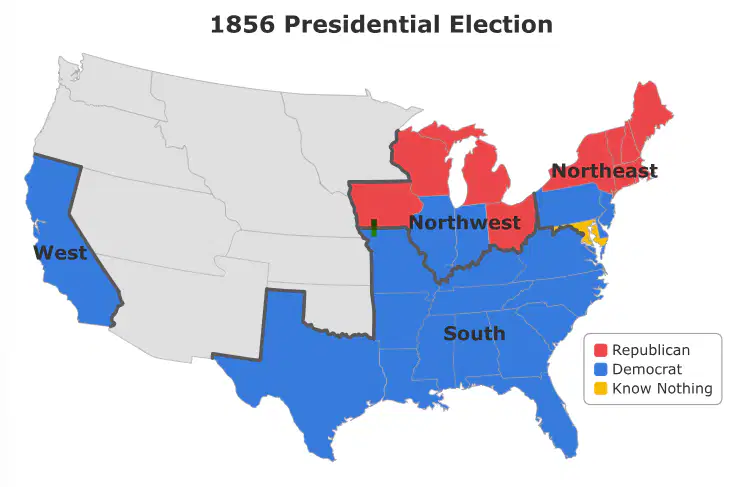
By the 1850s, slavery was a major issue in presidential elections. In 1856, the antislavery Republican Party competed in its first presidential election. Use the election map to answer the question below.
In which regions did the Republican candidate do the best? Select the two that apply
The West
The Northeast
The South
The Northwest

Based on the map, why did Dred Scott believe he should be free after living at these two forts?
Fort Snelling and Fort Armstrong were both slave states.
Fort Armstrong was in a free state and Fort Snelling was in a free territory
Fort Armstrong was in a slave territory and Fort Snelling was in a free state.

Dred Scott believed he had a right to freedom. Read the passage from the Supreme Court's decision about Dred Scott's rights. Read it and answer the question below.
Based on this document, what did the Supreme Court rule about Dred Scott's rights?
Dred Scott had the right to be paid for all the years he was enslaved.
Dred Scott had no rights because he was an African American person.
Dred Scott was an American citizen, so he had the right to be free.
Dred Scott had no rights because he was born outside the United States.
Under the Dred Scott ruling, which people were not considered citizens?
Enslavers
Women
African American people
Children
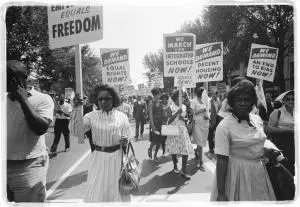
Individual Americans often had strong opinions about slavery. What were some ways that Americans in the 1850s could show their opinions about slavery? Select all that apply.
join political or debating clubs
take part in political marches
vote for candidtes who agreed with their views
protests, boycotts, sit ins, organizing, and speeches
The Emancipation Proclamation upset slave owners in the
Southern States
Border States
Who made the Emancipation Proclamation?
Harriet Tubman
Abraham Lincoln

Which of the below statements best describes the Emancipation Proclamation?
A change to the United States constitution allowing for all men to vote regardless of race.
A new law issued by congress that said slavery was illegal in the North.
An executive order from Abraham Lincoln that eventually led to the freedom of millions of slaves.
A speech given by Abraham Lincoln asking for the Civil War to end.
An order made by the Supreme Court saying that the Confederate states had the right to decide for themselves on slavery.

Why did President Lincoln wait to issue the proclamation until after the northern victory at Antietam?
He was too busy ordering troops around and didn`t have time before the victory.
It was a complicated document and it took him a long time to write.
He was waiting for the states to ratify it.
He was waiting on the Supreme Court to say it was okay.
He wanted strong support for the proclamation from the people and felt that the timing was right after this major victory in the Civil War.
The Emancipation Proclamation freed all the slaves
TRUE
FALSE
The Emancipation Proclamation freed all the slaves
TRUE
FALSE
The Emancipation Proclamation did NOT free the slaves living in the ______.
Border states
Union States
Confederate States
Western States

The Emancipation Proclamation freed enslaved people living in the ______.
Border states (Territories)
Union States
(United States)
Confederate States (Rebellion States)
Western States
Who did the Emancipation Proclamation help?
Slaves in the Southern States
Slaves in the Border States

The Emancipation Proclamation paved the way for what constitutional amendment that outlawed slavery in the United States?
The thirteenth amendment
The nineteenth amendment
The fifth amendment
The first amendment
The twenty-first amendment
The Emancipation Proclamation also said that former slaves could become ______.
Union soldiers
President
Congressmen
Teachers
After the Emancipation Proclamation, it was clear that the war was now about ______.
Winning
Ending slavery
Keeping the Union together
Voting rights
What was Jim Crow laws?
It was laws that kept African American separate from other Americans.
It was laws that kept Native Americans separate from other Americans.
It was laws that kept African American separate from other Native Americans.
It was laws that kept Americans separate from other Native Americans.
What were Black Codes?
Laws that were passed to restrict the freedom of African Americans and keep them working in low paying jobs.
Laws that were passed to restrict the freedom of Native Americans and keep them working in low paying jobs.
Laws that were passed to restrict the freedom of poor whites and keep them working in low paying jobs.
Laws that were passed to restrict the freedom of former Confederates and keep them working in low paying jobs.
What is segregation?
It forces the coming together of races of people.
It forces the separation of government officials.
It forces the separation of races of people.
It forces the coming together of government officials.
8. Which amendment abolished slavery?
13th
14th
15th
16th
What was the primary role of the Freedmen's Bureau in Virginia after the Civil War?
Assisting newly freed African Americans with food, schooling, and medical care
Providing military support
Offering financial loans to businesses
Building new government facilities
What was the practice where freed men and poor farmers rented land from landowners by promising to pay owners with the share of the crops?
Indentured servitude
slavery
Sharecropping
Apprenticeship
What is Reconstruction?
It is a period when the North rejoined the Union after the Civil War.
It is a period when the South rejoined the Union after the Civil War.
It is a period when the United States rejoined the Union after the Civil War.
It is a period when the Yankees rejoined the Union after the Civil War.
How did the 13th, 14th, and 15th Amendments protect the rights of African Americans?
Northern states had to follow these three amendments otherwise they could be arrested.
Southern states had to follow these three amendments or otherwise they could be arrested.
The Constitution now gave white Americans new rights.
The Constitution now stated that African Americans had to be offered the same opportunities as whites.
Which group of people were known as Freedmen?
African American slaves who ran away from their owners.
Northern whites who came to form governments in the southern states.
Southern whites who tried to frighten African Americans
Slaves who were freed at the end of the Civil War.
In addition to boycotts, marches, and freedom rides, the Student Non-Violent Coordinating Committee (SNCC) helped
organize sit-ins at lunch counters across the South.
Helped organized African/Black Americans to fight for equality
Helped sign up African Americans to vote at voter registration drives.
Freed slaves were forced to sign contracts and become sharecroppers so they could stay on the land to farm.
True
False
What were the laws designed to keep white people and black people apart called?
Segregation Laws
Jim Crow Laws
Seperation Laws
Separate but Equal Laws
What is the keeping of white and black people separate called?
Segregation
Seperation
Keeping Apart
Division
Which of the following were examples of places that were segregated during the Civil Rights Movement?
Busses
Restrooms/Water Fountains
Houses
All of the above
Which important Civil Rights figure refused to give up his/her spot on the bus after a long day of work?
Martin Luther King Jr.
Eleanor Roosevelt
Rosa Parks
Thurgood Marshall
After Rosa Parks was arrested, who led the protest to boycott busses called the Montgomery Bus Boycott?
Martin Luther King Jr.
Rosa Parks
Thurgood Marshall
John F. Kennedy
Martin Luther King Jr. believed that African Americans could gain their rights by protesting against unfair laws in what way?
Violently
By fighting
With a Civil War
Peacefully
Which law banned discrimination of any American because of their race, religion, or color?
The Civil Disobedience Act
The Civil Rights Act
Rights Law
Right to be Civil Act
What are the laws called that enforced segregation?
Separate But Equal
Discrimination Laws
Jim Crow Laws
Civil Rights Act
Which of the following did the Emancipation Proclamation do?
Freed all slaves in the Confederate states that were not currently under Union control.
Laid the groundwork for a future constitutional amendment to outlaw slavery.
Allowed for African American men to fight in the Union army.
All of the above

True or False: The Emancipation Proclamation immediately set all the slaves in the United States free?
TRUE
FALSE

What president gave the order for the Emancipation Proclamation?
Abraham Lincoln
George Washington
Thomas Jefferson
Confederate president Jefferson Davis
Andrew Johnson

Lincoln gained the confidence to order the emancipation of the slaves due to the victory of the Union army in this battle:
Battle of Gettysburg
Battle of Antietam
Battle of Fredericksburg
Battle of Shiloh
Battle of Fort Sumter
The Emancipation Proclamation paved the way for what constitutional amendment that outlawed slavery in the United States?
The thirteenth amendment
The nineteenth amendment
The fifth amendment
The first amendment
The twenty-first amendment
The Supreme Court ruled that segregation in public schools unconstitutional
Brown v. Board of Education
Plessy v. Ferguson
Voting Rights Act of 1955
Civil Rights Act of 1964
Forms of passive resistance
civil rights
integration
discrimination
sit-ins, boycotts, marches
The act of refusing to buy or use services
segregation
boycott
sit-ins
marches
The unjust, unfair, and unequal treatment of someone
boycott
segregation
integration
discrimination
Peaceful and calm ways to bring about change
riots
passive resistance
integration
segregation
Peaceful and calm ways to bring about change
riots
passive resistance
integration
segregation
Enforces the separation of different groups
integration
segregation
discrimination
mass media
Rights that protect individuals freedoms
segregation rights
discrimination rights
integration rights
civil rights
The court case that ruled that separate but equal was constitutional and allowed for Jim Crow Laws
Voting Rights Act of 1955
Civil Rights Act of 1964
Plessy v. Ferguson
Brown v. Board of Education
The Student Nonviolent Coordinating Committee (SNCC) was a student-led organization that promoted nonviolent protests against segregation.
True
False
What was the name of the the historical fiction novel written by Harriet Beecher Stowe?
"Civil War Slavery"
"Uncle Tom's Cabin"
"Harper's Ferry Raid"
"The War Between the North and South"
An "abolitionist" is someone who:
wanted to continue slavery
wanted to hide slavery
wanted to end slavery
wanted to increase the number of slaves
The southern states' economy included
slave labor
cotton fields
large plantations
all of the above
What does the term "secede" mean?
joining with a group
breaking away from a group
fighting for slave's rights
challenging a presidential election
Which economy relied heavily on agriculture and slavery
North
South
West
Which law allowed slave holders to gain access to the north to retrieve their runaway slaves
Fugitive Immigrant Law
Runaway Slave Clause
Fugitive Slave Law
Property Abandonment Clause
Kansas-Nebraska Act gave the people of these territories the right to vote on slavery. What piece of legislation did it overturn?
Missouri Compromise of 1820
Compromise of 1850
Henry Clay Treaty
Lincoln Agreement
The Kansas-Nebraska Act led to people flooding into these territories from the north and south to vote on slavery. This led to what event?
Bleeding Kansas
Red Kansas
Civil War I
Missouri Compromise Conflict
What was the tipping point that led South Carolina to be the first to succession?
Dred Scott Decision
Bleeding Kansas
Fugitive Slave Law
Lincoln is Elected President

Why did the South need slaves, but the North didn't?
Large plantations in the south needed slave labor to profit.
The South didn't want slave labor
Slaves ran the large steel mills and appliance factories in the South
Slave labor was needed to work the mines in the South
Which region had cotton as an important crop?
South
West
North
East
Which region relied heavily on slave labor?
South
West
North
East
Who invented the cotton gin?
Jerry Simmons
Andy Page
Kurt Graham
Eli Whitney
Where did many immigrants going to the north come from?
Ireland and Germany
France and Spain
South America
Other places in the USA
What main crop did people grow in the south?
wheat
cotton
grapes
apples

