
 Worksheets
Chemistry Second semester Review
Total questions: 161
Worksheet time: 7hrs 19mins

How much KNO3 solute is saturated at 40 degrees?
75
55
65
85
How much C12H22O11 solute is saturated at 40 degrees?
240
220
230
250
How much Ce2(SO4)3 solute is saturated at 80 degrees?
20
15
30
2
How much NaBr solute is saturated at 70 degrees?
110
120
130
140

Which solute is MOST likely a gas?
KNO3
NaNO3
KCl
Ce2(SO4)3
At what temperature can you fully dissolve 140g of NaNO3?
62
73
81
You cannot determine this
At what temperature can you fully dissolve 60g of KNO3?
27
30
37
You cannot determine this
At what temperature can you fully dissolve 120g of NaBr?
70
20
100
You cannot determine this
What type of a solution is 60g NaNO3 at 40ºC in 100g H2O?
Saturated
Unsaturated
Supersaturated
What type of a solution is 100g KNO3 at 40ºC in 100g H2O?
Saturated
Unsaturated
Supersaturated
What type of a solution is 260g sugar at 50ºC in 100g H2O?
Saturated
Unsaturated
Supersaturated
What type of a solution is 25g NaCl at 70ºC in 100g H2O?
Saturated
Unsaturated
Supersaturated
What type of a solution is 55g KCl at 70ºC in 100g H2O?
Saturated
Unsaturated
Supersaturated

15-19.
Answer the questions below after watching the video
What does molarity measure?
The weight of solute per liter of solution
The number of moles of solute per liter of solvent
The density of the solution
The volume of solvent per liter
How can the molarity of a solution be determined if the mass of the solute is known?
By measuring the density of the solution
By dividing the mass by the volume of the solvent
By multiplying the mass by the volume of the solution
By converting the mass to moles using molar mass and dividing by the solution volume
What is the effect of dilution on the concentration of a solution?
Changes the molar mass of the solute
Does not change the concentration
Decreases the concentration
Increases the concentration
How is the new concentration after dilution calculated?
By dividing the initial concentration by the final volume
By subtracting the final volume from the initial concentration
By multiplying the initial concentration by the initial volume and dividing by the final volume
By adding the initial and final volumes
What happens to the concentration of a solution if the volume is doubled?
It doubles
It remains the same
It quadruples
It is halved
What is the molarity of a 0.5L sample of a solution that contains 60.0 g of sodium hydroxide (NaOH)
0.8 M
1.5M
3.0M
6.0M
A student is preparing solutions for a laboratory experiment by dissolving solid solutes in liquid solvents. Which action will increase the rate of solubility
lowering the temperature of the solvent
stirring the solute in the solution
increasing the pressure on the solution
increasing the particle size of the solute
Which of the following substances is a heterogeneous substance?
baby oil
rocky road ice cream
salt water
milk
Which of the following substances is a homogeneous solution?
chocolate chip cookie
italian dressing
apple juice
orange juice
Which of the following is the correct formula for calculating molarity?
moles/liters of solution
moles/kg of solvent
# particles/Avogadro's #
theoretical yield/actual yield
Which of the following types of solutions has more room to dissolve solute?
supersaturated
saturated
unsaturated
When calculating molality, Kg of the following are included in the calculation?
solvent
solute
none of these
solvent & solute
To calculate molality you only need which of the following?
scale
flask
What is the molality of a solution in which 3.0 moles of NaCl is dissolved in 1.5 Kg of water?
2.0 M
0.22 m
135 m
2.0m
What is a solvent?
The substance that does the dissolving in a solution.
The substance that is being dissolved in a solution.
The mixing of different substances.
The process in which neutral molecules lose or gain electrons
The concentration of a mixture can be increased in which of the following ways?
Heating the mixture
Adding more water “solvent”
Adding more powder “solute”
Stirring the mixture
air is a
compound
element
heterogeneous mixture
solution
Another name for a homogeneous mixture is
an element.
a solution.
a compound.
If water is a polar molecule, then which of the following must be nonpolar
sugar
salt
oil
juice
Electrolytes
don't conduct electricity
conduct electricity
Which of the following will produce crystals if cooled or disturbed?
unsaturated solution
saturated solution
supersaturated solution
all of the above
Since "like dissolves like", water and oil will not mix because
both of them are polar
both of them are nonpolar
oil is polar and water is nonpolar
oil is nonpolar and water is polar
What is the molarity of a 2 liter solution containing 5 moles of NaCl?
5.0
0.4
2.5 moles/liter
10 moles/liter
How many liters would you need to get 0.5 moles if you had a 0.1M solution?
0.05 liters
0.2 liters
5 liters
2 liters
Molarity is ...
grams of solute/deciliters of solvent.
grams of solute/liters of solution.
moles of solute/liters of solution.
moles of solute/milliliters of solvent.
Which sweet tea would you expect to taste the sweetest?
1M
3M
3.1M
2.5M
Which law states that energy cannot be created nor destroyed, but it can be transformed or transferred?
Dalton's Law
Law of conservation of energy
Hess's Law
E=mc^2
What happens when kinetic energy increases?
Temperature increases.
Temperature decreases.
Temperature is not affected by kinetic energy.
A liquid has _________ temperature than a solid.
Higher
Lower
A gas has ________ kinetic energy than a liquid.
more
less
A sample of a compound has a mass of 30 g and a specific heat of 0.258 J/g*K. If its temperature drops 40 K, how much heat was released? ( q=mcΔT )
309.6 J
-309.6 J
465 J
-465 J
A sample of a compound has a mass of 77 g and a specific heat of 0.885 J/g*K. In order to increase the temperature by 25 degrees Celsius, how much heat must be added? ( q=mcΔT )
-3.48 J
3.48 J
1704 J
-1704 J
When water evaporates, the process is...
endothermic
exothermic
When wood is burned in a campfire, the process is...
endothermic
exothermic
For an exothermic reaction, ΔH is...
negative
positive
For an endothermic reaction, ΔH is...
negative
positive
In the following reaction, A + 2B --> 3C, ΔH = 640 kJ . How much energy is needed to react 4 moles of A?
2560 kJ
1280 kJ
1920 kJ
3840 kJ
In the following reaction, 2A + 2B --> C, ΔH=−60 kJ . What is the ΔH when 6 moles of A are reacted?
-180 kJ
-360 kJ
180 kJ
360 kJ
In an exothermic reaction, heat is a...
product
reactant
In an endothermic reaction, heat is a...
product
reactant
If you touch an exothermic reaction, it will feel...
hot
cold
If you touch an endothermic reaction, it will feel...
hot
cold

The graph is showing an ____________ reaction.
exothermic
endothermic

The graph is showing an _________ reaction
endothermic
exothermic
CO2 can be made using the following chemical equation:
2CO + O2 --> 2CO2
Find ΔHreaction if the heat of formation of CO is -99 kJ/mol and the heat of formation of CO2 is -393.5 kJ/mol.
-589 kJ/mol
589 kJ/mol
294.5 kJ/mol
-294.5 kJ/mol
In our coffee cup calorimetry experiment, we dropped a piece of hot metal into cool water. The heat lost by the metal was ___________ the heat gained by the water.
equal to
greater than
less than
O2(g) + 2 H2 (g) → 2 H2O (g) + Energy
endothermic
exothermic
6 CO2+ 6 H2O + Energy → C6H12O6 + 6 O2
endothermic reaction
exothermic reaction
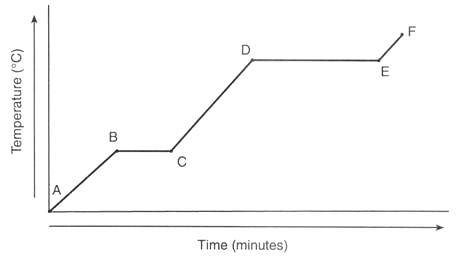
Describe the substance between letters C and D.
Gas
Liquid
Melting
Evaporating
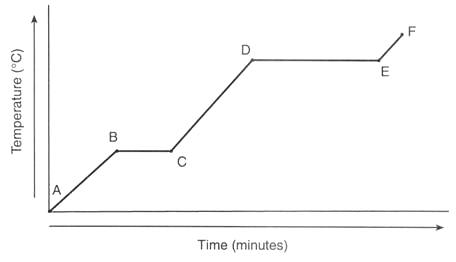
Between which points is the temperature of the substance remaining constant?
A-B only.
A-B, C-D, E-F
B-C only.
B-C, D-E
True or false: melting and freezing occur at the same temperature.
True
False

Describe what is happening between letters D and E.
Gas
Liquid
Melting
Evaporating

Describe the substance between letters E and F.
Gas
Liquid
Melting
Evaporating
How do you calculate Enthalpy of a reaction?
ΔH = ΔHproducts - ΔHreactants
ΔT = q / mC
ΔG = ΔH - TΔS
E = mc2
The SI unit of heat and energy is the ________.
calorie
heat
joule
watt
Temperature is a measure of average [blank] energy of individual atoms.
heat
potential
mechanical
kinetic
_?_ is the amount of energy required to raise the temperature of 1 gram of any substance 1oC.
Specific heat
A calorie
Thermal energy
Conduction
As 120 g of hot milk cools in a mug, it transfers 20,000 J of heat to the environment. What is the temperature change of the milk? The specific heat of milk is 2.6 J/g·°C. (Q=mcΔT)
64 °C
1.56 °C
640 °C
cannot be determined
How much heat does an aluminum block absorb if 10.00 grams are heated from 25.0oC to 50.0oC? The specific heat of aluminum is 0.900J/goC
450
-450
225
-225
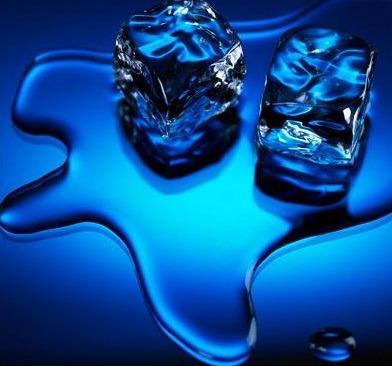
____ reactions usually feel cold.
endothermic
exothermic
During an endothermic reaction in a beaker if we are part of the surroundings and touched the beaker, it would feel _______.
Warm
Cold
76-80.
Answer the questions below after watching the video
What does molarity measure?
The weight of solute per liter of solution
The number of moles of solute per liter of solvent
The density of the solution
The volume of solvent per liter
How can the molarity of a solution be determined if the mass of the solute is known?
By measuring the density of the solution
By dividing the mass by the volume of the solvent
By multiplying the mass by the volume of the solution
By converting the mass to moles using molar mass and dividing by the solution volume
What is the effect of dilution on the concentration of a solution?
Changes the molar mass of the solute
Does not change the concentration
Decreases the concentration
Increases the concentration
How is the new concentration after dilution calculated?
By dividing the initial concentration by the final volume
By subtracting the final volume from the initial concentration
By multiplying the initial concentration by the initial volume and dividing by the final volume
By adding the initial and final volumes
What happens to the concentration of a solution if the volume is doubled?
It doubles
It remains the same
It quadruples
It is halved
What is the molarity of a 0.5L sample of a solution that contains 60.0 g of sodium hydroxide (NaOH)
0.8 M
1.5M
3.0M
6.0M
A student is preparing solutions for a laboratory experiment by dissolving solid solutes in liquid solvents. Which action will increase the rate of solubility
lowering the temperature of the solvent
stirring the solute in the solution
increasing the pressure on the solution
increasing the particle size of the solute
Which of the following substances is a heterogeneous substance?
baby oil
rocky road ice cream
salt water
milk
Which of the following substances is a homogeneous solution?
chocolate chip cookie
italian dressing
apple juice
orange juice
Which of the following is the correct formula for calculating molarity?
moles/liters of solution
moles/kg of solvent
# particles/Avogadro's #
theoretical yield/actual yield
Which of the following types of solutions has more room to dissolve solute?
supersaturated
saturated
unsaturated
When calculating molality, Kg of the following are included in the calculation?
solvent
solute
none of these
solvent & solute
To calculate molality you only need which of the following?
scale
flask
What is the molality of a solution in which 3.0 moles of NaCl is dissolved in 1.5 Kg of water?
2.0 M
0.22 m
135 m
2.0m
What is a solvent?
The substance that does the dissolving in a solution.
The substance that is being dissolved in a solution.
The mixing of different substances.
The process in which neutral molecules lose or gain electrons
The concentration of a mixture can be increased in which of the following ways?
Heating the mixture
Adding more water “solvent”
Adding more powder “solute”
Stirring the mixture
air is a
compound
element
heterogeneous mixture
solution
Another name for a homogeneous mixture is
an element.
a solution.
a compound.
If water is a polar molecule, then which of the following must be nonpolar
sugar
salt
oil
juice
Electrolytes
don't conduct electricity
conduct electricity
Which of the following will produce crystals if cooled or disturbed?
unsaturated solution
saturated solution
supersaturated solution
all of the above
Since "like dissolves like", water and oil will not mix because
both of them are polar
both of them are nonpolar
oil is polar and water is nonpolar
oil is nonpolar and water is polar
What is the molarity of a 2 liter solution containing 5 moles of NaCl?
5.0
0.4
2.5 moles/liter
10 moles/liter
How many liters would you need to get 0.5 moles if you had a 0.1M solution?
0.05 liters
0.2 liters
5 liters
2 liters
Molarity is ...
grams of solute/deciliters of solvent.
grams of solute/liters of solution.
moles of solute/liters of solution.
moles of solute/milliliters of solvent.
Which sweet tea would you expect to taste the sweetest?
1M
3M
3.1M
2.5M

PV=nRT
If volume goes down, pressure goes _____.
up
down

PV=nRT
If temperature goes up, pressure goes _____.
up
down
What assumption is NOT made about ideal gases?
The identity of the gas does not matter.
Particles are in constant motion.
Particles do not interact except during collisions.
Particles have significant volume.
What assumption is NOT made about ideal gases?
The identity of the gas does not matter.
Particles are in constant motion.
Particles do not interact except during collisions.
Particles have significant volume.
What variable describes the force exerted by a gas on its container?
Pressure
Temperature
Volume
Moles
According to Boyle's Law, what happens if the volume of a gas is decreased?
Pressure decreases
Temperature decreases
Temperature increases
Pressure increases
What variable describes the force exerted by a gas on its container?
Pressure
Temperature
Volume
Moles
What is directly proportional to volume according to Charles's Law?
Pressure
Temperature
Moles
Mass
PV = nRT
If the temperature goes up, volume must go ____.
up
down
What must be constant when applying Charles's Law?
Mass
Moles
Pressure
Volume
According to Boyle's Law, what happens if the volume of a gas is decreased?
Pressure decreases
Temperature decreases
Temperature increases
Pressure increases
What is the value of zero degrees Kelvin known as?
Boiling point
Freezing point
Absolute zero
Room temperature

PV=nRT
If the number of moles (n) goes up, temperature must go ____.
up
down
What does Avogadro's law state about equal volumes of gases?
They have the same temperature.
They exert the same force.
They contain the same number of molecules.
They have the same pressure.
What is directly proportional to volume according to Charles's Law?
Pressure
Temperature
Moles
Mass
What does the ideal gas law allow you to calculate?
The pressure of a gas at any volume
The number of moles of gas given pressure, volume, and temperature
The temperature of a gas at any pressure
The volume of a gas at any temperature
What must be constant when applying Charles's Law?
Mass
Moles
Pressure
Volume
What is the value of zero degrees Kelvin known as?
Boiling point
Freezing point
Absolute zero
Room temperature
What does Avogadro's law state about equal volumes of gases?
They have the same temperature.
They exert the same force.
They contain the same number of molecules.
They have the same pressure.
What does the ideal gas law allow you to calculate?
The pressure of a gas at any volume
The number of moles of gas given pressure, volume, and temperature
The temperature of a gas at any pressure
The volume of a gas at any temperature

If the pressure in a balloon remains constant what happens to the balloon's volume as the temperature of the air increases?
the volume decreases and the balloon shrivels up or shrinks
the volume increases and the balloon expands
the volume stays the same and the balloon stays the same size

Each of the flasks shown above have different volumes (they are different sizes) but the temperature of each flask is the same. In which flask will the pressure be the highest?
Flask 1
Flask 2
Flask 3
Flask 4
Which equation would you use to solve the following problem:
"The volume of of 300 mL of gas at 1 atm is decreased to 100 mL. What is the new pressure?"
P1V1 = P2V2
V1/T1 = V2/T2
(P1V1)/T1 = (P2V2)/T2
None of the above
Which equation would you use to solve the following problem:
"A gas occupies 2 L of space at 0 C. What will its volume be at 100 C?"
P1V1 = P2V2
V1/T1 = V2/T2
(P1V1)/T1 = (P2V2)/T2
None of the above
A tank of helium is full with a pressure of 4.5 atm at 298K. What is the temperature of the tank when the pressure drops to 2 atm?
670.5K
0.007K
132.4K
2682K
1.70 atm, a sample of gas takes up 4.25L. If the pressure in the gas is increased to 2.40 atm, what will the new volume be?
0.167 L
6.00 L
3.01 L
0.332 L
Which of the following is an assumption of the kinetic-molecular theory of gases?
Collisions between gas particles are inelastic.
Gases consist of closely spaced particles.
Gas particles move around in an orderly manner.
The temperature of a gas depends on the average kinetic energy of the gas particles.
A student sprays perfume in the back of the classroom, eventually a student in the front of the class can smell the perfume. This is an example of....
Effusion
Diffusion
Osmosis
Thermal Expansion
A container with a volume if 1.0 L is occupied by a gas at a pressure of 1.5 atm at 25°C. By changing the volume, the pressure of the gas increases to 6.0 atm as the temp is raised to 100.°C. What’s the new volume?
1.45 L
5.4 L
0. 31 L
504.7 L
The pressure in an automobile tire is 2.3 atm at 27°C. At the end of a journey on a hot, sunny day the pressure has risen to 2.6 atm. What is the temp of the air in the time assuming the volume has not changed?
60 K
650 K
273 C
339 K
What is the molar mass of Cl2?
17 g/mol
35.5 g/mo;
71.0 g/mol
89 g/mol
In a chemical reaction, the mass of reactants ___.
is less than the mass of products
is greater than the mass of products
has no relationship to the mass of products
is equal to the mass of products
What is the molar mass of C6H12O6?
180.15
180.36
180.00
180.06

This recipe makes 3 dozen cookies. How many eggs are needed to make 3 dozen cookies?
2 eggs
1 teaspoon vanilla extract
1 cup butter
2 cups semisweet chocolate chips
1 cup packed brown sugar
How much butter is needed for 2 cups of chocolate chips?
2 eggs
1 teaspoon vanilla extract
1 cup butter
2 cups semisweet chocolate chips
1 cup packed brown sugar
How many eggs would we need to make 9 dozen cookies? (This recipie makes 3 dozen)
6 eggs
5 eggs
4 eggs
2 eggs
1 egg
How much brown sugar would I need if I had ½ cup white sugar?
2 eggs
1 teaspoon vanilla extract
1 cup butter
2 cups semisweet chocolate chips
1 cup packed brown sugar
Given the reaction: 4Al + 3O2 --> 2Al2O3
How many moles of Aluminum oxide do you have if you have 2 moles of Al?
3 mole
2 mole
1 mole
0.5 mole
In the equation 2 Al2O3 --> 4 Al + 3 O2, what is the mole ratio of aluminum to oxygen?
10:6
3:4
4:3
2:3
N2 + 3H2 → 2NH3
What is the mole ratio between Nitrogen and Ammonium in the above reaction?
1 moles NH3 / 2 moles N2
2 moles NH3 / 1 moles N2
2 moles N2 / 3 moles NH3
1 moles N2 / 3 moles NH3
What is the Ratio of moles of Mg to moles Fe?

How many moles are in 32 grams of Oxygen (O)?
3
2
1
4
4NH3 + 5O2-->4NO + 6H2O
What is the total number of moles of H2O produced when 12 mole of NH3 is completely consumed?
15
18
20
24
Using the following equation:
Fe2O3(s) + 3H2(g) → 2Fe(s) + 3H2O(l)
How many moles of iron (Fe) can be made from 6 moles H2?
4 moles Fe
6 moles Fe
9 moles Fe
2 moles Fe
All alkali metals react with water to produce hydrogen gas and the corresponding alkaline metal hydroxide. A typical reaction is that between lithium and water :
2Li(s) + 2H2O(l) →2LiOH(aq) + H2(g)
Calculate the mass of H2 gas formed when 40.0 g of Li react with water
4.21 g
7.31 g
5.80 g
4.42 g
What is the empirical formula for C4H6?
CH
CH3
C2H3
C4H6
What is the empirical formula for N2S3?
NS
N3S2
N2S3
N1S1.5
Si2F6
Choose the correct empirical formula...
SiF
Si2F6
SiF3
Si6F2
C2F6
Choose the correct empirical formula...
CF
C2F6
C6F2
CF3

C2H6O
Which is the correct empirical formula
CHO
C2H6O
C4H14O2
None
How many "C" are in CO2
2
1
0
3
How many Carbons "C" are in C18H34O3
18
34
3
37
Which molecular formula only has 12 hydrogens "H"?
C4H10 (butane)
C5H12 (pentane)
C12H22O11 (sugar)
C8H10N4O2 (caffeine)

