
 Worksheets
Alg 1 Cumulative Review
Total questions: 210
Worksheet time: 16hrs 58mins
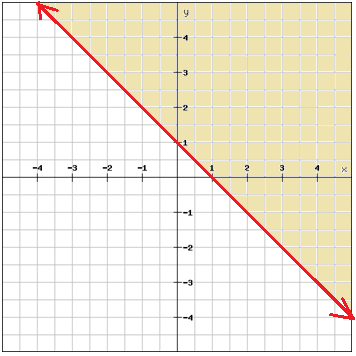
Is this graph shaded above or below?
above
below
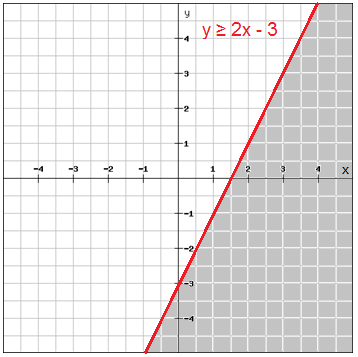
Is this graph shaded above or below?
above
below
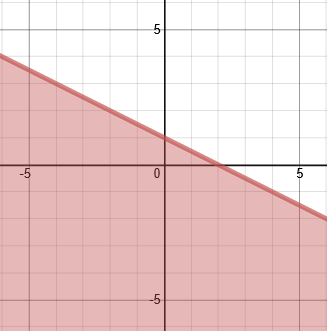
2x - 3y ≥ 12

Which inequality describes this graph...
y < 3x - 2
y > 3x + 2
y < 3x + 2
y > 3x -2

This is a graph of which inequality?
y > 4x - 2
y > -2x + 4
y < -2x
y < 4X - 2

According to the graph, which point is a solution? Choose all that apply.
(0, 0)
(4, 2)
(-1, -5)
(-3, 0)

Is the point (3, 1) a solution for the following inequality? Choose the best answer that has the best explanation.
Yes because it is located in the shaded region.
No because it is located on the line and the line is dotted.
Yes because it is located on the line.
No because it is in the shaded region.
Which inequality below is equivalent to
3x - y > 4
y > 3x - 4
y < -3x + 4
y < 3x - 4
y > -3x + 4
Which of the following is the graph of
3x - 2y < 10


When graphing y<53x−4 , you will draw which of the following.
A dotted line
A solid line
Shade up
Shade down
When graphing y≥−72x+1 , you will draw which of the following.
A dotted line
A solid line
Shade up
Shade down


The solution set for a linear inequality was graphed as shown. Which of the following linear inequalities best represents this solution set?
y > 3
y < 3
y > 3x
y < -3x
y > 3

Randy must graph x + 3y > 6. Part of his effort is shown in the graph. Which of the following is true about Randy's work so far?
All is great so far. He just needs to do the shading part.
He has the incorrect y-intercept indicated since it should be at (0, 6).
His "rise over run" technique is incorrect since it is reversed.



Solve: -3 ≤ 2x - 1 ≤ 5
-1 ≤ x ≤ 3
-2 ≤ x ≤ 6
-3 ≤ x ≤ 3
1 ≤ x ≤ 3
Solve:
3x + 2 < -7 or -4x + 5 < 1
All real numbers
x < -3 and x > 1
x < -3 or x < 1
x < -3 or x > 1
Give the solution set for: -13<2x+5<15
-9>x>5
-9<x<5
-4<x<5
-4>x>5


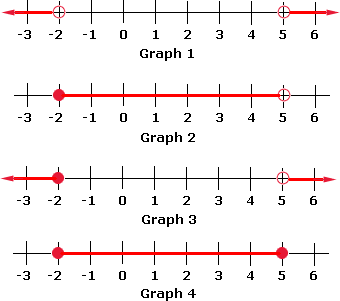

Give the solution set for: -13<2x+5<15
-9>x>5
-9<x<5
-4<x<5
-4>x>5
Solve and give the final solution set:
-4x + 1 ≤ 21 and 5x + 2 < 22
All real numbers
x ≥ -5 or x < 4
No Solution
x ≥ -5 and x < 4

6 > x
Solve and give the final solution set:
-4x + 1 ≤ 21 and 5x + 2 < 22
All real numbers
x ≥ -5 or x < 4
No Solution
x ≥ -5 and x < 4
Give the final solution set for:
2x + 1 > 9 or x - 4 < 6
No solution
4 < x < 10
x > 4 or x < 10
All real numbers
6x+10>5x-12
Which inequality symbol has a graph with an open (empty) circle?
<
≤
-2x ≥ 22


What inequality does the number line graph represent?
x ≤ 4
x ≥ -4
x < -4
x < 4

77 ≤ 5 + 8n


Solve the system of equations.
(10, 3)
(6, 3)
(15, 3)
No solution
Infinite Solution

Solve the system of equations.
(-23, 4)
(-4, -3)
(-2, -4)
No solution
Infinite solutions
Solve the following systems of equations using substitution:
x = 6
y = 2x - 3
(6, 6)
(6, 9)
(9, 6)
(9, 9)
h + 17 = 40
-23
23
57
-57
Use mental math to solve.
6x = 48
x = 6
x = 7
x = 8
x = 48
11p = 121
What is the inverse operation of addition?
Addition
subrtaction
multiplication
division
What is the inverse of multiplication?
Addition
Subtraction
Multiplication
Division
3(x - 2) = 18
-3h=27
(a)

Determine whether point A is a solution to the linear inequality that is shown.
Yes
No
Sometimes
Determine whether point (-2,-3) is a solution to the linear inequality that is shown.
Yes
No
Sometimes
Is the point (3, 1) a solution for the following inequality? Choose the best answer that has the best explanation.
Yes because it is located in the shaded region.
No because it is located on the line and the line is dotted.
Yes because it is located on the line.
No because it is in the shaded region.
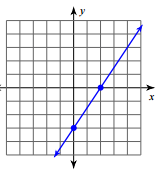
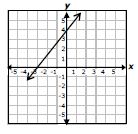

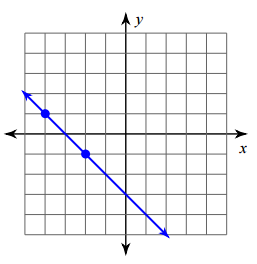


Slope-Intercept Form?
(y = mx +b)

Slope-Intercept Form?
(y = mx +b)

Slope-Intercept Form?
(y = mx +b)

Slope-Intercept Form?
(y = mx +b)
y = -3x + 7


8 : 9 = 24 : 18
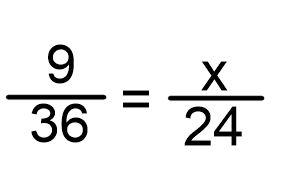


Solve for y:
5x + y = 16
y = -5x + 16
y = 5x + 16
y = 5y - 16
y = -5x - 16
Solve m - n = 5 for m.
m = n + 5
m = n - 5
m = 5n
m = 5 - n
Solve -2 = 4r + s for s.
s = -4r + 2
s = 4r - 2
s = -4r - 2
s = 4r + 2
Solve IR = V for R.
R = IV
R = I/V
R = V/I
R = V - I
Solve:
y = mx + b , for b
b = y - mx
b = y + mx
b = mx - y
b = -y - mx
Solve:
a - b + c = 9 , for a
a = b - c + 9
a = b + c - 9
a = b + c + 9
a = b - c - 9
Solve for x.
z = xy
x = z/y
x = y/z
x = yz
x = z - y
a = b + c , for c
c = a - b
c = a + b
c = ab
c = a/b
Solve I = prt for r.
r = I/pt
r = pt/I
r = I - pt
r = pt - I
To plot a point, start at the ___.
x axis
y axis
origin
To plot a point, start at the origin. Move right and then ____.
left
down
up
To plot (9,1): Start at the origin and move 9 units right and then 1 unit ___.
up
down
origin

W (1, 5)
W (1, 4)
W ( 5, 1)
Z (4, 1)
Z (4, 2)
Z (2 , 4)
Y (4, 2)
Y (4, 1)
Y (1, 4)
X (4, 2)
X (2, 4)
X (3, 2)

E (0, 0)
E (1, 0)
E (0, 1)
B (2, 2)
B (0, 2)
B (2, 0)
Which point is at the origin?
B
E
D
Is there a point at (5,1)?
yes
no
Is there a point at (1,5)?
yes
no
Is there a point at (3,3)?
yes
no
Is there a point at (0,5)?
yes
no
D (2, 2)
D (0, 2)
D (2, 0)
X (2, 2)
X (4, 2)
X (4,1)
The origin is ___
(0,0)
(0,1)
(1,1)

Which list of numbers completes the table?
41,46
42,46
42,45
44,48

The table represents the equation k=j-20.
Use the equation to find the value of the unknown.
34
27
41
38

The table represents the equation q= r + 15. Use the equation to find the value of the unknown.
26
40
47
27

Which list of numbers completes the table?
y=6x48, 60
63, 70
60, 66
54, 60

y=x-6
What is the missing number?
12
10
14
13
If my function rule is 4x, what is the OUTPUT if the input is 5?
45
54
9
20
If my function rule is 2x + 1, what is the OUTPUT if the input is 2?
5
4
22
23
If my function rule is x + 8, what is my INPUT if the output is 20?
10
12
8
28

Find the missing OUTPUT value.
8
-2
2
-8

Find the missing OUTPUT value.
-2
3
9
-7
If my function rule is x - 5, what is the OUTPUT if the input is 14?
9
19
21
1
If my function rule is 5x, what is my INPUT if the output is 10?
1
50
2
15
If my function rule is x - 4, what is my INPUT if the output is 7?
11
10
3
7

Find the missing OUTPUT value.
-19
17
19
17


√36
4√28
√100
√36X
√150X
√49x2
-4√200
-4√48x4
√27x2y2
√27xy
√180x
√25x4
√144x3
4√216
√63
(2x2 + 5x - 7) + ( 3 - 4x2 + 6x)
(3- 2x + 2x2) - (4x -5 +3x2)
-3x2( 7x2 - x + 4)
(x + 7)2
(b+3)(b2+2b+1)
(6x + 4x4 - 3x2) + (7x4 + 5x2 + 8x)
-8 (5b + 2) -7 (b - 5)
(4x+1)(5x−2)

Simplify.
10x9
24x14
24x9
10x14
Simplify.
(2x3y)6
2x18y6
64x18y6
64x3y6
2x3y6

Simplify.
-9a3
-9a6
-24a6
30a6

Simplify.
3h1.25
3h80
12h2
3h2

Simplify.
-5x4y3
5x4y3
5x10y7
-5x10y7
x ×x=
2x
x2
x +x=
2x
x2
Which expression is equivalent to
x2 ⋅ x5 ?
x10
x3
x7
1/33
(x + 7)2
-8 (5b + 2) -7 (b - 5)


Find f(2).
f(2)=0
f(2)=1
f(2)=3
f(2)=4


Given the graph of f(x), evaluate f(2).
undefined
-1
5
2

Given the graph of g(x), find g(-6).
(a)

Find f(0)
f(0)=−2
f(0) = 0
f(0) = 2
f(0) = 4
f(x) = x+7 find f(1)
5
6
7
8
f(x) = x+7 find f(4)
11
12
9
10
f(x) = x-5 find f(9)
4
14
9
13
f(x) = x-5 find f(8)
5
3
9
13
f(x) = x-5 find f(0)
4
-5
5
-4
f(x) = x-5 find f(-2)
-7
3
7
-3
f(x) = x-9 find f(-1)
-10
8
-8
10
f(x) = x-9 find f(4)
-13
5
-5
13
f(x) = x-2 find f(4)
-2
6
2
4
f(x) = x+8 find f(-4)
-2
6
2
4
g(x) = 5x-7
Find f(x)+g(x).
All of the y values or outputs are called what?

