
 Worksheets
NET+ Quiz Part 4
Total questions: 79
Worksheet time: 40mins
As a network administrator, you are called in to troubleshoot a problem on a token ring network. The network uses two MSAUs connected using the ring-in ports on both devices. All network cards are set at the same speed. What is the likely cause of the problem?
Bad network card
Faulty cabling
MSAU configuration
Network card configuration
A mesh network uses a point-to-point connection to every device on the network. What does this configuration create?
Single point of failure
High degree of redundancy
Centralized control
Minimal wiring requirements
In a star/hub-and-spoke network, what is the role of the centralized device?
To connect directly to the internet
To act as a backup server
To make a point-to-point connection to each network device
To provide power to the network devices
What is a significant shortcoming of a bus network?
High cost of implementation
Single point of failure
Complex configuration
Requires a centralized device
In a bus network, what does a single cable act as?
A power supply
A backup server
A backbone to which all networking devices attach
A firewall
True or false: The biggest difference between a LAN and a WAN is usually the size of the network.
True
False
What network type is essentially a LAN created to share data among devices associated with you?
WAN
PAN
SAN
MAN
In what networking type is consolidated, block-level data storage made available to networked devices?
LAN
WAN
PAN
SAN
What are the two most common network classifications based on geographic coverage and size?
LANs and MANs
LANs and WANs
PANs and SANs
MANs and WANs
What is the main difference between a peer-to-peer network and a client/server network?
The number of devices
The geographic location
The presence of a dedicated server
The type of data shared
What type of network does not have dedicated servers and where communication occurs between similarly capable network nodes that act as both clients and servers?
Client/server network
Peer-to-peer network
Local-area network
Wide-area network
What is a local-area network (LAN) typically used for?
Connecting computers over a large geographic area
Interconnecting workstation computers for sharing files and resources
Providing internet access to remote locations
Connecting multiple networks together
Which of the following is a characteristic of a LAN?
It covers a large geographic area
It is typically high speed and cheaper to set up than a WAN
It relies on wireless transmissions
It is dependent on a hotspot
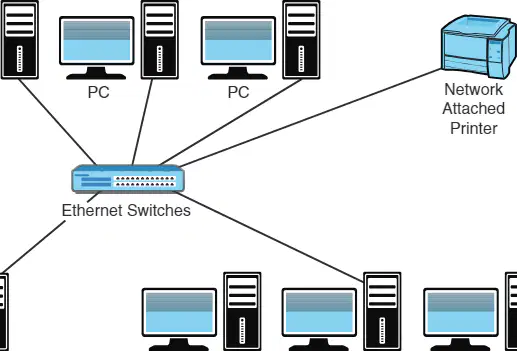
What does Figure 1.9 in the document show?
A wide-area network
A peer-to-peer network
A local-area network
A client/server network
What does a wireless LAN (WLAN) use to send and receive data?
Ethernet cables
Fiber optics
Radio frequency (RF) signals
Satellite signals
Where can a WLAN hotspot be typically found?
In a private home
In a public place like a coffee shop or train station
In a corporate office
In a data center
In a common wireless implementation, what is the role of a wireless transceiver (transmitter/receiver)?
To connect to the wired network from a fixed location using standard cabling.
To provide internet access to mobile devices.
To act as a firewall for the network.
To encrypt data for secure transmission.
What do wireless LAN adapters provide in a wireless network?
They act as a firewall.
They provide the communication point between the client system and the airwaves via an antenna.
They encrypt data for secure transmission.
They manage the IP addresses of the network.
What is a wide-area network (WAN)?
A network that spans a single building.
A network that spans more than one geographic location, often connecting separated LANs.
A network that only connects mobile devices.
A network that is faster than LANs.
What is a characteristic of WANs compared to LANs?
WANs are faster than LANs.
WANs are slower than LANs.
WANs are less expensive to implement than LANs.
WANs do not require any additional hardware.
What is a metropolitan-area network (MAN)?
A network that spans multiple countries.
A network confined to a certain geographic area, such as a university campus or city.
A network that only connects personal devices.
A network that is faster than WANs.
What does the acronym MAN stand for in networking?
Metropolitan Area Network
Main Area Network
Multiple Area Network
Mobile Area Network
Which type of network is typically smaller than a WAN but larger than a LAN?
MAN
GAN
SAN
PAN
What is a campus-area network (CAN) primarily used for?
Linking buildings within a limited geographical area
Connecting personal devices
Providing block-level data storage
Connecting devices in close proximity
What does SAN stand for in networking?
Storage-Area Network
System-Area Network
Service-Area Network
Secure-Area Network
Which type of network offers block-level data storage within the operating systems of connected devices?
SAN
CAN
PAN
MAN
What is a personal-area network (PAN) primarily used for?
Sharing data among devices associated with an individual
Connecting multiple LANs within a campus
Providing file-level access
Linking buildings within a limited geographical area
What does WPAN stand for?
Wireless Personal-Area Network
Wide Personal-Area Network
Wireless Public-Area Network
Wide Public-Area Network
Which technology is commonly used in WPAN for close proximity data exchange?
Bluetooth
Ethernet
Fiber Optics
Satellite
What does SDWAN stand for?
Software-Defined Wide Area Network
Software-Driven Wide Area Network
System-Defined Wide Area Network
Service-Defined Wide Area Network
Which technology is SDWAN an extension of?
Software-Defined Networking (SDN)
Multiprotocol Label Switching (MPLS)
Frame Relay
Asynchronous Transfer Mode (ATM)
What is one of the main benefits of SDWAN?
Reduces operational costs
Increases hardware requirements
Limits scalability
Requires more manual configuration
What technology did SDWAN evolve from?
MPLS
ATM
DSL
E1
What is the goal of Software-Defined Networking (SDN)?
To add dynamic capabilities to the network and reduce IT costs
To increase the complexity of network management
To maintain static network configurations
To eliminate the need for cloud architectures
What does MPLS stand for?
Multiprotocol Label Switching
Multilayer Packet Switching
Multipath Label System
Multichannel Packet Switching
What is the primary function of MPLS?
To use short path labels to direct data from one node to another
To increase the number of network addresses
To replace all existing network technologies
To limit the use of virtual links
When a WAN is confined to a certain geographic area, such as a city, it is known as a
LAN
MAN
VAN
VPN
Which of the following is a computer network in a defined area that links buildings and consists of multiple LANs within that limited geographical area?
SAN
PAN
DAN
CAN
What is the primary goal of using SDWANs with MPLS technology?
To increase the cost of connectivity
To eliminate or minimize the usage of MPLS
To reduce the speed of connectivity
To complicate network management
What does mGRE stand for?
Multipoint Generic Routing Encapsulation
Multipoint General Routing Encapsulation
Multipoint Generic Routing Encryption
Multipoint General Routing Encryption
What is one of the main advantages of mGRE over GRE?
mGRE is more expensive
mGRE requires explicit configuration of mapping entries
mGRE can dynamically establish tunnels without explicit configuration
mGRE is slower than GRE
Which of the following provides a flexible and secure data communications system that augments an Ethernet LAN or, in some cases, replaces it altogether?
PHLAN
MAN
WLAN
CRAN
Which technology uses short path labels instead of longer network addresses to direct data from one node to another?
MPLS
Metropolitan Ethernet
DMVPN
PPP
Which WAN architecture allows an enterprise to leverage a combination of transport services such as MPLS, 5G, LTE, or broadband to securely connect users to applications?
WPAN
SDWAN
GRE
mGRE
What is the main concept behind SDWAN?
To provide a secure private path for packets through a public network.
To take many of the principles that make cloud computing attractive and make them accessible at the WAN level.
To connect devices in very close proximity using Bluetooth, infrared, or NFC.
To establish tunnels without the need to explicitly configure mapping entries.
What does WPAN refer to?
Technologies involved in connecting devices over long distances.
Technologies involved in connecting devices in very close proximity.
A secure private path for packets through a public network.
A virtual WAN architecture leveraging a combination of transport services.
What does GRE provide?
A virtual WAN architecture leveraging a combination of transport services.
Technologies involved in connecting devices in very close proximity.
A secure private path for packets through a public network.
The ability to dynamically establish tunnels without the need to explicitly configure mapping entries.
What is the function of mGRE?
To provide a secure private path for packets through a public network.
To connect devices in very close proximity using Bluetooth, infrared, or NFC.
To dynamically establish tunnels without the need to explicitly configure mapping entries.
To adopt a virtual WAN architecture leveraging a combination of transport services.
What is VHDSL commonly used for?
Low-bandwidth applications
High-bandwidth applications such as VoIP and HDTV
Dial-up internet connections
Basic email services
True or false: DSL using regular phone lines transfers data over the same copper wire.
True
False
What is the difference between a one-way and a two-way satellite system?
One-way uses a satellite card and dish, two-way uses only a dish
One-way sends data both ways, two-way sends data one way
One-way requires a satellite card and dish, two-way provides data paths for both upstream and downstream data
One-way is faster than two-way
What hardware is located at the demarcation point?
Router
Modem
Smart jack, also known as the network interface device (NID)
Switch
What does DSL stand for in the context of Internet access?
Digital Subscriber Line
Direct Service Line
Data Service Link
Digital Service Line
Which type of DSL provides a high data rate in only one direction?
ADSL
HDSL
SDSL
VDSL
What is the main characteristic of Asymmetric DSL (ADSL)?
Faster download speeds than upload speeds
Equal upload and download speeds
Only used for business applications
Requires fiber optic cables
Which type of DSL is most suitable for applications such as web hosting, intranets, and e-commerce?
SDSL
ADSL
HDSL
VDSL
What improvement did ADSL2 make over ADSL?
Increased data rate and distance from the telephone exchange
Equal upload and download speeds
Only used for analog traffic
Requires a dedicated phone line
Which type of DSL is symmetric and commonly used in environments where SDSL and ADSL are unavailable?
RADSL
VDSL
IDSL
HDSL
Which type of DSL can modify its transmission speeds based on signal quality?
IDSL
RADSL
VDSL
HDSL
Which type of DSL supports high-bandwidth applications such as VoIP and HDTV and uses fiber-optic cabling?
IDSL
RADSL
VDSL
HDSL
Which type of DSL offers identical transmission rates in both directions and does not allow line sharing with analog phones?
IDSL
RADSL
VDSL
HDSL
What is the upload speed of ADSL2+?
(a)
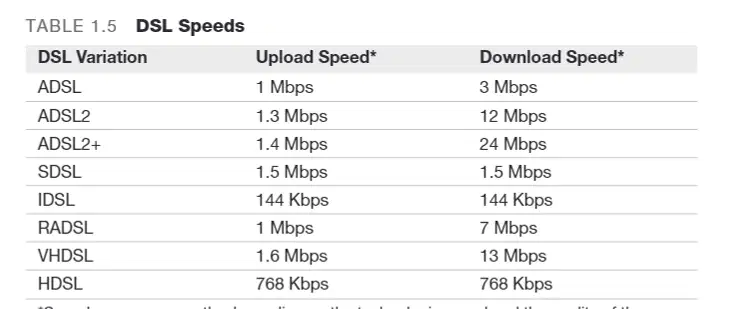
Which DSL variation has the highest download speed according to Table 1.5?
ADSL
ADSL2
ADSL2+
VDSL
What does ADSL stand for?
Asymmetric Digital Subscriber Line
Advanced Digital Subscriber Line
Asynchronous Digital Subscriber Line
Analog Digital Subscriber Line
Why are DSL filters used in DSL connections?
To increase the speed of the connection
To minimize interference between data and voice signals
To convert analog signals to digital
To amplify the signal strength
What is a cable modem used for in cable broadband Internet access?
To convert digital signals to analog
To connect to the provider's outlet and a system or router
To amplify the signal strength
To filter out noise from the signal
What type of connection does a cable modem use to connect to a system or router?
Coaxial cable
Fiber optic cable
Unshielded twisted-pair (UTP) connection
Wireless connection
What is a common feature of cable modems regarding Ethernet connections?
They support a lower-speed Ethernet connection
They support a higher-speed Ethernet connection
They do not support Ethernet connections
They only support wireless connections
What is one of the biggest disadvantages of cable access?
It is very expensive.
It requires special equipment.
You share the available bandwidth with everyone else in your cable area.
It is only available in urban areas.
During which times is the performance of a cable link typically poorer?
Early mornings
Peak times such as evenings and weekends
Midday
Late nights
What type of bandwidth does DSL deliver?
Shared bandwidth
Local bandwidth
Global bandwidth
Dedicated local bandwidth
What is the Public Switched Telephone Network (PSTN) often considered?
ADSL
POTS
ISDN
DSL
What is a significant drawback of using the PSTN to establish WAN connections?
High cost
Limited transfer speeds
Complex setup
Limited availability
What is the transfer speed limit of PSTN with a modem?
128 Kbps
256 Kbps
56 Kbps
512 Kbps
What is the transmission speed of a T1 line?
1.544 Mbps
6.312 Mbps
44.736 Mbps
274.176 Mbps
Which T-carrier line uses 96 64-Kbps B channels to achieve its transmission speed?
T1
T2
T3
T4
In North America, what is the more accurate name for T3?
DS1
DS2
DS3
DS4
Which T-carrier line offers the highest transmission speed?
T1
T2
T3
T4
What is the term used for leasing portions of a T-carrier service?
Partial T
Fractional T
Segmental T
Divided T

