
 Worksheets
Chemistry Study Guide
Total questions: 84
Worksheet time: 4hrs 0mins
Draw a model of an atom. Label the following in the model: nucleus, electron levels, protons, neutrons, electrons. Be sure to include the charges of the subatomic particles.
Explain the conditions of a neutral atom in terms of protons and electrons.
Explain the conditions of a positive ion and a negative ion in terms of protons and electrons.
A positive ion has more protons than electrons, and a negative ion has more electrons than protons.
A positive ion has more electrons than protons, and a negative ion has more protons than electrons.
Both positive and negative ions have equal numbers of protons and electrons.
A positive ion has more neutrons than protons, and a negative ion has more protons than neutrons.
Which of the following lists the steps for naming an ionic compound?
Identify the cation and anion, name the cation first, then the anion.
Identify the anion and cation, name the anion first, then the cation.
Name the elements in alphabetical order.
Name the elements in reverse alphabetical order.
What is the first step for writing an ionic formula?
Identify the cation and its charge
Identify the anion and its charge
Balance the charges
Write the formula
Which of the following lists the characteristics of an ionic compound?
High melting and boiling points, conducts electricity when molten or dissolved in water
Low melting and boiling points, does not conduct electricity
Soft and malleable, conducts electricity in solid state
Low density, does not conduct electricity in any state
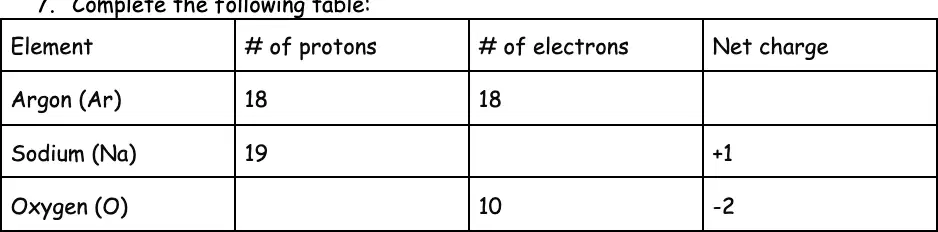
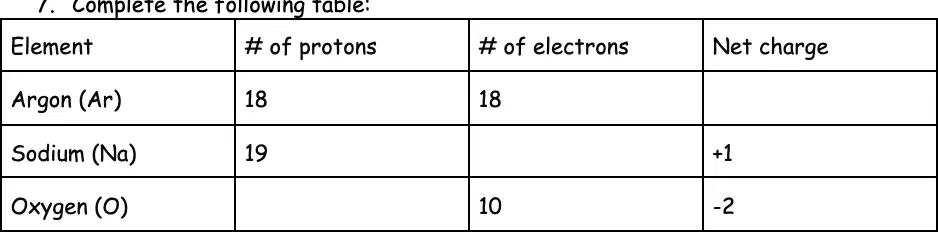
Complete the following table:
18
18
0
Which of the following is the correct formula for potassium bromide?
KBr
BeCl2
Al2O3
NaCl
What is the name for KBr?
Potassium Bromide
Calcium Fluoride
Aluminum Sulfide
Sodium Chloride
What number on the periodic table describes the number of protons for an atom?
Atomic number
Mass number
Isotopic number
Neutron number
The periodic table indicates the number of valence electrons for an atom by:
The group number
The period number
The atomic number
The atomic mass
The periodic table indicates the number of energy levels of an atom by:
The period number
The group number
The atomic number
The atomic mass
Describe the trends for atomic size:
Atomic size increases across a period and decreases down a group.
Atomic size decreases across a period and increases down a group.
Atomic size remains constant across a period and increases down a group.
Atomic size increases across a period and remains constant down a group.
Electronegativity generally increases across a period from left to right and decreases down a group. Which of the following elements has the highest electronegativity?
Fluorine
Oxygen
Nitrogen
Chlorine
Which of the following summarizes the steps for drawing a Lewis Structure?
Count the total number of valence electrons.
Draw the skeletal structure of the molecule.
Place electrons around the outer atoms to satisfy the octet rule.
Place any remaining electrons on the central atom.
Which of the following lists the steps for naming a covalent compound?
Identify the elements, use prefixes to denote the number of atoms, and end with -ide.
Identify the elements, use suffixes to denote the number of atoms, and end with -ate.
Identify the elements, use prefixes to denote the number of atoms, and end with -ate.
Identify the elements, use suffixes to denote the number of atoms, and end with -ide.
Which of the following lists the steps for writing a covalent formula?
Identify the elements involved and their valence electrons, then combine them to form a stable molecule.
Identify the elements involved and their atomic numbers, then combine them to form a stable molecule.
Identify the elements involved and their isotopes, then combine them to form a stable molecule.
Identify the elements involved and their atomic masses, then combine them to form a stable molecule.
Which of the following is a characteristic of a covalent compound?
High melting and boiling points
Conducts electricity in molten state
Formed by sharing of electrons
Soluble in water
Which of the following lists the steps for naming an ionic compound containing a polyatomic ion?
Identify the cation and the anion, name the cation first, then the anion.
Identify the anion and the cation, name the anion first, then the cation.
Identify the cation and the anion, name the anion first, then the cation.
Identify the anion and the cation, name the cation first, then the anion.
List the steps for writing an ionic compound containing a polyatomic ion:
How many protons does an atom of bromine have?
35
45
55
65
Answer the following questions about Magnesium: a. How many electrons does an atom of magnesium have? ___________ b. How many valence electrons does it have? ___________ c. Is it a metal, nonmetal, or metalloid? ___________ d. What elements are similar to magnesium? ___________
What is the charge on simple ions formed from atoms in group 1?
+1
+2
-1
0
What is the name for the covalent compound N₂O₄?
Nitrogen dioxide
Dinitrogen tetroxide
Nitrogen tetroxide
Dinitrogen dioxide
Write the formula for the covalent compounds:
Name the following ionic compound containing polyatomic ions:
Sodium nitrate
Calcium carbonate
Ammonium sulfate
Potassium permanganate
What is the formula for the ionic compound containing the polyatomic ion sulfate and sodium?
Na2SO4
NaSO4
Na2S
NaSO3
Write the Electron configuration (1s²2s²2p⁶ etc) for Boron, B:
1s²2s²2p¹
1s²2s²2p²
1s²2s²2p³
1s²2s²2p⁴
What is the Noble gas configuration for Calcium, C?
[Ar] 4s2
[Ne] 3s2 3p6 4s2
[He] 2s2 2p6 3s2 3p6 4s2
[Kr] 5s2 4d10 5p6
Balance and classify the following chemical equations: a. ___Ag₂O → ___ Ag + ___O₂
Balance and classify the following chemical equations: b. ___Al + ___Fe₂O₃ → ___Fe + ___Al₂O₃
Balance and classify the following chemical equations: c. ___PbCl₂ + ___Li₂SO₄ → ___LiCl + ___PbSO₄
Balance and classify the following chemical equations: d. ___H₂ + ___O₂ → ___H₂O
Which of the following is the correct Lewis structure for H₂O?
H-O-H
H=O-H
H-O=H
H=O=H
Which of the following lists the rules for the naming of acids?
The name of the acid is based on the anion it forms when dissolved in water.
Acids are named based on the number of hydrogen atoms they contain.
The name of the acid is derived from the base it neutralizes.
Acids are named after the scientist who discovered them.
Describe an unsaturated solution and where the point on a solubility graph would be in relation to the curve.
An unsaturated solution contains less solute than it can dissolve at a given temperature, and the point would be below the curve.
An unsaturated solution contains more solute than it can dissolve at a given temperature, and the point would be above the curve.
An unsaturated solution contains the maximum amount of solute it can dissolve at a given temperature, and the point would be on the curve.
An unsaturated solution contains no solute, and the point would be on the x-axis.
Describe a saturated solution and where the point on a solubility graph would be in relation to the curve.
A solution that contains the maximum amount of solute that can dissolve at a given temperature; the point would be on the curve.
A solution that contains less solute than can dissolve at a given temperature; the point would be below the curve.
A solution that contains more solute than can dissolve at a given temperature; the point would be above the curve.
A solution that contains no solute; the point would be on the x-axis.
Describe a supersaturated solution and where the point on a solubility graph would be in relation to the curve.
Which of the following lists everything we learned about the properties of acids?
Acids have a sour taste, turn blue litmus paper red, and react with metals to produce hydrogen gas.
Acids have a bitter taste, turn red litmus paper blue, and do not react with metals.
Acids are slippery to touch, have a sweet taste, and do not change the color of litmus paper.
Acids are odorless, have a salty taste, and react with bases to form water and salt.
Which of the following lists everything we learned about the properties of bases:
Bases are bitter, slippery, and turn red litmus paper blue.
Bases are sweet, sticky, and turn blue litmus paper red.
Bases are sour, rough, and have no effect on litmus paper.
Bases are salty, smooth, and turn red litmus paper green.
Describe a neutralization reaction.
A reaction between an acid and a base to form water and a salt
A reaction between two acids
A reaction between two bases
A reaction that produces only water
What is the formula for Molarity?
M = moles of solute / liters of solution
M = mass of solute / volume of solvent
M = moles of solute / mass of solvent
M = volume of solute / volume of solution
Molar mass is calculated by:
Adding the atomic masses of all atoms in a molecule
Dividing the atomic mass by Avogadro's number
Multiplying the atomic mass by the number of moles
Subtracting the atomic mass of the smallest atom
Model the generic conversion of a substance using:
Mass to mole
Mole to mass
Mole to atom
Atom to mole
Model the generic conversion of a substance using:
Which of the following is the correct name for HNO₃?
Nitric Acid
Nitrous Acid
Ammonia
What is the molarity of a solution that contains 0.25 mole of solute in 0.50 L of solution?
0.5 M
0.25 M
0.75 M
1.0 M
How many moles of HCl are present in 0.70 L of a 0.33 M solution of HCl?
0.23 moles
0.33 moles
0.46 moles
0.70 moles
What mass of KCl is contained in 3.00 L of solution that has a molarity of 1.50M?
167.0 g
223.5 g
298.5 g
335.0 g
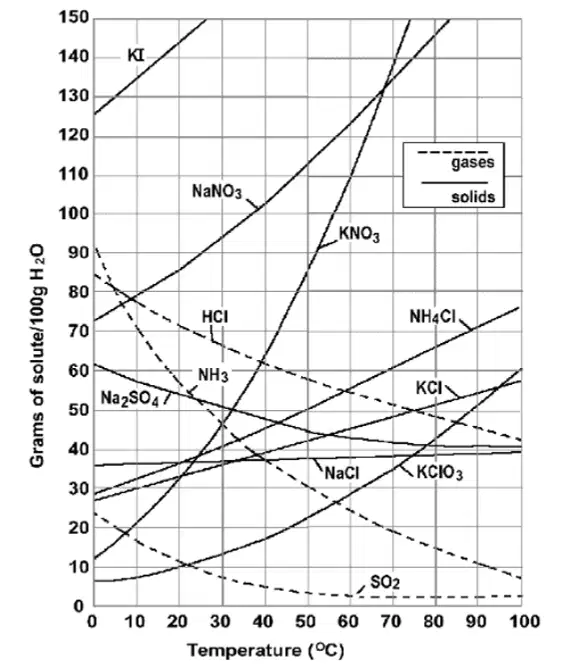
Using the solubility graph above, answer the following questions: Determine if each of the following is saturated, unsaturated, or supersaturated a. 110 g NaNO₃ @ 10°C ______________________ b. 90 g KNO₃ @ 85°C ______________________ c. 30 g NaCl @ 20°C ______________________
Determine the amount of solute that could be dissolved to make a saturated solution of: a. KClO₃ @20°C ______________ b. KNO₃ @50°C ______________
Predict the direction the above reaction will shift for each of the following stresses: Forward (F), Backward (B), or No Change (NC) 2H₂O(g) + 2Cl₂(g) + heat(113kJ) ⇌ 4HCl(g) + O₂(g) a. increase Cl₂. ________ b. decrease O₂ ________ c. increase HCl ________ d. Increase pressure. ________
Calculate the pH if the [H⁺] = 0.0030 M.
2.52
3.52
4.52
5.52
What is the [H⁺] of a solution with a pH of 4.98?
1.05 x 10⁻⁵ M
1.05 x 10⁻⁶ M
1.05 x 10⁻⁴ M
1.05 x 10⁻⁷ M
What is the pH of a 0.035 M solution of hydrochloric acid?
1.46
2.46
3.46
4.46
Calculate the molar mass of: a. Ca₃N₂ is ________ g/mol b. Pb(NO₃)₂ is ________ g/mol
Determine the number of moles in 15.57 g of Bi(OH)₂.
How many grams are in 0.70 mol Ba(NO₃)₂?
How many moles are in 1.2 x 10²⁴ atoms of gold, Au?
How many molecules are in 0.70 mol Ba(NO₃)₂?

Use the following chemical reaction to answer the questions:

Use the following chemical reaction to answer the questions:

Aluminum metal reacts with zinc chloride to produce zinc metal and aluminum chloride.

Aluminum metal reacts with zinc chloride to produce zinc metal and aluminum chloride.
What are the products when a hydrocarbon fuel goes through a combustion reaction?
Describe an endothermic reaction.
Describe an exothermic reaction.
Describe the relationship of the variables in Boyle’s Law.
Describe the relationship of the variables in Charles’ Law.
List the types of radiation in order from lowest energy to highest energy.
What is the definition of a half-life?
Compare fission and fusion.
A quantity of gas under a pressure of 302 kPa has a volume of 0.6 L. The pressure is increased to 604 kPa, while the temperature is kept constant. What is the new volume?
A sample of gas has a volume of 0.102 L at a temperature of 400 K. At what temperature will the volume of the gas be 0.204 L, assuming there is no change in pressure?
For the following reaction: A + B → C + D ΔH = +455 kJ a. State if the reaction is endothermic or exothermic. b. State if the products have higher or lower bond energy than the reactants.
Write the thermochemical equation for the combustion of CH₄. The enthalpy is -889 kJ. Is this reaction endo or exothermic?
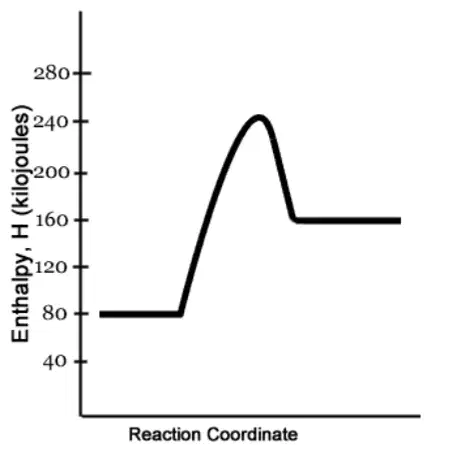
On the energy diagram below, identify and label the following: energy of the reactants, energy of the products, activation energy, enthalpy change, and classify the reaction as either endothermic or exothermic. Additionally, calculate the activation energy and the enthalpy change values.
Balance these nuclear reactions and identify the type of decay or capture: a. ¹⁶₈O + ¹₁H → ⁴₂He + _____ b. ²³⁹₉₄Pu + ⁰₋₁e → ¹₀n + _____
If nuclide X has a half-life of 250 years, determine how long are three half-lives?
Given 500 grams of nuclide X, with a half-life of 250 years, how many grams will remain after 1000 years?
Match the following to form true statements:
When solid, ionic compounds
cannot conduct electricity
When melted ionic compounds
can conduct electricity
Ionic compounds have
high melting and high boiling points
There are many strong bonds
between ions in an ionic compound.
Elements in group 1 of the periodic table form ions
with a charge of 1+
Match the charge with the groups.
-1
Group 17
-3
Group 15
-2
Group 16
(a) are in the (b) and contribute to the overall mass of an atom. They are the (c) particles inside the atom. the (d) are in the (e) and DO NOT contribute to the overall mass of an atom.
The proper formula for magnesium hydroxide.
MgOH
Mg2OH
Mg(OH)2
Mg2OH2

