
 Worksheets
Spring US History Final
Total questions: 50
Worksheet time: 37mins
The Great Depression occurred MAINLY because of...
over-speculation of the stock market
civilians being irresponsible with their money
high unemployment
high taxes
FDR's plan to get the country out of the Depression was called the...
Great Deal
New Deal
Best Deal
Amazing Deal
One of The New Deal's programs that still exists today is the...
18th Amendment
Public Works Administration
Tennessee Valley Authority Act
Social Security Act
What was the banks' response to the public if they came in demanding to withdraw their money?
they would give them all their money in full
they would apologize and not give them anything
they would only give them 80% of their full amount
Which of the following was not a goal of the New Deal?
Reform
Relief
Recovery
Retirement
True or False: Conditions for Minorities improved during the Great Depression
True
False
What was Black Tuesday?
A massive sale that companies held once a year
The day the Dust Bowl hit
The 1929 collapse of the Stock Market
The total eclipse of 1929
What was the bank run?
A 5k run sponsored by the big banks
People wanting to give as much money as possible
Banks running out of paper
Americans withdrawing all of their money from the banks
drought-related conditions in the Great Plains states.
Dust Bowl
Acai Bowl
Duster
The US developed an atomic bomb with this program.
Manhattan
Los Alamos
Big Bomb
Area 51

Why is Japan invading and conquering many lands in Asia?
need more natural resources
wanted to take back lands lost in the past
help other countries fight for independence
What actions did the Western Allies take that caused Japan to attack the U.S.?
the U.S. demanded the Japanese leave Manchuria
the U.S. occupied Okinawa
the U.S. condemned German aggression in Europe
the U.S. banned the sale of iron, steel, and oil to Japan
Why did the US enter World War II?
Germany was attacking other nations.
The United States wanted to be allies and fight with Japan.
There was pressure from Congress to join the war.
The Pearl Harbor attack was unprovoked and put Americans in danger.
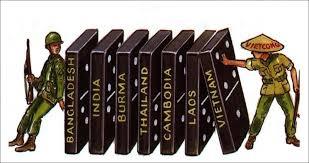
Vietnamization
Communism
Domino Theory
Imperialism
Geneva Accords
Tonkin Gulf Resolution
Marshall Plan
Operation Rolling Thunders
A chemical herbicide used to clear out forests and tall grasses
A type of lotion soldiers would use to get rid of the sent on their clothing
Another name for a flamethrower
An intensely burning explosive used to destroy jungle growth
Nickname of a Soviet agent that would always wear orange while on important missions
Term used to describe the South Vietnamese agents because they
A chemical herbicide used to clear out forests and tall grasses
An intensely burning explosive used to destroy jungle growth

The Geneva Accords
Operation Rolling Thunder
The Tet Offensive
Gulf of Tonkin
Which of the following was NOT used by the American military in Vietnam?
Aerial attacks (regular bombs)
Agent Orange
Napalm
Nuclear bombs
In the ____________________, United States soldiers killed at least 450 women, children, and elderly men, shocking the American public.
My Lai Massacre
Attack on Sai Pan
Tet Offensive
Attack on Khe Sanh
Which group was most likely to be drafted in the military
18-25 poor and uneducated men
20-30 college students
19-21 uneducated rich kids
30-40 history teachers

What court case made segregation of schools illegal in the 1950s?
Guzman V. School
Brown V. Board of Education
Miranda V. Arizona
Plessy V. Ferguson
Which leader of the civil rights movement used non-violent civil disobedience to oppose segregation in the south?
Dolores Huerta
Malcom X
Martin Luther King Jr.
Ceaser Chavez

What group during the Civil Rights Movement allowed members to use all necessary means to defend and provide for their community?
Southern Peace Corps
NAACP
SNCC
Black Panthers

During which event did Eisenhower send troops to Arkansas in order to desegregate a high school?
Tuskegee Airmen
Little Rock Nine
Atomic Bombs
Flying Tigers
What acts of protest during the Civil Rights Movement encouraged the government to expand political and economic opportunities for minority citizens?
March on Washington, Freedom Rides, Greensboro Sit-In, Montgomery Bus Boycott
Black Panthers
Mass Support Demonstrations
Little Rock Nine
What happened as a result of the Civil Rights Act of 1964, Voting Rights Act of 1965, and the 24th Amendment?
Expanded the political and economic opportunities for minorities
Decreased the political and economic opportunities for minorities
What event challenged the federal government to enforce the Supreme Court rulings against discrimination in interstate transportation?
Sit-in
Boycotts
Freedom Rides
March on Washington
U.S. Supreme Court case that made segregation legal in the U.S. - created the "seperate but equal" principle.
Plessy V. Ferguson
Brown V. Board of Education
Hernanadez V. Texas
Miranda V. Arizona


This famous civil rights leader wanted equal rights "by any means necessary"
Martin Luther King
Malcolm Luther King
Malcolm X
Malcolm Y

What two nations were in competition with each other during the Cold War?
Spain and Portugal
England and France
Germany and Italy
United States and Soviet Union


Why were the US and Soviet Union on opposite sides of the Cold War?
The US dropped bombs on the Soviet Union
The two countries have different viewpoints of Government and Economy
The Soviet Union dropped bombs on the US
What role did the United States play in the Korean War?
The United States and its allies did not join the Korean War
The US and its allies fought to defend North Korea.
The US joined its allies in the fight against North Korea to keep communism from spreading.
The United States and its allies only sent supplies and weapons to Korea.
What was the arms race?
The US and Soviet Union began to race and see who could conquer more countries.
The US wanted to have peace with the Soviet Union
The US and Soviet Union began building and storing powerful weapons.
The Soviet Union wanted to become allies with the United States
Korea was divided along the __________ Parallel after World War II.
31st
36th
38th
40th

