
Font size
 Worksheets
Manual Transmission Aut-103 week 8
Total questions: 25
Worksheet time: 10mins
The spur gear is:
Straight cut
Angle cut
Cut on two diagonal lines
a very quite running gear set
When a small gear is driving a larger gear you will have:
Underdrive
Overdrive
A speed increase
A torque decrease
The Helical gear is:
Cut with straight teeth
Cut with a double offset
A noisy gear set
Cut on an angle
When a large gear is driving a smaller gear you will have:
A speed decrease in the driven gear
A torque increase in the drive gear
Overdrive
Underdrive
What is double clutching and when is it typically used?
Double clutching is a technique used in automatic transmission vehicles to smoothly shift gears.
Double clutching is a technique used in motorcycles to increase speed.
Double clutching is a technique used in electric vehicles to conserve battery power.
Double clutching is a technique used in manual transmission vehicles to smoothly shift gears.
What is the purpose of synchronizers in a manual transmission?
To increase fuel efficiency
To reduce engine noise
To match the rotational speeds of the gears before engaging them
To prevent gear slippage
The function of the manual transmission detent is: NOTE! There maybe more than one correct answer
To prevent the engagement of two gears at the same time.
To properly position the shift rod, fork and synchronizer.
To provide for a positive shift feel.
To prevent damage to the gears during shifting.
The manual transmission interlock mechanism is used to:
Interlock the synchronizer sleeve to the speed gear
Prevent the engagement of two gears at the same time.
Engage reverse idler gear
Interlock the transfer case to the transmission.
How does a clutch work in a manual transmission?
A clutch in a manual transmission is responsible for changing gears.
A clutch in a manual transmission controls the speed of the vehicle.
A clutch in a manual transmission is used to engage the brakes.
A clutch in a manual transmission connects and disconnects the engine from the transmission.
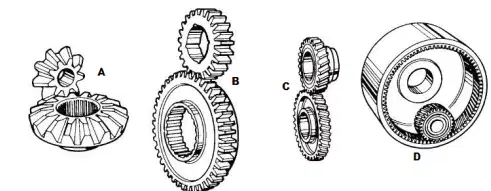
Match the following
Used to connect shafts that are not parallel to each other. Mainly used in final drives and transaxles
A. bevel gears
Straight-cut gears that may be used for reverse gears in a manual transmission.
B. Spur gears
Gears with teeth cut on an angle. Used in manual transmissions and transaxle final drives.
C. helical gears
Used as part of planetary gears in an automatic transmission.
D. ring gear
Explain how reverse drive is achieved in a compound train.
The same as first gear but backwards
By meshing a reverse idler gear with other gears to change the direction of gear rotation.
List the three main shafts in a manual transmission.
Reverse shaft
cluster shaft
Main shaft
Input shaft
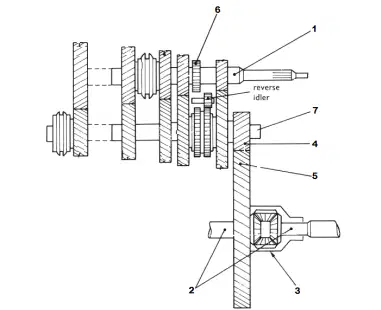
Look at the diagram and match the number to the description.
1
input shaft
2
drive shaft
3
differential assembly
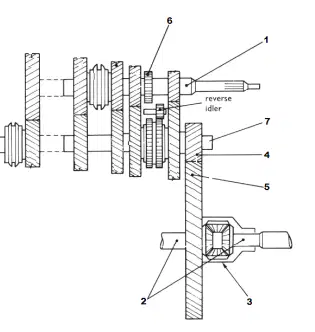
Match the following
4
ring gear
5
pinion gear
6
reverse gear
7
secondary shaft
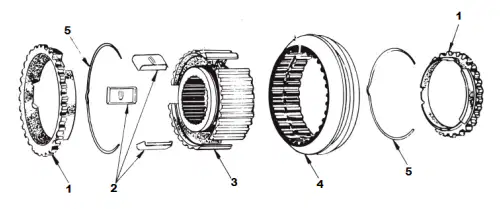
Identify the assembly shown in the diagram:
synchromesh assembly
constant mesh assembly
non synchro assembly
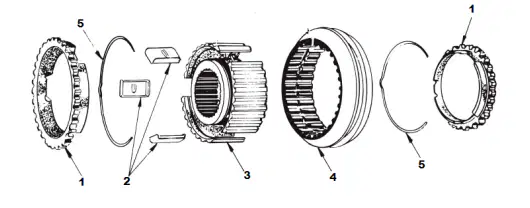
Match the number with its description:
1
Baulk ring
2
Inserts
3
hub
4
sleeve
5
insert spring
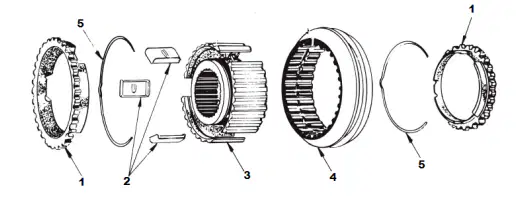
What is the purpose of the above assembly?
allows you to skip gears
prevents gears crunching during gear selection
used in CVT assemblies
Stops the driver selecting the wrong gear
Label the A of this assembly
Blocker / Baulk ring
Splined Hub
Engagement Sleeve
Metal Inserts
Radial Spring
Label B of this assembly
Blocker / Baulk ring
Splined Hub
Engagement Sleeve
Metal Inserts
Radial Spring
Label E of this assembly
Blocker / Baulk ring
Splined Hub
Engagement Sleeve
Metal Inserts
Radial Spring
Calculate the Gear Ratio for:
Driver: 15 teeth
Driven: 60 teeth
8:1
2:1
6:1
4:1
Label D of this assembly
Blocker / Baulk ring
Splined Hub
Engagement Sleeve
Metal Inserts
Radial Spring
Label C of this assembly
Blocker / Baulk ring
Splined Hub
Engagement Sleeve
Metal Inserts
Radial Spring
Calculate the Gear Ratio for:
Driver: 12 teeth
Driven: 87 teeth
(a) :1
What is the function of the clutch fork in the transmission?
To connect the transmission input shaft to the engine crankshaft
To press against the release or throwout bearing
To disconnect power flow from the transmission input shaft
To control the gear shifting process

