
Font size
 Worksheets
Unit 7 Review - Earth's History and Changing Climate
Total questions: 53
Worksheet time: 13hrs 15mins
A principle in geology and earth sciences that suggests that the same geological processes observed today have been at work throughout Earth's history. This principle, often encapsulated in the phrase "the present is the key to the past," implies that the processes shaping the Earth's surface, such as erosion, sedimentation, volcanic activity, and tectonic movements, have been operating in a uniform and consistent manner over long periods of time.
Theory of Catastrophism
Theory of Evolution
Theory of Relative Processes
Theory of Uniformitarianism

What is the most recent event?
E
B
C
D

What rock in the Oldest?
Conglomerate
Shale
Breccia
Sandstone

What is the last event to happen?
Deposition of Breccia
Igneous Intrusion
Faulting
Deposition of Limestone

Above what layer is there an unconformity?
H
M
R
F

Which layer is an igneous intrusion?
I
R
F
H

Which letter is the best index fossil?
W
X
Y
Z

The diagram represents the rock layers and fossils found in four separate rock outcrops.
Which fossil is the best index fossil?
It is found in all four layers in one outcrop.
It is found in only one of the four outcrops.
It is found in one layer in all four outcrops
It is found in both the oldest and youngest layers.
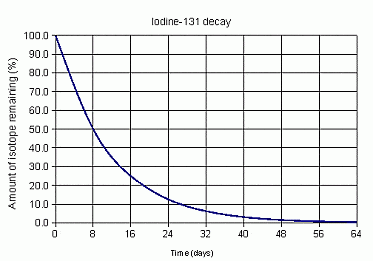
After 3 half lives, what percentage of the atoms in the sample have decayed into daughter products?
25%
87.5%
24%
75%
The % of the parent isotope remaining after 2 Half Lives.
50%
25%
12.5%
6.25%

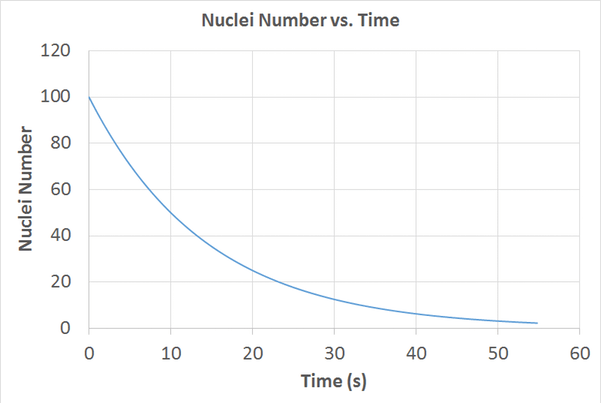
What is the Half life of this isotope?
5 seconds
10 seconds
15 seconds
20 seconds
Atoms of the original isotope that undergoes radioactive decay are known as the...
daughter atoms
elemental atoms
parent atoms
carbon-14 atoms

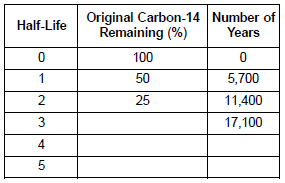
After 22,800 years, approximately what percentage of the original carbon-14 remains?
15%
12.5%
6.25%
3.125%
Smaller more stable atoms are called
Daughter isotopes.
Half lives.
Radioactive Decay.
Parent isotopes.
Larger unstable atoms are called
Daughter isotopes.
Half lives.
Radioactive Decay.
Parent isotopes.
An atom with a different number of protons and neutrons
electrons
isotopes
ions
reaction partners

How many half-lives have passed if 12.5% 14C remains?
1 Half-life
2 Half-lives
3 Half-lives
4 Half-lives

The shaded boxes represent the undecayed atoms for Isotope "X". If Isotope X has a half-life of 1,000 years, how old is this sample?
1,000 years
2,000 years
3,000 years
4,000 years
What is the term used to describe the age in which humans have been the strongest force of change on the planet?
Anthropocene
Holocene
Precambrian
Technosphere
What is the oldest and longest period in Earth's history?
Precambrian
Paleozoic era
Mesozoic era
Cenozoic era
Geologists organize Earth's history according to grouping called _____. Each eon contains ____, which, in turn contain _______. Each period in the geologic time scale contains _______. The current geologic epoch is called the Holocene epoch.
period, eras, epoch, eons
epoch, period, eras, eons
eons, eras, period, epoch
eras, eons, period, epoch

During the Precambrian Eon all of the events happened except.
Fish began to evolve
Single cell organism like bacteria developed
Earth was flowing with lava and their was not oxygen in the atmosphere.
The Proterozoic Era was at the end of Precambrian Eon
Fossils provide evidence of __________.
how life and the environment has remained stable over time
how the climate and weather has remained stable over time
how life and the environmental conditions have changed over time

The diagram shows the distribution of different fossils. During what geologic time period would they have existed TOGETHER?
Jurassic
Triassic
Permian
Carboniferous

Why did the sponges and worms from Precambrian time leave few fossils?
there were not many sponges and worms
they burned up in magma
they only have soft body parts
rocks did not form at that time
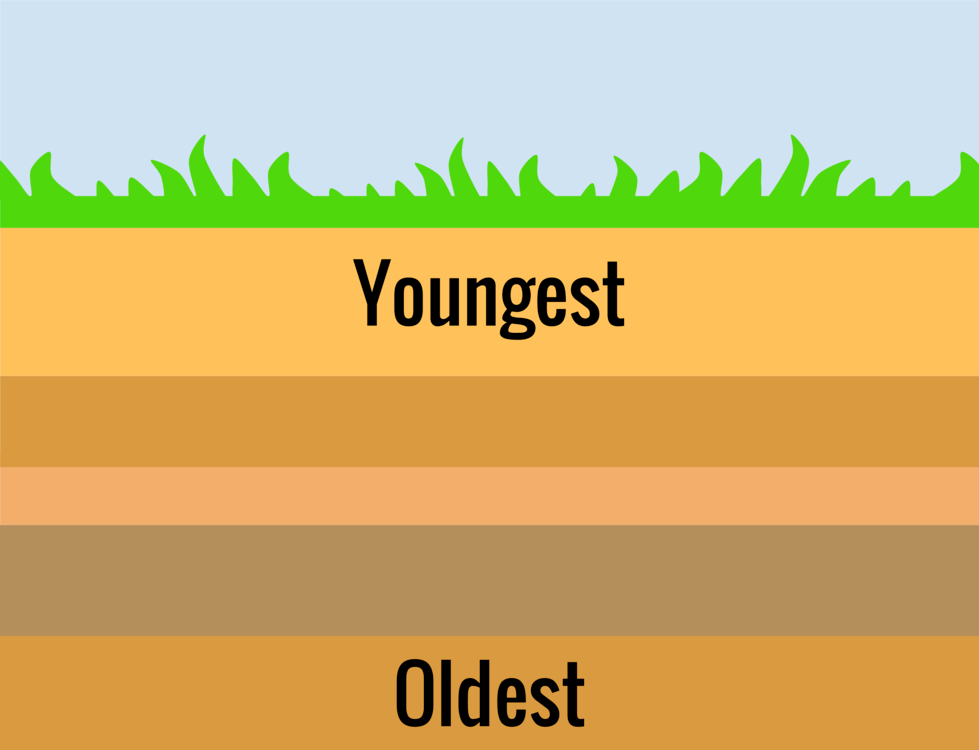
What geologic principles(or law) is best displayed here? CHOOSE 2.
Superposition
Original horizontality
Cross-cutting relationships
Inclusions

Which statement best describes the layers of rock in this picture?
The layers would have been deposited as they are pictured, so nothing has happened to them.
The layers have been disturbed since they would have been deposited horizontally .
The layers are all the same age since they are all in the same location.
Which is the most recent era of time- the one that we are currently in?
Cenozoic
Mesozoic
Paleozoic
Precambrian
Which Principle of Geology states that igneous rocks or faults that “cut” into other rocks are younger than the rock layers it cut into.
Law of Superposition
Law of Inclusion
Law of Cross-Cutting Relationships
Law of Original Horizontality
How does absolute age differ from relative age?
only absolute dating indicates which rock is older than another
only relative dating finds the age in years
only absolute dating finds the age in years
none of the above
What major event marks the beginning of the Paleozoic Era?
The Cambrian Explosion
The Formation of Pangea
The mass extinction of dinosaurs
The appearance of multicellular life
What significant event marks the end of the Mesozoic Era?
The formation of the Himalayas
The extinction of the dinosaurs
The rise of flowering plants
The beginning of the Ice Age
What major biological event characterizes the Ordovician Period?
The first appearance of mammals
The colonization of land by plants
The diversification of marine life
The extinction of the dinosaurs
Which era encompasses the time of the most recent ice ages?
Mesozoic Era
Paleozoic Era
Cenozoic Era
Archean Eon
The ice age with mammoths, sabertooth tigers, and Sid existed when?
Quaternary
Pennsylvianian
Silurian
Mississippian
During what time period did pangea break apart?
Cambrain
Silurian
Cretaceous
Jurassic

What is a likely event that occurred between fossil layers B and D?
explosion of new species
mass extinction
can not tell from the image
small changes to the environment

Do no rush, examine the diagram. How has life evolved starting with the oldest fossils?
Life started in the ocean and over time organism became to appear with no common ancestors. Fish evolved first, then reptiles, then mammals and finally birds.
Life started in the ocean then slowly evolved through natural selection to life on land. Fish evolved first, then reptiles, then mammals and finally birds.
Life started on land and over time humans began to evolve into fish, then reptiles, and birds.
Life started in the ocean as four-legged amphibians which then evolved to palm trees, then to dinosaurs, and eventually into humans.

Which is the major difference between the Permian period and the Jurassic period?
Organisms evolved to from land animals to being able to fly
Organisms went from four legs to two
Organisms got fatter
Organisms stayed the same during these periods
The Anthropocene is a proposed geological epoch that reflects the significant impact of human activities on Earth's geology and ecosystems. It is characterized by the unprecedented influence of human activities on the planet's atmosphere, biosphere, hydrosphere, and geosphere. The term "Anthropocene" combines "anthropo," meaning human, with "-cene," denoting a geological epoch. Which of the following environmental changes would relate to the Anthropocene (check all that apply).
Oxygen in the atmosphere falling under 15%
Waning of ice sheets and glaciers
Increased rate of acidification in the oceans
Increased rate of warming due to greenhouse gas buildup
Increased rate of species extinction.
Which of the following had the greatest effect to stabilize temperatures during precambrian time?
Increase of oxygen in the atmosphere
Global ice sheets (snowball Earth)
Condensation of atmospheric water vapor leading to oceans
Formation of supercontinents

List from youngest to oldest
ECADB
CABED
BADCE
BDACE

In the diagram, what scientific law tells us that rock layer D is older than rock layer B?
Cross-cutting
Inclusions
Superposition
Unconformities

List from youngest to oldest
BAECD
DCEAB
CEABD
ACEDB

