
 Worksheets
Chemical Reactions And Equations_LS_14
Total questions: 58
Worksheet time: 2hrs 39mins
2CaO--> 2Ca + O2

What element is being Oxidized?
N+5
H+1
O-2
S-2

What element is being Reduced?
N+5
H+1
O-2
S-2

What element is being Oxidized?
I0
H+1
S+4
O-2

What element is being reduced?
I0
H+1
S+4
O-2
In the reaction Zn + H2O --> ZnO2 + H2
which element, if any, is oxidized?
Zn0
Zn+2
O-2
H20
None
4Fe + 3O2 --> 2Fe2O3
Cl2 + 2e- --> 2Cl - is an example of:
a chemical reaction
redox
oxidation
reduction
An increase in oxidation number.
more acidic
reduction
less basic
oxidation
A decrease in oxidation number.
redox
reduction
oxidation
dilute
Oxidation-reduction reactions occur because of the competition between particles for...
protons
neutrons
electrons
positrons
Mg + PbCl2 --> MgCl2 + Pb. Which statement correctly describes the oxidation and reduction that occur?
Mg is oxidized and Cl- is reduced
Mg is oxidized and Pb+2 is reduced
Mg is reduced and Cl- is oxidized
Mg is reduced and Pb+2 is oxidized
As an element is oxidized, its oxidation number...
increases as electrons are gained
decreases as electrons are gained
decreases as electrons are lost
increases as electrons are lost
When a magnesium ribbon burns in air with a dazzling flame and forms a white ash, is magnesium oxidised or reduced ? Why ?
2Mg + O2⟶ 2MgO
Magnesium is oxidised as addition of oxygen to magnesium takes place leading to formation of magnesium oxide.
Magnesium is reduced as addition of hydrogen to magnesium takes place leading to formation of magnesium oxide.
In the reaction represented by the equation :
MnO2+4HCl→MnCl2+2H2O+Cl2
name the substance oxidised.
HCl is oxidised to Cl2.
MnO2 is the oxidising agent.
MnO2 is reduced to MnCl2.
HCl is the reducing agent.
In the reaction represented by the equation :
MnO2+4HCl→MnCl2+2H2O+Cl2
name the oxidising agent.
HCl is oxidised to Cl2.
MnO2 is the oxidising agent.
MnO2 is reduced to MnCl2.
HCl is the reducing agent.
In the reaction represented by the equation :
MnO2+4HCl→MnCl2+2H2O+Cl2
name the substance reduced.
HCl is oxidised to Cl2.
MnO2 is the oxidising agent.
MnO2 is reduced to MnCl2.
HCl is the reducing agent.
In the reaction represented by the equation :
MnO2+4HCl→MnCl2+2H2O+Cl2
name the reducing agent.
HCl is oxidised to Cl2.
MnO2 is the oxidising agent.
MnO2 is reduced to MnCl2.
HCl is the reducing agent.
Two Reactants and One Product
Decomposition
Synthesis
Combustion
Single Replacement
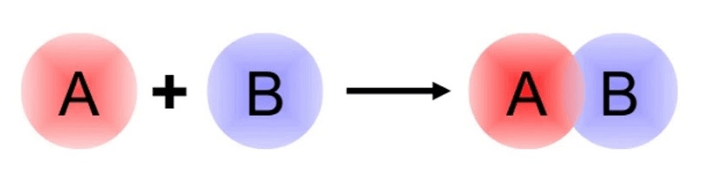
What is the type of reaction shown above?
Synthesis
Decomposition
Single Replacement
Double Replacement
A chemical change in which two substances react to form a new substance is a ____________________________.
decomposition reaction
Combination reaction
precipitation reaction
combustion reaction
When magnesium ribbon burns in the presence of oxygen it produces:
magnesium iodide
magnesium chloride
magnesium oxide
none
Which of the following is an example of combination reaction? Select all that apply.
Na + Br2 → NaBr
KClO3 → KCl + O2
HgO + Cl2 → HgCl + O2
2 Mg+O2 → 2MgO
Ca + I2 → CaI2
Burning of carbon in presence of oxygen to produce carbon dioxide is an example of a combination reaction which is also an _______ reaction.
C (s) + O2 (g) →CO2 + Heat
Exothermic
Endothermic
Reaction of Nitrogen with oxygen to give nitrous oxide is an example of a combination reaction which is also an _____ reaction.
N2 (g) + O2 (g) + Heat → 2NO (g)
Exothermic
Endothermic
Reduction is the ___________ of electrons.
loss
gain
sharing
transfer
Oxidation is the _________ of electrons.
loss
gain
sharing
transfer
Gaining hydrogen is an example of...
oxidation
reduction
Gaining oxygen is an example of...
oxidation
reduction
In a redox reaction, the species reduced
gains electrons and is the oxidizing agent
loses electrons and is the oxidizing agent
loses electrons and is the reducing agent
gains electrons and is the reducing agent
Mg → Mg2+ + 2e–
2Ca(s) + O2(g) --> 2CaO(s), calcium is __________
Is oxidation an exothermic or an endothermic reaction?
Oxidation reaction is an exothermic reaction as heat is released during this reaction
Oxidation reaction is an endothermic reaction as heat is released during this reaction
Explain, by giving an example, how oxidation and reduction proceed side by side.
CuO + H2 → Cu + H2O In this reaction, CuO gets reduced to Cu by losing oxygen and H2 gets oxidized to H2O by gaining oxygen. Hence, oxidation and reduction proceed side by side.
2Na(s) + Cl2(g)------> 2NaCl(s)
Here Na loses electrons and gets oxidised and Cl gains the same electrons to be reduced. So, both oxidation and reduction occur simultaneously in a given reaction.
C(s) + 2H2(g) → CH4(g)
Cu2++Zn⇌Cu+Zn2+, Zn is oxidized to Zn2+ and Cu2+ is reduced to Cu.
What is the colour of ferrous sulphate crystals ?
Green
Ochre
Olive
Juniper
How does the colour of ferrous sulphate crystals change after heating?
Green
Ochre
Olive
Juniper
Brown
Name the product formed on strongly heating ferrous sulphate crystals.
ferric oxide
ferrous oxide
ferrosoferric oxide
ferroferric oxide
Name the product formed on strongly heating ferrous sulphate crystals.
ferric oxide
ferrous oxide
ferrosoferric oxide
ferroferric oxide
Name the product formed on strongly heating ferrous sulphate crystals.
Combination Reaction. .
Decomposition Reaction
Displacement Reaction.
Double Displacement Reaction.
Precipitation Reaction.
Decomposition Reaction. What is the first statement of the video clip?
Decomposition Reactions:
the reaction in which a single compound
breaks up into two or more simple substances is known as
reactions
The decomposition reaction generally takes place when energy in some form such as heat, electricity or light is
supplied to the reactants
CaCO3(s)+heat (when heated) → CaO(s) + CO2(g)
decomposition of a substance by heating is thermal decomposition
Electrolysis: the decomposition of a substance by passing electric current through it is
known as electrolysis
Decomposition Reaction. What is the second statement of the video clip?
2 NaCl(l) (electrolysis) ---> 2 Na(l) + Cl2(g)
Sodium chloride on passing electric current gives sodium 2na and chlorine cl2
The decomposition reaction generally takes place when energy in some form such as heat, electricity or light is
supplied to the reactants
CaCO3(s)+heat (when heated) → CaO(s) + CO2(g)
decomposition of a substance by heating is thermal decomposition
Electrolysis: the decomposition of a substance by passing electric current through it is
known as electrolysis
Decomposition Reaction. What is the third statement of the video clip?
2 NaCl(l) (electrolysis) ---> 2 Na(l) + Cl2(g)
Sodium chloride on passing electric current gives sodium 2na and chlorine cl2
Photolysis: the decomposition of a compound with light is called photolysis
CaCO3(s)+heat (when heated) → CaO(s) + CO2(g)
decomposition of a substance by heating is thermal decomposition
Electrolysis: the decomposition of a substance by passing electric current through it is
known as electrolysis
Decomposition Reaction. What is the fourth statement of the video clip?
2 NaCl(l) (electrolysis) ---> 2 Na(l) + Cl2(g)
Sodium chloride on passing electric current gives sodium 2na and chlorine cl2
Photolysis: the decomposition of a compound with light is called photolysis
study of decomposition of silver chloride: take about 2 grams of silver chloride in
a china dish
decomposition of a substance by heating is thermal decomposition
Electrolysis: the decomposition of a substance by passing electric current through it is
known as electrolysis
Decomposition Reaction. What is the fifth statement of the video clip?
2 NaCl(l) (electrolysis) ---> 2 Na(l) + Cl2(g)
Sodium chloride on passing electric current gives sodium 2na and chlorine cl2
Photolysis: the decomposition of a compound with light is called photolysis
study of decomposition of silver chloride: take about 2 grams of silver chloride in
a china dish
place this china dish in the sunlight for sometime
Electrolysis: the decomposition of a substance by passing electric current through it is
known as electrolysis
Decomposition Reaction. What is the sixth statement of the video clip?
2 NaCl(l) (electrolysis) ---> 2 Na(l) + Cl2(g)
Sodium chloride on passing electric current gives sodium 2na and chlorine cl2
Photolysis: the decomposition of a compound with light is called photolysis
study of decomposition of silver chloride: take about 2 grams of silver chloride in
a china dish
place this china dish in the sunlight for sometime
it is observed that the white silver chloride turns gray on exposure to sunlight
Decomposition Reaction. What is the seventh statement of the video clip?
2AgCl (on exposure to sunlight) ---- 2Ag +Cl2
Photolysis: the decomposition of a compound with light is called photolysis
study of decomposition of silver chloride: take about 2 grams of silver chloride in
a china dish
place this china dish in the sunlight for sometime
it is observed that the white silver chloride turns gray on exposure to sunlight
Decomposition Reaction. What is the eighth statement of the video clip?
2AgCl (on exposure to sunlight) ---- 2Ag +Cl2
silver bromide undergoes decomposition when exposed to light
study of decomposition of silver chloride: take about 2 grams of silver chloride in
a china dish
place this china dish in the sunlight for sometime
it is observed that the white silver chloride turns gray on exposure to sunlight
Decomposition Reaction. What is the ninth statement of the video clip?
2AgCl (on exposure to sunlight) ---- 2Ag +Cl2
silver bromide undergoes decomposition when exposed to light
2AgBr (when exposed to light) ----> 2Ag +Br2
place this china dish in the sunlight for sometime
it is observed that the white silver chloride turns gray on exposure to sunlight
Decomposition Reaction. What is the tenth statement of the video clip?
2AgCl (on exposure to sunlight) ---- 2Ag +Cl2
silver bromide undergoes decomposition when exposed to light
2AgBr (when exposed to light) ----> 2Ag +Br2
the above reactions are used in black and white photography
it is observed that the white silver chloride turns gray on exposure to sunlight
Decomposition Reaction. What is the eleventh statement of the video clip?
2AgCl (on exposure to sunlight) ---- 2Ag +Cl2
silver bromide undergoes decomposition when exposed to light
2AgBr (when exposed to light) ----> 2Ag +Br2
the above reactions are used in black and white photography
it is observed that the white silver chloride turns gray on exposure to sunlight
Decomposition Reaction. What is the Twelfth statement of the video clip?
2AgCl (on exposure to sunlight) ---- 2Ag +Cl2
silver bromide undergoes decomposition when exposed to light
2AgBr (when exposed to light) ----> 2Ag +Br2
the above reactions are used in black and white photography
it is observed that the white silver chloride turns gray on exposure to sunlight
Decomposition Reaction. What is the Thirteenth statement of the video clip?
2AgCl (on exposure to sunlight) ---- 2Ag +Cl2
silver bromide undergoes decomposition when exposed to light
2AgBr (when exposed to light) ----> 2Ag +Br2
the above reactions are used in black and white photography
it is observed that the white silver chloride turns gray on exposure to sunlight
Decomposition Reaction. What is the Fourteenth statement of the video clip?
2AgCl (on exposure to sunlight) ---- 2Ag +Cl2
silver bromide undergoes decomposition when exposed to light
2AgBr (when exposed to light) ----> 2Ag +Br2
the above reactions are used in black and white photography
it is observed that the white silver chloride turns gray on exposure to sunlight

