wayground logo

Free Printable Worksheets

NEW

Font size

S
M
L
XL
Worksheets

Unit 3 Chem A Review

Total questions: 62

Worksheet time: 1hrs 15mins

Name
Class
Date
1.
A block has a mass of 54g and a volume of 20cm3.  What is the density of the block?
a)
74 g/cm3
b)
1080 g/cm3
c)
34 g/cm3
d)
2.7 g/cm3
2.
A diamond has a mass of 1.2 g.  If diamond has a density of 3.51 g/mL, what is the volume of the diamond.
a)
0.34 mL
b)
2.9 g/mL
c)
2.3 mL
d)
4.2 mL
3.
Calculate 12.34 + 1.234 + 0.1234
a)
13.6974
b)
13.697
c)
13.70
d)
13.7
4.

The dimensions of rectangular solid are measured to be 1.27 cm, 1.3 cm, and 2.5 cm. The volume should be recorded as

a)

4.128 cm3.

b)

4.12 cm3.

c)

4.13 cm3.

d)

4.1 cm3.

5.
Convert 300 cm to m:
a)
3 m
b)
30 m
c)
0.3 m
d)
0.03 m
6.
490,000 g =____ kg
a)
490
b)
49
c)
4,900
d)
0.49
7.
How many gallons are in a pool that holds 758,000 Liters?
(1 gallon = 3.79 Liters)
a)
200
b)
20,000
c)
200,000
d)
2,000,000
8.

How many kilograms of calcium are there in 173 pounds of calcium? (1 pound = 454 grams; 1 kg = 1000 g)

a)

1.10 kg

b)

78.5 kg

c)

110 kg

d)

78500 kg

9.

What is the atomic number?

a)

the number of protons in the nucleus

b)

the number of protons and neutrons in the nucleus

c)

the number of neutrons in the nucleus

d)

the number of protons in the energy levels

10.

What is the mass number?

a)

the number of protons in the nucleus

b)

the number of protons and neutrons in the nucleus

c)

the number of neutrons in the nucleus

d)

the number of protons and electrons in the atom
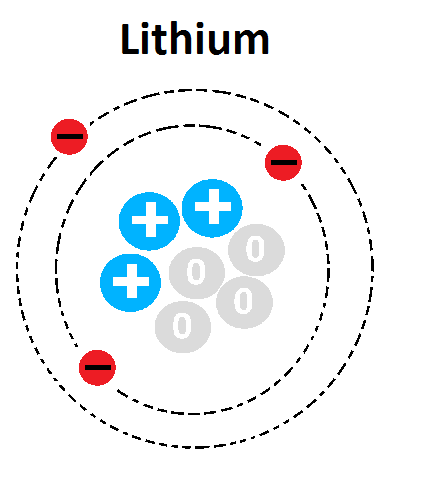
11.

What is the mass number of this atom?

a)

1

b)

3

c)

4

d)

7

12.
In order for an atom to be neutral what has to be true?
a)
The atom has more protons than neutrons
b)
The atom has more neutrons than protons
c)
The atom has the same number of protons and neutrons
d)
The atom has the same number of protons and electrons
13.

An atom has 10 protons, 15 neutrons and 10 electrons what is its mass number.

a)

20

b)

10

c)

35

d)

25

14.
An element with a mass number of 11 and an atomic number of 5 has how many neutrons?
a)
11
b)
5
c)
6
d)
16
15.

Which of the following determines the identity of an element?

a)

number of protons

b)

atomic mass

c)

number of neutrons

d)

number of shells

16.
What is the atomic number of the atom pictured? 
a)
9
b)
10
c)
18
d)
19
17.

Isotopes of an element have a different number of...

a)

Protons

b)

Neutrons

c)

Electrons

d)

Mass

18.

There are two primary isotopes found in any sample of copper: copper-63 and copper-65. The isotope 65Cu composes 69.2% of the sample and 63Cu comprises the other 30.8%. Based on this data, what is the atomic mass of copper?

a)

29 amu

b)

63.546 amu

c)

64.4 amu

d)

63.6 amu

19.
4.35% of all X atoms have a mass of 39.946 amu. 83.79% have a mass of 41.941 amu, 9.50% have a mass of 42.941 amu, and 2.36% have a mass of 43.939 amu. What is the average atomic mass of atom X?
a)
41.97 amu
b)
42.19 amu
c)
10.43 amu
d)
40.04 amu
20.

Nickel-59 has how many neutrons?

a)

30

b)

31

c)

32

d)

33

21.

12 protons and 13 neutrons

a)

Mg-12

b)

Mg-13

c)

Mg-25

d)

Mg-24.305

22.
A certain photon of light has a wavelength of 4.22x10⁻⁷nm. What is the frequency? (v=c/λ)
a)
7.11x10¹⁴ Hz
b)
7.11Hz
c)
1.41x10⁻¹⁵
d)
-1.41x10¹⁵
23.
A wave with a large wavelength will have a ______ frequency and _____ energy
a)
high, low
b)
high, high
c)
low, high
d)
low, low
24.
Which has the SHORTEST wavelength and, therefore, the highest frequency/most energy
a)
Radio waves
b)
Ultraviolet Rays
c)
Gamma Rays
d)
X-rays
25.
What is a photon?
a)
When radiation burst through electric waves
b)
The emission of electrons from a metal caused by light striking the metal
c)
The rate at which a waves energy flows through a given unit of area.
d)
packets of electromagnetic energy
26.
What is the wavelength for a quantum of light with energy of 7.56x10⁻¹⁹J? (λ=hc/E) 
a)
2.62x10⁻⁷m
b)
2.62x10⁷m
c)
2.64x10-45m
d)
2.64x1045m
27.
Certain blue lights have a frequencey of 6.91x10¹⁴Hz. What is the wavelength? (λ=c/v)
a)
4.34x10²¹
b)
4.34x10⁻²¹
c)
4.34x10⁻⁷
d)
2.07x10²³
28.
What is the energy of a quantum of light with a frequency of 7.39x10¹⁴Hz.(E=Hv)
a)
4.88x10¹⁹
b)
4.88x10⁻¹⁹
c)
2.22x10²³
d)
2.22x10⁻²³
29.

Who proposed that electrons are only found in specific, discrete circular orbits around the nucleus?

a)

Albert Einstein

b)

Erwin Schrodinger

c)

Ernest Rutherford

d)

Niels Bohr

30.

If n = 3, what is the maximum number of electrons that can fit in this shell?

a)

2

b)

8

c)

18

d)

32

31.

What orbital is shown in the picture?

a)

s orbital

b)

p orbital

c)

d orbital

d)

f orbital

32.

Which quantum number represents the shape of the orbital?

a)

principal quantum number

b)

azimuthal (angular momentum) quantum number

c)

magnetic quantum number

d)

spin quantum number

33.

Which quantum number represents the orientation of the orbital?

a)

principal quantum number

b)

azimuthal (angular momentum) quantum number

c)

magnetic quantum number

d)

spin quantum number

34.

When atoms _____________ energy, their electrons move to higher energy levels. These electrons _____________ energy by emitting light when they return to lower energy levels.

a)

lose, absorb

b)

absorb, lose

c)

lose, lose

d)

absorb, absorb

35.

What states that every orbital of a subshell must be singly occupied before any orbital can have a pair?

a)

Pauli exclusion principle

b)

Hund's rule

c)

Aufbau principle

d)

None of the above

36.

This states that no two electrons will have the same 4 quantum numbers in an atom or molecule. The two electrons of the same orbital must have opposite spin states.

a)

Pauli exclusion principle

b)

Hund's rule

c)

Aufbau principle

d)

None of the above

37.

What states that electrons fill the lowest energy orbitals/levels first before occupying higher energy levels?

a)

Pauli exclusion principle

b)

Hund's rule

c)

Aufbau Principle

d)

None of the above

38.

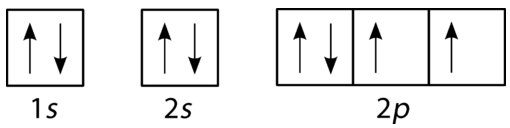
This orbital diagram represents:

a)

Carbon

b)

Boron

c)

Nitrogen

d)

Oxygen

39.

This orbital diagram represents

a)

Nitrogen

b)

Oxygen

c)

Carbon

d)

Neon

40.

Which orbital diagram violates of Hund's Rule?

a)

A

b)

B

c)

C

d)

D

41.

This orbital diagram represents

a)

Sodium

b)

Magnesium

c)

Aluminum

d)

Iron

42.
What atom matches this electron configuration?
1s22s22p63s23p64s23d10
a)
Zinc
b)
Copper
c)
Nickel
d)
Germanium
43.
The electron configuration of an atom is 1s22s22p6.  The number of electrons in the atom is 
a)
3
b)
6
c)
8
d)
10
44.
How many electrons can the d sublevel hold?
a)
14
b)
10
c)
2
d)
6
45.

Choose the correct shortcut configuration for iodine.

a)

[Ar]4s24d104p5

b)

[Kr]5s24d105p5

c)

[Xe]5s25d105p5

d)

none of the above

46.

Each row on the periodic table represents:

a)

an energy level

b)

a sublevel

c)

an electron

d)

an orbital

47.

Which area on the periodic table represents the electrons in the "d" sublevel?

a)

representative elements

b)

columns 3-8

c)

rare earth elements

d)

transition elements

48.
There are 4 different types of subshells (orbitals) s,p,d,f.
a)
true
b)
false
49.
As you move down a group, atomic radius increases because - 
a)
you add more and more neutrons
b)
you add more and more protons
c)
you add more and more shells (energy levels)
d)
you add more atomic mass
50.
The atom with the largest atomic radius in Group 18 is - 
a)
Ar
b)
He
c)
Kr
d)
Rn
51.
As you move across the periodic table from left to right, the atomic radius decreases.  This is because - 
a)
the number of protons increases, so attraction to electrons increases
b)
the number of energy levels increases
c)
the number of electrons increases
d)
the atomic mass increases
52.
The atom with the largest atomic radius in Period 4 (row 4) is - 
a)
K
b)
Kr
c)
Fe
d)
Fe
53.
Francium (Fr) has the lowest ionization energy in Group 1 because - 
a)
it has the smallest number of valence electrons
b)
it has the greatest atomic mass
c)
it has the greatest number of protons, so it attracts its electrons the strongest
d)
its 1 valence electron is very far from the nucleus, so little energy is needed to remove it
54.
The element with the smallest ionization energy in Period 6 is - 
a)
Rn
b)
Cs
c)
Os
d)
Tm
55.
As you move across the periodic table atoms tend to get smaller because, ______________.
a)
the atoms have more mass.
b)
the atoms have less mass
c)
the atoms have more protons.
d)
the atoms have less electrons.
56.
The energy required to remove electrons is the definition of: 
a)
Electronegativity
b)
Atomic Number
c)
Atomic Radius
d)
Ionization
57.
How many protons does He have?
a)
4
b)
2
c)
6
d)
0
58.
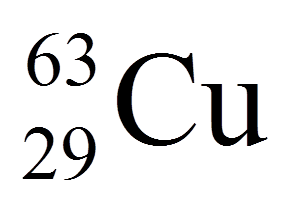
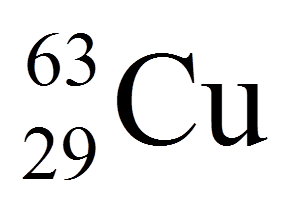
The top number in this isotope notation is
a)
the mass number
b)
the atomic number
c)
the atomic mass
d)
the neutron number
59.
The bottom number in this isotope notation is
a)
the mass number
b)
the atomic number
c)
the atomic mass
d)
the neutron number
60.
According to the isotopic notation for copper-63, how many neutrons are present in this type of atom?
a)
29
b)
34
c)
63
d)
92
61.
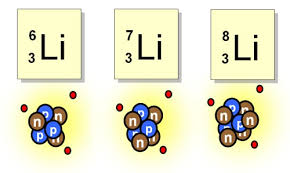
which atom has  4 neutrons?
a)
Li-6
b)
Li-7
c)
Li-8
d)
they have the same # of neutrons
62.

How many grams is 1.20 x1024 atoms of Silver?

a)

1.99 grams

b)

215 grams

c)

6.022 x101 grams

d)

1.2 x10¹² grams