wayground logo

Free Printable Worksheets

NEW

Font size

S
M
L
XL
Worksheets

Atoms and Periodic Table Review

Total questions: 63

Worksheet time: 45mins

Name
Class
Date
1.

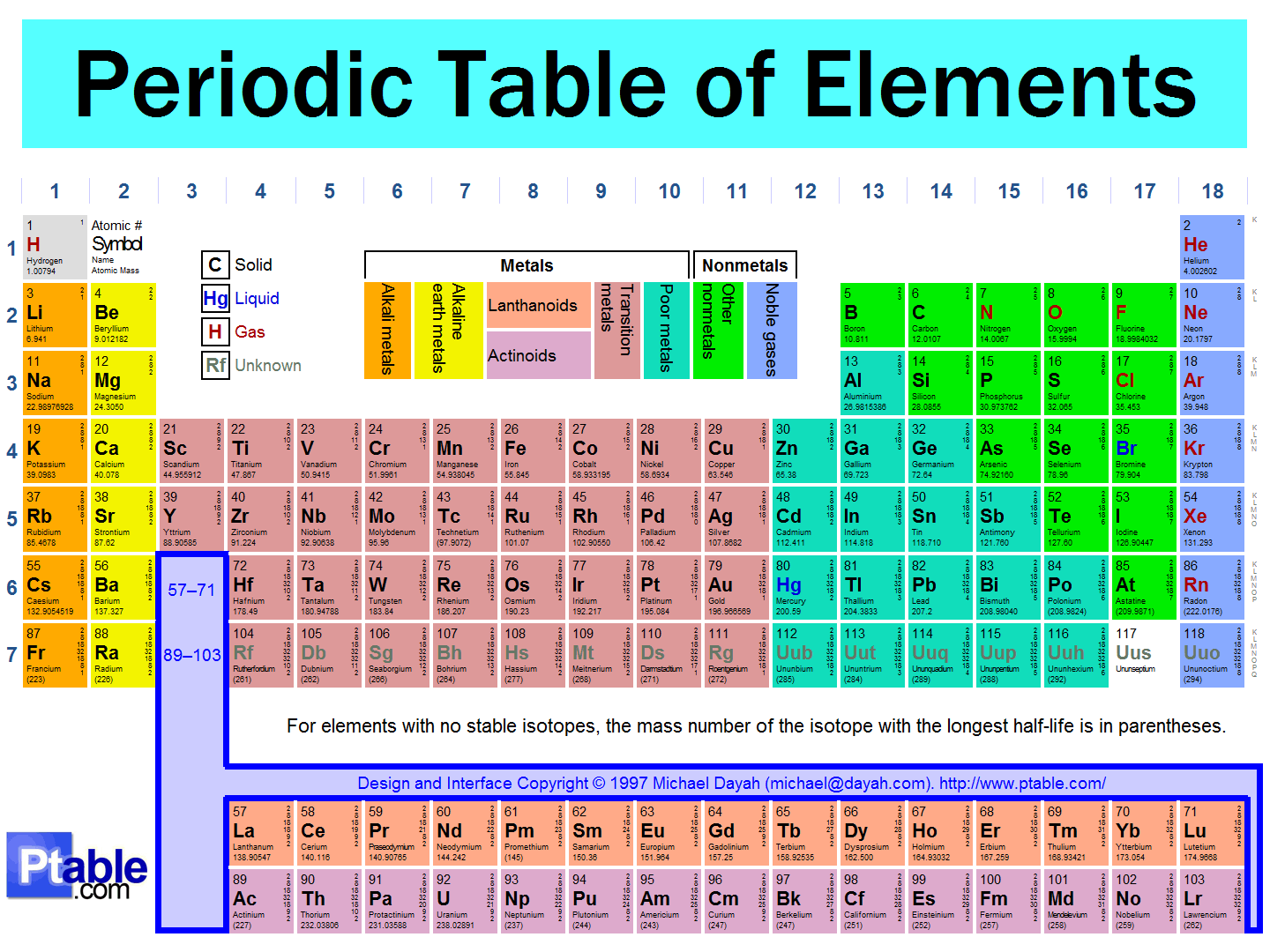
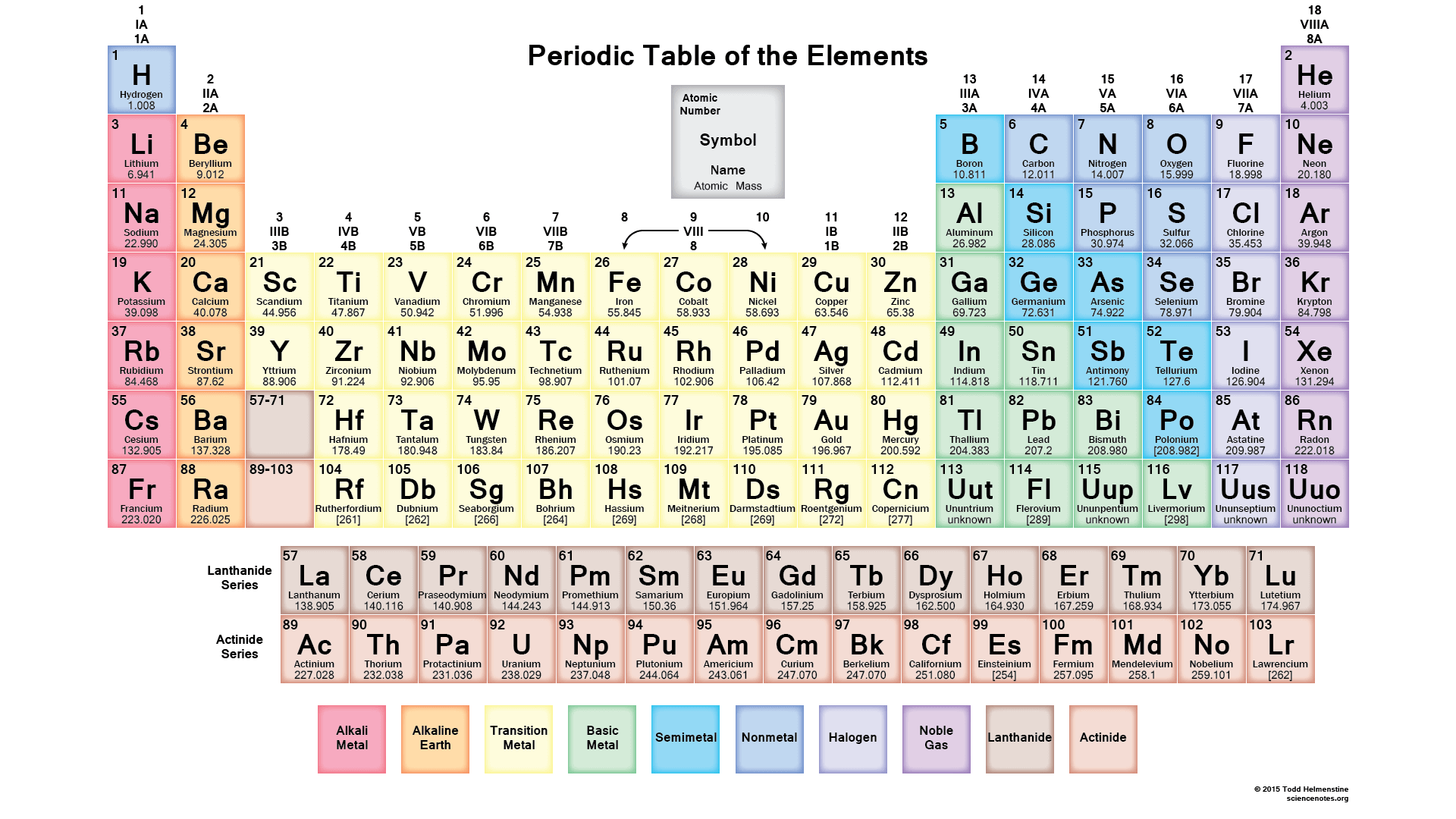
What is the atomic Mass of Copper?

a)

64

b)

29

c)

23

d)

63

2.

How many neutrons does an atom of Iron contain?

a)

55.847

b)

26

c)

30

d)

56

3.

How many electrons does a balanced atom of oxygen contain?

a)

8

b)

16

c)

0

d)

15.9994

4.

What is the atomic number of aluminum? What does this number represent?

a)

17, number of neutrons

b)

13, number of neutrons

c)

13, number of protons OR electrons

d)

27, number of neutrons + protons

5.

What is the charge of a neutron

a)

Neutral ; No charge

b)

Positive

c)

Positive or negative, depending on the atom

d)

Negative

6.

Where are protons located?

a)

In the energy levels surrounding the nucleus

b)

In the nucleus of an atom, with electrons

c)

In the nucleus of an atom, with neutrons

7.

Which of the following is represented by the Bohr Model?

a)

Cl

b)

F

c)

Ne

d)

Li

8.

How many electrons are in the outer most shell of Aluminum?

a)

2

b)

3

c)

1

d)

4

9.

How many electrons are in the outermost shell of Phosphorus?

a)

1

b)

6

c)

5

d)

4

10.

The vertical (up and down) columns in the Periodic Table are called

a)

groups

b)

towers

c)

periods

d)

atomic numbers

11.
Sodium (Na) is found in group 
a)
1
b)
2
c)
3
d)
4
12.

What subatomic particles would you find in the nucleus of an atom?

a)

Protons only

b)

Protons and Neutrons

c)

Neutrons and Electrons

d)

Protons and Electrons

13.
What is the atomic number of the atom pictured? 
a)
9
b)
10
c)
18
d)
19
14.
An electron has a _____ charge.
a)
negative
b)
positive
c)
neutral
15.
Which of the following has a full valence shell?
a)
Oxygen
b)
Neon
c)
Barium
d)
Carbon
16.
Elements on the LEFT side of the periodic table will most likely form:
a)
Positive ions
b)
Negative ions
c)
Neutral Ions
d)
None of these
17.
All chemical bonds involve two atoms sharing electrons.
a)
True
b)
False
18.
If an atom loses two electrons what charge will it have?
a)
+ 2
b)
 - 2
c)
+1
d)
-1
19.
If an atom gains one electron what charge will it have?
a)
-2
b)
-1
c)
+1
20.
Covalent compounds
a)
Share electrons
b)
transfer electrons
c)
contain a sea of electrons
d)
conduct electricity
21.
How many valence electrons in this structure?
a)
6
b)
5
c)
4
d)
7
22.
Is Hydrogen considered a metal or a non-metal?
a)
Metal
b)
Non-metal
23.

What is the chemical formula for Lithium + Nitrogen?

a)

Li3N

b)

LiN3

c)

NLi3

d)

N3Li

24.

What is the ionic formula for a bond between Calcium and Phosphorus?

a)

Ca2P3

b)

Ca3P2

c)

Ca2P5

d)

P5Ca2

25.

What category of element usually forms a positive ion?

a)

Metals

b)

Nonmetals

c)

metalloids

d)

Noble gases

26.

Which category of elements usually form negative ions?

a)

metals

b)

nonmetals

c)

metalloids

d)

noble gases

27.

CaCl2 is an example of what type of bond?

a)

Covalent

b)

Metallic

c)

Ionic

28.

Which of these combinations is an ionic compound made of?

a)

Metal and Metal

b)

Nonmetal and Nonmetal

c)

Metal and Nonmetal

d)

Cation and Cation

29.
Which is most likely to form a negative ion?
a)
an element from group 17
b)
a metal
c)
an element from group 1
d)
an element with atoms that have eight valence electrons
30.
Covalent bonds are between...
a)
Metal and Non-metal
b)
Non-metal and Non-metal
c)
Metal and Metal
31.
Is this ionic bond drawn correctly?
a)
Yes
b)
No
32.
What is a valence electron?
a)
The sum of neutrons and protons.
b)
The # of electrons in the last shell.
c)
A type of bond.
d)
A popular compound.
33.
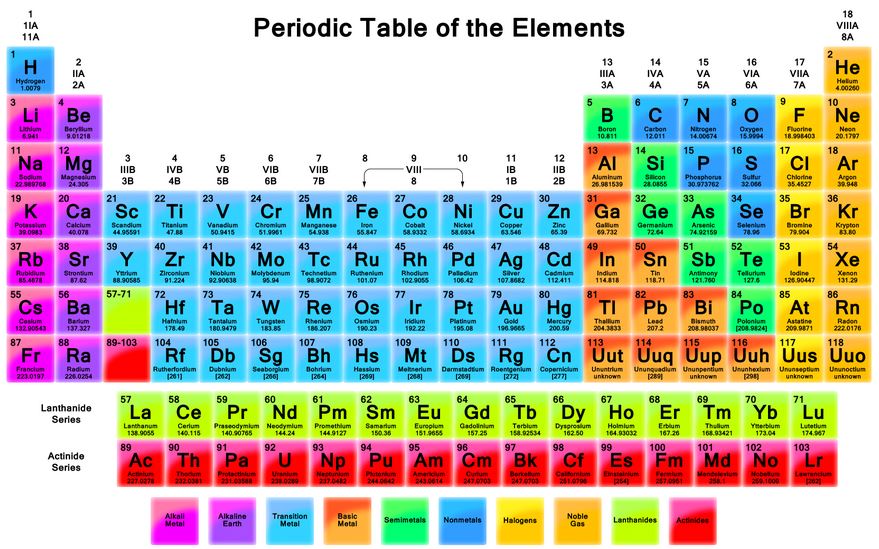
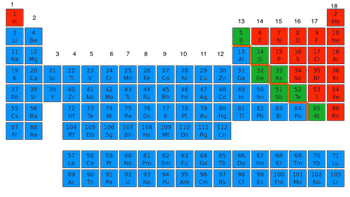
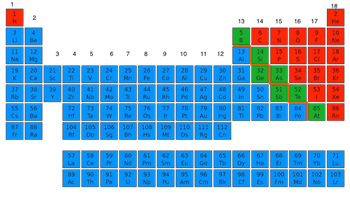
Where are metals located on the periodic table?
a)
Blue
b)
Green
c)
Red
34.
Where are the nonmetals located on the periodic table? 
a)
Blue
b)
Red
c)
Green
35.
Where are the metalloids located on the periodic table?
a)
Blue
b)
Red
c)
Green
36.
Which of the following is NOT an ionic compound:
a)
CaO
b)
NaOH
c)
BaCl2
d)
Br2
37.

Columns on the periodic table are known as __________.

a)

Periods

b)

Groups

c)

Pillars

d)

Grouper Fish

38.

How many valence electrons does this atom have?

a)

3

b)

5

c)

5

d)

11

39.

Which element has similar properties to Oxygen (O)?

a)

Cl

b)

He

c)

Mg

d)

S

40.

Which group is the most reactive nonmetal group?

a)

1

b)

17

c)

7

d)

18

41.

Which is the most reactive group of metals?

a)

1

b)

17

c)

11

d)

18

42.

Which subatomic particle determines an elements identity?

a)

Proton

b)

Neutron

c)

Electron

d)

Valence Electron

43.

If an element has 13 Protons, 13 electrons and a mass of 26.9, how many neutrons does it have?

a)

27

b)

14

c)

26

d)

0

44.

Which element in Period 2 has the greatest atomic radius?

a)

Be

b)

C

c)

Na

d)

Li

45.

Of the halogens, which has the smallest radius?

a)

F

b)

Br

c)

He

d)

At

46.
As you move across the periodic table from left to right, the atomic radius decreases.  This is because - 
a)
the number of protons increases, so attraction to electrons increases
b)
the number of energy levels increases
c)
the number of electrons increases
d)
the atomic mass increases
47.
Electronegativity __________ from left to right within a period and __________ from top to bottom within a group.
a)
decreases, increases 
b)
increases, increases
c)
increases, decreases 
d)
stays the same, increases
48.
Name group 2 on the periodic table.
a)
alkali metals
b)
alkaline earth metals
c)
noble gases
d)
transition metals
49.
Name groups 3 - 12 on the periodic table.
a)
noble gases
b)
halogens
c)
metalloids
d)
transition metals
50.

Name the following ionic compound: MgO

a)

Magnesium Oxide

b)

Monomagnesium monoxide

c)

Magnesium monoxide

d)

Magnesium oxygen

51.

Name the following covalent compound: NO2

a)

Nitrogen oxide

b)

Mononitrogen dioxide

c)

Nitrogen dioxide

d)

Nitrogen oxygen

52.

Name the following covalent compound: CF4

a)

Carbon fluoride

b)

Monocarbon tetrafluoride

c)

Carbon tetrafluoride

d)

Carbon fluorate

53.

Name the following ionic compound: NaF

a)

Sodium fluoride

b)

Monosodium fluoride

c)

Sodium monofluorine

d)

Sodium monofluoride

54.

Energy is released when

a)

valence electrons are removed from an atom

b)

valence electrons are gained by an atom

c)

a positive ion forms

d)

A and B

55.

What is the correct molecular formula of Calcium Chloride?

a)

CaCl

b)

Ca2Cl

c)

CaCl2

d)

Ca3Cl2

56.

An example of a covalent compound is

a)

sodium floride

b)

calcium chloride

c)

carbon dioxide

d)

all of the above

57.

The chemical formula for carbon dioxide is

a)

CO

b)

C2O

c)

CO2

d)

C2O2

58.

The correct name for the molecular formula CO is

a)

carbon monoxide

b)

carbon dioxide

c)

calcium oxide

d)

calcium dioxide

59.
How do the following two elements bond together?
Al3+  O2-         
a)
AlO
b)
Al2O3
c)
Al3O6
d)
Al3O2
60.
What formula results when Ca+2  and  Br- ions bond?
a)
Ca2Br2
b)
CaBr
c)
Ca(br)2
d)
CaBr2
61.

Which of the following is an ionic compound:

a)

CH4

b)

I2

c)

LiBr2

d)

CO

62.

The formula for Magnesium phosphide is:

a)

Mg3(PO4)2

b)

MgP

c)

MgPO4

d)

Mg3P2

63.
What is the correct formula for Sodium Oxide?
a)
NaO
b)
NaO2
c)
Na2O
d)
Na2O2