wayground logo

Free Printable Worksheets

Font size

S
M
L
XL
Worksheets

Periodic Table History and Use LC Chemistry

Total questions: 59

Worksheet time: 30mins

Name
Class
Date
1.
Which of these was not proposed by John Dalton in 1805?
a)
All matter is made of atoms
b)
Atoms are made of protons, neutrons and electrons
c)
During chemical reactions, atoms rearrange themselves
d)
The atoms of a particular element are all identical
2.
What was Dmitri Mendeleev's greatest contribution to the history of the periodic table?
a)
He arranged all of the known elements by their atomic number
b)
He realised that there was a pattern of reactivity which repeated every 8 elements
c)
He predicted the existence (and properties) of new elements
d)
He identified the "law of triads" which became the groups
3.
What was significant about the X-ray experiments performed by Henry Moseley?
a)
It demonstrated that all atoms contained protons in their nuclei
b)
It explained what made up the "missing" mass in the nucleus
c)
It led to the idea that electrons can only occupy specific "orbits" around the nucleus
d)
It allowed people to determine the nuclear charge of any atom
4.
The periodic table is organized by the number of ______ in each element's nucleus
a)
neutrons
b)
protons
c)
electrons
d)
atoms
5.
Who arranged the first periodic table.
a)
Mosely
b)
Einstein
c)
Mendeleev
d)
Bohr
6.
What property did Menedleev use to organize his first periodic table?
a)
atomic number
b)
atomic mass
c)
alphabetical order
d)
chemical properties
7.
The periodic law states that if you organize elements by their atomic mass 
a)
elements will overlap
b)
elements will not share properties
c)
physical properties will remain the same.
d)
chemical properties will occur periodically. 
8.
Scientist who first grouped the elements in groups of threes (triads).
a)
Johann Dobereiner
b)
John Newlands
c)
Demitri Mendeleev
d)
Henry Mosely
9.
Which of the following models of an atom is most widely accepted as correct?
a)
Bohr model
b)
Quantum-mechanical model
c)
Atomic model
d)
Radioactive model
10.
Why did scientists need/want to organize the elements?
a)
Scientists like things organized
b)
make it easier to understand the elements
c)
have one list of the known elements.
d)
none of the above
11.
2. What were the scientists looking for among the element properties to help them organize?                                  
a)
boiling points 
b)
chemical reactivity 
c)
patterns among properties 
d)
naming similarities          
12.
Why did Dobereiner group his triads the way he did?
a)
each triad had the same mass.
b)
each triad had the same number of protons.
c)
each triad had a similar name.
d)
each triad had elements with similar properties.
13.
Did all of Dobereiner's triads obey the average atomic mass rule?
a)
no his version of the periodic table is no longer used.
b)
yes, his triads are incorporated into the modern periodic table.
14.
What property did Newlands use to arrange his elements?                               
a)
atomic mass
b)
 number of protons 
c)
atomic size     
d)
melting point      
15.
Newlands compared his arrangement to a piano and called it what?  
a)
Newlands Piano
b)
Piano Keys of Newlands
c)
Newlands Octaves
d)
Beethoven's Octaves
16.
Mendeleev classified elements based on not only atomic mass but what else?                                                   
a)
reactivity
b)
boiling points
c)
physical properties only 
d)
 chemical & physical properties
17.
How many elements were discovered during Mendeleev's time?                                           
a)
63
b)
56
c)
101
d)
34
18.
Why were there blank spaces left in Mendeleev's periodic table?                                              
a)
He didn't know what to put there.
b)
 Undiscovered elements not yet known.
c)
Multiple elements could have fit
d)
He forgot to add the elements in.
19.
Moseley discovered that the ________ was the most fundamental property needed for organization.                                                 
a)
atomic mass
b)
mass number
c)
atomic number
d)
number of protons
20.
Which statement is not a difference between Mendeleev's table and the modern periodic table?
a)
there are no transition elements Mendeleev's table.
b)
Elements are arranged according to atomic no. not atomic mass.
c)
no gaps in the modern periodic table.
d)
much more than 60 elements in the modern periodic table.
21.

How are elements organized in the periodic table ?

a)

Alphabetically

b)

Based on physical and chemical properties

c)

Increasing number of electrons

d)

Most reactive to least reactive

22.

Most elements on the periodic table are classified as ____________.

a)

Gases

b)

Metalloids

c)

Metals

d)

Nonmetals

23.

Groups on the periodic table are arranged...

a)

Vertically

b)

Horizontally

c)

Diagonally from bottom right corner

d)

Diagonally from top right corner

24.

Which accurately describes nonmetals?

a)

Poor conductors of electricity

b)

Often used in computer parts

c)

Both malleable and ductile

d)

Both dull and brittle

25.

Which group on the periodic table is the most reactive?

a)

Group 1

b)

Group 2

c)

Group 13

d)

Group 18

26.

What is the chemical symbol for Sodium?

a)

S

b)

So

c)

Na

d)

Ca

27.

How many neutrons does Chlorine have?

a)

17

b)

36

c)

35

d)

18

28.

How many periods are there in the periodic table?

a)

7

b)

9

c)

10

d)

18

29.

Each horizontal row on the periodic table is called a what?

a)

Group

b)

Row

c)

Period

d)

Family

30.

Identify the unknown atom.

a)

Flourine

b)

Beryllium

c)

Boron

d)

Helium

31.

Vertical columns on the periodic table are called ___?

a)

groups

b)

periods

c)

rows

d)

families

32.

Which color on the image of the periodic table corresponds with the halogens.

a)

red

b)

black

c)

blue

d)

orange

33.

Which color on the image of the periodic table corresponds with the transition metals.

a)

red

b)

black

c)

blue

d)

orange

34.

Which color on the image of the periodic table corresponds with the metalloids.

a)

bright yellow

b)

gold

c)

teal

d)

light blue

35.

Which color on the image of the periodic table corresponds with the alkaline earth metals.

a)

yellow

b)

dark yellow

c)

blue/green

d)

teal

36.

Which color on the image of the periodic table corresponds with the alkaline earth metals.

a)

yellow

b)

dark yellow

c)

blue/green

d)

teal

37.

Which family of elements does not combine with other elements unless under special conditions in a laboratory?

a)

Noble gases

b)

Halogens

c)

Metalloids

d)

Alkaline earth metals

e)

Actinides

38.

What are valence electrons?

a)

Any of an atom's electrons

b)

Electrons located on the first energy level

c)

Electrons not attached to any atom

d)

electrons located on the outer energy level

39.

How many electrons does Barium (Ba) have?

a)

13

b)

2

c)

71

d)

56

40.

How many electrons does a Strontium (Sr) ION have?

a)

38

b)

10

c)

8

d)

36

41.

How many electrons does a Strontium (Sr) ION have?

a)

38

b)

10

c)

8

d)

36

42.

Why are halogens so reactive?

a)

They want to get rid of their only valance electron

b)

They only need one more electron

c)

They are non reactive, they have a full shell

43.

How many valence electrons does a carbon atom have?

a)

8

b)

4

c)

2

d)

6

44.

How do you calculate the number of neutrons? *

a)

Mass = Atomic number - Neutrons

b)

Mass - Atomic number = Neutrons

c)

Atomic number = Neutrons

45.

What is the name of the element? (Periodic table will be needed)

a)

sodium

b)

magnesium

c)

vanadium

46.

How many valence electrons does the element have?

a)

1

b)

2

c)

3

d)

4

47.

How many protons and electrons does nickel have?

a)

28

b)

58.69

48.

What is the atomic mass?

a)

58.693

b)

28

49.

What is the name of a positive atom?

a)

Cation

b)

Positron

c)

Anion

d)

Negatron

50.

What makes an atom negative?

a)

More protons than neutrons

b)

More electrons than protons

c)

More protons than electrons

d)

more neutrons than protons

51.

How many diatomic elements are there?

a)

6

b)

7

c)

8

d)

118

52.

What does the atomic number tell you about an element?

a)

The number of protons in the nucleus of one atom of an element

b)

The number of electrons in the nucleus of one atom of an element

c)

The number of neutrons in the nucleus of one atom of an element

d)

The number of electrons orbiting the nucleus of one atom of an element

53.

Isotopes are atoms of the same element with different #’s of __________ & therefore different __________.

a)

neutrons ; atomic numbers

b)

protons ; atomic numbers

c)

electrons ; mass numbers

d)

neutrons ; mass number

54.
How many neutrons does an atom of the isotope Neon-22 have?
a)
12
b)
10
c)
22
d)
20
55.
How many neutrons does the isotope of lithium have?
a)
8
b)
3
c)
4
d)
5
56.

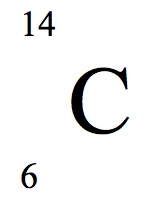
The photo above shows the isotopic notation for which isotope?

a)

Carbon 12

b)

Carbon 13

c)

Carbon 14

d)

Carbon 15

57.
How many neutrons does a Calcium 48 isotope have?
a)
16
b)
20
c)
28
d)
12
58.
In a stable atom the amount of electrons is electron is equal to
a)
neutrons
b)
protons
c)
atomic mass
d)
neutrons + protons
59.
What quantities vary between isotopes of an element?
a)
protons, electrons, and atomic mass
b)
protons, electrons, and atomic number
c)
neutrons and electrons
d)
neutrons and atomic mass