wayground logo

Free Printable Worksheets

NEW

Font size

S
M
L
XL
Worksheets

CBA #1 Review

Total questions: 60

Worksheet time: 41mins
Name
Class
Date
1.
When is it OK to eat or drink in the lab?
a)
Always
b)
Never
2.
If you break glassware in the lab, you should...
a)
Tell the teacher
b)
Clean it up quickly before the teacher notices
c)
Scream at the top of your lungs
3.
When in the lab...
a)
long sleeves and loose clothing should be rolled up
b)
closed toe shoes should be worn
c)
long hair should be pulled back
d)
all of the above
4.
 If you do not understand a direction or part of a lab procedure, you should 
a)
skip it and go on to the next part.
b)
ask the instructor before proceeding
c)
try several methods until something works
d)
figure it out as you do the lab
5.
 After completing an experiment, all chemical wastes should be
a)
taken home
b)
dumped in the sink
c)
disposed of according to your instructor’s directions
d)
left at your lab station for the next class
6.
What does the blue diamond tell you?
a)
Flammability Hazard
b)
Health Hazard
c)
Stability Hazard
d)
Radioactive Hazard
7.

What level of hazard does the blue diamond have?

a)

None

b)

Slight

c)

Moderate

d)

High

8.
What does the red diamond tell you?
a)
Slight Health Hazard
b)
High Radioactive Hazard
c)
Moderate Health Hazard
d)
Moderate Flammability Hazard
9.
What Hazard is represented with the white diamond?
a)
Flammability
b)
Health
c)
Stability
d)
Radioactive 
10.
In the hazard diamond the red diamond represents what?
a)
specific hazards
b)
Fire 
c)
Health Hazard 
d)
Reactivity 
11.
What is the part of the experiment that is left alone or “natural", and is used to compare back to?
a)
Independent Variable
b)
Dependent Variable
c)
Control Group
d)
Experimental Group 
12.
When you decide whether or not the data supports the original hypothesis, you are
a)
drawing conclusions
b)
forming a hypothesis
c)
asking questions
d)
making observations
13.
A possible explanation to a problem that has not yet been tested. 
a)
data
b)
theory
c)
hypothesis
d)
fact
14.
What step does every scientific experiment begin with?
a)
hypothesis
b)
question/problem
c)
procedures
d)
conclusion
15.
The summary at the end of an experiment that explains the results. 
a)
conclusion
b)
procedures
c)
materials
d)
responding variable
16.
Observations made during an experiment are called:
a)
data
b)
problems
c)
conclusions
d)
questions
17.
An experiment is performed on plants to see how different liquids affect plant growth. Each plant in the experiment is given a different liquid; water, apple juice, or milk. Each plant has the same amount of soil, sunlight, and listens to the same music. In this investigation, what are the controlled variables?
a)
Type of plant, amount of music, and sunlight
b)
Water, apple juice, milk
c)
Plant growth
18.
An experiment is performed on plants to see how different liquids affect plant growth. Each plant in the experiment is given a different liquid; water, apple juice, or milk. Each plant has the same amount of soil, sunlight, and listens to the same music. In this investigation, the independent variable is ...
a)
The type of plant
b)
The amount of sunlight
c)
The type of music
d)
The type of liquid
19.
Which is NOT a step in the scientific method?
a)
Make observation
b)
Form a theory
c)
Collect data
d)
Form a hypothesis
20.
Squidward found new reeds to tryout for his clarinet.  He used an APPLAUSOMETER to measure applause after playing  Under the Sea with each reed.  The results were put in the table.
What was controlled?
a)
The Song
b)
The Reed
c)
The Applause
21.
Squidward found new reeds to tryout for his clarinet.  He used an APPLAUSOMETER to measure applause after playing  Under the Sea with each reed.  The results were put in the table.
What was the independent variable?
a)
The Song
b)
The Reed
c)
The Applause
22.
The data collected supports which of the following questions that Squidward could have tested?
a)
Which song does the audience prefer?
b)
Which instrument does the audience like best?
c)
Which reed length creates the best sound?
d)
How do applause affect performance?
23.
How many sig figs are there?
0.0009009090000
a)
3
b)
10
c)
14
24.

Calculate 12.34 + 1.234 + 0.1234 and give your answer with the appropriate number of significant figures.

a)

13.6974

b)

13.697

c)

13.70

d)

13.7

25.
Calculate 1.23 m x 0.89 m and give your answer with the appropriate number of significant figures.
a)
1.0 m2
b)
1.1 m2
c)
1.0947 m2
d)
1.09 m2
26.
Which form of matter does not take the shape of its container?
a)
liquid
b)
gas
c)
solid
d)
air
27.
How is a gas defined?
a)
Indefinite shape, indefinite volume
b)
Definite shape, definite volume
c)
Found in stars
d)
Definite volume, indefinite shape
28.
Particles of a liquid
a)
are tightly packed together and stay in a fixed position.
b)
have no viscosity.
c)
decrease in volume with increasing temperature.
d)
are free to move around one another but still touch.
29.
Molecules are closest together in a 
a)
Solid
b)
Liquid
c)
Gas
30.
The state of matter that has no definite size or shape is
a)
Solid
b)
Liquid
c)
Gas
31.
Define a liquid.
a)
Indefinite shape, indefinite volume
b)
Definite shape, definite volume
c)
Found in stars
d)
Definite volume, indefinite shape
32.
What does this picture represent? 
a)
solid
b)
liquid
c)
gas
d)
plasma
33.
What does this picture represent? 
a)
solid
b)
liquid 
c)
gas
d)
plasma
34.
What does this picture represent?
a)
solid
b)
liquid
c)
gas
d)
plasma
35.
Are made from a combination of 2 or more elements...
a)
Molecules
b)
Pure Substances
c)
Compounds
d)
Elements
36.
A combination that can be separated by physical processes is a .....
a)
Pure Substance
b)
Glucose
c)
Element
d)
Mixture
37.
Mixture, such as mixed nuts or dry soup mix, in which different materials are unevenly distributed and are easily identified.
a)
suspension
b)
homogeneous mixture
c)
heterogeneous mixture
d)
colloid
38.
Substance with atoms that are all alike.
a)
element
b)
compound
c)
homogeneous mixture
d)
heterogeneous mixture
39.
Which of the following is not an element?
a)
water
b)
hydrogen
c)
carbon
d)
oxygen
40.
Which of the following IS a mixture?
a)
air
b)
hydrogen
c)
water
d)
sugar
41.
Table salt is an example of a.....
a)
pure element
b)
pure compound
c)
heterogeneous mixture
d)
homogeneous mixture
42.
This picture represents: 
a)
Element
b)
Compound
c)
Mixture of Elements
d)
Mixture of Compounds
43.
Matter is defined as anything that _____
a)
can be weighted
b)
contains kinetic energy
c)
has mass and takes up space
d)
many colors
44.
Changing the phase, size or shape of something....
a)
Chemical change
b)
Physical Change
c)
Suspension
d)
Colloid
45.
If you change a substance into a new substance...
a)
Partial Change
b)
Physical Change
c)
Chemical Change
d)
Freezing
46.
Which is NOT a chemical change?
a)
Leaves changing colors in the fall
b)
Iron rusting
c)
Digesting Lunch
d)
Ice Melting
47.
Any characteristic of a material, such as shape or size, that you can observe or attempt to observe without changing the identity of the material.
a)
physical change
b)
chemical change
c)
physical property
d)
chemical property
48.
Which of the following is not a clue that a chemical change is taking place?
a)
rapid release of energy (heat, light, or sound)
b)
phase change
c)
formation of bubbles
d)
formation of a precipitate from solution
49.
A magnet was placed near a pile that contained both iron and sulfur. The magnet was moved gradually closer to the pile. As it neared the pile, the magnet started attracting small pieces of iron from the pile. 
Which of these statements best describes the contents of the pile?
a)
It is a heterogeneous mixture of iron and sulfur that can be separated by magnetism.
b)
It is a solution of iron and sulfur that can be separated by magnetism.
c)
 It is a compound of iron and sulfur that can be separated by magnetism.
d)
It is a suspension of sulfur in iron that can be separated by magnetism.
50.
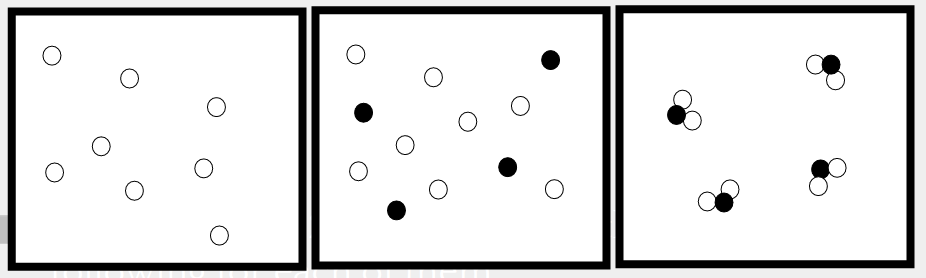
Which one of these pictures represents a pure substance? 
a)
1 and 2
b)
1 and 3
c)
2 and 3
d)
1, 2 and 3
51.
Which one of these pictures represents a mixture? 
a)
1
b)
2
c)
3
d)
1, 2 and 3
52.

What is the best description of an intensive property?

a)

a property of matter that does not change as the amount of matter changes

b)

a property of matter that depends on sample size

53.

What is the best description of extensive property?

a)

a property of matter that does not change as the amount of matter changes

b)

a property of matter that depends on sample size

54.

Which of the following is an example of an intensive property?

a)

color

b)

mass

c)

volume

d)

length

55.

Which of the following is an example of an intensive property?

a)

length

b)

mass

c)

boiling point

d)

volume

56.

Which of the following is an example of intensive property?

a)

volume

b)

density

c)

length

d)

mass

57.

Which of the following is an example of an extensive property?

a)

pressure

b)

volume

c)

concentration

d)

odor

58.

Which of the following is an example of an extensive property of matter?

a)

Density

b)

color

c)

temperature

d)

length

59.

Which of the following is an example of an extensive property?

a)

color

b)

odor

c)

density

d)

mass

60.

Conductivity (the ability to conduct electricity) is an example of a ________________ property

a)

extensive

b)

intensive