
 Worksheets
Year 10 Chemistry Revision
Total questions: 64
Worksheet time: 46mins
What is the name of the element with an atomic number of 3?
Lithium
Magnesium
Sodium
Potassium
The atomic mass of an element tells you
The number of protons and neutrons
The number of protons and electrons
The number of neutrons and electrons
The number of neutrons only
The atomic number tells you
The number of electrons
The number of protons
The number of neutrons
The number of nucleons
The electronic configuration of a magnesium ATOM is
2, 8
2, 8, 3
2, 6
2, 8, 2
Which element has an electronic configuration of 2, 7
Chlorine
Bromine
Fluorine
Iodine

Write the electronic configuration of the Boron atom (as an ion)
2, 3
3, 2, 1
1
2
Which statement best describes the following species: Al3+
This is an aluminium cation. It has lost 3 electrons
This is an aluminium cation. It has gained 3 electrons
This is an aluminium anion. It has lost 3 electrons
This is an aluminium anion. It has gained 3 electrons
Metallic bonding takes place between
A metal and non-metal
Elements from groups 1-3 and transition metals
Two non-metals
A non-metal and a noble gas
When hydrogen and sulfur react together, they undergo which type of bonding?
Metallic
Ionic
Teronic
Covalent
How would you name the following compound? MgS2
Magnesium sulfur
Dimagnesium sulfide
Magnesium sulfide
Magneside sulfide
Write the formula for calcium chloride
CaCl
Ca2Cl
CaCl2
Ca3Cl2
What process is used to separate crude oil in hydrocarbons with different chain lengths?
distillation
fractional distillation
cracking
polymerisation
Fractional distillation separates crude oil based on the different __________ of the molecules in the mixture
melting point
boiling point
freezing point
chemical reactivity
Molecules collected at the bottom of the fractionating column tend to be...
more viscous, less flammable and less volatile
less viscous, more flammable and more volatile
more viscous, more flammable and less volatile
less viscous, less flammable and more volatile
Molecules collected at the top of the fractionating column tend to be...
more viscous, less flammable and less volatile
less viscous, more flammable and more volatile
more viscous, more flammable and less volatile
less viscous, less flammable and more volatile
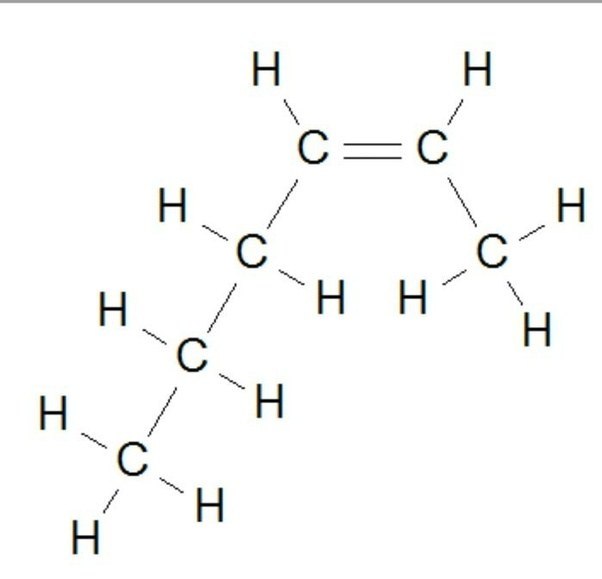
Name the following hydrocarbon
butane
hexane
heptane
hexene
When testing for alkenes (unsaturation) bromine water turns from...
orange --> blue/black
colourless --> pink
orange --> colourless
orange --> clear
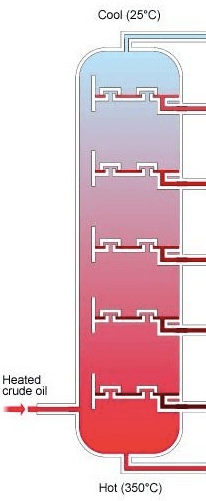
What process happens at each level in the fractionating column?
Evaporation
Condensation
Combustion

Where do long chain hydrocarbons collect?
At the top
In the middle
At the bottom

What chemical is this? (C5H10)
Pentene
Pentane
Hexane
Heptene
Which of the following shows the structure of propene?


Which of the following elements will form a cation?
Arsenic
Copper
Bromine
Fluorine
Which of the following will form an anion?
Tin
Lead
Chlorine
Zinc
Calcium (Ca) has 20 electrons. Its electron configuration is
2, 8, 8, 2
20
2, 2, 8, 8
2, 8, 6, 4
An ion is
Also a compound
An atom that has gained or lost an electron
An atom that has only gained electrons
An atom where the number of protons=electrons
Cations
Gain electrons, has an overall positive charge
Lose electrons, has an overall positive charge
Lose electrons, has an overall negative charge
Gain electrons, has an overall negative charge
Anions
Gain electrons, has an overall positive charge
Lose electrons, has an overall positive charge
Lose electrons, has an overall negative charge
Gain electrons, has an overall negative charge
How do we test for CO2 as a product of a chemical reaction in the lab?
Pop Test
Lit Splint Test
Limewater Test
How do we test for H2 as a product of a chemical reaction in the lab?
Pop Test
Lit Splint Test
Limewater Test
How do we test for O2 as a product of a chemical reaction in the lab?
Pop Test
Glowing Splint Test
Limewater Test
Which of the following is true for ionic bonding & ionic compounds?
They must be made of ions with like charges.
The negative ion must be written first.
Compounds must have an overall charge of zero.
They are made of metals and nonmetals.
The positive ion must be written first.
What is the charge of ion "X" in the formula XF3?
+3
-3
+1
-1
Ionic bonds happen because of the ____ of valence electrons.
sharing
transfer
keeping
covering

Which of the following is the best representation of a molecule of fluorine (F2)?
A
B
C
D
What is the state of matter symbol for a soluble compound?
(s)
(aq)
(g)
(l)

Is NaCl (sodium chloride) soluble or insoluble?
Soluble
Insoluble
Neither
Soluble and Insoluble

Predict the product(s) of this reaction (Don't worry about balancing the equation)
Pb(NO3)2 + KI →
PbK(s) + INO3(aq)
No Reaction
PbI2(s) + KNO3(aq)
PbI2(aq) + KNO3(s)

Predict the products of the following equation.
MgCl2 + AgNO3 ---->
AgCl(s) + Mg(NO3)2(aq)
No Reaction
AgCl(aq) + Mg(NO3)2(s)
AgCl(s) + MgNO3(aq)

Predict the products fo the following equation.
CuCl2 + H2S ---->
CuS(s) + HCl(aq)
Cu2S(s) + HCl(aq)
No reaction
CuS(s) + HCl(s)

Predict the products of the following reaction.
H2SO4 + BaCl2 ---->
BaSO4(s) + HCl(aq)
BaSO4(aq) + HCl(s)
No Reaction
ClSO4(aq) + BaH(s)
Sulphuric acid + sodium carbonate
-->
Hydrochloric acid + magnesium hydroxide -->
Because carbon has 4 valence electrons
it can form up to 4 covalent bonds
it can form ionic bonds
it can form only double bonds
it can form covalent bonds with H only


