wayground logo

Free Printable Worksheets

Font size

S
M
L
XL
Worksheets

Chemistry Test 3 Review - CWHS

Total questions: 64

Worksheet time: 1hrs 4mins
Name
Class
Date
1.
What elements generally make an ionic bond?
a)
metal and nonmetal
b)
2 or more nonmetals
c)
metal
d)
none of the above
2.
When forming an ionic bond, a metal atom
a)
Gains electrons to form a cation
b)
Loses electrons to form a cation
c)
Gains electrons to form an anion
d)
Loses electrons to form an anion
3.
An ionic bond forms when 
a)
Valence electrons are shared
b)
a sea of mobile electrons surround the cations
c)
valence electrons are transferred between atoms
d)
none of the above
4.
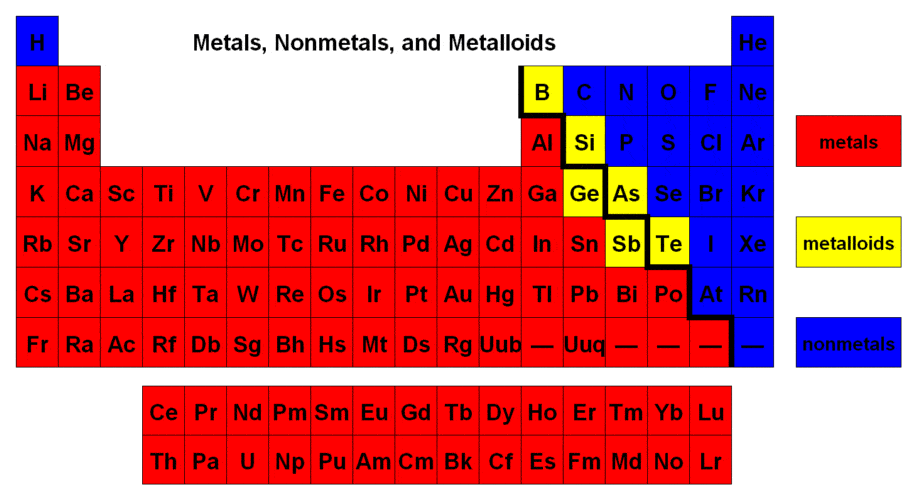
Predict the bond that will form between Se and Cl.
a)
Ionic
b)
Covalent
5.
The polarity of a bond between two elements can be best determined by
a)
The difference in electronegativity between the elements
b)
The difference in first ionization energy between the elements
c)
The number of electrons shared in the bond
d)
The difference in atomic radius between the elements
6.

Which electron configuration rule says that "Electrons occupy the lowest energy orbital available."

a)

Hund's rule

b)

Pauli exclusion principle

c)

aufbau principle

7.

Which electron configuration rule says that "In a sublevel, all orbitals must have at least one electron before a second electron can fill the orbital."

a)

Hund's rule

b)

Pauli exclusion principle

c)

aufbau principle

8.

Which part of the Quantum Mechanical Model describes the shape of the electron cloud?

a)

Electron

b)

Orbital

c)

Sublevel

d)

Energy Level

9.

Which electron configuration rule says that "There is a maximum of two electrons per orbital"

a)

Hund's rule

b)

Pauli exclusion principle

c)

aufbau principle

10.
Predict the bond that will form between Be and F.
a)
Ionic
b)
Covalent
11.
Predict the bond that will form between Sr and S.
a)
Ionic
b)
Covalent
12.
Force that holds together atoms in a substance.
a)
compound
b)
ion
c)
chemical bond
d)
ionic bond
13.
How many elements make up this compound?
a)
6
b)
4
c)
2
d)
3
14.

Is this compound Ionic or Covalent: Ca3(PO4)2

a)

ionic

b)

covalent

15.

What type of bond will conduct electricity in a dissolved state?

a)

ionic

b)

covalent

16.

All are properties of a metallic compound, except for __

a)

Conducts electrity

b)

Does not dissolve in water

c)

Brittle and easy to break

d)

Made entirely of metal atoms

17.

Which of these substances conducts electricity as a solid. ____ (Make all that apply)

a)

SiO2 (sand)

b)

Sodium Bicarbonate (baking soda)

c)

Gold

d)

Sugar

18.
If an atom becomes an ion with a 2+ charge, what does that mean?
a)
It has lost 2 electrons
b)
It has gained 2 electrons
c)
The atom is in period 2
d)
The atom has an atomic # of 2
19.
How do the following two elements bond together?
Cr3+  O2-         
a)
CrO
b)
Cr3O2
c)
Cr2O3
d)
CrO3
20.
How do the following two elements bond together?
K1+  S2- 
a)
KS
b)
K8S
c)
K6S3
d)
K2S
21.
What is the formula for magnesium chloride?
a)
MgCl
b)
Mg2Cl
c)
MgCl2
d)
Mg(ClO3)2
22.
What is the formula for copper(I) sulfate?
a)
Cu(SO3)
b)
Cu(SO4)
c)
Cu2(SO3)
d)
Cu2(SO4)
23.

What are the four kinds of sublevels that appear on the periodic table?

a)

a,b,c,d

b)

s,p,d,f

c)

g,h,i,j

d)

x,y,z,aa

24.

Hydrogen nitrite (nitrous acid)

a)
H2NO3
b)
HNO3
c)
HNO2
d)
H2NO2
25.
What is the element/ion symbol for Iron(III)?
a)
Fe
b)
Fe3+
c)
Fe3-
d)
Fe(III)
26.
What is the name of the compound Li(OH)?
a)
lithium hydrogen oxide
b)
lithium hydroxide
c)
lithium hydride
d)
lithium oxide hydride
27.
The chemical formula for an ionic compound of potassium and oxygen is
a)
KO.
b)
K2O.
c)
K2O2.
d)
KO2.
28.
Name this compound: 
Ca(CO3)
a)
Calcium carbon oxide
b)
Calcium (II) carbonate
c)
Calcium carbonate
d)
Carbonate (I) calcide
29.
What is the formula for sodium nitrate?
a)
Na3(NO)
b)
Na(NO)
c)
Na3(NO3)
d)
Na(NO3)
30.
What is the compound made between Chlorate and Magnesium
a)
Cl2Mg
b)
(ClO3)2Mg
c)
MgCl2
d)
Mg(ClO3)2
31.
How do the following two elements bond together?
Pb4+  O2-       
a)
PbO
b)
Pb4O2
c)
PbO2
d)
Pb2O4
32.
The name of FeCl₂ is
a)
iron chloride
b)
iron (II) chloride
c)
iron (I) chloride
d)
iron dichloride
33.
The name of Cu₃N₂ is
a)
copper (III) nitride
b)
copper (II) nitride
c)
copper nitride
d)
tricopper dinitride
34.
Whats the formula
Sr+2  +  (CO3)-2
a)
Sr(CO3)
b)
Sr(CO3)2
c)
Sr1(CO)5
d)
Sr(CO5)
35.
What is the formula for Copper II Sulfide?
a)
CuS
b)
Cu₂S
c)
CuS₂
d)
CuSO₃
36.
What is the name of N2O3
a)
Nitrogen trioxide
b)
Dinitrogen oxide
c)
Dinitrogen trioxide
d)
Nitrogen oxide
37.
What is the name of C3Cl?
a)
Carbon octachloride
b)
Tricarbon octachloride
c)
Carbon trichloride
d)
Octacarbon trichloride
38.
What is the name of Br6F10 ?
a)
Bromium fluoride
b)
Hexabromine fluoride
c)
Bromium decafluoride
d)
none of the above
39.
BrO3
a)
bromine oxide
b)
monobromine trioxide
c)
bromine trioxide
d)
bromine (III) oxide
40.
What is the correct name for C4H6?
a)
Carbon Hexahydride
b)
Pentacarbon Pentahydride
c)
Hexacarbon Tetrahydride
d)
Tetracarbon Hexahydride
41.
What is the correct name for NO?
a)
Mononitrogen Monoxide
b)
Nitrogen Monoxide
c)
Mononitrogen Dioxide
d)
Nitrogen Oxide
42.

Unlike Ionic compounds, Covalent compounds require what when naming them?

a)

A roman numeral

b)

A charge

c)

A prefix

43.

When is the prefix mono not used?

a)

It is never used when naming covalent compounds

b)

It is never used on the second element

c)

It is never used when on the first element

44.

What is the name for NI3?

a)

Mononitrogen TretraIodide

b)

Nitrogen Triiodide

c)

Nitrogen (III) Triiodide

d)

Nitrogen Iodide

45.

In covalent bonds elements ____________ electrons.

a)

donate

b)

give

c)

share

46.

Which neutral element does this orbital diagram belong to?

a)

Sulfur

b)

Carbon

c)

Oxygen

d)

Neon

47.

Classify the following molecule as polar or nonpolar: F2

a)

Polar

b)

Nonpolar

48.
HCl
a)
Polar 
b)
Nonpolar 
49.
H2O
a)
Polar 
b)
Nonpolar 
50.

NH4+

(a)  

51.

CH3COO-

(a)  

52.

ClO3-

(a)  

53.

Which orbital diagram is INCORRECT?

a)

1st

b)

2nd

c)

3rd

d)

4th

54.

CN-

(a)  

55.

HCO3-

(a)  

56.

CO3-2

(a)  

57.

OH-

(a)  

58.

NO2-

(a)  

59.

NO3-2

(a)  

60.

SO4-2

(a)  

61.

PO4-3

(a)  

62.

MnO4-

(a)  

63.

CrO4-2

(a)  

64.

O2-2

(a)