wayground logo

Free Printable Worksheets

NEW

Font size

S
M
L
XL
Worksheets

PAP Atomic Structure Test Review

Total questions: 60

Worksheet time: 53mins
Name
Class
Date
1.
Particles in an atom's nucleus that are neutral and have no charge are 
a)
megatrons. 
b)
electrons.
c)
neutrons.
d)
protons. 
2.
An atom with atomic number 6 would have how many protons?
a)
6
b)
12
c)
3
d)
cannot be determined 
3.
A negatively charged particle that moves around the nucleus is a(n)
a)
proton
b)
neutron
c)
electron
d)
quark
4.
Most of an atom's mass is found in the
a)
electrons.
b)
nucleus.
5.
A neutral atom of the element sodium has 11 protons and ____ electrons.
a)
22
b)
23
c)
8
d)
11
6.
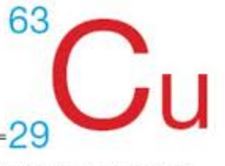
How many electrons does a Copper atom have?
a)
63
b)
29
c)
92
d)
34
7.
What is the atomic number for an element with 41 neutrons and a mass number of 80?
a)
39
b)
41
c)
80
d)
121
8.
How many protons are present in phosphorus-31
a)
15
b)
16
c)
31
d)
46
9.
Found in the nucleus of the atom
a)
electrons only
b)
protons only
c)
neutrons and protons
d)
neutrons and electrons
10.
Which element has 73 protons ?
a)
Titanium
b)
Tantulum
c)
Thallium
d)
Thorium
11.
Which element has 5 more protons than Oxygen (O)?
a)
Aluminum
b)
Lithium
c)
Chlorine
d)
Silicon
12.
How many protons does this isotope of titanium have?
a)
48
b)
22
c)
26
d)
70
13.

An element has two naturally occurring isotopes. One is 10 amu and is 19.9% abundant. The other is 11 amu and is 80.1% abundant. What is the average atomic mass? What element is it?

a)

9.012amu, Beryllium

b)

12.011amu, Carbon

c)

6.941amu, Lithium

d)

10.812amu, Boron

14.
Nitrogen has three occurring isotopes: Nitrogen-13, Nitrogen-14, Nitrogen-15. Which isotope is the most abundant?
a)
Nitrogen-13
b)
Nitrogen-14
c)
Nitrogen-15
d)
Based on the information given, it cannot be determined
15.
In a correctly written symbol what would be located in the "A" position?
a)
number of neutrons
b)
atomic number
c)
number of electrons 
d)
mass number
16.
Complete the missing label on the diagram.
a)
Neutron
b)
Centre
c)
Nucleus
d)
Sub atomic particle
17.
J.J. Thomson used a cathode ray tube to find what particle in the atom?
a)
Proton
b)
Neutron
c)
Electron
18.
What scientist is best known for his gold foil experiment?
a)
J.J. Thomson
b)
Ernest Rutherford
c)
John Dalton
d)
Democritus
19.
What scientist is best known for his "Plum Pudding" model of the atom?
a)
J.J. Thomson
b)
Ernest Rutherford
c)
John Dalton
d)
Democritus
20.
A neutral atom of Carbon-13 has ________ electrons and _________ neutrons
a)
13, 13
b)
6, 7
c)
7, 7
d)
6, 6
21.
The electron configuration of an atom is 1s22s22p6.  The number of electrons in the atom is 
a)
3
b)
6
c)
8
d)
10
22.
What atom matches this electron configuration?
1s22s22p63s23p64s23d10
a)
Zinc
b)
Copper
c)
Nickel
d)
Germanium
23.
What is the noble gas shorthand electron for Sulfur atom?
a)
[Ar] 3p4
b)
[He] 3s23p4
c)
[Ne] 3s23p4
d)
[Na] 3s23p4
24.
Valence electrons are: 
a)
Electrons farthest away from the nucleus
b)
Electrons closest to the nucleus
c)
Electrons that just come and go - they don't stay with the atom
25.

What is the shape of a p orbital?

a)

sphere

b)

it's just too complex to think about it

c)

dumbbell

d)

clover leaf

26.
What is the shape of an s orbital?
a)
sphere
b)
dumbbell
c)
double dumbbell
d)
TOO COMPLEX TO KNOW IT.
27.

What is the maximum capacity for any orbital?

a)

2

b)

8

c)

6

d)

10

28.
In an orbital diagram,  an arrow represents: 
a)
an electron
b)
an orbital
c)
an element
29.
Spherical orbital, also the lowest energy orbital. 
a)
s
b)
p
c)
d
d)
f
30.

The total number of electrons that can be placed in an f sublevel.

a)

2

b)

6

c)

10

d)

14

31.

The maximum number of electrons that can be placed in any d sublevel.

a)

2

b)

6

c)

10

d)

14

32.
Maximum number of electrons that can be placed in an s orbital.  
a)
2
b)
6
c)
10
d)
14
33.

The maximum number of orbitals that can be found in the p sublevel.

a)

1

b)

3

c)

5

d)

7

34.
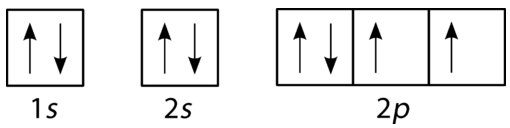
What is incorrect about this orbital diagram?
a)
Both arrows in the 2p box should be pointing up
b)
There is nothing incorrect with this diagram
c)
In the there should only be 1 orbital in the first 2p box and one in the 2nd 2p box
d)
All the arrows should be pointing up.
35.
This orbital diagram represents:  
a)
C
b)
B
c)
N
d)
O
36.

What is the electron configuration for Bromine (Br)

a)

1s2 2s2 2p6 3s2 3p6 4s2 3d1

b)

1s2 2s2 2p4

c)

1s2 2s2 2p6 3s2 3p6 4s2 3d10 4p5

d)

1s2 2s2 2p6

37.
What is this element? 
[Ne] 3s23p64s2
a)
Calcium
b)
Sodium
c)
Scandium
d)
Titanium
38.
Discovered the neutron
a)
Chadwick
b)
Bohr
c)
J J thomson
d)
Dalton
39.

Hypothesized that the atom was a tiny hard sphere

a)

Dalton

b)

Rutherford

c)

Democritus

d)

J J thomson

40.
Believed that atoms of a given element are identical
a)
 JJ Thomson
b)
Dalton
c)
Democritus
d)
Heisenberg
41.
Greek Philosopher
a)
Democritus
b)
Dalton
c)
J J Thompson
d)
Rutherford
42.

Believed that the universe was made of tiny “un-cuttable” particles

a)

Democritus

b)

Rutherford

c)

J J Thompson

d)

Heisenberg

43.
Found the missing mass of the atom’s nucleus
a)
Heisenberg
b)
Chadwick
c)
JJ Thomson
d)
Dalton
44.
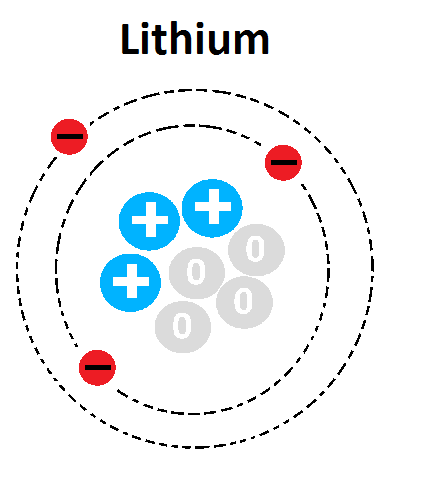
What element is represented in this Bohr Model? 
a)
Carbon
b)
Hydrogen
c)
Aluminum
d)
Lithium
45.

How many electrons should Barium have around its Lewis dot model?

a)

1

b)

2

c)

3

d)

4

46.
Who's atomic theory said that electrons travel in circular paths around the nucleus
a)
Bohr
b)
Dalton
c)
Rutherford
d)
Thomson
47.
If an atom contains exactly 79 protons, then it's an atom of _____
a)
lithium
b)
gold
c)
nitrogen
d)
carbon
48.
Which model of the atom came about from experiments with a cathode ray tube?  This also led to the discovery of the electron.
a)
Rutherford Model
b)
Dalton Model
c)
Thomson Model
d)
Bohr Model
49.
What particles make up light?
a)
Photons
b)
Neutrons
c)
Protons
50.

What produces light from an atom?

a)

Electrons jump an energy level, emitting the energy as a photon.

b)

Happy Thoughts!

c)

The photons are dancing

d)

The photons jump an energy level, emitting an electron.

51.
Discovered that the atom has a small, dense, positively charged nucleus.
a)
Ernest Rutherford
b)
Heisenberg
c)
Democritus
d)
JJ Thomson
52.
The following element has _______________ neutrons.
a)
15
b)
16
c)
31
d)
46
53.
What is the mass number of this atom?
a)
1
b)
3
c)
4
d)
7
54.
How many valence electrons?
a)
2
b)
3
c)
5
d)
10
55.
What is the name of this element?
a)
Lithium
b)
Boron
c)
Carbon
d)
Neon
56.
What is the electron configuration of Sulfur  using noble gas method
a)
[Ne]3s1
b)
[Ne]3s23p3
c)
[Ne]3s23p4
57.

What atom matches this electron configuration?

[Xe] 6s24f145d9

a)

Mercury

b)

Gold

c)

Platinum

d)

Thallium

58.
How many valence electrons are in Phosphorus?
a)
15
b)
4
c)
5
d)
31
59.
How many electrons should Beryllium have around its Lewis dot model?
a)
1
b)
2
c)
3
d)
4
60.

This could be the dot diagram of

a)

Mg

b)

Cl

c)

C

d)

O