wayground logo

Free Printable Worksheets

NEW

Font size

S
M
L
XL
Worksheets

Periodic Table

Total questions: 66

Worksheet time: 1hrs 16mins

Name
Class
Date
1.

the positively charged subatomic particle contained in the nucleus of an atom

a)

proton

b)

neutron

c)

electron

d)

matter

2.

a subatomic particle, contained in the nucleus of an atom, having the same mass as a proton but no electrical charge

a)

proton

b)

neutron

c)

electron

d)

matter

3.

a negatively charged subatomic particle that orbits the nucleus of an atom

a)

proton

b)

neutron

c)

electron

d)

matter

4.

an arrangement of the elements according to their atomic numbers so that elements with similar properties are in the same column and properties repeat from row to row

a)

Periodic Table of Elements

b)

Atomic Theory

c)

Isotopes

d)

Subatomic Particles

5.

a unique number for each element that equals the number of protons in an atom of that element

a)

element name

b)

element symbol

c)

atomic number

d)

atomic mass

6.

the mass of an atom, calculated by adding the number of protons and neutrons in the nucleus of the atom

a)

element name

b)

element symbol

c)

atomic number

d)

atomic mass

7.

a grouping of elements based on similar properties, arranged by columns in the periodic table

a)

group/family

b)

period

c)

row

d)

isotope

8.

a row on the Periodic Table of Elements

a)

family

b)

period

c)

row

d)

isotope

9.

one of several forms of a single element, which contains the same number of protons, but different numbers of neutrons

a)

isotope

b)

ion

c)

orbital

d)

nucleus

10.
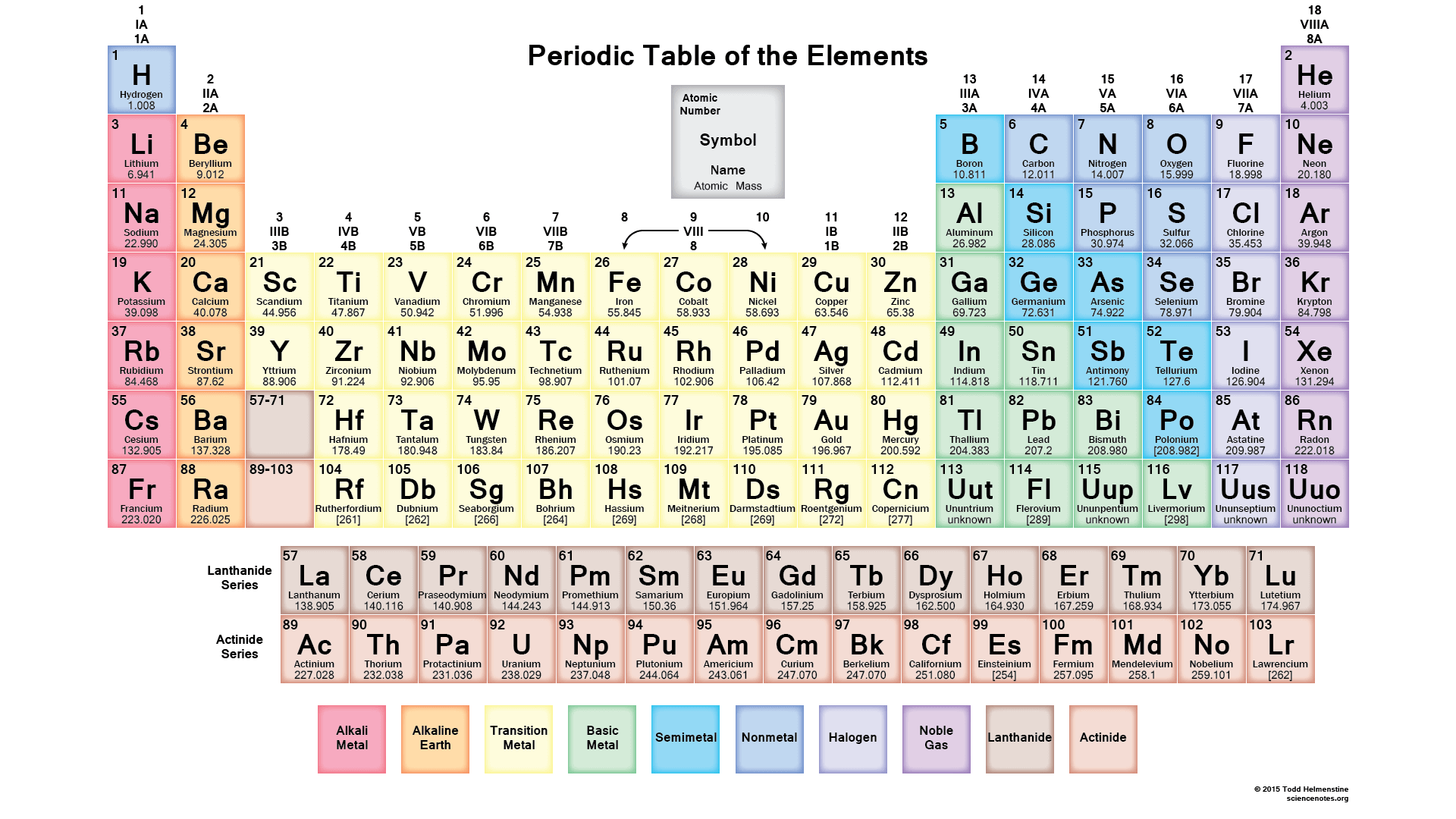
Sodium (Na) is found in period 
a)
3
b)
2
c)
4
d)
1
11.
Sodium (Na) is found in group 
a)
1
b)
2
c)
3
d)
4
12.
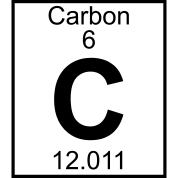
What does the 6 represent?
a)
atomic mass
b)
atomic number
c)
element name
d)
chemical symbol 
13.
What does 12.011 represent?
a)
atomic mass
b)
atomic number
c)
element name
d)
chemical symbol 
14.

what is the name of group number 2

a)

transition metals

b)

halogens

c)

metaloids

d)

alkaline earth metals

15.

what is the name of group number 1

a)

halogens

b)

noble gases

c)

alkali metals

d)

alkaline earth metals

16.

where are the metaloids found

a)

far left, vertical

b)

stair step/diagonal

c)

far right horizontal

d)

at the bottom

17.

what group number are the halogens

a)

18

b)

1

c)

2

d)

17

18.

what group number are the noble gases

a)

17

b)

18

c)

14

d)

15

19.
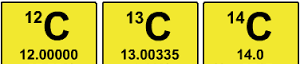
What do these isotopes of carbon all have in common?
a)
neutrons & mass number
b)
atomic number and neutrons
c)
atomic number and electrons
d)
protons, atomic number, and mass number
20.
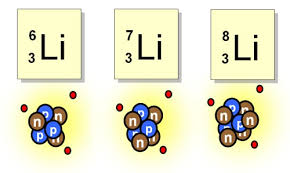
How many neutrons does the isotope of lithium have?
a)
8
b)
3
c)
4
d)
5
21.
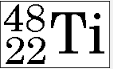
How many protons does this isotope of titanium have?
a)
48
b)
22
c)
26
d)
70
22.
What quantities vary between isotopes of an element?
a)
protons, electrons, and atomic mass
b)
protons, electrons, and atomic number
c)
neutrons and electrons
d)
neutrons and atomic mass
23.
which atom has  4 neutrons?
a)
Li-6
b)
Li-7
c)
Li-8
d)
they have the same # of neutrons
24.
Isotopes are atoms of the same element with different #’s of __________ & therefore different __________.
a)
n0 ;  atomic #’s
b)
p+ ; atomic #’s
c)
e- ; atomic masses
d)
n0 ; atomic masses
25.
Four isotopes of lead include lead-204, lead-206, lead-207, and lead-208.  The average atomic mass of lead is 207.2.  Which isotope of lead is likely to be the most abundant.
a)
204
b)
206
c)
207
d)
208
26.
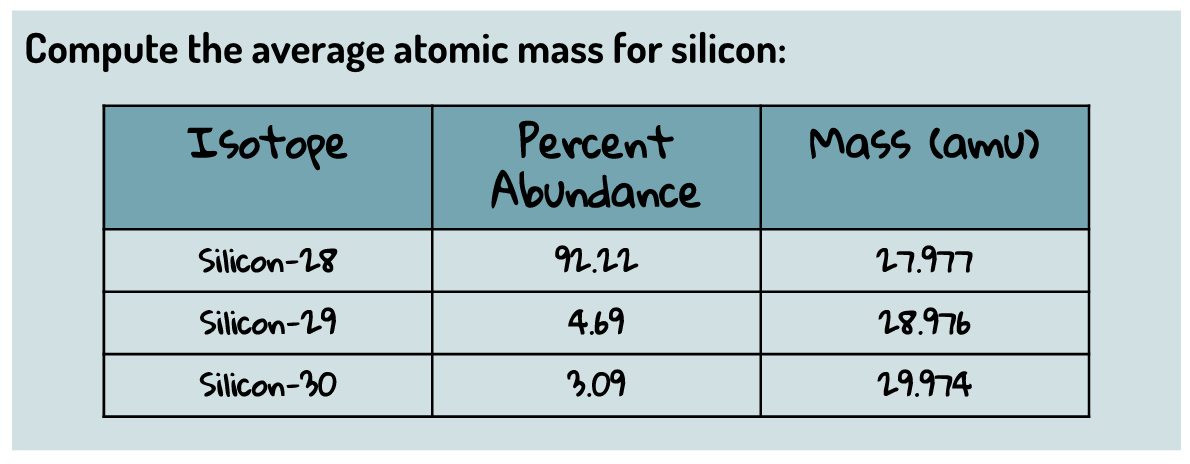
Compute the average atomic mass for silicon:
a)
27.977
b)
28.09
c)
28.976
d)
The average mass cannot be determined from provided information.
27.
As you move down a group, atomic radius increases because - 
a)
you add more and more neutrons
b)
you add more and more protons
c)
you add more and more shells (energy levels)
d)
you add more atomic mass
28.
As you move across the periodic table from left to right, the atomic radius decreases.  This is because - 
a)
the number of protons increases, so attraction to electrons increases
b)
the number of energy levels increases
c)
the number of electrons increases
d)
the atomic mass increases
29.
The atom with the largest atomic radius in Period 4 (row 4) is - 
a)
K
b)
Kr
c)
Fe
d)
Fe
30.
Electronegativity is...
a)
the ability of an atom to attract/ accept electrons
b)
the ability of an atom to lose electrons
c)
the energy required to remove an electron from a specific atom
d)
how easy it is to make friends. 
31.
Electronegativity __________ from left to right within a period and __________ from top to bottom within a group.
a)
decreases, increases 
b)
increases, increases
c)
increases, decreases 
d)
stays the same, increases
32.

Atomic Radius is...

a)

the relative size of the atom's nucleus

b)

the relative size of an atom

c)

the energy required to shield the outer electrons from the nucleus

d)

a measure of the ability of an atom to attract electrons

33.
Which atom has the largest atomic radius?
a)
potassium
b)
rubidium 
c)
francium
d)
cesium
34.
Which of the following will have a higher electronegativity than arsenic (As)?
a)
Carbon (C)
b)
Neon (Ne)
c)
Antimony (Sb)
d)
Germanium (Ge)
35.

what is the biggest group on the table

a)

metals

b)

nonmetals

c)

metaloids

d)

halogens

36.

O is the symbol for which element?

a)

Osmium

b)

Oxalate

c)

Oxygen

d)

Uranium

37.

Na is the symbol for which element?

a)

Nitrogen

b)

Sodium

c)

Potassium

d)

Sulfur

38.

C is the symbol for which element?

a)

Carbon

b)

Chromium

c)

Calcium

d)

Cesium

39.

Ne is the symbol for which element?

a)

Nitrogen

b)

Neodymium

c)

Neon

d)

Sodium

40.

Cl is the symbol for which element?

a)

Carbon

b)

Chlorine

c)

Chromium

d)

Calcium

41.

Potassium (K) is in which group?

a)

Carbon Family

b)

Noble Gasses

c)

Alkali Metals

d)

Metalloids

42.

Phosphorus (P) is in which group?

a)

Boron Family

b)

Noble Gasses

c)

Alkaline Earth Metals

d)

Nitrogen Family

43.

Which of these is a metalloid?

a)

Na (Sodium)

b)

I (Iodine)

c)

Si (Silicon)

d)

Fe (Iron)

44.

Which of these is a transition metal?

a)

K (Potassium)

b)

C (Carbon)

c)

Ca (Calcium)

d)

Cu (Copper)

45.

Argon (Ar) belongs to which group?

a)

Alkaline Earth Metals

b)

Carbon Family

c)

Rare Earth Metals

d)

Noble Gasses

46.

What is the group number for O (Oxygen)?

a)

2

b)

6

c)

8

d)

12

47.

What is the group number for Li (Lithium)?

a)

1

b)

4

c)

6

d)

8

48.

What is the group number for Al (Aluminum)?

a)

1

b)

3

c)

7

d)

8

49.

What is the group number for Cl (Chlorine)?

a)

1

b)

3

c)

5

d)

7

50.

What is the group number for He (Helium)?

a)

1

b)

5

c)

7

d)

8

51.
Sodium (Na) and potassium (K) are in the same group on the periodic table. Based on their locations, which statement about sodium and potassium is true?
a)
Sodium is less electronegative than potassium. 
b)
Sodium has fewer energy levels than potassium. 
c)
Sodium has a larger ionic radius than potassium. 
d)
Sodium has lower ionization energy than potassium. 
52.
Which of these elements has the greatest atomic radius? 
a)
H
b)
N
c)
Cl
d)
Cs
53.
The Periodic Table of the Elements is useful for revealing patterns and trends in the elements. Which statement accurately describes a pattern in the size of atomic radii in the Periodic Table of the Elements?
a)
Atomic radii decrease from left to right across a period and decrease from top to bottom in a group.
b)
Atomic radii increase from left to right across a period and increase from top to bottom in a group.
c)
Atomic radii decrease from left to right across a period and increase from top to bottom in a group.
d)
Atomic radii increase from left to right across a period and decrease from top to bottom in a group.
54.
The symbols W, X, Y, and Z represent four elements shown on the outline of a periodic table.
Which element has the highest electronegativity?

a)
W
b)
X
c)
Y
d)
Z
55.
All elements found on the left side of the Periodic Table of the Elements have what properties in common?
a)
They conduct heat and electricity 
b)
They are all gases 
c)
They are brittle and dull
d)
They are radioactive
56.
Which of these elements has an electron structure most similar to that of element X?
a)
1
b)
2
c)
3
d)
4
57.
Based on their locations in the periodic table, which element has chemical properties most similar to those of calcium, Ca?
a)
beryllium, Be
b)
potassium, K
c)
titanium, Ti
d)
yttrium, Y
58.
The number of valence electrons in an element affects the reactivity of that element. Which element listed has the fewest valence electrons?
a)
beryllium (Be)
b)
sodium (Na) 
c)
oxygen (O) 
d)
neon (Ne)
59.
According to the Periodic Table of the Elements, which set of elements has similar properties?
a)
H, C, I
b)
He, H, Al
c)
He, Ne, Ar
d)
Na, Ca, Al
60.
What is the family name of this group of elements? 
a)
Alkali metals 
b)
Halogens 
c)
Noble Gases 
d)
Alkali Earth Metals 
61.
Which element has 2 valence electrons? 
a)
cesium (Cs) 
b)
magnesium (Mg)
c)
boron (B)
d)
argon (Ar) 
62.
How many Valance electrons does Iodine Have?
a)
6
b)
16
c)
7
d)
17
63.
Which atom has the largest atomic radius?
a)
potassium
b)
rubidium 
c)
francium
d)
cesium
64.
Electronegativity is...
a)
how good an atom is at attracting electrons
b)
the ability of an atom to lose electrons
c)
the energy required to remove an electron from a specific atom
d)
how easy it is to make friends. 
65.
Which of the following will have a larger radius than Zinc?
a)
Gallium
b)
Aluminum
c)
Magnesium
d)
Strontium
66.
As you move down the periodic table atoms get bigger.  This is because ____________.
a)
The atoms have more mass.
b)
The atoms have more protons.
c)
The atoms have more energy levels
d)
The atoms have more neutrons