
 Worksheets
Chemical and Physical Properties and Changes
Total questions: 64
Worksheet time: 32mins
Name
Class
Date
1.
Blue Color
a)
Physical Property
b)
Chemical Property
2.
Density
a)
Physical Property
b)
Chemical Property
3.
Flammability (burns)
a)
Physical Property
b)
Chemical Property
4.
Solubility (dissolves)
a)
Physical Proeprty
b)
Chemical Property
5.
Reacts with acid
a)
Physical Property
b)
Chemical Property
6.
Supports combustion
a)
Physical Property
b)
Chemical Property
7.
Sour taste
a)
Physical Property
b)
Chemical Property
8.
Melting point
a)
Physical Property
b)
Chemical Property
9.
Reacts with water
a)
Physical Property
b)
Chemical Property
10.
Hardness
a)
Physical Property
b)
Chemical Property
11.
A student removes a loaf of bread hot from the oven. The student cuts a slice off the loaf and spreads butter on it.
a)
Physical Change
b)
Chemical Change
12.
Your friend decides to toast a piece of bread, but leaves it in the toaster too long. The bread is black and the kitchen if full of smoke.
a)
Physical Change
b)
Chemical Change
13.
You forgot to dry the bread knife when you washed it and reddish brown spots appeared on it.
a)
Physical Change
b)
Chemical Change
14.
In baking biscuits and other quick breads, the baking powder reacts to release carbon dioxide bubbles. The carbon dioxide bubbles cause the dough to rise.
a)
Physical Change
b)
Chemical Change
15.
You take out your best silver spoons and notice that they are very dull and have some black spots.
a)
Physical Change
b)
Chemical Change
16.
A straight piece of wire is coiled to form a spring.
a)
Physical Change
b)
Chemical Change
17.
Food color is dropped into water to give it color.
a)
Physical Change
b)
Chemical Change
18.
In a fireworks show, the fireworks explode giving off heat and light.
a)
Physical Change
b)
Chemical Change
19.
Chewing food to break it down into smaller particles represents a _________ change, but the changing of starch into sugars by enzymes in the digestive system represents a ___________change.
a)
Chemical then Physical
b)
Physical then Chemical
c)
Both Physical
d)
Both Chemical
20.
Which of the following tells you that a chemical change may have occurred?
a)
Change Shape
b)
Melting
c)
Vaporizing
d)
Change in color
21.
What happens in ALL chemical changes?
a)
Change in state of matter
b)
A new substance is formed
c)
Bubbles are produced
d)
An explosion
22.
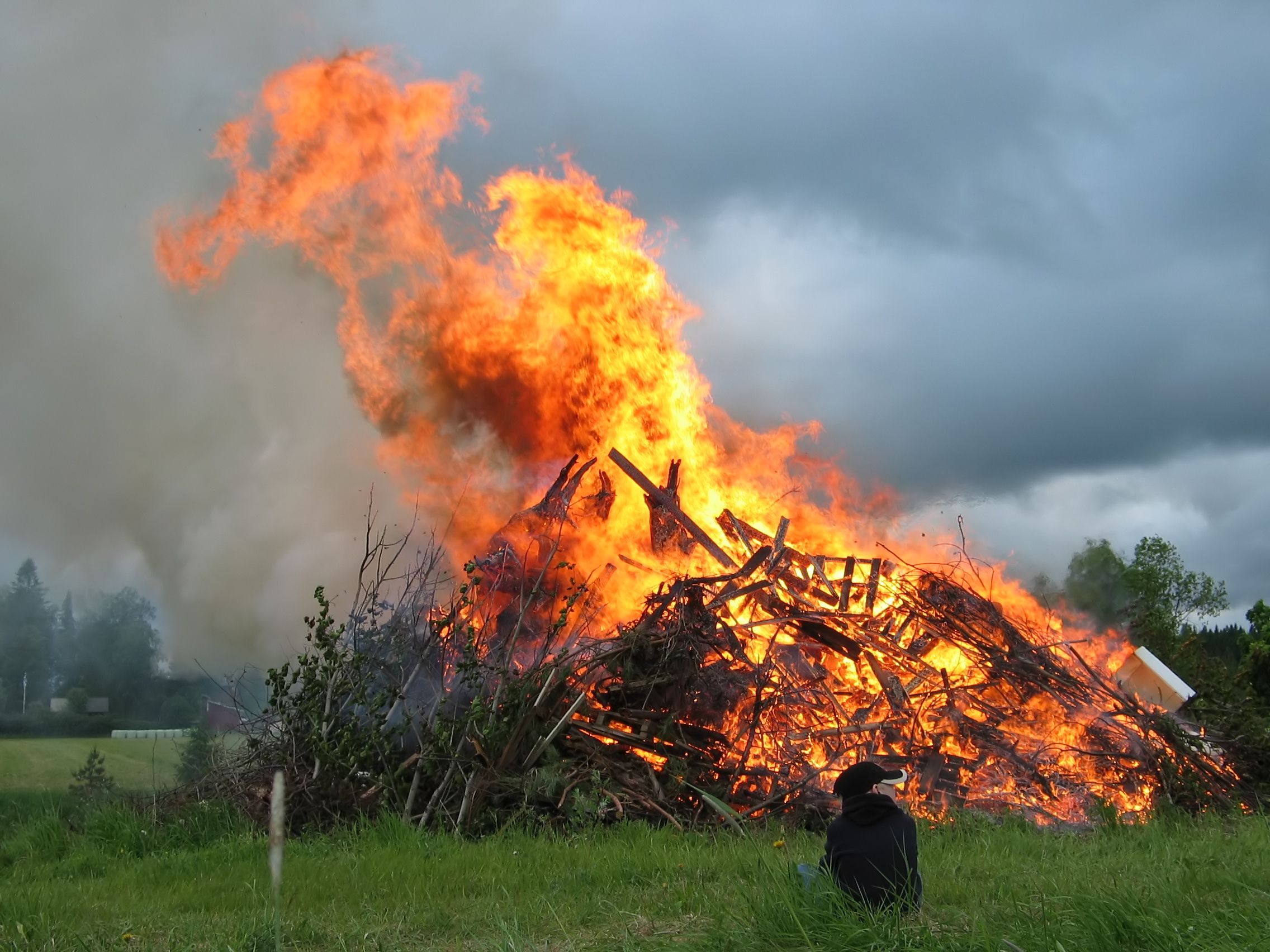
Is wood burning a physical or chemical change?
a)
Physical
b)
Chemical
23.
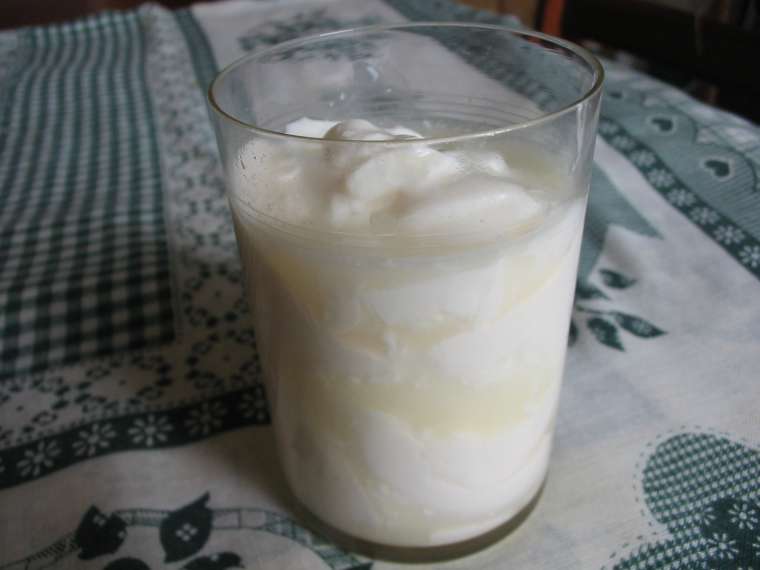
Is milk going sour a physical or chemical change?
a)
Physical
b)
Chemical
24.

Is Gatorade powder dissolving in water physical or chemical change?
a)
Physical
b)
Chemical
25.

Is mold growing on cheese a physical or chemical change?
a)
Physical
b)
Chemical
26.

Is making orange juice a physical or chemical change?
a)
Physical
b)
Chemical
27.

Is sharpening a pencil a physical or chemical change?
a)
Physical
b)
Chemical
28.

Is copper tarnishing a physical or chemical change?
a)
Physical
b)
Chemical
29.
Which of the following is not a clue that a chemical reaction has taken place?
a)
Changing size
b)
Changing color
c)
A gas being formed
d)
Formation of a precipitate
30.
Which of the following IS a clue that a chemical change has occurred?
a)
State of matter change
b)
Size Change
c)
Change in temperature
d)
Shape change
31.
In a chemical reaction, how do the reactants compare to the products?
a)
They are the same
b)
They are different
32.
What is the phase change of a solid to a liquid?
a)
freezing
b)
melting
c)
boiling
d)
condensation
33.
How are solids different from liquids?
a)
particles in solids are moving freely around each other.
b)
particles in solids have no motion.
c)
particles in solids are vibrating in place.
d)
particles in solids have more motion than in liquids
34.
2. A change of state from a liquid to a solid is called....
a)
Melting
b)
Freezing
c)
Evaporation
35.
5. What is it called when a solid turns directly into a gas?
a)
Sublimation
b)
Condensation
c)
Liquid
36.
7. All phase changes (changing states) requires energy to be added or taken away.
a)
True
b)
False
37.
Change from Gas to Solid is called........
a)
Sublimation
b)
Deposition
c)
Fusion
d)
condensation
38.
Change from gas to liquid...
a)
condensation
b)
evaporation
c)
expansion
d)
movement
39.
change from liquid to gas is called....
a)
expansion
b)
evaporation
c)
condensation
d)
sublimation
40.
What happens to particles when they are heated?
a)
They speed up and spread out
b)
They slow down and compress
c)
They stop moving
d)
They move closer together and speed up
41.

The faster molecules move,
a)
the higher the temperature
b)
the less temperature
c)
the same temperature
d)
I don't know
42.

What line segment represents only the solid state? (Diagram F)
a)
A-B
b)
B-C
c)
C-D
d)
D-E
43.
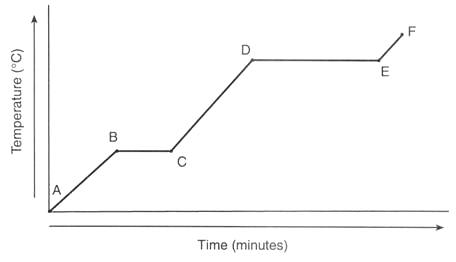
Between which points is the temperature of the substance remaining constant? (Diagram F)
a)
A-B only.
b)
A-B, C-D, E-F
c)
B-C only.
d)
B-C, D-E
44.
True or false: melting and freezing occur at the same temperature!
a)
True
b)
False
c)
I don't know
45.

A substance's heating curve is shown in the graph. What is its boiling point? (Diagram B)
a)
100 C
b)
60 C
c)
80 C
d)
20 C
46.
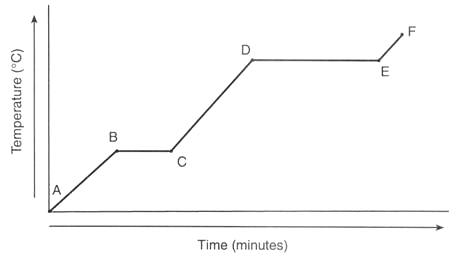
Are the particles moving faster or slower as time goes on? (Diagram F)
a)
Faster
b)
Slower
47.

Is the substance gaining or losing energy? (Diagram D)
a)
Gaining
b)
Losing
48.

Which line segment demonstrates vaporization occurring? (Diagram E)
a)
B-C
b)
C-D
c)
D-E
d)
E-F
49.

What happens when thermal energy is taken away from particles?
a)
They move faster and farther apart
b)
They move slower and closer together
50.
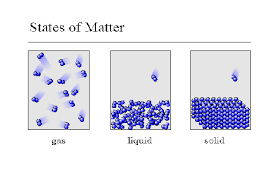
At higher temperatures
a)
particles in an object have less energy
b)
particles in an object move faster
c)
a gas contracts
51.
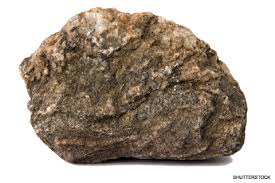
Which state of matter has tightly packed molecules?
a)
solid
b)
liquid
c)
gas
52.
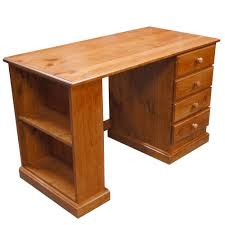
Which state of matter has a definite shape?
a)
solid
b)
liquid
c)
gas
53.
What is happening when my ice cream changes from a solid to a liquid?
a)
freezing
b)
melting
c)
burning
d)
evaporation
54.
Define a liquid.
a)
Indefinite shape, indefinite volume
b)
Definite shape, definite volume
c)
Found in stars
d)
Definite volume, indefinite shape
55.
The state of matter that has no definite size or shape is
a)
Solid
b)
Liquid
c)
Gas
56.
Particles of a liquid
a)
are tightly packed together and stay in a fixed position.
b)
have no viscosity.
c)
decrease in volume with increasing temperature.
d)
are free to move around one another but still touch.
57.
What term describes a solid changing to a gas?
a)
Deposition
b)
Sublimation
c)
Evaporation
d)
Freezing
58.
Particles (molecules) in a ______________________ have more energy than the other states of matter.
a)
gas
b)
solid
c)
liquid
59.
What is condensation?
a)
gas to solid
b)
gas to liquid
c)
liquid to solid
d)
solid to liquid
60.
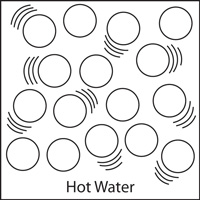
The speed of the molecules determines the _____.
a)
volume
b)
density
c)
pressure
d)
temperature
61.
Which has a greater distance between particles?
a)
Solid
b)
Liquid
62.
The slower the particles in a substance move,
a)
the colder it is.
b)
the warmer it is.
c)
the more energy it has.
d)
the less energy it has.
63.
A chemical change
a)
doesn't really change much.
b)
creates a new substance
c)
is a change in the state of matter
64.
A physical change is...
a)
a change that doesn't change the identity
b)
a change that makes something new.
c)
a chemical reaction
100 %

