wayground logo

Free Printable Worksheets

Font size

S
M
L
XL
Worksheets

Forces That Shape the Earth Test

Total questions: 25

Worksheet time: 23mins
Name
Class
Date
1.
Stress that pushes a mass of rock in two opposite directions is called ____.
a)
shearing.
b)
tension.
c)
compression.
d)
deformation.
2.
In a normal fault, the part of the fault that lies below the other part is called the ____.
a)
hanging wall.
b)
reverse fault.
c)
footwall.
d)
anticline.
3.
Which type of stress force produces reverse faults?
a)
shearing
b)
tension
c)
compression
d)
deformation
4.
The ____is the point beneath Earth’s surface where rock breaks under stress and triggers an earthquake
a)
syncline
b)
footwall
c)
epicenter
d)
focus
5.
The type of seismic waves that arrive at the surface first and move by compressing and expanding the ground like an accordion are called
a)
s-waves
b)
p-waves
c)
surface waves
d)
Mercalli waves
6.
To tell how far an earthquake’s epicenter is from a seismograph, scientists measure the difference between the ____.
a)
arrival times of the P waves and S waves.
b)
speeds of the P waves and S waves.
c)
strengths of the P waves and S waves.
d)
sizes of the P waves and S waves.
7.
If a volcano’s magma is high in silica, the volcano will probably ____.
a)
erupt quietly.
b)
remain dormant.
c)
erupt explosively.
d)
produce dark-colored lava.
8.
The huge hole left by the collapse of a volcanic mountain is called a ____.
a)
lava plateau.
b)
caldera.
c)
cinder cone.
d)
shield volcano.
9.
When magma hardens in a volcano’s pipe, the result will eventually be a landform called a ____.
a)
batholith.
b)
dike.
c)
volcanic neck.
d)
sill.
10.
When groundwater heated by magma rises to the surface and collects in a natural pool, it is called a ____.
a)
hot spring.
b)
geyser.
c)
vent.
d)
pyroclastic flow.
11.
When many layers of thin, runny lava build up a high, level area, the result is a ____.
a)
lava plateau.
b)
shield volcano.
c)
cinder cone volcano.
d)
composite volcano.
12.

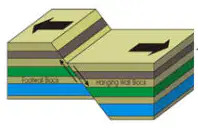
What type of fault is pictured below?

(a)  
13.

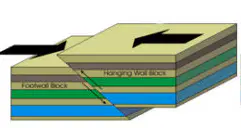
What type of fault is pictured below?

(a)  
14.

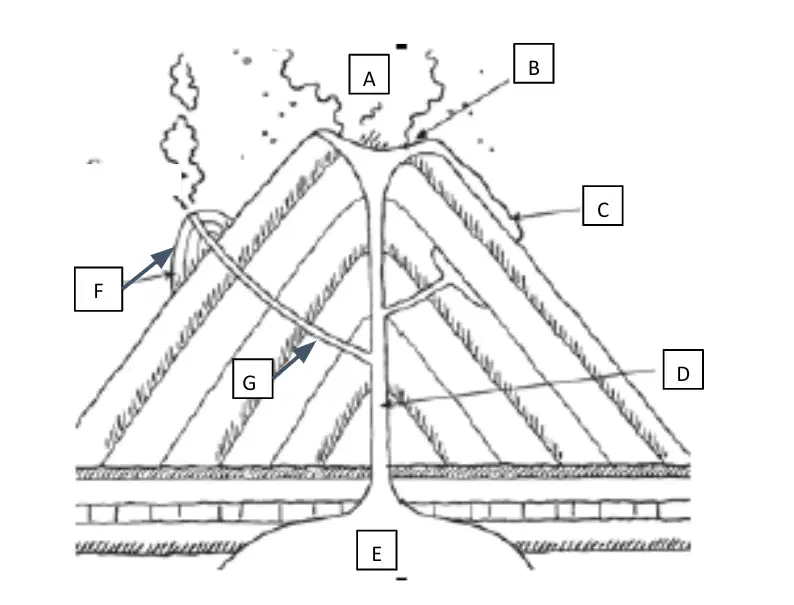
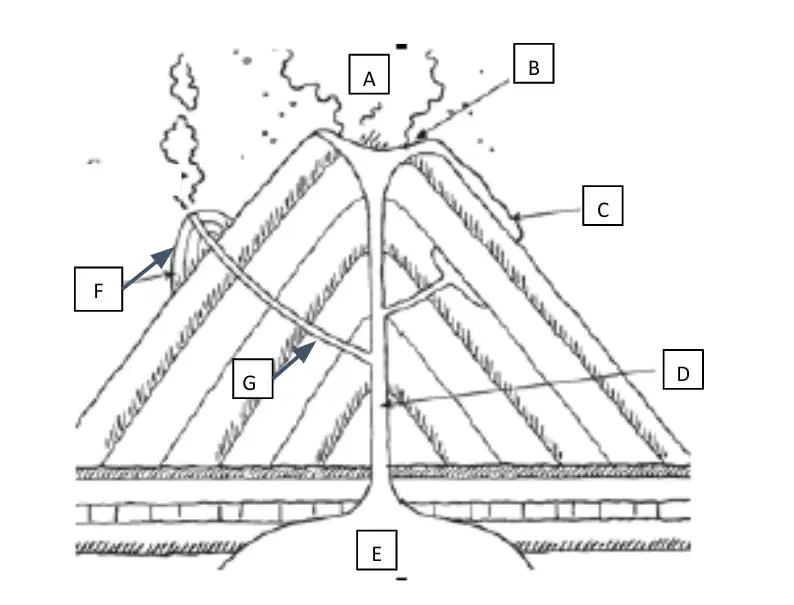
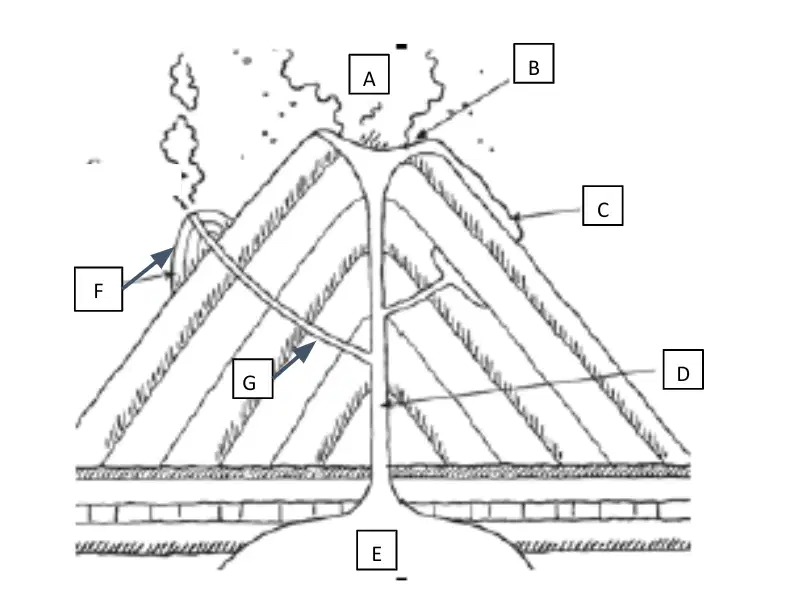
What is part D?

(a)  

15.

What is part E?

(a)  

16.

What is part G?

(a)  

17.

Vibrations that move through the ground carrying the energy released during an earthquake are called ___________________________.

4 lines
18.

Molten material that leaves a volcano's vent is called ___________________________.

4 lines
19.

This type of volcano forms when repeated lava flows build up a broad, gently sloping mountain. The lava type is typically low viscosity with a low silica content, which leads to quiet eruptions.

4 lines
20.

These are high, level areas that has been built up over time from lava seeping out of several cracks then traveling a distance before cooling.

4 lines
21.

Which type of stress force produces reverse faults?

a)

shearing

b)

tension

c)

compression

d)

deformation

22.

What does a seismograph record?

a)

the Mercalli scale rating for an earthquake

b)

the speed of seismic waves

c)

the ground movements caused by seismic waves

d)

the location of the epicenter

23.

A ____is a long tube in the ground that connects the magma chamber to Earth's surface.

a)

vent

b)

side vent

c)

pipe

d)

crater

24.

The ____is the point beneath Earth's surface where rock breaks under stress and triggers an earthquake.

a)

syncline

b)

footwall

c)

epicenter

d)

focus

25.

The volcanoes along converging oceanic plate boundaries may form ____.

a)

a hot spot

b)

a part of the mid-ocean ridge

c)

an island arc

d)

a subducting plate