
 Worksheets
"The Tell-Tale Heart"
Total questions: 20
Worksheet time: 10mins
Name
Class
Date
1.
1. Situational irony is when a character or the reader expects one thing, but something very different happens or is true. Dramatic irony is when the reader knows something that a character does not know. Which of the following is an example of irony in the story?
a)
A The narrator’s attempts to hide the murder actually result in him giving himself up to the police.
b)
B The narrator chooses to commit the murder in the middle of the night, when the old man is asleep.
c)
C The more the narrator insists that he is not mad, the more readers can detect evidence of his madness.
d)
D The narrator admits that he liked, even loved, the old man, and that he only objected to his pale, filmy eye.
2.

2. Foreshadowing occurs when a writer provides hints that suggest future events in a story, and it can help create suspense. How does the narrator’s mention of his acute hearing in paragraph 1 foreshadow the old man’s death?
a)
F. It foreshadows the point when the old man’s heartbeat drives the narrator to kill him.
b)
G. It foreshadows his ability to hear the police coming when they respond to the old man’s murder.
c)
H. It foreshadows his decision to murder the old man because he was tired of listening to him.
d)
J. It foreshadows the moment when the old man hears the narrator at the door and wakes up.
3.
3. The author creates suspense by describing the sound of the old man’s heartbeat as the sound of a -
a)
A. watch’s ticking as if enveloped in cotton
b)
B. cricket’s chirping
c)
C. mouse’s footsteps
d)
D. lantern’s creaking
4.
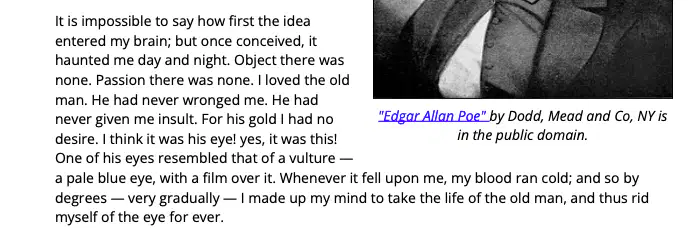
4. In paragraph 2, the word conceived means to —
a)
F. become pregnant with a child
b)
G. have an opinion on an issue
c)
H. form a plan in the mind
d)
J. imagine something abstract
5.

5. In this paragraph, the narrator describes visiting the old man every night at midnight. Why is he unable to commit the murder for the first seven nights?
a)
A. The old man is a restless sleeper, so the narrator cannot sneak in.
b)
B. The narrator does not have enough light from the lantern to commit the murder.
c)
C. He is trying to be kind by giving the old man a few more days to live.
d)
D. He cannot see the old man’s eye, which is what he feels he needs to kill.
6.
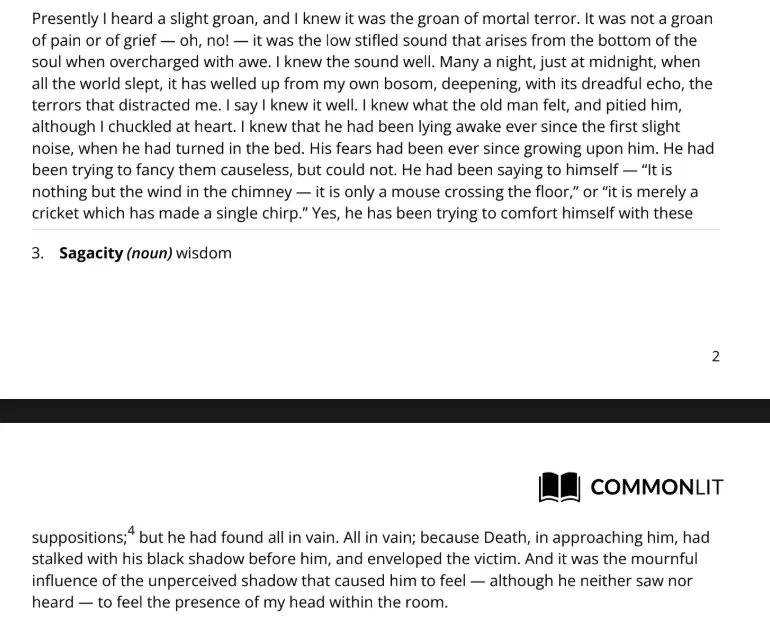
6. Which choice best expresses the main idea of the paragraph?
a)
F. The old man stirs and cries out when he hears the narrator at the door and scares the narrator away.F
b)
G. The narrator can relate to the old man’s fear, but that only makes the narrator feel more powerful.
c)
H. The narrator chooses to wake the old man so that he can face him directly for the murder.
d)
J. The narrator slips into the room when the old man wakes, hoping that the old man will not see him.
7.
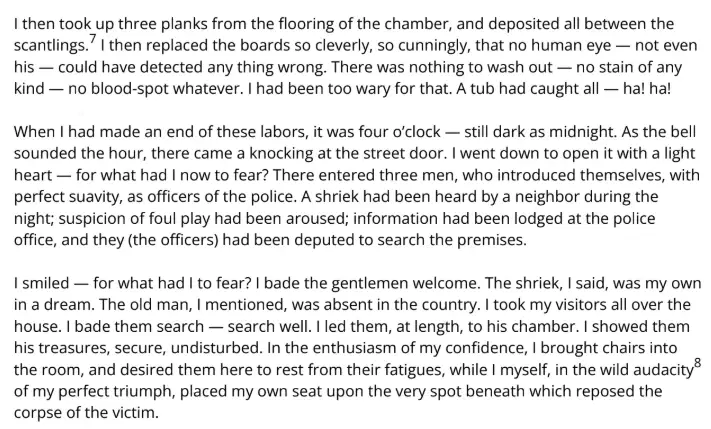
7. In paragraphs 13–15, the narrator describes his cleanup and first encounter with the police with a tone of —
a)
A. anxiety
b)
B. melancholy
c)
C. confidence
d)
D. indifference
8.

8. Which word from paragraphs 17 - 18 is closest to meaning contempt?
a)
F. Agony
b)
G. Derision
c)
H. Swore
d)
J. Hypocritical
9.
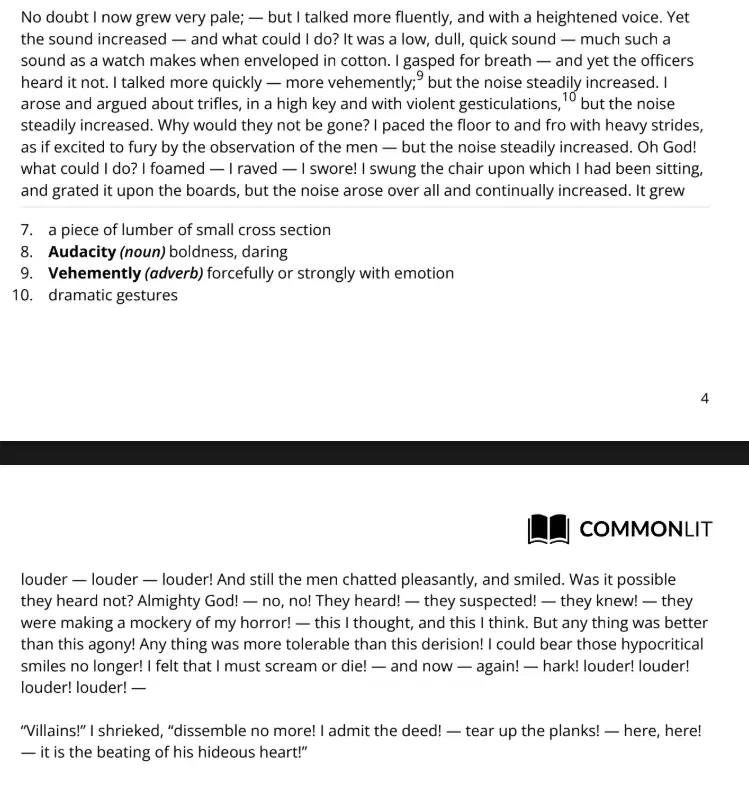
9. Poe’s extensive use of dashes in the last two paragraphs (17-18) is effective because it —
a)
A, highlights the narrator’s increased sense of nervousness
b)
B. slows down the story so that it is easier to understand
c)
C. suggests that the police know more than they are letting on
d)
D. allows the readers to understand the narrator’s motives
10.
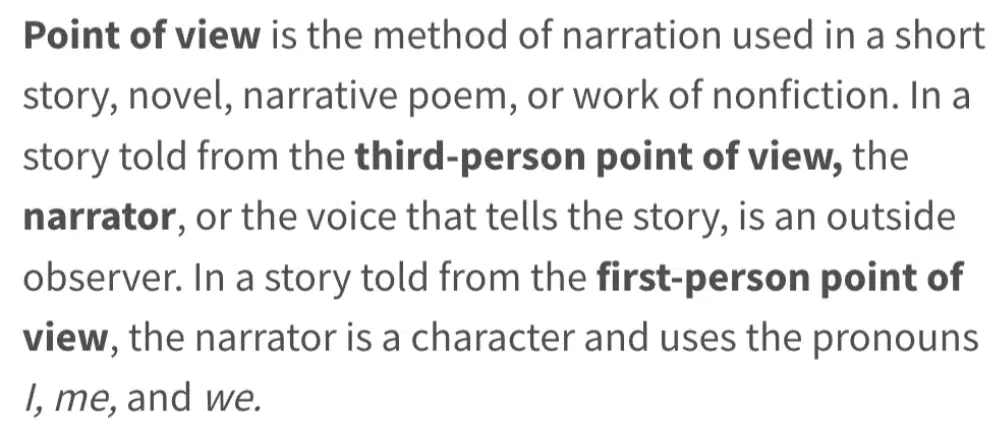
10. The use of a first-person narrator in the story —
a)
F. allows readers to understand each character’s point of view
b)
G. helps to explain how the characters are related to each other
c)
H. gives readers insight into the narrator’s mental instability
d)
J. illustrates how the old man treats the narrator every day
11.
11. It is impossible to say how first the idea entered my brain; but once conceived, it haunted me day and night. Object there was none. What does the word conceived mean in this paragraph?
a)
A. think of it or form, devise a plan
b)
B. tell about it
c)
C. dream about it
d)
D. walk toward it
12.
12. Above all was the sense of hearing acute. I heard all things in the heaven and in the earth. I heard many things in hell. What does the word "acute" mean in that sentence?
a)
F. nervous
b)
G. pretty
c)
H keen; sharp
d)
J. mad
13.
13. "And this I did for seven long nights—every night just at midnight—but I found the eye always closed; and so it was impossible to do the work; for it was not the old man who vexed me, but his Evil Eye." What does the word "vexed" mean in this sentence?
a)
A. plan
b)
B. wake
c)
C. annoy
d)
D. scream
14.
14. "It was not a groan of pain or grief—oh, no!—it was the low, stifled sound that arises from the bottom of the soul when overcharged with awe." In this sentence, what does the word "stifled" mean?
a)
F. evil
b)
G gloomy
c)
H frightened
d)
J.smothered
15.
15. What does the word "crevice" mean in the following sentence? "When I had waited a long time, very patiently, without hearing him lie down, I resolved to open a little—a very, very little crevice in the lantern."
a)
A. lantern
b)
B. crack
c)
C. floor
d)
D. room
16.
16. What does the word "stealthily" mean in the following sentence? "So I opened it—you cannot imagine how stealthily, stealthily—until, at length, a single dim ray, like the thread of the spider, shot from out the crevice and fell full upon the vulture eye."
a)
F. confidently
b)
G. uncertainly
c)
H. cautiously
d)
J. steadily
17.
17.In the following sentence, what does the word "audacity" mean? "In the enthusiasm of my confidence, I brought chairs into the room, and desired them here to rest from their fatigues, while I myself, in the wild audacity of my perfect triumph, placed my own seat upon the very spot beneath which reposed the corpse of the victim."
a)
A. overwhelming terror
b)
B. scornful mockery
c)
C. shameless daring
d)
D. fierce hostility
18.
18. In the following sentence, what does the word "vehemently" mean? "I talked more quickly—more vehemently; but the noise steadily increased."
a)
F. by good fortune
b)
G. with intense emotion
c)
H. in genuine admiration
d)
J. with true appreciation
19.
19. What does the word "derision" mean in the following sentence? "Anything was more tolerable than this derision!"
a)
A. ridicule
b)
B. murder
c)
C. agony
d)
D. madness
20.
20. What does the word "hypocritical" mean in the following sentence? "I could bear those hypocritical smiles no longer! I felt that I must scream or die!—and now—again!—hark! louder! louder! louder!"
a)
F. attentive
b)
G confused
c)
H. sensitive
d)
J. false or deceptive
100 %

