
 Worksheets
Physical Science 8th Grade Exam! Lets Pass Together.
Total questions: 234
Worksheet time: 2hrs 21mins
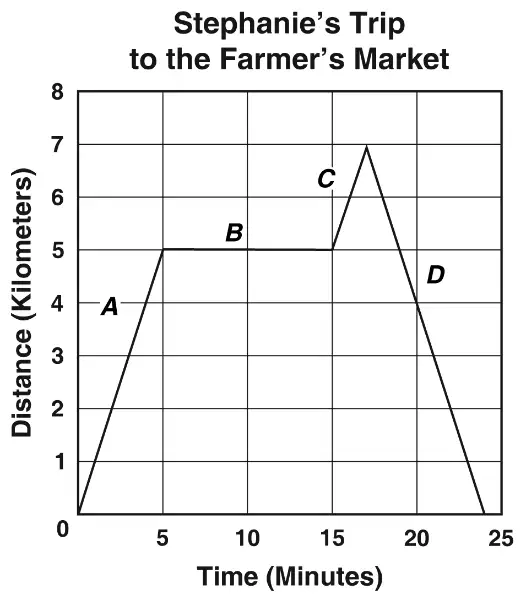
Stephanie leaves the house and rides to the local farmer's market with her grandmother. The graph below illustrates their trip.
Which line segment represents the time the car is returning to the house?
Segment A
Segment B
Segment C
Segment D
To make an object move you must first apply ---
an opposing force
an unbalanced force
a stationary force
a vertical force
Oliver stepped onto a three-car subway train with standing room only. What caused him to fall backward into other riders when the train suddenly moved forward?
He was riding in the last car of the train.
He had heat exhaustion from the overcrowded train.
Oliver's body resisted a change in the subway train's inertia.
Oliver's body was responding to the force of gravity.
Which law of motion predicts that a moving hockey puck will continue to move in the same direction at the same speed unless acted upon by another force?
Newton's First Law of Motion
Newton's Second Law of Motion
Newton's Third Law of Motion
Newton's Law of Universal Gravitation
Which law explains the relationship among mass, force and acceleration?
Universal Law of Gavitation
Newton's First Law of Motion
Newton's Second Law of Motion
Newton's Third Law of Motion
The force of an object, with a certain mass accelerating at a certain rate, can be determined by using the equation below.
force = mass x acceleration
Which object would have the greatest force?
A 5 kg object accelerating at 10 m/s
A 5 kg object accelerating at 20 m/s
a 20 kg object accelerating at 4 m/s
a 20 kg object accelerating at 3 m/s

According to Newton's Third Law of Motion, if Mike pushes down on the springboard to being his dive, what is the reaction force?
Mike splashing into the water
The springboard pushing Mike into the air
The height of the water when Mike enters the water
The sound the board makes as he pushes into the air

If the man and the ball travels 90 m in 9 seconds, what is their average speed?
10 m/s
180 m/s
99 m/s
10 meters

Person on the left = 45 N
Person on the right = 32 N
What is the net force?
zero N
10 N
77 N
13 N
What is speed?
Speed is how far something travels in one hour.
Speed is how fast it takes something to travel a set distance
Speed is the distance something travels in a set amount of time.
Speed is the change in velocity of something.
If an unbalanced force acts on a stationary object, the object will:.
remain stationary
move away from the force
accelerate in the direction of the force
accelerate in the opposite direction of the force
A flexible structure that protects and controls what goes in and out of the cell
Chromosome
Cell wall
Cytoplasm
Cell Membrane
The rigid outer layer that protects and supports plant cells
Cell membrane
Cytoplasm
Cell Wall
Organelle
The jelly-like substance found inside the cell that contains organelles
Cytoplasm
Mitosis
Cell membrane
DNA
A structure located in the nucleus that contains DNA
Gene
Chromosome
DNA
Organelle
The stage of the cell cycle in which the cell's nucleus divides in two
Interphase
Cytokinesis
DNA
Mitosis
Where in the cell does photosynthesis happen?
chloroplast
mitochondria
cell membrane
nucleus
Where in the cell does cellular respiration happen?
chloroplast
mitochondria
nucleus
cell membrane
The breaking down of sugar with oxygen to make energy is called ____.
cellular respiration
photosynthesis
fermentation
diffusion
Which of the following has the correct order of phases of mitosis?
telophase, metaphase, anaphase, prophase
prophase, metaphase, anaphase, telophase
metaphase, prophase, anaphase, telophase
telophase, prophase, metaphase, anaphase
Which of the following cells is in Telophase?


What phase is this cell in?
prophase
anaphase
telophase
metaphase

What phase is this cell in?
Anaphase
Telophase
Interphase
Metaphase

What phase is this cell in?
Prohase
Interphase
Anaphase
Telophase

What phase is this cell in?
Anaphase
Cytokinesis
Interphase
Prophase
Which of the following has the correct order of phases of mitosis?
telophase, metaphase, anaphase, prophase
prophase, metaphase, anaphase, telophase
metaphase, prophase, anaphase, telophase
telophase, prophase, metaphase, anaphase
Which of the following cells is in Telophase?
What phase is this cell in?
prophase
anaphase
telophase
metaphase
What phase is this cell in?
Anaphase
Telophase
Interphase
Metaphase
What phase is this cell in?
Prohase
Interphase
Anaphase
Telophase
What phase is this cell in?
Anaphase
Cytokinesis
Interphase
Prophase
What is the acryonym used to remember the four phases of mitosis?
P, S, A, T
P, R, O, M
P, T, A, P
P, M, A, T
In which phase of mitosis do chromosomes condense or come together?
Interphase
Anaphase
Prophase
Cytokinesis
In which phase of mitosis do chromosomes line up along the middle of the cell?
Interphase
Prophase
Metaphase
Anaphase
In which phase of mitosis do the chromosomes split apart?
Interphase
Prophase
Metaphase
Anaphase
The division of the cytoplasm is called _______.
Mitosis
Interphase
S Phase- Synthesis
Cytokinesis
Why do cells replicate?
growth, repeat, release
growth, repair, replace
glow, repair, replace
growth only
The cell spends most of it's life in ________________.
mitosis
cytokinesis
Interphase
None of the above
Which statement is a part of the cell theory?
all cells come from preexisting cells
bacteria are prokaryotic cells
eukaryotic cells are complex
humans are multicellular
The ___ is the basic unit of sturucture and function of organisms
atom
cell
matter
all other answers are correct
When does DNA replication happen?
Interphase
Anaphase
Cytosis
Telophase
Cell splits into two.
Metaphase
Cytokinesis
Interphase
Prophase
Fully grown parent cells split into two halves resulting in two daughter cells with the exact DNA as the parent.
Binary Fission
Budding
Fragmentation
Vegetative Reproductions
Bacteria reproduce asexually by a process called
replication
meiosis
mitosis
binary fission
Chromosomes condense from long stands into rod like structures.
Prophase
Interphase
Choose all the items that are elements.
NaCl (table salt)
Sulfur
O2
Water
Air
Choose all of the items that are compounds.
NaCl (table salt)
Sulfur
O2
Water
Air
Choose all of the items that are mixtures
NaCl (table salt)
Sulfur
O2
water
Air

Which element is similar to Li?
Be
K
Which element is similar to He?
H
Ar
Students in Mrs. Clark's science class are investigating a substance that has the following properties
-shiny
-bends easily
-hard, not easily broken
Based on these properties how would you classify the substance?
metal
nonmetal
metalloid
Metalloids are on the:
Left side
Right Side
Stairstep
Nonmetals are on the:
Left side
Right Side
Stairstep
A student is studying a mystery substance. It breaks easily. It has a very dull luster. It doesn't conduct any electricity. What is the most likely substance this is?
Metal
Metalloid
Nonmetal
The same student works with a new substance. He concludes it conducts electricity very well. It has a very shiny luster. When he hammers it, it simply dents and flattens. What is the most likely substance type?
Metal
Metalloid
Nonmetal
The third substance the student works with is a little brittle. It is just a little shiny. When he tries to conduct electricity through it at first, it doesn't conduct, but upon heating up, it does start to allow electrons to flow. What is the most likely substance type?
Metal
Metalloid
Nonmetal

Which two elements share common characteristics based on the periodic table?
Sodium and Magnesium
Chlorine and Sulfur
Argon and Neon
Calcium and Bromine
Periods run:
up and down
left to right
Groups run:
up and down
left to right

How many orbitals does Nickel have?
3
4
5
10

What is the atomic mass?
58.693
28

How many protons and electrons does nickel have?
28
58.69

How many valence electrons does the element have?
1
2
3
4

What group and period does this element belong in? *
period 1 and group 3
period 3 and group 1
period 2 and group 3
period 3 and group 2

What is the name of the element? (Periodic table will be needed)
sodium
magnesium
vanadium
How do you calculate the number of neutrons? *
Mass = Atomic number - Neutrons
Mass - Atomic number = Neutrons
Atomic number = Neutrons
What does the number of proton tell us?
electrons
atomic number
atomic mass
neutrons
What are the horizontal rows on the periodic table called?
periods
groups
metals
nonmetals
metalloids
What is the definition of matter?
Anything that has mass and takes up space
A substance that is liquid, solid, or gas
Anything that is pure
Anything that you can see or hold
What term means "take up space"
Volume
Matter
Mass
Substance
What term refers to a single kind of matter that is pure?
Solution
Mixture
Substance
Matter
What term refers to "two or more substances combined physically, but are still able to be separated?"
Mixture
Solution
Matter
Combination
Which of the following is NOT an example of matter?
Sunlight
Air
Tree trunk
Sponge
Which of the following is NOT a mixture?
Salsa
Guacamole
Egg Salad
Bleach
What is the difference between a mixture and a solution?
A mixture retains its properties, a solution creates new ones
A mixture and solution are the same
A solution cannot be separated into it's individual components
A mixture is chemically bonded, a solution is not.
Which term refers to "two substances that have bonded together to form a new substance"
Mixture
Solution
Substance
Matter


1. When ice melts. Its particles
gain energy and begin to move
lose energy and begin to move
move far apart and gain energy
close together and lose energy

In which state of matter are the particles least able to move?
A
B
C

Which of these three states represents a liquid?
A
B
C

These are what type of particles?
gas
solid
liquid
Not all particles in a substance move at the same ________, some are faster, some are slower.
speed
direction
energy
fast
Most forms of ________ can exist as solids, liquids, and gases.
particles
matter
gases
energy
__________ is the energy that flows from warmer to cooler regions of matter.
power
kinetic
heat
liquids
The 1st shell (energy level) can hold up to ___ electrons, while the 2nd and 3rd shells can hold up to 8 electrons.
2
4
6
8
Other than H and He, how many electrons do atoms want to have in their outer shell to be FULL and HAPPY?
4
6
8
10
An ion will always have a(n) _____ , so it will never be neutral.
sweet odor
low boiling point
electrical charge
Covalent bonds take place between...
two metals
two nonmetals
a metal and a nonmetal
Metallic bonds occur between...
two nonmetals
a metal and a nonmetal
two metals
Ionic bonds occur between...
a metal and a nonmetal
two metals
two nonmetals
Nonmetals are located to the _____ of the stair-step line, on the periodic table.
right (except for H)
left (except for He)
With covalent bonds, electrons are _____ between the atoms.
lost and gained
shared
The tendency for a material to oppose the flow of electrons is _____.
current
resistance
conductor
voltage
Items with opposite charges _____ each other.
attract
repel
move
none of the above
Items with like charges _____ each other.
attract
repel
move
none of the above
Clothes clinging together and lightning are examples of _____.
current electricity
circuit electricity
alternating electricity
static electricity
A good conductor is a material that does not allow electricity to flow through it.
True
False
In a series circuit, all parts of the circuit are connected in a single path.
True
False
Which of the following are examples of conductors?
Copper
Plastic
Glass
Aluminum foil
Pencil lead
Which of the following are examples of insulators?
Copper
Plastic
Glass
Aluminum foil
Pencil lead
When a wave BOUNCES off of a surface, that is...
reflection
refraction
diffraction
When a wave BENDS (changes speed) after leaving one medium and entering another, that is...
reflection
refraction
diffraction
When a wave passes an opening in a surface, it BENDS around the edge. This is...
reflection
refraction
diffraction
When CONSTRUCTIVE interference occurs, a ____ wave is created.
larger
smaller
One important characteristic of sound waves is that they are ___________________ waves.
mechanical
short
ultraviolet
primary
Sound waves must travel through ___________________.
air
a medium
an outward area
a short
Longitudinal waves means that the disturbance of the wave travels in different directions as the wave.
True
False
This is a visual of a sound wave. It is an example of _____________________ wave.
a mechanical
a longitudinal
both a mechanical and longitudinal
What is the source of a sound wave?
Electricity
Vibration
Light waves
Tiny nuclear explosions

The crest of a wave is
the highest point of a transverse wave.
the lowest point of a transverse wave.
the highest point on a longitudinal wave.
the lowest point on a longitudinal wave.

The lowest point on this wave is called a
crest.
trough.
compression.
rarefaction.

The parts of this wave where the particles are compressed is called
the crest.
the trough.
the rarefaction.
the compression.
In what way does a longitudinal wave move?
parallel to the direction of the wave
back and forth
tangentially to the direction of the wave
perpendicular to the direction of the wave

What type of wave is this?
rarefaction
compressional
longitudinal
transverse

What type of wave is this?
compressional
transverse
longitudinal
surface
Waves transfer
the medium in which they occur.
energy.
energy and matter.
disturbances.

A surface wave is
transverse wave.
longitudinal wave.
a combination of both.
none of the above.
Examples of mechanical waves are (choose all that apply)
sound waves.
radio waves.
microwaves.
earthquakes.

A
B
C
D

A
B
C
D

A
B
C
D

A
B
C
D

A
B
C
D
The tendency of an object to resist a change in its motion
acceleration
inertia
mass
frame of reference
A push or pull acting on an object is
speed
force
position
mass
What is needed to overcome inertia?
mass
unbalanced force
gravity
Which type of cell uses cellular respiration?
Plant cells
Animal cells
Both Animals and Plants
What are the reactants for cellular respiration?
oxygen
carbon dioxide
water
ATP energy
glucose
What are the products for cellular respiration?
oxygen
carbon dioxide
water
ATP energy
glucose
Cellular respiration occurs in the __________ of Eukaryotic cells.
chloroplast
nucleus
ribosomes
mitochondria
What is the chemical equation for cellular respiration?
water + carbon dioxide ----------> oxygen + glucose + ATP energy
oxygen + glucose -------------> water + carbon dioxide + ATP energy
The process by which plants and some other organisms capture the energy in sunlight and use it to make food is called __________.
Photosynthesis
Cellular Respiration
ATP Synthesis
Photorespiration
__________ are rod-shaped organelles found in plant and animal cells that produce most of the energy needed by the cell.
nucleus
cytoplasm
chloroplast
mitochondria
What kind of energy is released during cellular respiration?
light energy
ATP energy
nuclear energy
thermal energy
Why doesn't photosynthesis or cellular respiration occur in Prokaryotes?
Prokaryotes do not have organelles
Prokaryotes do not have DNA
Prokaryotes have flagella
Which characteristic of a substance is considered a chemical property?
its boiling point
its reactivity
its density
its conductivity
A scientist is examining an unknown solid. Which procedure would most likely help determine a chemical property of the substance?
heating it to find the temperature at which it melts
exposing it to a flame to see if it catches on fire
hitting it with a hammer to determine if it breaks or bends
placing it in water to find out whether or not it dissolves
Which is an example of a chemical change?
frying an egg
boiling water
melting butter
chopping onions
Which statement describes all chemical changes, but not all physical changes?
Bubbles are produced.
A new substance forms.
Phase changes occur.
A color change occurs.
Choose which one is a physical property
Flammability
Solubility
Water Reaction
Magic
The melting point of a substance is the temperature at which the substance changes from a solid to
Gas
Liquid
Solid
Plasma
Choose the one that is a chemical property
Magnetism
Size
Color
Reactivity with water
Flammability is the ability of a substance to _________
Burn
Transfer heat
Transfer electricity
Cook
If you describe a substance as being corrosive, you have given a __________ property of that substance
Chemical
Large
Physical
Thermal
Electrical conductivity is an example of what kind of property?
Chemical
Large
Physical
Boiling
Choose the 3 that are physical properties of aluminum foil
Malleable
Luster
Oxidation
High melting point
What is the outcome of observing a chemical property?
Nothing
A new substance is formed with different properties
NaCl
A rise in thermal conductivity
Choose whether the following is a physical or chemical property: Malleability
Physical
Chemical
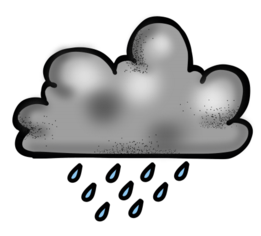
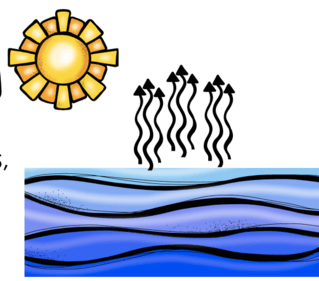
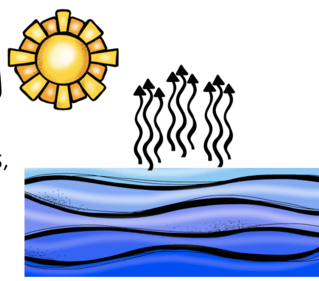
What is the energy source for the water cycle?
the Sun
the Earth
water
the Moon



Which of the following chemical formulas represents the nitrogen in the atmosphere?
NH4
NO3
NO4
N2
N2O4
What living organisms play an important role in helping nitrogen change states in the soil?
Reptiles
Algae
Mammals
Bacteria
Fish
Which process in the nitrogen cycle turns dead plants and animals into ammonium?
Fixation
Nitrification
Assimilation
Ammonification
Denitrification
Which process in the nitrogen cycle turns ammonium into nitrates?
Fixation
Nitrification
Assimilation
Ammonification
Denitrification
Which process in the nitrogen cycle takes extra nitrogen from the soil and puts it back into the air?
Fixation
Nitrification
Assimilation
Ammonification
Denitrification
Which process in the nitrogen cycle turns nitrogen into ammonium?
Fixation
Nitrification
Assimilation
Ammonification
Denitrification
Which process in the nitrogen cycle occurs when plants absorb nitrogen from nitrates in the soil?
Fixation
Nitrification
Assimilation
Ammonification
Denitrification
In what way is nitrogen important to life on Earth?
It is used in making DNA.
It is used to make chlorophyll in plants.
It is used in amino acids and proteins.
All of the above.
None of the above.
Flashback! Choose the 4 macromolecules.
Carbohydrate
Lipid
Protein
Potassium
Nucleic Acid
*Choose all that apply* What are benefits of photosynthesis?
It makes food that plants and animals can use for energy
It changes light energy from the sun into a form that can be used by living things
It changes carbon into a form that can be used by living things
In which organelle does photosynthesis take place?
Chloroplast
Mitochondria
Nucleus
How are cellular respiration and photosynthesis related?
They are the same reaction, which means that their reactants (starting substances) and their products (ending substances) are exactly the same
They are opposite reactions, which means the products (ending substances) of photosynthesis become the reactants (starting substances) of cellular respiration and vice versa
Photosynthesis and cellular respiration are not related
Choose the three fossil fuels
natural gas
water
coal
hydrogen
oil
What kind of organism takes out the most carbon from the atmosphere?
Plants
Bacteria
Animals
Humans
Where does all the carbon in organisms (living things) originate from?
Earth's atmosphere
Rocks
Water
Soil
In the carbon cycle, animals can release carbon back into the cycle through __________ or through __________.
burning . . . photosynthesis
fixation . . . decomposition
decomposition . . . photosynthesis
respiration . . . decomposition
respiration . . . photosynthesis
Humans burn fossil fuels and wood, releasing carbon dioxide into the atmosphere. This carbon dioxide is then absorbed by trees for photosynthesis. These processes are contributory to which chemical cycle?
The carbon cycle
The water cycle
The nitrogen cycle
The phosphorous cycle
All of the carbon in existence is continually recycled in the carbon cycle.
Which of the following processes does NOT move carbon to the atmosphere?
Animal respiration (Breathing)
Volcanic eruption
Photosynthesis
Burning fossil fuels
Why does cutting down trees increase global warming?
trees soak up carbon dioxide and removing them causes more carbon to stay in the atmosphere
trees provide shade which counteracts global warming
trees absorbs the sun's energy without radiating back into the atmosphere
trees drain greenhouse gases like methane from soil
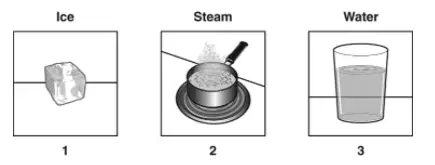
The motion of atoms is affected by temperature. The pictures show water at three different temperatures.
Place the pictures in order of decreasing motion of water molecules starting with the fastest at the top:
Picture 1
Picture 2
Picture 3
Picture 3
Picture 2
Picture 1
Picture 2
Picture 3
Picture 1
Picture 1
Picture 3
Picture 2
What happens when a gas is heated?
pressure increases
Volume increases
kinetic energy of the particles increases
All of the above
Objects with greater _________ also have greater inertia.
speed
mass
force
friction
Distance divided by time is how this is calculated.
Average Speed
Instant Speed
Acceleration
Velocity
Suppose you walked 80 meters in 40 seconds. What is your average speed?
80 n/s
2 m/s
1 m/s
0.5 m/s
Suppose you are running at 8 mph for a race but then encounter a nice downhill. Which of the following is a likely instant speed during any part of the downhill portion of the race?
0 mph
8 mph
9.5 mph
7 mph
How fast an object is traveling in a certain direction is the definition of __________.
speed
velocity
acceleration
position

Which of the following time intervals shows an object moving at a constant speed toward the reference point?
9:00 to 11:00
11:00 to 12:00
12:00 to 12:30
12:30 to 14:00

