
 Worksheets
Changing a circular saw blade
Total questions: 25
Worksheet time: 14mins
Which legislation covers the provision of work equipment regulations for circular saws?
Safe Use of Woodworking Machinery Approved Code of Practice (ACoP)
The Provision of Work Equipment Regulations 2002 (PUWER)
Health and Safety at Work Act
Machinery Safety Regulations
What does ACoP stand for in the context of safety legislation for circular saws?
Approved Code of Practice
Advanced Code of Practice
Authorized Code of Practice
Accredited Code of Practice
What should be done before any maintenance is carried out on a saw?
The machine has stopped
The machine is running
The machine is isolated and locked
A sign has been placed on the machine warning ‘Do not operate. Maintenance in progress’
What should be done to the machine before maintenance to ensure safety?
The machine is running
The machine is isolated and locked
The machine is unplugged
The machine is covered
What sign should be placed on the machine before maintenance?
‘Do not touch. Maintenance in progress’
‘Do not operate. Maintenance in progress’
‘Do not use. Maintenance in progress’
‘Do not move. Maintenance in progress’
Why might you need to change a saw blade?
The teeth have become damaged or blunt.
The saw is too heavy.
The handle is broken.
The saw is too old.
What is one reason for changing a saw blade?
The teeth require cleaning of resin build-up.
The saw is too light.
The handle is too short.
The saw is too new.
Which of the following is a reason to change a saw blade?
The type of material being cut.
The saw is too expensive.
The handle is too long.
The saw is too cheap.
When might you need a different type of saw blade?
The type of cutting process requires a different type of blade.
The saw is too colorful.
The handle is too smooth.
The saw is too noisy.
What is the saw blade mounted on?
A. A spindle
B. A flange
C. A nut
D. A drive pin
Which of the following is NOT used to hold the saw blade in position?
A. The flange
B. The drive pin
C. A removable flange
D. A machine table
What is located below the machine table?
A. The spindle
B. The crown guard
C. The saw driving flange
D. The spindle nut
What is the first step in the procedure for removing the blade?
Remove or raise the crown guard.
Remove finger plate or draw back sliding table.
Undo the nut.
Tighten the nut.
What should you note about the nut when undoing it?
It will have a right-hand thread.
It will be very tight.
It will have a left-hand thread.
It will be very loose.
What should you remove first when taking off the blade, after the crown guard?
The blade
The spindle
The nut and flange
The drive pin
Where should you place the blade after removing it?
Directly onto the metal bed
On the floor
On timber
On a plastic sheet
What should be cleaned after removing the blade?
The blade and the drive pin
The flanges, spindle, and nut
The metal bed
The timber
What should you select for the intended material to be cut?
The required correct tooth pitch
The required handle material
The required blade color
The required saw length
What should you ensure about the replacement blade?
It is the correct color
It has the correct angle of the hook
It is made of plastic
It is longer than the saw
What must be checked about the blade size?
It is within the size limits, follows the curve of riving knife by 8mm
It is the largest available
It is the smallest available
It is the same size as the handle
What should you do first when dealing with a riving knife?
Remove the riving knife and clean.
Select a riving knife suitable for the replacement blade.
Measure the thickness of the riving knife.
Check the radius of the riving knife.
When selecting a riving knife suitable for the replacement blade, what should you consider?
Length, thickness (kerf), and radius to follow blade.
Color, material, and brand.
Weight, height, and width.
Price, availability, and warranty.

What is the maximum gap allowed between the riving knife and the saw blade for blades less than 600mm in diameter?
8mm
10mm
12mm
15mm
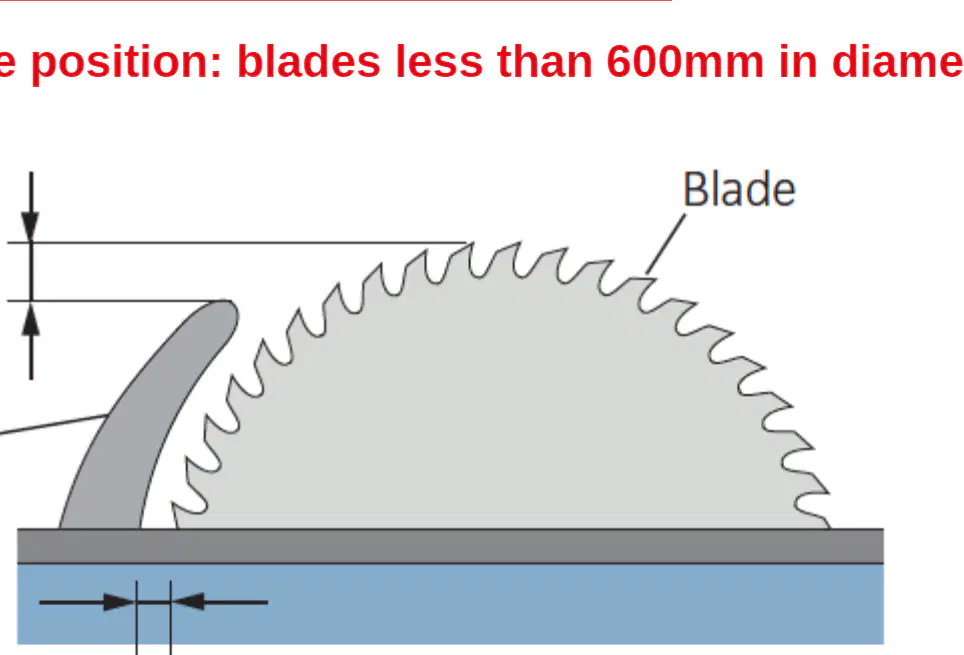
What is the maximum height the riving knife can be above the saw blade for blades less than 600mm in diameter?
10mm
15mm
20mm
25mm
Reorder the following for your prestart checks
Fit all the guards and refit the finger plate.
Remove all tools, etc.
Set the guard as low as possible.
Start then stop the machine, listening carefully for any unusual noise.
Ensure the blade comes to a standstill within 10 seconds. Then, trial cut

