
 Worksheets
Unit 7
Total questions: 65
Worksheet time: 6hrs 54mins
How did Missouri's application as a state with slavery in 1819 challenge U.S. law?
It did not have a state constitution.
States west of the Mississippi River were to be states with slavery.
It did not have the population required for statehood.
States north of the Ohio River were to be free states.
What was an effect of the Missouri Compromise?
It temporarily ended the slavery debate.
It required Southern states to pay higher taxes.
It led to the South seceding from the Union.
It upset the balance of states with and without slavery.

What is the significance of the 36"30 parallel?
It separated the North from the South.
It indicated the northern border of Missouri.
It showed the boarders of the United States.
It indicated where slavery was allowed and banned.
What did Southern senators fear would happen if there were more free states than states with slavery?
losing respect
losing tax revenue
losing voting power
losing future elections
According to the Wilmot Proviso of 1846, in which area was slavery banned?
Southern states
Northern states
Louisiana Territory
Land acquired from Mexico
In what way did the Compromise of 1850 appease the South?
It created new taxes for railroad construction.
It provided an end to the trade of enslaved people in Washington, D.C.
It included a law requiring the return of people who had escaped slavery.
It required the Underground Railway to be disbanded.
Which two people worked together to balance the interests of the North and the South with regard to slavery?
Daniel Webster and Henry Clay
James Polk and John Quincy Adams
Nat Turner and John Brown
Charles Sumner and Stephen A. Douglas
All of these were reasons the Fugitive Slave Law failed except
many enslaved people moved to Canada.
Northerners refused to obey the law.
People who caught fugitives from slavery were driven back to the South.
plantation owners did not want enslaved people returned.

What was the impact of the publication of Uncle Tom's Cabin?
It caused enslaved people to revolt in Kentucky.
It turned many more people against slavery.
Congress agreed that slavery should be abolished.
The South became more resolved to secede from the Union.
How did the Kansas-Nebraska Act nullify the Missouri Compromise?
It changed the borders of Missouri.
It required that all of Missouri be free.
It allowed slavery in new Northern territories.
It established new interstate trade rules.
Which of these was a result of the Kansas-Nebraska Act?
It led to a violent struggle over slavery in Kansas.
It settled the slavery issue in Nebraska.
It calmed the country's dispute over slavery.
It required that the new territories would be free states.
What was the Supreme Court's decision on the Dred Scott case?
that slavery diminished the national character
that African American rights were protected by the Constitution
that African Americans did not have the right to sue in federal court
that slavery should be abolished by executive order
What did John Brown hope to achieve by his raid at Harpers Ferry?
to create a rebellion led by enslaved people that would bring an end to slavery
to bring attention to the conflict between the North and the South
to bring the two sides together to form a new compromise
to create a revolution that would lead to a war between the states
How did the Lincoln-Douglas debates of 1858 impact Lincoln's political future?
He won the senate race in Illinois.
He became known throughout the nation.
He was seen as a poor candidate for public office.
He felt discouraged and removed himself from politics for a time.
What was apparent following the presidential election of 1860?
The nation was divided over slavery.
Lincoln was popular throughout the nation.
There was little support for abolitionists in the North.
Southern states were eager to abolish slavery.
Which event turned the secession crisis into a civil war?
the election of Abraham Lincoln
South Carolina's shelling of Fort Sumter
John Brown's raid on Harpers Ferry
Preston Brook's attack on Charles Sumner

When did Abraham Lincoln speak these words?
at the Lincoln-Douglas debates
at his presidential inauguration
when he gave a campaign speech
when he accepted the senatorial nomination

What does the word "house" in Lincoln's statement refer to?
the U.S. House in Congress
the United States
the Illinois state legislature
Lincoln's home in the state of Illinois

Based on his statement, which of these did Lincoln believe?
All the states will become free states.
All the states will become states with slavery.
The United States will not survive if divided.
The United States will be divided into two countries.
Which river was the dividing line between free (non-slave) states to the North and non-free (enslaved states) to the South?
Mississippi River
Columbia River
Ohio River
Chattahoochee River
For years, there had been an unspoken agreement in ___ to keep the number of states that allowed enslavement and the number that banned it equal.
the White House
Congress
the Constitution
the Declaration of Independence
Taney argued that enslaved people were property and that the __ Amendment to the Constitution said that property could not be taken from people without due process of law- that is a proper court hearing.
1st
4th
5th
9th
As a result of the Supreme Court rulings from the Dred Scott court case, what new political party formed in the U.S. in opposition to slavery?
Democratic-Republicans
Whig-Torries
Republicans
Democrats
Soon after President Lincoln won the election several Southern states seceded and forms the
Confederacy.
Confederate States of America.
Rebel Nation.
United Southern States of America.
Which of the following statements most accurately describes President Lincoln's views on the future of slavery in the U. S.?
He would not interfere with the Fugitive Slave Act.
He would not interfere with the institution of slavery in the South.
He would not stand for slavery expanding into the territories.
All of the answers are correct.
Which of these was a Northern advantage at the start of the Civil War?
highly trained soldiers
abundant natural resources
fighting in familiar territory
control of the Mississippi River
Why did General Lee join the Confederate military?
He was in favor of slavery.
He felt loyalty to his native Virginia.
He believed in the rights of states to secede.
He had been defeated in the presidential election.
Which of these was a Southern advantage at the start of the Civil War?
large population
strong military leadership
control of the railway system
many factories and businesses
What was Jefferson Davis’s role prior to becoming president of the Confederate States?
He was a Northern abolitionist.
He was a wealthy plantation owner.
He represented Mississippi in the U.S. Senate.
He was a candidate in the 1860 presidential election.
What was the significance of the Battle of Bull Run?
It proved that the South was weak.
It showed that the North would win.
It proved that a quick victory was impossible.
It showed that the armies were unwilling to fight long battles.
The Union’s Anaconda Plan included all of the following strategies except
dividing the South.
blocking Southern ports.
capturing Richmond, Virginia.
assassinating the Confederate president.
Women supported the Civil War cause in all of the following ways except
spying on the enemy.
working in factories.
fighting on the battlefield.
treating wounded soldiers.
Which of these was the greatest cause of death in the Civil War?
wounds
disease
frostbite
starvation
What did General Lee hope would be the result of sending his troops to fight on Union soil?
A show of strength in Maryland might convince the state to join the Confederacy.
Union troops would be defeated and the war would end.
Confederate troops would cut off Union access to the Potomac.
Seeing their land being destroyed by war would discourage the Union.
Lincoln’s Emancipation Proclamation declared that
slaves in U.S. territories were free.
slaves throughout the world were free.
slaves in Confederate states were free.
slaves in Union slave states were free.
Why was the Battle of Gettysburg a turning point in the war?
Lee succeeded in capturing a city in the North.
The South suffered many losses while the North had few.
The loss of troops convinced Lee to never again invade the North.
The outcome convinced European nations to aid the Confederacy.
Which document did Lincoln reference in his Gettysburg Address?
"Four score and seven years ago our fathers brought forth on this continent a new nation, conceived in liberty, and dedicated to the proposition that all men are created equal."
U.S. Constitution
Emancipation Proclamation
Preamble to the Constitution
Declaration of Independence
What was the result of the Battle of Vicksburg?
The Confederate troops deserted.
The Union controlled all Southern ports.
The Union gained control of the Mississippi River.
The Confederacy enlisted more troops than ever before.
Which of these was a danger for African American troops who fought for the Union?
if captured, they could be sold into slavery.
They were frequently attacked by other Union soldiers.
If captured, they would be forced to fight for the Confederacy.
They were easily overcome since they had no weapons.
Which of these describes General Sherman’s march through Georgia?
an example of total war
a defeat for both armies
a peaceful end to the conflict
the bloodiest battle of the war.
Which of these describes Grant’s terms of surrender at Appomattox Court House?
They were meant to punish the Confederacy.
They were generous so as to avoid further suffering.
They were stern in their demand for payment of losses.
They were meant to show that the North sought forgiveness.

Use the table and your knowledge of history to answer the question.
How might the distribution of farmland have affected the outcome of the Civil War? Which statement below is not true?
The North was able to produce more food to feed the civilian and military populations.
The South used most of their farmland to produce cotton and other products for export.
The South had more financial resources.
The North had a greater manufacturing ability to produce war resources.

Use the table and your knowledge of history to answer the question.
Based on the table, why might the North have been better equipped than the South to fight a long war? Which statement below is false? Select the false statement.
The North had more determined soldiers unlike the South, even though the South had a larger population to draw soldiers from.
The North had a better transportation system to move soldiers and equipment.
The North had more financial resources.
The North had a greater manufacturing ability to produce war resources.

Use the table and your knowledge of history to answer the question
Based on the table, which of the following accounted for the high value of exports in the South?
banking
railroads
cotton production
iron and steel production
What factor or event do you think most influenced the Outcome of the civil war?
The distribution of Farmland.
The Fact that the North had been better equipped than the South to fight a long war.
The Battle of Gettyburg
Abraham Lincoln

Southern states should be left alone to reconstruct themselves.
The South should be severely punished for its part in the war.
Southern states should be required to ratify the Fourteenth Amendment.
The South should be treated with kindness and justice.
All of these were included in President Johnson's Reconstruction plan except
cancellation of war debts
new state constitutions for Confederate states.
ratification of the Thirteenth Amendment.
guarantee of voting rights for freedmen.
Which of these was a lasting effect of the Freedmen's Bureau?
job security
land distribution
free medical care
educational opportunity
What was the purpose of the Black Codes?
to control freed people
to provide fair wages for freed people
to reconstruct the plantation system
to teach reading skills to freed people
What was the purpose of the Thirteenth Amendment?
to abolish slavery
to provide citizenship to freed people
to allow freedmen to run for office
to legislate fair treatment of all citizens
What does the Fourteenth Amendment guarantee to all individuals in the United States?
the right to vote
the right to medical care
equal protection of the law
equal access to public facilities
During Congressional Reconstruction, which group held political power in the South?
wealthy, white landowners
former Confederate leaders
members of the Ku Klux Klan
people who had been loyal to the United States
As a result of the Military Reconstruction Act 1867, which of these made up the largest group of new Southern voters?
African Americans
white Southern Democrats
former Confederate soldiers
Northerners who moved to the South
What was the purpose of the Fifteenth Amendment?
to give all citizens the right to vote
to provide education for all citizens
to raise taxes to repair damage to the South
to protect the voting rights of African American men
What did Congress hope the Enforcement Acts would prevent?
misuse of tax money
attacks on political leaders
attempts to keep people from voting
opposition to new state governments
Why did some Southerners form the Ku Klux Klan?
to integrate Southern schools
to end government corruption
to return white Democrats to power
to protect the voting rights of Southerners
Why did Southern Democrats pass Jim Crow laws?
to ensure equal education for all
to encourage Southerners to move to the North
to separate African Americans and white people in public life
to prevent African Americans from voting

In this diagram, what should replace the question mark?
Jim Crow laws are unconstitutional
Public facilities should be available to all races.
Integration of schools is required by law.
Separate but equal public facilities are constitutional.
What was the effect of Southern poll tax laws?
African Americans were denied voting rights.
Money was raised to fund public education.
Public funding of small businesses increased.
Southern Democrats were voted out of office.
Southern segregation pushed African Americans to move. What pulled them to other parts of the country?
the promise of free land
the promise of free education
the hope of better opportunities
the hope of political opportunities
How did African Americans who remained in the South improve their lives?
They depended upon government welfare.
They worked together to build communities.
They received money from relatives in the North.
They conducted violent protests to obtain their rights.
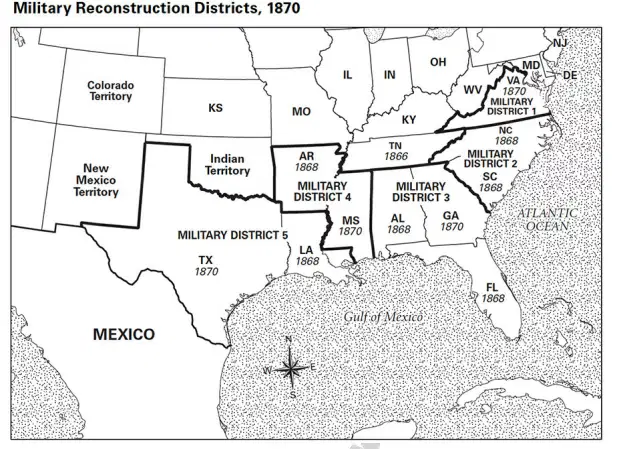
What do the years under the Southern states represent?
the dates they seceded from the Union
the dates the states were readmitted to the Union
The dates they signed the peace agreement.
The dates the ratified their new state constitutions.

Why did Congress believe it was necessary to establish these military districts?
to provide work soldiers
to quell violent revolts by enslaved people
to prevent another civil war
to form legal state governments
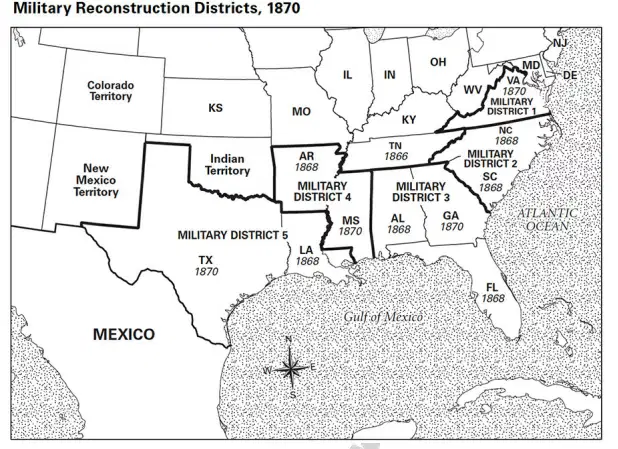
The Military Reconstruction Act was enacted in response to the actions of which president?
Ulysses S. Grant
Andrew Johnson
Abraham Lincoln
Rutherford B. Hayes
There will be a short essay on the test. You will need to describe at least three ways the government tried to guarantee African Americans full citizenship during Reconstruction. Then you will need to describe three ways that various groups tried to deny African Americans full citizenship during and immediately after Reconstruction.
I understand the short essay I will need to write for the test.
I am not aware that I will have to write a short essay on the test.

