
NEW
Font size
 Worksheets
QAM #4 Review
Total questions: 22
Worksheet time: 44mins
What is the molarity of 1.5 Liters of solution that contains 52 grams of LiF?
1.3 M
2.0 M
3.0 M
0.75 M
What is the concentration of a solution, in parts per million, if 0.02 gram of Na3PO4 is dissolved in 1000 grams of water?
20 ppm
2 ppm
0.2 ppm
0.02 ppm
Compared to a 0.1 M aqueous solution of NaCl, a 0.8 M aqueous solution of NaCl has a
higher boiling point and higher freezing point
higher boiling point and lower freezing point
lower boiling point and higher boiling point
lower boiling point and lower freezing point
Which two compounds are electrolytes?
C6H12O6 and CH3CH2OH
C6H12O6 and HCl
NaOH and HCl
NaOH and CH3CH2OH
Given the reaction at equilibrium:
HSO4- + NH3 <---> SO42- + NH4+
What are the two species that are acids?
NH3 and NH4+
NH3 and SO42-
HSO4- and SO42-
HSO4- and NH4+
When the pH of a solution is changed from 4 to 3, the hydronium ion concentration of the solution
decreases by a factor of 10
increases by a factor of 10
decreases by a factor of 100
increases by a factor of 100
Which indicator is blue in a solution that has a pH value of 7.0?
bromcresol green
methyl orange
phenolphthalein
thymol blue
Which equation represents a neutralization reaction?
6HClO --> 4HCl + 2HClO3
CH4 + 2O2 --> CO2 + 2H2O
Ca(OH)2 + H2SO4 --> CaSO4 + 2H2O
Ba(OH)2 + Cu(NO3)2 --> Ba(NO3)2 + Cu(OH)2
In a titration, 5.0 mL of a 2.0 M NaOH(aq) solution exactly neutralizes 10.0 mL of an HCl(aq) solution. What is the concentration of the HCl(aq) solution?
1.0 M
2.0 M
10 M
20 M

Given the potential energy diagram in the image, which numbered interval represents the activation energy of the reaction?
1
2
3
4

Given the potential energy diagram in the image, what is the heat of reaction?
20kcal
40kcal
60kcal
80kcal
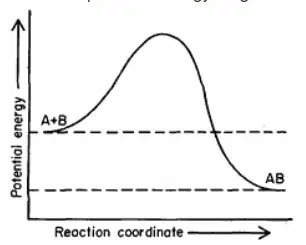
Given the potential energy diagram in the image,
the reaction A + B --> AB can best be described as,
endothermic, having a +ΔH
endothermic, having a -ΔH
exothermic, having a +ΔH
exothermic, having a -ΔH
Chemical systems in nature tend to undergo changes towards
lower energy and lower entropy
lower energy and higher entropy
higher energy and lower entropy
higher energy and higher entropy
Given the equation representing a system at equilibrium:
2NO2(g) <--> N2O4(g)
Which statement describes this reaction at equilibrium?
The concentration of the reactant and product must be equal
The concentration of the reactant and product must be constant
The rates of the forward and reverse reactions are increasing
The rates of the forward and reverse reactions are decreasing
Given the equation representing a reaction at equilibrium:
N2(g) + 3H2(g) <--> 2NH3(g)
What occurs when the concentration of H2(g) is increased?
The equilibrium shifts to the left, and the concentration of NH3(g) decreases
The equilibrium shifts to the left, and the concentration of NH3(g) increases
The equilibrium shifts to the right, and the concentration of NH3(g) decreases
The equilibrium shifts to the right, and the concentration of NH3(g) increases
Given the reaction that occurs in an electrochemical cell:
Zn(s) + CuSO4(aq) --> ZnSO4(aq) + Cu(s)
During this reaction, the oxidation number of Zn changes from
0 to +2
0 to -2
+2 to 0
-2 to 0
All chemical reactions have a conservation of
mass, only
mass and charge, only
charge and energy, only
mass, charge, and energy
Based on Reference Table J, which of the following elements will react spontaneously with Pb(NO3)2(aq)?
Mg(s)
Au(s)
Cu(s)
Ag(s)
Which statement is true about oxidation and reduction in an electrochemical cell?
Both occur at the anode
Both occur at the cathode
Oxidation occurs at the anode and reduction occurs at the cathode
Oxidation occurs at the cathode and reduction occurs at the anode
Which energy conversion occurs in an operating electrolytic cell?
Chemical energy to electrical energy
Electrical energy to chemical energy
Nuclear energy to electrical energy
Electrical energy to nuclear energy
A 1.0-gram piece of zinc reacts with 5 milliliters of HCl(aq). Which of these conditions of concentration and temperature would produce the fastest rate of reaction?
1.0 M HCl(aq) at 20oC
1.0 M HCl(aq) at 40oC
2.0 M HCl(aq) at 20oC
2.0 M HCl(aq) at 40oC

What is the purpose of the salt bridge in a voltaic cell?
It blocks the flow of electrons
It blocks the flow of positive and negative ions
It is a path for the flow of electrons
It is a path for the flow of positive and negative ions

