
Font size
 Worksheets
Grade 8 revision
Total questions: 145
Worksheet time: 6hrs 29mins

y = 2x + 1
y = 4x - 1

8x + 4y = 12
y = -2x + 3
y=-4x
2x − 3y = −1
y = x − 1
3x + 2y = 16
7x + y = 19
y = 2x -11
-3y = -6x -15

-12x-4y= -8
-6x-2y= -4
5x + 3y = 7
y = 4
2x − 3y = −1
y = x − 1
3x + 2y = 16
7x + y = 19
y = 4x+1
3x + 2y = 13
-x + y = -4
y = 2x - 11


Solve this system by substitution.
(1, -4)
(1, 4)
(-4, -7)
(-7, -4)
Is (1,10) a solution to
y=7x+5
y=x+9
yes
no
Is (1,7) a solution for
y=3x+4
y=x+6
yes
no

What is the solution?
8x + 4y = 12
y = -2x + 3


What is the solution?

y - 3x = -8
y = 4 - x
4x + 8y = 20
-4x + 2y = -30
Which variable will be eliminated by adding the two equations?
Solve:
3x - y = 11
x + y = 5
x = 4
y = 1
x = 4
y = -1
x = -4
y = 1
x = -4
y = -1
Solve: 3x−4y=26 2x−4y=20
x = 6
y = -2
x = -6
y = -2
x = -6
y = 2
x = 6
y = 2
Solve:
x = -3y - 17
2x + 3y = -7
(1, -20)
(10, 0)
(-5, -2)
(10 , -9)

Solve the following system of equations algebraically using elimination method.
(-3, 4)
(3, 4)
(3, -4)
(-3, -3)

Solve the following system of equations algebraically using Elimination Method.
(1, 1)
(3, 1)
(-1, -1)
(1, 3)
−4x + 2y = −30
3x + 2y = 16
7x + y = 19
y = 2x + 1
y = 4x - 1
-2x + y = 5
x - 2y = -3
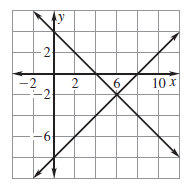
y = 3
10, 20, 30, 40, ...
3, 7, 11, 15, ...
97, 86, 75, 64, ...
Write the explicit formula for the sequence.
9, 5, 1, -3, ...
an=9+5(n−1)
an=9−4(n−1)
an=4+9(n−1)
an=9⋅4(n−1)
Write the explicit formula for the sequence.
15, 22, 29, 36, 43, ...
an=15+22(n−1)
an=15⋅7(n−1)
an=15+7(n−1)
an=29−14(n−1)
Use the explicit formula to find the 7th term of the sequence.
an=22−3(n−1)
4
1
18
114
Write the recursive formula of 13, 9, 5, 1, -3, ...
an=an-1-4
an=an-1+3
an=an-1-5
an=an-1+4
The Recursive Formula for the Arithmetic Sequence is:
A. an = a1 + d (n−1)
B. an = a(n−1) + d
an = a1 ⋅ r (n−1)
an = a(n−1) ⋅ r
The Explicit Formula for the Arithmetic Sequence is:
A. an = a1 + d (n−1)
B. an = a(n−1) + d
an = a1 ⋅ r (n−1)
an = a(n−1) ⋅ r
We will start with the explicit formula. Given the following sequence, state the first term and common difference.
Example 1: 4, 7, 10, 13, 16, …
a1 = 3, d = 4
a1 = 16, d = 3
a1 = 4, d = 3
a1 = 16, d = 13
Now, write the explicit formula for the given sequence.
Example 1: 4, 7, 10, 13, 16, …
an = 4 + (n − 1)(3)
an = 3 + (n − 1)(4)
an = 7 + (n − 1)(3)
an = 16 + (n − 1)(4)
Now, let's go backwards!!! Given the explicit formula, what is the first term?
an = 3 + (n − 1)(2)
(a)
2, 8, 14, ...
(Hint: Write your formula and then simplify it.)
an = 6n + 2
an = 6n - 6
an = 6n - 4
an = -6n + 4
What is a formula for the nth term in the sequence 12, 20, 28, ...?
an=20+8(n−1)
an=−4+8(n+1)
an=12+8(n+1)
an=12(8)n
Which is a *recursive rule* for the nth term in the sequence 15, 8, 1, ...?
a1=15, an=an−1−7
an=15−7(n−1)
a1=−7, an=an−1+15
an=−7+15(n−1)
2, 8, 14, ...
(Hint: Write your formula and then simplify it.)
A sequence is shown below:
2, 5, 8, 11, ...
Which explicit formula can be used to model the sequence?
an = 3 - 11(n - 1)
an = 2 + 3(n - 1)
an = 11 - 3(n - 1)
an = 3 + 2(n - 1)
Which of the following equations is the rule for this sequence: 6, 11, 16, 21, . . .
an = 6 + 5(n - 1)
an = 4 + 6(n - 1)
an = 6 - 4(n - 1)
25, 21, 17, 13,...
Write the explicit equation that models the sequence.
an = 25 + 4(n-1)
an = 25 + 21(n-1)
an = 25 - 4(n-1)
an = 13 + 4(n-1)
15, 12, 9, 6, 3 ....
un = un-1 + 3
un = un-1 + 3
un = un-1 - 3
un = un-1 - 3
a0 = 1
an = an-1 + 5
3, 8, 13, 18 ...
15, 12, 9, 6, 3 ....
un = un-1 + 3
un = un-1 + 3
un = un-1 - 3
un = un-1 - 3
a0 = 1
an = an-1 + 5

Parallelogram ABCD was translated to parallelogram A'B'C'D'.
How many units and in which direction were the x-coordinates of parallelogram ABCD moved?
3 units to the right
3 units to the left
7 units to the right
7 units to the left

a translation across the x-axis
a rotation
a reflection across the x-axis
a dilation

Which type of transformation is represented by the figures in the graph?
reflection and translation
reflection
rotation
dilation and rotation

Which of the following describes the transformation from figure A to figure B on the grid?
reflection across the x-axis
reflection across the y-axis
rotation about point (0,0)
translation 6 units right

Karin used a single transformation of trapezoid P to create the image Q on the coordinate plane shown. Which of these describe the transformation that Karin used?
reflection over the x-axis
reflection over the y-axis
translation down
translation up

Lainey drew figure P on a coordinate grid. Then she did a one-step transformation of figure P to draw figure Q as shown. Which of the following one-step transformations of figure P could Lainey have done to draw figure Q?
reflection over the x-axis
reflection over the y-axis
rotation 1800 clockwise
translation to the right

Are the two angles below congruent?
yes
no


Reflection means
turn
flip

Rotation means
to slide
to turn

Translation means
slide
flip

When one shape can become another using only Turns, Flips and/or Slides, then the two shapes are
congruent
similar

An image is
The new position of a shape after a transformation
the position of a shape before a transformation

This is an example of
a reflection
a rotation

Two trapezoids are shown on the coordinate grid. Which sequence of transformations shows that the two trapezoids are congruent
Reflect Trapezoid 1 across the x-axis, then reflect the resulting figure across the y-axis.
Translate Trapezoid 1 to the right 4 units, then reflect the resulting figure across the x-axis.
Translate Trapezoid 1 to the right 4 units, then translate the resulting figure down 4 units.
Translate Trapezoid 1 down 4 units, then reflect the resulting figure across the x-axis.

Two triangles are shown on the coordinate grid. Which sequence of transformations shows that ΔABC≅ΔDEF
Reflect △ABC across the x-axis, then translate it right 1
Reflect △ABC across the y-axis, then translate it right 1
Reflect △ABC across the x-axis, then translate it left 1
Reflect △ABC across the y-axis, then translate it left 1

What geometric transformation has been applied to the shape?
translation
reflection
flip
rotation
Which picture shows a triangle and its image when it is reflected over the line?


Which shows a reflection?


This is an example of what?
Reflection
Rotation
Translation

Rotation
Reflection
Translation

Rotation
Reflection
Translation

Describe the transformation in the image
Translation
Reflection
Rotation

Describe the transformation in the image.
Translation
Reflection
Rotation
A flip is also called ___________.
Translation
Reflection
Rotation
Transformation

Describe the transformation in the image
Translation
Reflection
Rotation

Describe the transformation that occurred.
h(x) = f(x) + 2
up 2 units
left 2 units
Vertical Strech
right 2 units
Describe the transformation that occurred
m(x) = f(x + 1)
Left 1 Unit
Right 1 unit
vertical stretch
up 1 unit
y=(x-2)3+4

f(x) = x2 to the graph of g(x) = (x + 4)2?

Moves up 2
Moves left 4

Moves right 7

Match the equation to its description.
Stretched vertically by 2 and up 4
Compressed vertically by 2 and up 4
Stretched vertically by 2 and left 4
Compressed vertically by 2 and left 4


f(x) = 2x - 6 ; g(x) = f(x) - 6
f(x) = 2x - 6 ; g(x) = f(2/3x)
p(x) = f(x + 3)
y = (x - 3)2
Which of the following show a Vertical stretch and a horizontal reflection
-f(1/2*x)
-f(2*x)
1/2*f(-x)
2 *f(-x)
A translation moves a figure 3 units to the left. Which would describe this move?
x - 3
x + 3
y - 3
y + 3


When you graph an inequality, you used a solid line when you use which symbols?
≤, ≥
<, >
When graphing an inequality, you use a dotted line when you use which symbol?
<, >
≤, ≥

Which point below is part of the solution set?
(5, 0)
(-1, -5)
(3, -5)
(0, -1)

The graph shows which inequality?
y ≤ 2
y ≥ 2
y > 2
x > 2


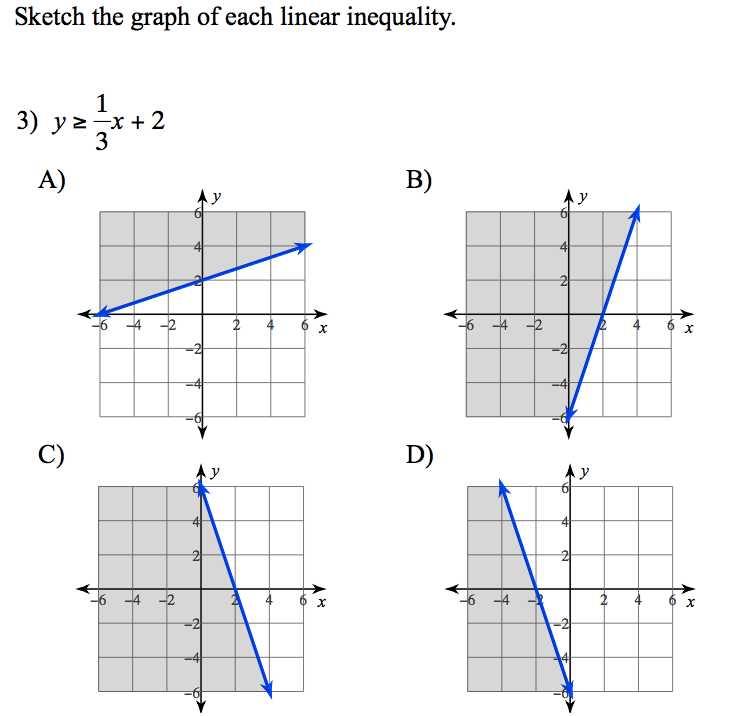

Which of the following inequalities match the given graph?
y ≤ -3/4 x + 3
y ≥ -3/4 x + 3
y < -3/4 x + 3
y > -3/4 x + 3

Select the correct graph that represents the inequality.
A
B
C
D

