wayground logo

Free Printable Worksheets

Font size

S
M
L
XL
Worksheets

Transformation and Rotation

Total questions: 205

Worksheet time: 14hrs 7mins

Name
Class
Date
1.

Rotation Rules (clockwise):

90o rotation: (x, y)→(y, -x)

What are the coordinates for A' after a 90rotation clockwise?

a)

(1, 3)

b)

(3, 1)

c)

(3, -1)

d)

(1, -3)

2.

Rotation Rules (clockwise):

180o rotation: (x, y)→(-x, -y)

What are the coordinates of C' after a rotation of 180° clockwise?

a)

(-3, -1)

b)

(3,1)

c)

(1,3)

d)

(-1, -3)

3.

Does the image show a rotation? If so, what is the angle of rotation?

a)

90° counterclockwise

b)

180° counterclockwise

c)

270° counterclockwise

d)

Not a rotation

4.

Does this image show a rotation? If so, what is the angle of rotation?

a)

90° counterclockwise

b)

180° counterclockwise

c)

270° counterclockwise

d)

Not a rotation

5.
If you were to rotate ABCD 180°  about the origin, what would the coordinate of A' be?
a)
(-5, 5)
b)
(-3, -5)
c)
(-5, 3)
d)
(-3, 3)
6.
What is this picture an example of? 
a)
An angle
b)
A cat vertex 
c)
Rotation 
d)
Dilation
7.
The image A'B'C' is a rotation of ABC.
a)
True
b)
False
8.
What type of rotation does this represent (from red to blue)?
a)
270⁰ clockwise
b)
360⁰
c)
90⁰ counterclockwise
d)
180⁰
9.

What is the angle of the clockwise rotation?

a)

90°

b)

180°

c)

270°

10.

Triangle A is rotated 270° clockwise with the origin as the center of rotation to create a new figure. Which triangle shows the new location?

a)

A

b)

B

c)

C

d)

D

11.
If you were to rotate ABCD 180° about the origin, what would the coordinates of B' be?
a)
(0, 0)
b)
(-6, -5)
c)
(-1, 3)
d)
(-6, 2)
12.

The coordinates of triangle JRB are ,J(1, -2) , R(-3, 6) and B(4, 5) . What are the coordinates of its image after the transformation (x, y) ->(x+2, y-1) then reflect over the y-axis?

a)

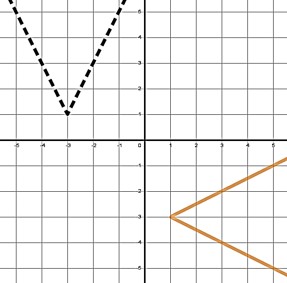
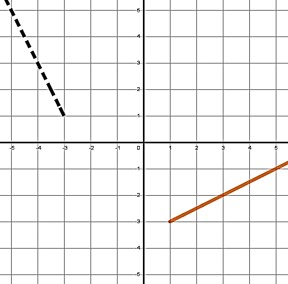
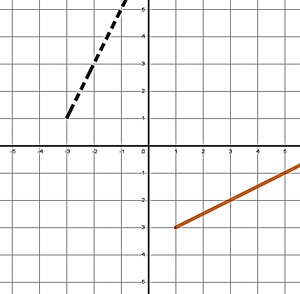
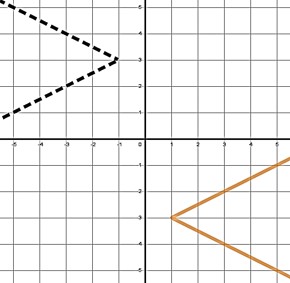
J"(3, 1), R"(-1, -7), B"(6, -6)

b)

J"(3, -3), R"(-1, 5), B"(6, 4)

c)

J"(-3, -3), R"(1, 5), B"(-6, 4)

d)

J"(-1, -2), R"(3, 6), B"(-4, 5)

13.

Rotation Rules (clockwise):

90o rotation: (x, y)→(y, -x)

What are the coordinates for A' after a 90rotation clockwise?

a)

(1, 3)

b)

(3, 1)

c)

(3, -1)

d)

(1, -3)

14.
Which answer shows a reflection across the y-axis?
a)
a
b)
b
c)
c
d)
d
15.
If the coordinates of point P are (2, -3) , then R90 o R180 is
a)
(-2, 3)
b)
(-2, -3)
c)
(3, -2)
d)
(-3, -2)
16.

How do you get from the red triangle to the orange triangle?

a)

reflection over the y-axis and then the x-axis

b)

rotate 270 degrees and reflect over y = 2

c)

reflection over the y-axis and translate up 7

d)

rotate 180 degrees and reflect over y = 2

e)

translate up 7, translate right 6, and then reflect over the x-axis

17.
What type of rotation does this represent (from red to blue)?
a)
270⁰ clockwise
b)
360⁰
c)
90⁰ counterclockwise
d)
180⁰
18.

A turn is also called a ___________.

a)

Translation

b)

Reflection

c)

Rotation

d)

Transformation

19.

A flip is also called a ___________.

a)

Translation

b)

Reflection

c)

Rotation

d)

Transformation

20.

A slide is also called a ___________.

a)

Translation

b)

Reflection

c)

Rotation

d)

Transformation

21.

Transformation can be....

(Check all possible answers)

a)

Translation

b)

Reflection

c)

Rotation

d)

Geometry

22.
Identify the transformation.
a)
Reflection across y-axis
b)
90 Rotation counter clockwise
c)
Translation 5 units left, 1 unit up.
d)
Translation 5 units right, 1 unit down
23.
Identify the transformation from ABCD to A'B'C'D'.
a)
Translation
b)
Reflection across the y-axis
c)
Reflection across the x-axis
d)
90o counter clockwise Rotation
24.
Identify the transformation from ABC to A'B'C'.
a)
90o clockwise rotation
b)
90o counter clockwise rotation
c)
Reflection across the y-axis
d)
Reflection across the x-axis
25.
Translations, reflections and rotations are all known as ________________________.
a)
Geometry
b)
Transformations
c)
Congruent
26.
How is triangle ABC being translated to triangle A'B'C'?
a)
up 3, left 8
b)
up 9, left 4
c)
down 3, right 8
d)
down 9, right 4
27.

Translations, rotations, and reflections are three different types of what?

a)

Transformations

b)

Geometry

c)

Vectors

d)

Shapes

28.

A turn is also called a ___________.

a)

Translation

b)

Reflection

c)

Rotation

d)

Transformation

29.

A slide is also called a _________.

a)

Translation

b)

Reflection

c)

Rotation

d)

Transformation

30.

A flip is also called a _________.

a)

Translation

b)

Reflection

c)

Rotation

d)

Transformation

31.

Congruent means...

a)

The same angles.

b)

The same size and same shape.

c)

Equal to.

d)

The same transformation.

32.

Describe the Transformation

a)

Translation

b)

Reflection

c)

Rotation

33.

Describe the transformation in the image.

a)

Translation

b)

Reflection

c)

Rotation

34.

The original figure prior to a transformation.

a)

Pre-image

b)

Image

35.

The result of a transformation.

a)

Pre-image

b)

Image

36.

What is this picture an example of?

a)

Reflection

b)

Translation

c)

Rotation

d)

Dilation

37.

Name the transformation.

a)

Translation

b)

Reflection

c)

Rotation

38.

The mathematical term for the line that you reflect a shape over is the...

a)

Mirror

b)

Reflective tape

c)

Line that you reflect over

d)

Line of reflection

39.

After a figure has been transformed, we call the new figure the...

a)

Image

b)

Different shape

c)

Figure that moved

d)

Prime

40.
a)

A

b)

B

c)

C

d)

D

41.
a)

A

b)

B

c)

C

d)

D

42.
a)

A

b)

B

c)

C

d)

D

43.
a)

A

b)

B

c)

C

d)

D

44.
a)

A

b)

B

c)

C

d)

D

45.
a)

A

b)

B

c)

C

d)

D

46.
a)

A

b)

B

c)

C

d)

D

47.
a)

A

b)

B

c)

C

d)

D

48.
a)

A

b)

B

c)

C

d)

D

49.
a)

A

b)

B

c)

C

d)

D

50.

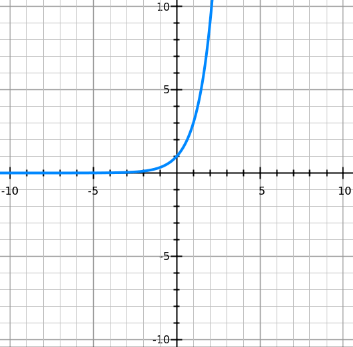
What does this graph represent?

a)

Exponential Decay

b)

Exponential Growth

51.

What is the asymptote of the parent function y=2x?

a)

x=0

b)

y=0

c)

x=2

d)

y=2

52.
What is the x-intercept of the exponential function? 
a)
(0,1)
b)
(0,0)
c)
There is not one
53.
What is the y-intercept?
a)
(0,0)
b)
(0,1)
c)
(-3,0)
d)
(0,-3)
54.
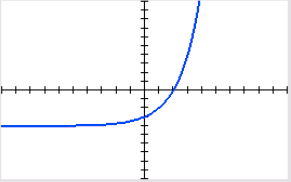
Which equation best describes the graph? 
a)
y = 2x + 4
b)
y = 2x - 3
c)
y = 2x - 4
d)
y = 2x + 3 
55.
What is the asymptote value in the function?
a)
3
b)
2
c)
7
d)
0
56.

For a cubic graph  y=ax3+bx2+cx+dy=ax^3+bx^2+cx+d  , what's the graph looks like if  a>0a>0  ?

a)
b)
57.

For a cubic graph  y=ax3+bx2+cx+dy=ax^3+bx^2+cx+d  , what's the graph looks like if  a<0a<0  ?

a)
b)
58.

For a reciprocal graph  y=axy=\frac{a}{x}  , what's the graph looks like if  a>0a>0  ?

a)
b)
59.
a)
A
b)
B
c)
C
d)
D
60.

Which of the following could be a graph of y=3x3y=3x^3 ?

a)
b)
c)
d)
61.
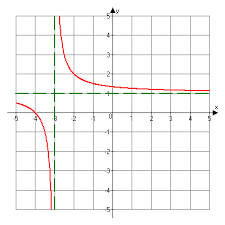
What are the asymptotes?
a)
x = -3        y = 1  
b)
x = 3         y = 1
c)
x = -3        y = -1
d)
x = 3         y = -1
62.
Which of these lines has a negative gradient?
a)
The orange one
b)
The red one
c)
The blue one
d)
The green one
63.

Choose the correct function that represents this graph.

a)

f(x) = x2

b)

f(x) = x3

c)

f(x) = 1/x2

d)

f(x) = ∛x

64.
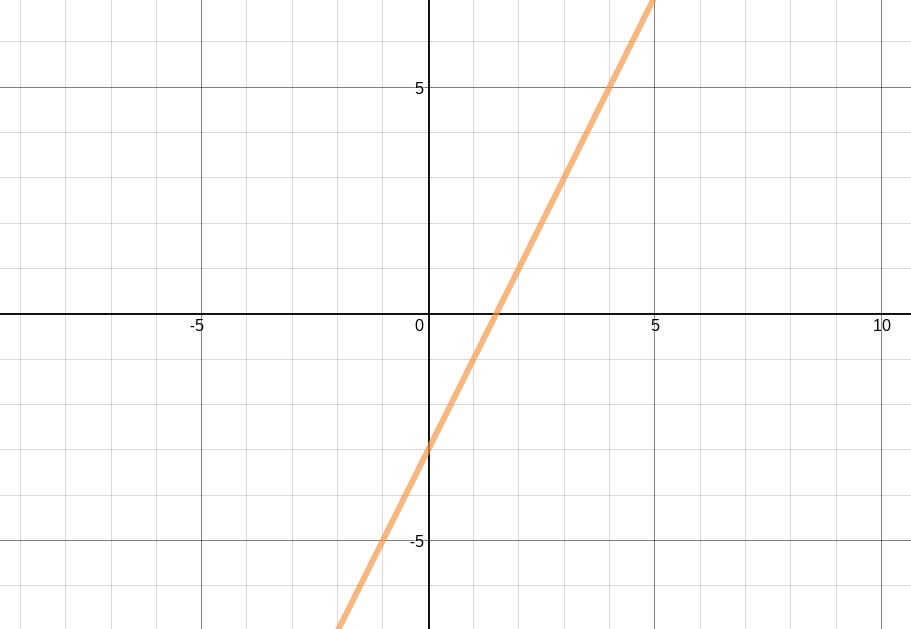
What is the gradient of this line?
a)
2
b)
½
c)
d)
-3
65.

a)

y=5

b)

y=5x

c)

y=x2y=x^2

d)

y=1xy=\frac{1}{x}

66.

a)

y=5

b)

y=5x

c)

y=x2y=x^2

d)

y=1xy=\frac{1}{x}

67.

a)

y=x2+5y=x^2+5

b)

y=x2+3y=-x^2+3

c)

y=x2y=x^2

d)

y=x2+3y=x^2+3

68.

a)

y=x21y=x^2-1

b)

y=x2+1y=x^2+1

c)

y=x21y=-x^2-1

d)

y=x2+1y=-x^2+1

69.

a)

y=x2y=x^2

b)

y=x3y=x^3

c)

y=1xy=\frac{1}{x}

d)

y=1x2y=\frac{1}{x^2}

70.

a)

y=x3y=x^3

b)

y=x3y=-x^3

c)

y=x3+5y=-x^3+5

d)

y=x35y=-x^3-5

71.

a)

y=1xy=\frac{1}{x}

b)

y=xy=x

c)

y=x2y=x^2

d)

y=x3y=x^3

72.

a)

y=1xy=\frac{1}{x}

b)

y=1xy=-\frac{1}{x}

c)

y=1x+3y=\frac{1}{x}+3

d)

y=1x+3y=-\frac{1}{x}+3

73.

a)

y=1xy=\frac{1}{x}

b)

y=1xy=-\frac{1}{x}

c)

y=1x+3y=\frac{1}{x}+3

d)

y=1x+3y=-\frac{1}{x}+3

74.

a)

y=5x

b)

y=5xy=5^x

c)

y=x2y=x^2

d)

y=1xy=\frac{1}{x}

75.
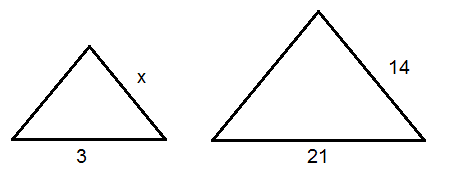
Find the length of x
a)
x = 1
b)
x = 2
c)
x = 7
d)
x = 1/7
76.
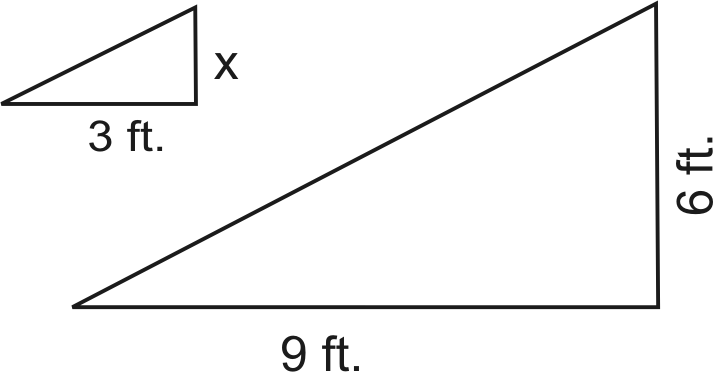
Solve for X.
a)
2 ft
b)
3 ft
c)
4 ft
d)
6 ft
77.
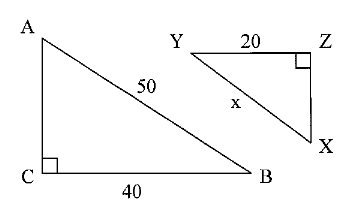
Triangle ABC and XYZ are similar.  Use your knowledge of scale factor to find the length of X.
a)
20
b)
25
c)
100
d)
40
78.
Find the missing side length.
a)
9
b)
6
c)
8
d)
7
79.
Find missing side
a)
5
b)
7
c)
9
d)
11
80.
Solve for X.
a)
36
b)
27
c)
45
d)
56
81.
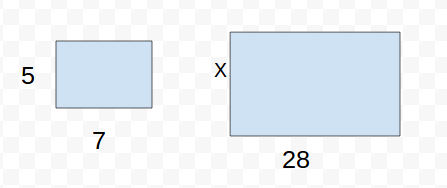
The pair of figures is similar. Find the missing side.
a)
x = 20
b)
x = 12
c)
x = 5
d)
x = 4
82.
a)

12

b)

14

c)

16

d)

18

83.
a)

6

b)

4

c)

12

d)

16

84.

Find x.

a)

6.6

b)

4.5

c)

5.4

d)

7.2

85.

The pyramids are similar. The volume of pyramid A is 26 cm326\ cm^3  . Find the volume of pyramid B.

a)

3.25 cm33.25\ cm^3  

b)

13 cm313\ cm^3  

c)

52 cm352\ cm^3  

d)

208 cm3208\ cm^3  

86.

The rectangular prisms are similar. The volume of prism B is 1728 cm31728\ cm^3  . Find the volume of prism A.

a)

8 cm38\ cm^3  

b)

48 cm348\ cm^3  

c)

10368 cm310368\ cm^3  

d)

157248 cm3157248\ cm^3  

87.

The boxes are similar. The volume of the small box is 500 cm3500\ cm^3  . Find the volume of the large box.

a)

166.67 cm3166.67\ cm^3  

b)

1500 cm31500\ cm^3  

c)

5300 cm35300\ cm^3  

d)

13500 cm313500\ cm^3  

88.

The hearts are similar. The area of heart B is 150 cm2150\ cm^2  . Find the area of heart A.

a)

6 cm26\ cm^2  

b)

30 cm230\ cm^2  

c)

750 cm2750\ cm^2  

d)

3750 cm23750\ cm^2  

89.

The pentagonal prisms are similar. The volume of prism A is 15 cm315\ cm^3  . Find the volume of prism B.

a)

0.56 cm30.56\ cm^3  

b)

15 cm315\ cm^3   

c)

  405 cm3405\ cm^3  

d)

729 cm3729\ cm^3   

90.

The triangles are similar. The area of triangle A is 20 cm220\ cm^2  . Find the area of triangle B.

a)

20 cm220\ cm^2  

b)

40 cm240\ cm^2  

c)

60 cm260\ cm^2  

d)

80 cm280\ cm^2  

91.
What is the scale factor?
a)
4
b)
.25
c)
5
d)
6
92.
What is the measurement of x?
a)
21
b)
1.25
c)
20
d)
4
93.

The solids are similar. Find the measure of side l.

a)

2 m

b)

1 m

c)

1.3 m

d)

3 m

94.

The solids are similar. Find the measure of side h.

a)

18 m

b)

12 m

c)

24 m

d)

32 m

95.

The solids are similar. Find the missing dimension(s).

a)

6 ft

b)

9 ft

c)

4.2 ft

d)

8 ft

96.

Retype the following statement including your answer for angle 3


Angle 3 measures _ degrees

4 lines
97.

True or False, side AB is similar to side YZ

a)

True

b)

False

98.

The scale factor of the triangles is _.

(a)  

99.

The dilation was a _ because _


HINT: Shrink or Enlargement?

4 lines
100.

XZ is _ cm long.


HINT: Type only the number

(a)  

101.
What is the scale factor of these similar shapes?
a)
10
b)
7
c)
9
d)
11
102.

The 2 shapes are similar. Find x.

a)

2

b)

7

c)

0.5

d)

12

103.

If two figures are similar, their volume ratio is ...?

a)

the same

b)

squared

c)

cubed

d)

three times as much

104.

Calculate the value of the scale factor between the 2 triangles

a)

2.5

b)

3

c)

3.5

d)

4

105.
What is the value of X?
a)
X=4
b)
X=6
c)
X=3
d)
X=2
106.

Two similar cones have a scale factor of 8/27. What is the ratio of their volumes?

a)

2/3

b)

64/729

c)

512/19683

d)

8/27

107.

If all of the dimensions of a triangular prism decreased by 1/3, how much would the volume decrease by?

a)

1/27

b)

1/9

c)

1/3

d)

1/6

108.

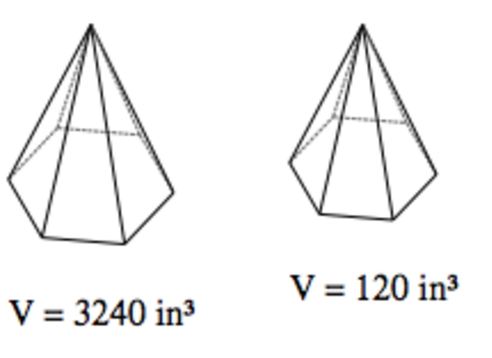
What is the scale factor of the side lengths of the figure on the left to the figure on the right.

a)

3/1

b)

3240/120

c)

27/1

d)

9/1

109.
Two spheres have a scale factor ratio of 1:3.  The smaller sphere has a surface area of 16 ft2.  Find the surface area of the larger sphere.
a)
48 ft2
b)
144 ft2
c)
432 ft2
d)
32 ft2
110.
Two similar pyramids have heights of 4 inches and 7 inches.  What is the ratio of the volume of the small pyramid to the volume of the large pyramid? 
a)
4:7
b)
16:49
c)
64:343
d)
12:21
111.

The volume of a prism is 1000 cubic centimeters. A similar prism has a volume of 27 cubic centimeters. What is the ratio of their surface areas?

a)

100:9

b)

10:3

c)

500:13.5

d)

100:2.7

112.

In a display at a museum, two planets have volumes of 8 cubic inches and 27 cubic inches. What is the ratio of their diameters?

a)

4:13.5

b)

2:9

c)

2:3

d)

4:13.5

113.

The ratio of the volume of two spheres is 8:27. What is the ratio of their radii?

a)

2:3

b)

4:9

c)

3:4

d)

64:729

114.
The surface area of the larger prism is 2560 m2.  Find the surface area of the smaller prism.
a)
921.6 m2
b)
1536 m2
c)
553 m2
d)
7111.1 m2
115.
What is the ratio of the surface areas from large to small. 
a)
49/16
b)
7/4
c)
42/24
d)
10/8
116.
If two similar rectangles have corresponding sides with a ratio of 2:3, what is the ratio of their areas?
a)
4:5
b)
4:9
c)
2:3
d)
5:9
117.
The ratio of the areas of two similar rectangles is 1:4. What is the ratio of the corresponding sides?
a)
1:6
b)
1:8
c)
1:2
d)
1:4
118.
The ratio of the volumes of two spheres is 64:27. What is the ratio of the lengths of the radii of these two spheres?
a)
2:1
b)
3:4
c)
4:3
d)
4:9
119.

What is the scale factor of the side lengths of the figure on the left to the figure on the right.

a)

3/1

b)

3240/120

c)

27/1

d)

9/1

120.

What are the inverse points for the coordinates:

(3, 0) , (2, -4), (5, 5) and (-6,8)

a)

(3,0) , (2, -4) , (5,5) , (6,8)

b)

(0,3) , (-4,2) , (5,5) , (8,-6)

c)

(3,2), (0, -4), (5, -6), (5,8)

121.

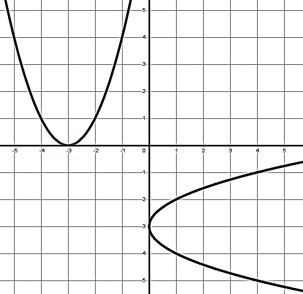
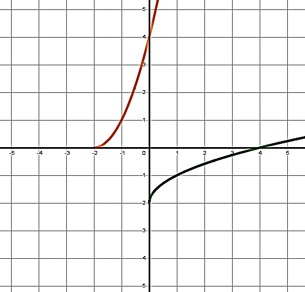
Are these inverse functions?

a)

yes

b)

no

122.

Are these functions inverses?

a)

No

b)

Yes

c)

No way to tell

123.

Are these functions inverses?

a)

Yes

b)

No

124.
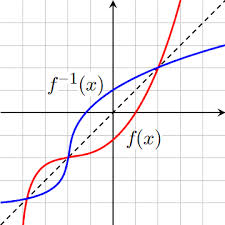
The inverse has been reflected over which line?
a)
y = x
b)
y =1
c)
y = 0
d)
y = x + 1
125.

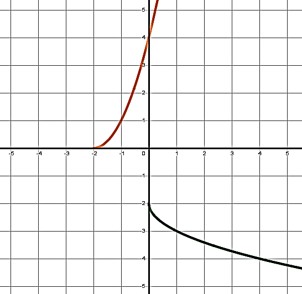
Which graph represents the functions f(x) and f-1(x)?
a)
b)
c)
d)
126.

Find the inverse of  f(x)=10+7xf(x)=10+7x  

a)

f1(x)=x710f^{-1}(x)=\frac{x-7}{10}

b)

f1(x)=x107f^{-1}(x)=\frac{x-10}{7}

c)

f1(x)=110+7xf^{-1}(x)=\frac{1}{10+7x}

127.

Find the inverse of  f(x)=4xf(x)=4x  

a)

f1(x)=x4f^{-1}(x)=\frac{x}{4}

b)

f1(x)=4f^{-1}(x)=4

c)

f1(x)=14f^{-1}\left(x\right)=\frac{1}{4}

128.

Find the inverse of  f(x)=x53f(x)=\frac{x-5}{3}  

a)

f1(x)=35+xf^{-1}(x)=\frac{3}{5}+x

b)

f1(x)=3x+5f^{-1}(x)=3x+5

c)

f1(x)=5x+3f^{-1}(x)=5x+3

129.

Find the inverse of  f(x)=2x+1f(x)=2x+1  

a)

f1(x)=2xf^{-1}(x)=2x

b)

f1(x)=x12f^{-1}(x)=\frac{x-1}{2}

c)

f1(x)=2f^{-1}(x)=2

130.

Find the inverse of  f(x)=3x+2f(x)=3x+2  

a)

f1(x)=3x2f^{-1}(x)=3x-2

b)

f1(x)=2+3xf^{-1}(x)=2+3x

c)

f1(x)=x23f^{-1}(x)=\frac{x-2}{3}

131.

The inverse of f(x)=8x+30f(x)=8x+30  is f1(x)=830f^{-1}(x)=\frac{8}{30}  .

a)

True

b)

False

132.

The inverse of f(x)=x+30f(x)=x+30   is  f1(x)=x30f^{-1}(x)=x-30  .

a)

True

b)

False

c)

I have no idea how to do this.

133.

The inverse of the function f(x) is written as ...

a)

f -1(x)

b)

f 2(x)

c)

f '(x)

d)

f +(x)

134.

Find the inverse of  f(x)=3x+2f(x)=3x+2  

a)

f1(x)=3x2f^{-1}(x)=3x-2

b)

f1(x)=2+3xf^{-1}(x)=2+3x

c)

f1(x)=x23f^{-1}(x)=\frac{x-2}{3}

135.

Find the inverse of  f(x)=2x+1f(x)=2x+1  

a)

f1(x)=2xf^{-1}(x)=2x

b)

f1(x)=x12f^{-1}(x)=\frac{x-1}{2}

c)

f1(x)=2f^{-1}(x)=2

136.

Find the inverse of  f(x)=4xf(x)=4x  

a)

f1(x)=x4f^{-1}(x)=\frac{x}{4}

b)

f1(x)=4f^{-1}(x)=4

c)

f1(x)=14f^{-1}\left(x\right)=\frac{1}{4}

137.

Find the inverse of  f(x)=x53f(x)=\frac{x-5}{3}  

a)

f1(x)=35+xf^{-1}(x)=\frac{3}{5}+x

b)

f1(x)=3x+5f^{-1}(x)=3x+5

c)

f1(x)=5x+3f^{-1}(x)=5x+3

138.

Find the inverse of  f(x)=10+7xf(x)=10+7x  

a)

f1(x)=x710f^{-1}(x)=\frac{x-7}{10}

b)

f1(x)=x107f^{-1}(x)=\frac{x-10}{7}

c)

f1(x)=110+7xf^{-1}(x)=\frac{1}{10+7x}

139.

The inverse of f(x)=x+30f(x)=x+30   is  f1(x)=x30f^{-1}(x)=x-30  .

a)

True

b)

False

c)

I have no idea how to do this.

140.

The inverse of f(x)=8x+30f(x)=8x+30  is f1(x)=830f^{-1}(x)=\frac{8}{30}  .

a)

True

b)

False

141.

The inverse of  f(x)=x21f(x)=x^2-1  is f1(x)=(x+1)12f^{-1}(x)=(x+1)^{\frac{1}{2}}  .

a)

True

b)

False

142.

Find the inverse of f(x)=1xf(x)=\frac{1}{x}  .

a)

f1(x)=1xf^{-1}\left(x\right)=\frac{1}{x}  

b)

f1(x)=xf^{-1}\left(x\right)=x  

c)

no solution

143.

The notation for an inverse is

a)

f1(x)f^{-1}\left(x\right)

b)

g1(x)g^{-1}\left(x\right)

c)

All of the above

144.
Find the inverse of
f(x) = 1/4x - 7
a)
f-1(x) = 4x + 7
b)
f-1(x) = -4x + 28
c)
f-1(x) = -4x - 7
d)
f-1(x) = 4x + 28
145.
Was the inverse function found correctly?
a)
no,
b)
yes
146.
Find the inverse of f(x) = -4x - 12
a)
f-1(x) = 4x - 3
b)
f-1(x) = -1/4x - 3
c)
f-1(x) = 1/4x + 3
d)
f-1(x) = -4x - 3
147.
Find the inverse of the function
f(x) = 3x − 5
a)
f-1(x)=3x +5
b)
f-1(x)=(x+5)/3
c)
f-1(x)=3y-5
d)
f-1(x)=3y+5
148.
Are the following inverses of each other?
a)
True
b)
False
149.
Find the inverse 
f(x)=2x-2
     
a)
f-1(x)=1/2x+1
b)
f-1(x)=-2-1/2x
c)
f-1(x)=-7/3x-20/3
d)
2-2/5x
150.

Is the inverse function found correctly?

a)

yes

b)

no

151.
What does it mean to find the inverse of a function?
a)
the x's and y's are switched
b)
the x's and y's are divided by 2
c)
the x's and y's are made negative
d)
the x's and y's are the same
152.
The inverse of the function f(x) is written as ...
a)
f -1(x)
b)
f 2(x)
c)
f '(x)
d)
f +(x)
153.
The inverse has been reflected over which line?
a)
y = x
b)
x = 0
c)
y = 0
d)
x = -y
154.

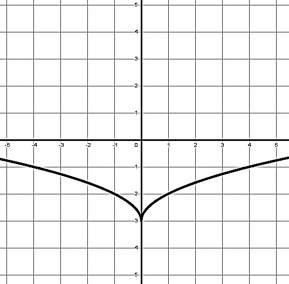
Which graph represents the functions f(x) and f-1(x)?
a)
b)
c)
d)
155.
What is the first step in finding the equation of the inverse of a function?
a)
get x by itself
b)
switch x and y
c)
solve for y
d)
write the function in inverse function notation
156.
If the equation of f(x) goes through (1, 4) and (4, 6), what points does f-1(x) go through?
a)
(1, 4) and (4, 6)
b)
(-4, -1) and (-6, -4)
c)
(-1, -4) and (-4, -6)
d)
(4, 1) and (6, 4)
157.
are these inverse functions?
a)
no
b)
yes
c)
no way to tell
158.
are these inverse functions?
a)
no
b)
yes
c)
no way to tell
159.

Rotation Rules (clockwise):

90o rotation: (x, y)→(y, -x)

What are the coordinates for A' after a 90rotation clockwise?

a)

(1, 3)

b)

(3, 1)

c)

(3, -1)

d)

(1, -3)

160.

Rotation Rules (clockwise):

180o rotation: (x, y)→(-x, -y)

What are the coordinates of C' after a rotation of 180° clockwise?

a)

(-3, -1)

b)

(3,1)

c)

(1,3)

d)

(-1, -3)

161.

Does the image show a rotation? If so, what is the angle of rotation?

a)

90° counterclockwise

b)

180° counterclockwise

c)

270° counterclockwise

d)

Not a rotation

162.

Does this image show a rotation? If so, what is the angle of rotation?

a)

90° counterclockwise

b)

180° counterclockwise

c)

270° counterclockwise

d)

Not a rotation

163.
If you were to rotate ABCD 180°  about the origin, what would the coordinate of A' be?
a)
(-5, 5)
b)
(-3, -5)
c)
(-5, 3)
d)
(-3, 3)
164.
What is this picture an example of? 
a)
An angle
b)
A cat vertex 
c)
Rotation 
d)
Dilation
165.
The image A'B'C' is a rotation of ABC.
a)
True
b)
False
166.
What type of rotation does this represent (from red to blue)?
a)
270⁰ clockwise
b)
360⁰
c)
90⁰ counterclockwise
d)
180⁰
167.

What is the angle of the clockwise rotation?

a)

90°

b)

180°

c)

270°

168.

Triangle A is rotated 270° clockwise with the origin as the center of rotation to create a new figure. Which triangle shows the new location?

a)

A

b)

B

c)

C

d)

D

169.
If you were to rotate ABCD 180° about the origin, what would the coordinates of B' be?
a)
(0, 0)
b)
(-6, -5)
c)
(-1, 3)
d)
(-6, 2)
170.

The coordinates of triangle JRB are ,J(1, -2) , R(-3, 6) and B(4, 5) . What are the coordinates of its image after the transformation (x, y) ->(x+2, y-1) then reflect over the y-axis?

a)

J"(3, 1), R"(-1, -7), B"(6, -6)

b)

J"(3, -3), R"(-1, 5), B"(6, 4)

c)

J"(-3, -3), R"(1, 5), B"(-6, 4)

d)

J"(-1, -2), R"(3, 6), B"(-4, 5)

171.

Rotation Rules (clockwise):

90o rotation: (x, y)→(y, -x)

What are the coordinates for A' after a 90rotation clockwise?

a)

(1, 3)

b)

(3, 1)

c)

(3, -1)

d)

(1, -3)

172.
Which answer shows a reflection across the y-axis?
a)
a
b)
b
c)
c
d)
d
173.
If the coordinates of point P are (2, -3) , then R90 o R180 is
a)
(-2, 3)
b)
(-2, -3)
c)
(3, -2)
d)
(-3, -2)
174.

How do you get from the red triangle to the orange triangle?

a)

reflection over the y-axis and then the x-axis

b)

rotate 270 degrees and reflect over y = 2

c)

reflection over the y-axis and translate up 7

d)

rotate 180 degrees and reflect over y = 2

e)

translate up 7, translate right 6, and then reflect over the x-axis

175.
What type of rotation does this represent (from red to blue)?
a)
270⁰ clockwise
b)
360⁰
c)
90⁰ counterclockwise
d)
180⁰
176.
If you were to rotate ABCD 180°  about the origin, what would the coordinate of A' be?
a)
(-5, 5)
b)
(-3, -5)
c)
(-5, 3)
d)
(-3, 3)
177.
If you were to rotate ABCD 180° about the origin, what would the coordinates of B' be?
a)
(0, 0)
b)
(-6, -5)
c)
(-1, 3)
d)
(-6, 2)
178.
Rotate the point (-3,-4) around the origin 180 degrees. State the image of the point.
a)
(-4,-3)
b)
(-4,3)
c)
(4,-3)
d)
(3,4)
179.
What is this picture an example of? 
a)
An angle
b)
A cat vertex 
c)
Rotation 
d)
Dilation
180.
The image A'B'C' is a rotation of ABC.
a)
True
b)
False
181.
What type of rotation does this represent (from red to blue)?
a)
270⁰ clockwise
b)
360⁰
c)
90⁰ counterclockwise
d)
180⁰
182.
Triangle A is rotated 90° clockwise with the origin as the center of rotation to create a new figure. Which rule describes rotating 90° clockwise?
a)
(x,y)→(y, -x) 
b)
(x,y)→(-x,-y)
c)
(x,y)→(-y,x)
d)
(x,y)→(x,y)
183.
Triangle A is rotated 270° counterclockwise with the origin as the center of rotation to create a new figure. Which rule describes rotating 270° counterclockwise?
a)
(x,y)→(y, -x) 
b)
(x,y)→(x,y)
c)
(x,y)→(-y,x)
d)
(x,y)→(-x,-y)
184.
Triangle C is rotated 180° clockwise with the origin as the center of rotation to create a new figure. Which rule describes rotating 180° clockwise?
a)
(x,y)→(y, -x) 
b)
(x,y)→(-x,-y)
c)
(x,y)→(x,y)
d)
(x,y)→(-y,x)
185.
Triangle B is rotated 90° counterclockwise with the origin as the center of rotation to create a new figure. Which triangle shows the new location?
a)
A
b)
B
c)
C
d)
D
186.

f(x)=2x+5f\left(x\right)=2x+5  and g(x)=x7g\left(x\right)=x-7  
Find  f(g(5))f\left(g\left(5\right)\right)  

a)

-1

b)

1

c)

8

d)

9

187.

f(x)=x3f\left(x\right)=x-3  and g(x)=2x+6g\left(x\right)=2x+6  
Find  g(f(1))g\left(f\left(-1\right)\right)  

a)

-2

b)

-1

c)

1

d)

16

188.

g(x)=x2+1g\left(x\right)=x^2+1  and h(x)=x7h\left(x\right)=x-7  
Find  h(g(5))h\left(g\left(5\right)\right)  

a)

-1

b)

5

c)

12

d)

19

189.

g(x)=x3g\left(x\right)=x-3  and h(x)=x2+2x3h\left(x\right)=x^2+2x-3  
Find  g(h(1))g\left(h\left(-1\right)\right)  

a)

-21

b)

-7

c)

5

d)

19

190.

Which one is the same as (fg)(x)\left(f\circ g\right)\left(x\right)

a)

g(f(x))g\left(f\left(x\right)\right)

b)

f(g(x))f\left(g\left(x\right)\right)

191.

Given f(x)=5x+7f\left(x\right)=5x+7  and  g(x)=3+4xg\left(x\right)=3+4x , find  (gg)(x)\left(g\circ g\right)\left(x\right)  in simplest form.

a)

15+16x15+16x  

b)

31+20x31+20x  

c)

22+20x22+20x  

d)

42+25x42+25x  

192.

Given f(x)=5x+7f\left(x\right)=5x+7  and , find  in simplest form.

a)

  25x+4225x+42  

b)

3x263x^2-6

c)

3x2+63x^2+6  

d)

  3x2123x^2-12  

193.

Given f(x)=3x6f\left(x\right)=3x-6  and  g(x)=x2+4g\left(x\right)=x^2+4 , find  (fg)(x)\left(f\circ g\right)\left(x\right)  in simplest form.

a)

3x2+123x^2+12  

b)

3x263x^2-6  

c)

3x2+63x^2+6  

d)

3x2123x^2-12  

194.

h(x)=(x3)2h\left(x\right)=\left(x-3\right)^2  and  g(x)=x7g\left(x\right)=\sqrt{x-7}  
Find  h(g(11))h\left(g\left(11\right)\right)  

(a)  

195.

h(x)=x2+4h\left(x\right)=x^2+4  and  g(x)=3x+7g\left(x\right)=3x+7  
Find  g(h(4))g\left(h\left(4\right)\right)  

(a)  

196.

f(x)=6x1f\left(x\right)=6x-1  and  g(x)=3x+1g\left(x\right)=3x+1  
Find  g(f(2))g\left(f\left(2\right)\right)  

(a)  

197.

f(x)=x+4f\left(x\right)=-x+4  and  g(x)=5x2g\left(x\right)=5x-2  
Find  f(g(3))f\left(g\left(-3\right)\right)  

(a)  

198.

If  f(x)=3x+1f\left(x\right)=-3x+1   and  g(x)=2x+7g\left(x\right)=2x+7  , what is the value of  f(g(2))f\left(g\left(-2\right)\right)  ?


(a)  

199.

If  f(x)=3x+1f\left(x\right)=-3x+1   and  g(x)=2x+7g\left(x\right)=2x+7  , what is the value of  g(f(5))g\left(f\left(-5\right)\right)  ?


(a)  

200.

If  f(x)=x+7f\left(x\right)=-x+7   and  g(x)=12x4g\left(x\right)=\frac{1}{2}x-4  , what is the value of  f(g(10))f\left(g\left(10\right)\right)  ?


(a)  

201.

If  f(x)=x+7f\left(x\right)=-x+7   and  g(x)=12x4g\left(x\right)=\frac{1}{2}x-4  , what is the value of  g(f(3))g\left(f\left(-3\right)\right)  ?


(a)  

202.

If  f(x)=4x7f\left(x\right)=4x-7   and  g(x)=2x+1g\left(x\right)=-2x+1  , what is the value of  g(g(5))g\left(g\left(-5\right)\right)  ?


(a)  

203.

If  f(x)=4x7f\left(x\right)=4x-7   and  g(x)=2x+1g\left(x\right)=-2x+1  , what is the value of  f(g(f(1)))f\left(g\left(f\left(1\right)\right)\right)  ?


(a)  

204.

C(g)=2.20gC\left(g\right)=2.20g  and  g(d)=d20g\left(d\right)=\frac{d}{20}   Find  C(g(100))C\left(g\left(100\right)\right)  

(a)  

205.

V(B)=12BV\left(B\right)=12B  and  B(x)=x2B\left(x\right)=x^2  
Find  V(B(3))V\left(B\left(3\right)\right)  

(a)