
Font size
 Worksheets
cpbio Intro to Ecology Quizzez
Total questions: 22
Worksheet time: 13mins
Which of the following would be a limiting factor for growth of a population of downy woodpeckers living in the Ozark Mountains of southwestern Missouri?
limiting insecticide use in the area to control mosquito populations (the food source of downy woodpeckers)
lack of black rat snakes that feed on young woodpeckers living in this area
introduction of individuals of the same species from other areas
the presence of West Nile virus in this region, which has been known to kill a wide variety of birds, including downy woodpeckers
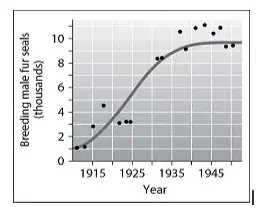
According to this graph of the population growth of fur seals, in what year did the population first reach its carrying capacity?
1950
1925
1940
1930
The maximum number of individuals a habitat can support is called its
carrying capacity.
reproductive potential.
density-dependent factor.
community size.
A newly mated queen ant establishes an ant nest in an unoccupied patch of suitable habitat. The population of the nest grows quickly at first, then levels off at carrying capacity. Which of the following models best describes its population growth?
logistic
exponential
logarithmic
linear
If an ecosystem has a carrying capacity of 1,000 individuals for a given species and 2,000 individuals of that species are present, we can predict that the population
size will remain at equilibrium.
will show a clumped dispersion pattern.
size will decrease.
size will slowly increase.
What kind of curve represents exponential growth?
J-shaped
descending straight line
ascending straight line
S-shaped
An ecologist hypothesizes that predation by a particular owl species is the major factor controlling the population of a particular rabbit species. If this is the case, which of the following population effects could be expected in this rabbit-owl pair?
An increase in the incidence of disease in the rabbit population should not change the owl population.
A fall in the rabbit population should cause an increase in the owl population.
A fall in the owl population should cause a fall in the rabbit population.
An increase in the owl population should cause a fall in the rabbit population.
Consider the following prairie food chain. Tall grass is consumed by grasshoppers that, in turn, are eaten by mice, and the mice are eaten by prairie kingsnakes. Red-tailed hawks prey on mice and prairie kingsnakes. When a red-tailed hawk dies, bacteria, beetles, fungi, and many types of worms help break down the body. Which of the following correctly identifies a trophic level in this ecosystem?
The worms are primary producers.
The red-tailed hawk is a secondary consumer.
The tall grass is a decomposer.
Grasshoppers are primary consumers.
In a certain ecosystem, field mice are preyed on by snakes and hawks. The entry of wild dogs into the system adds a third mouse predator. The most likely short-term result of this addition is
migration of the hawks to another ecosystem.
an increase in the snake population.
a reduction in numbers of mice.
a tendency for hawks to prey on the dogs.
When you eat an apple, you are serving as a __________.
producer
primary consumer
tertiary consumer
secondary consumer
Which statement regarding food webs is true?
Detritivores consume dead organic matter from a specific trophic level.
Several species of primary consumers may feed on the same species of producer.
A consumer eats only one type of producer.
Energy transfer moves from producer to consumer and back.
What generally flows in one direction through an ecosystem, from producers up through each level of consumers, and is not recycled?
energy
water
carbon
sunlight
Which process does not occur in ecosystems?
Producers convert light energy to chemical energy.
Carbon (matter) is cycled between biotic and abiotic forms.
Energy flows through the system.
Consumers directly use the energy source that powers the system.

Exponential growth curve
unlimited amount of resources

Logistic growth curve
the population has leveled out

On day 23 the population has reached its carrying capacity
Read the following passage about the predator and prey relationships between animals in a forest ecosystem. Classify the animals into the appropriate category according to their interactions in the passage. A rabbit runs through the forest trying to escape the talons of a red-tailed hawk that is trying to feed its offspring. In the same forest, a snake is curling around a possum in expectation of an easy meal. Prior to being caught by the snake, the possum had dined on a breakfast of insects. Later that afternoon, a fox wandering through the forest finds a snake, unable to move because of its large meal, and effectively kills it for an easy meal.
Select what can be Both Predator and Prey. A. snake B. fox C. rabbit D. possum E. insects F. red-tailed hawk (a) (b)
Match the following
feeds only other animals
carnivore
feeds only on plants
herbivore
feeds on both plants and animals
omnivore
feeds on dead organisms
decomposer
feeds itself
producer
Which of the following best describes the role of decomposers in an ecosystem?
They produce energy through photosynthesis.
They consume primary producers.
They break down dead organic matter.
They compete with primary consumers for food.
What is the primary source of energy for producers in an ecosystem?
Water
Sunlight
Carbon dioxide
Oxygen
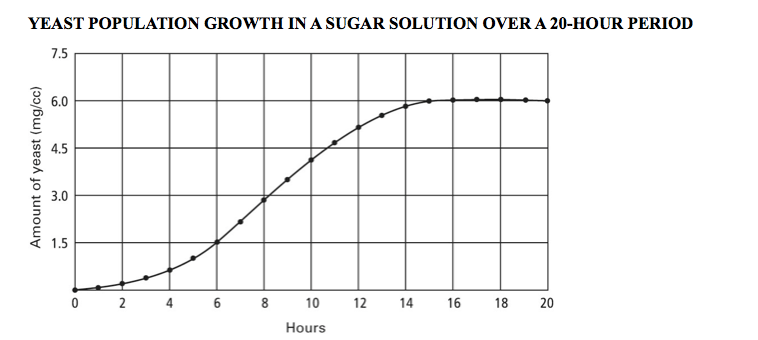

What type of growth is this graph representing
Logistical Growth
Exponential Growth
The term for any factor that limits population growth
Limiting Factor
Immigration
Succession
Abiotic Factor

