
 Worksheets
Science Final Review
Total questions: 32
Worksheet time: 49mins
How do you determine the number of protons, neutrons, and electrons an element has based on the information on the periodic table? Which ones are always the same number?
Protons and neutrons are always the same number.
Electrons and neutrons are always the same number.
Protons and electrons are always the same number.
Neutrons and protons are always the same number.
What are four common properties of most metals?
High melting points, good conductors of electricity, malleable, ductile
Low melting points, poor conductors of electricity, brittle, non-ductile
High melting points, poor conductors of electricity, brittle, non-ductile
Low melting points, good conductors of electricity, malleable, ductile
Generally, what can be said about the properties of the elements that are in the same column?
They have similar properties.
They have completely different properties.
They have no properties in common.
They have random properties.
Define: Reactants
What is the law of conservation of mass and what does it have to do with balancing equations?
How many atoms of Hydrogen are present in this compound? C₂H₃O₂
What is meant by the amplitude of a wave?
the height or depth of the wave from it's rest position

Which transverse wave has the highest frequency?
1
2
3
4
Which diagram shows the wavelength of a wave?


What does a wave carry from place to place?
energy
matter
people
The lowest point on a transverse wave is the
compression
crest
rest position
trough
If the wavelength of a wave increased, what would happen to the frequency?
decrease
increase
stay the same
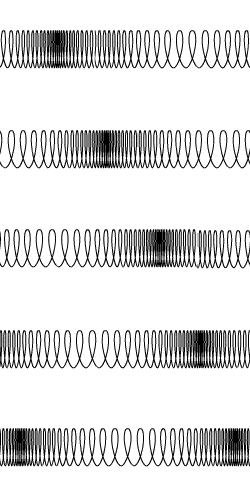
What type of wave is this?
Longitudinal
Transverse
Electromagnetic
x ray

This illustration best depicts which of the following behaviors?
Reflection
Refraction
Diffraction
Resonance

This image best depicts which of the following wave behaviors?
Reflection
Refraction
Diffraction
Resonance

This image depicts which of the following wave behaviors?
Reflection
Refraction
Diffraction
Resonance


__________ are negatively charged particles that are in the orbitals around the nucleus.
protons
nucleus
neutrons
electrons
What did Rutherford discover?
The electron cloud
The proton
The atom
The electron
He developed the planetary model of the atom, where the electrons orbit in levels around the atom

What scientist is best known for his "Plum Pudding" model of the atom? A positive atom with electrons floating around.

In this image, what is the mass number?
27
Co
Cobalt
58.933
Thought that atoms are tiny, hard, and uncuttable spheres.
Schrodinger
Rutherford
Democritus
Thomson
How many VALENCE ELECTRONS does Lithium have?
3
1
2
What are valence electrons?
The total number of electrons in an atom
The number of electrons in the outermost shell
The number of electrons in the second shell
The number of protons in the outermost shell



