wayground logo

Free Printable Worksheets

Font size

S
M
L
XL
Worksheets

MCR3U Exam Review

Total questions: 232

Worksheet time: 19hrs 35mins

Name
Class
Date
1.

-160=?

a)
0
b)
-1
c)
1
d)
16
2.

(⅖)6=?

a)
0.00032
b)
0.004096
c)
0.0016
d)
0.000064
3.

(-8)-4

a)
1/64
b)
1/4096
c)
64
d)
-16
4.

[9-393]-6

a)
-6
b)
27
c)
0
d)
1
5.

Write 84 as a power with a base of ½

Hint: 8 = (1/2) ^ ?

a)
(1/2)^(-8)
b)
(1/2)^(-16)
c)
(1/2)^(-12)
d)
(1/2)^(-6)
6.

(-9)-3+22-50

a)

-2187/729

b)

-2188/729

c)

2186/729

d)

-2186/729

7.

(⅚)-9- (⅝)-9

a)
1562501
b)
1562500
c)
1562502
d)
1562499
8.

A soda has an original mass of 22.3g. What will the mass be, in 50000 years?

a)
21.8g
b)
23.0g
c)
22.3g
d)
22.4g
9.

-(-8)5

a)
-1024
b)
-4096
c)
-16384
d)
-32768
10.

61/2

a)
2.449
b)
4.567
c)
1.732
d)
3.142
11.

(72)1/2 - 60

a)

6

b)

7

c)

48

d)

0

12.

[s1/4x z 1/4] = (s4 x z4)1/4

a)
(s^4 * x * z^4)^1/2
b)
(s^2 * x^2 * z^2)^1/4
c)
(s^8 * x^2 * z^8)^1/4
d)

s=1/4z

13.

Daniel’s Print Shop purchased a new printer for $35,000. Each year it depreciates (loses value) at a rate of 5%. What will its approximate value be at the end of the fourth year?

a)
$30,000
b)
$28,000
c)
$25,000
d)
$29,091.19
14.

A $12,500 car depreciates 9% each year. Find the value of each function after five years.

a)
$9,500.30
b)

$7,768.65

c)
$8,950.00
d)

$6,250.75

15.

Suppose that there is a rumour going around your school that next year all weekends will be extended to three days. Initially, on day 0, five students know the rumour. Suppose that each person who knows the rumour tells two more students the day after they hear about it. Also assume that no-one hears the rumour more than once. How many people will learn about the rumour…

i) on day 1

ii) on day 2

a)
i) 10 students, ii) 30 students
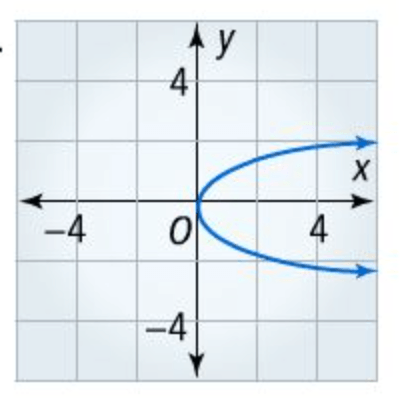
b)

i) 20 students, ii) 60 students

c)

i) 10 ii) 20

d)
i) 25 students, ii) 75 students
16.

A recent college grad accepts a job at Google Inc. The job has a salary of $50,000 and is guaranteed an annual pay increase of 3%. What will their salary be after 7 years?

a)
$60,000
b)
$58,000
c)
$62,000
d)
$59,873.28
17.

Write the equation for the function that results from each transformation applied to the base function y= 5x a) translate down 3 units

b) shift right 2 units

a)
y = 5^(x-3) - 2
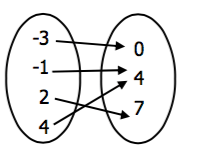
b)
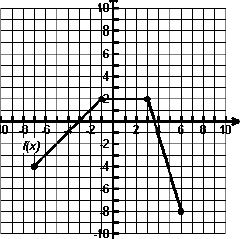
y = 5^(x-2) + 3
c)
y = 5^(x-2) - 3
d)
y = 5^(x+2) - 3
18.

Expand (x - 7)(x + 7)

a)

x2 + 7x - 49

b)

x2 - 7x + 49

c)

x2 - 49

d)

x2 + 49

19.

Expand (g + 4)(g + 5)

a)

g2 + 9g + 20

b)

g2 + 20

c)

g2 + 9g + 9

d)

g2 + 11g + 20

20.

Expand (x + 5)2

a)

x2 + 25

b)

x2 + 10x + 25

c)

x2 + 10 x + 10

d)

x2 + 10

21.

Expand (3x – 1)(x + 5)

a)

3x2 + 4x + 5

b)

3x2 + 4x - 5

c)

3x2 + 14x + 5

d)

3x2 + 14x - 5

22.
Factor out the GCF:
12x + 6
a)
6(2x + 1)
b)
3(4x + 2)
c)
6x(2x + 1)
d)
2(6x + 3)
23.
Factor:
x² - 5x - 14
a)
(x - 2)(x + 3)
b)
(x - 2)(x + 7)
c)
(x + 2)(x - 7)
d)
(x - 2)(x - 3)
24.
Factor Completely: 
3x2 + 18x +15
a)
3(x2 + 6x + 5)
b)
(x + 5)(x + 1)
c)
3(x + 5)(x + 1)
d)
Prime
25.
Factor:
2x² + 11x + 14
a)
(x + 7)(2x + 2)
b)
(x + 2)(2x + 7)
c)
(x + 14)(2x + 1)
d)
(x + 1)(2x + 14)
26.
What is the vertex of the parabola: y=2(x-3)2+4
a)
(3,4)
b)
(-3,4)
c)
(3, -4)
d)
(-3,-4)
27.
Complete the Square and write in Vertex Form:
f(x) = x2 + 6x + 5
a)
(x + 3)2 - 4
b)
(x + 6)2 - 4
c)
(x + 3x)2 - 4
d)
(x + 3)2 + 9
28.

Convert to vertex form:

y = 6x2+12x+13y\ =\ 6x^2+12x+13  

a)

y=6(x+1)2+7y=6\left(x+1\right)^2+7  

b)

y = (6x+6)242y\ =\ \left(6x+6\right)^2-42  

c)

y=(x6)2+7y=\left(x-6\right)^2+7  

d)

y=136(x+1)2+7y=\frac{13}{6}\left(x+1\right)^2+7  

29.
What is the constant that should be added to the expression to complete the square: x+ 16x + ___
a)
16
b)
8
c)
64
d)
32
30.
What is the equation for axis of symmetry?
a)
y=3
b)
x=3
c)
x=5
d)
x=1
31.
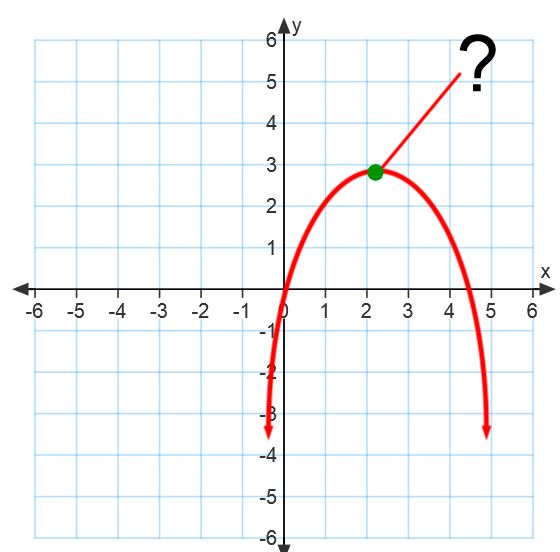
What is the green dot on the parabola called?
a)
maximum
b)
minumum
c)
roots
d)
zeros
32.
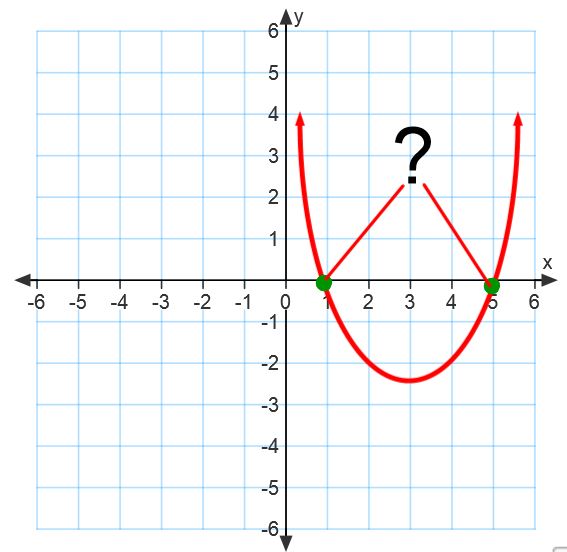
What are the green dots called?
a)
axis of symmetry
b)
vertex
c)
parabola
d)
roots or x-intercepts
33.
Does this parabola have a minimum or maximum and what is its value?
a)
minimum: 2
b)
maximum: 2
c)
minimum: 5
d)
maximum: 5
34.

The coordinates of the y-intercept in this function f(x) = x2 + 8x - 2

a)

(0,0)

b)

(2,0)

c)

(0,-2)

d)

(-2,0)

35.
The axis of symmetry line passes through which point?
a)
y-intercept
b)
any random point
c)
vertex
d)
none of these
36.

Select all the equations that would graph the parabola.

a)

y = (x + 5)2 - 4

b)

y = x2 + 10x + 21

c)

y = x2 - 10x + 21

d)

y = (x - 5)2 - 4

e)

y = (x + 7)(x + 3)

37.

Select all equations that would graph the following quadratic.

a)

y = 3(x - 1)2 - 3

b)

y = 3(x - 3)2 + 1

c)

y = 3x(x - 2)

d)

y = 3x2 - 6x

e)

y = 3x2 + 3x + 6

38.

Select all the equations that would graph the parabola.

a)

y = x2 + 4x - 12

b)

y = -1/2(x + 2)2 + 8

c)

y = -1/2x2 - 2x + 6

d)

y = -(x + 2)2 + 8

e)

y = -1/2(x + 6)(x - 2)

39.

Which of the following is equivalent to the expression:

868^{-6}  

a)

8168^{\frac{1}{6}}  

b)

186\frac{1}{8^6}  

c)

68\frac{6}{8}  

d)

(8)6\left(-8\right)^6  

40.

Evaluate

(38)2(310)2\left(\frac{3}{8}\right)^{-2}-\left(\frac{3}{10}\right)^{-2}  

a)

36-36  

b)

4-4  

c)

23-\frac{2}{3}  

d)

811600-\frac{81}{1600}  

41.

Which of the following is equivalent to
641364^{\frac{1}{3}}  

a)

4

b)

8

c)

16

d)

262144

42.

Which of the following is equivalent to

8114(8124)81^{\frac{1}{4}}\left(81^{\frac{2}{4}}\right)  

a)

5.196

b)

9

c)

27

d)

6561

43.

Evaluate the expression for r = 8 and s = -2

(r3s1r2s6)1\left(\frac{r^3s^{-1}}{r^2s^6}\right)^{-1}  

a)

-1024

b)

-16

c)

116-\frac{1}{16}  

d)

164-\frac{1}{64}  

44.

Which of the following is equivalent to the expression:

((3j3k6)4j2k8)12\left(\frac{\left(3j^{-3}k^6\right)^4}{j^{-2}k^{-8}}\right)^{\frac{1}{2}}  

a)

j10162k64\frac{j^{10}}{162k^{64}}  

b)

9k16j5\frac{9k^{16}}{j^5}  

c)

9k8j5\frac{9k^8}{j^5}  

d)

40.5k16j5\frac{40.5k^{16}}{j^5}  

45.

Which of the following functions represents this function after a reflection on the x-axis and a vertical translation of 5 units down?

f(x)=9xf\left(x\right)=9^x  

a)

g(x)=(9x5)g\left(x\right)=-\left(9^{x-5}\right)  

b)

g(x) = 9x+5g\left(x\right)\ =\ 9^{-x+5}  

c)

g(x) = (9x)5g\left(x\right)\ =\ -\left(9^x\right)-5  

d)

g(x) = (9x)+5g\left(x\right)\ =\ -\left(9^x\right)+5  

46.

What are the domain and range for the following function:


f(x)=4(22x+3)7f\left(x\right)=4\left(2^{-2x+3}\right)-7  

a)

Domain: {xeR x > 7}Domain:\ \left\{xeR\ \left|x\ >\ 7\right|\right\}   Range: {yeR}Range:\ \left\{yeR\right\}  

b)

Domain: {xeR }Domain:\ \left\{xeR\ \right\}   Range: {yeRy<7}Range:\ \left\{yeR\left|y<-7\right|\right\}  

c)

Domain: {xeR }Domain:\ \left\{xeR\ \right\}   Range: {yeRy>7}Range:\ \left\{yeR\left|y>-7\right|\right\}  

d)

Domain: {xeR }Domain:\ \left\{xeR\ \right\}   Range: {yeR}Range:\ \left\{yeR\right\}  

47.

Solve:  62.5=10(b)262.5=10\left(b\right)^2  

a)

b = 1.25

b)

b = 1.5

c)

b = 2

d)

b = 2.5

48.

Which function describes exponential decay?

a)

f(x) =6(1.01)xf\left(x\right)\ =6\left(1.01\right)^x

b)

f(x) =3.4(40)2xf\left(x\right)\ =3.4\left(40\right)^{2x}

c)

f(x) =25(0.8)xf\left(x\right)\ =25\left(0.8\right)^x

d)

f(x) =8(17)x4f\left(x\right)\ =8\left(17\right)^{\frac{x}{4}}

49.

Is this sequence arithmetic, geometric, or neither?

-7, 93, 193, 293, 393, ...

a)

arithmetic

b)

geometric

c)

neither

50.

Is this sequence arithmetic, geometric, or neither?

1, 2, 6, 24, 120, ...

a)

arithmetic

b)

geometric

c)

neither

51.

Is this sequence arithmetic, geometric, or neither?

2.5, 5, 10, 20, 40 ...

a)

arithmetic

b)

geometric

c)

neither

52.

Is this sequence arithmetic, geometric, or neither?

-2, 6, -18, 54, -162 ...

a)

arithmetic

b)

geometric

c)

neither

53.

Is this sequence arithmetic, geometric, or neither?

-3, -18, -108, -648, -3888

a)

arithmetic

b)

geometric

c)

neither

54.

What is the next term in this sequence?

-5, 15, -45, 135, ______, ...

a)

405

b)

-405

c)

-675

d)

675

55.

What is the next term in this sequence?

2, 9, 16, 23, ______, ...

a)

29

b)

37

c)

33

d)

30

56.

What is the next term in this sequence?

12, 6, 3, 3/2, ____, ...

a)

0

b)

1

c)

3/4

d)

3/8

57.

What is the next term in this sequence?

14, 6.5, -1, -8.5, ______, ...

a)

-16

b)

-14

c)

-14.5

d)

-15.5

58.

What is the next term in this sequence?

1, 1/5, 1/25, 1/125, ______, ...

a)

1/5

b)

1/3125

c)

-1/3125

d)

1/625

59.

What is the next term in this sequence?

1, 4, 9, 16, 25, ______, ...

Note: this is neither arithmetic nor geometric but the pattern is still obvious

a)

42

b)

34

c)

36

d)

49

60.

What is the next term in this sequence?

1, 6, 1, 6, 1, 6, ______, ...

Note: this is neither arithmetic nor geometric but the pattern is still obvious

a)

1

b)

2.5

c)

3

d)

6

61.

What is the first term,  t1t_1 , of this sequence? tn=6+(n1)8t_n=6+\left(n-1\right)8  

a)

1

b)

6

c)

8

d)

-2

62.

What is the common difference of this sequence? tn=6+(n1)8t_n=6+\left(n-1\right)8  

a)

1

b)

6

c)

8

d)

-2

63.

What is the first term,  t1t_1 , of this sequence? tn=2(13)n1t_n=-2\cdot\left(\frac{1}{3}\right)^{n-1}  

a)

13\frac{1}{3}  

b)

22  

c)

2-2  

d)

23-\frac{2}{3}  

64.

What is the common ratio of this sequence? tn=2(13)n1t_n=-2\cdot\left(\frac{1}{3}\right)^{n-1}  

a)

13\frac{1}{3}  

b)

22  

c)

2-2  

d)

23-\frac{2}{3}  

65.

A student measures the height of a plant each week. The height after each of the first three weeks was 7mm, 20mm, and 33mm. Which expression best represents the height of the plant after nn  weeks?

a)

tn=13+(n1)7t_n=13+\left(n-1\right)\cdot7  

b)

tn=13+7nt_n=13+7n  

c)

tn=7+13nt_n=7+13n  

d)

tn=7+(n1)13t_n=7+\left(n-1\right)\cdot13  

66.

The salary at a tech company is set up so you get $20,000 in your first year and your salary doubles every year. What expression best represents your salary during your nthn^{th} year?

a)

tn=2(20000)nt_n=2\left(20000\right)^n  

b)

tn=20000(2)nt_n=20000\left(2\right)^n  

c)

tn=20000(2)n1t_n=20000\left(2\right)^{n-1}  

d)

tn=20000(12)n1t_n=20000\left(\frac{1}{2}\right)^{n-1}  

67.

A house worth $350,000 when purchased, was worth $335,000 after the first year and $320,000 after the second year. If the economy does not pick up and this trend continues, what will be the value of the house after the sixth year.

a)

$260,000

b)

$245,000

c)

$275,000

d)

$305,000

68.

After knee surgery, your trainer tells you to return to your jogging program slowly. He suggests jogging for 12 minutes each day for the first week. Each week thereafter, he suggests that you increase that time by 6 minutes per day. How many weeks will it be before you are up to jogging 60 minutes per day?

a)

8 weeks

b)

9 weeks

c)

10 weeks

d)

11 weeks

69.

Find the exact value of sin135°\sin135\degree  in fully simplified form.

a)

12-\frac{1}{\sqrt{2}}  

b)

2-\sqrt{2}  

c)

22-\frac{\sqrt{2}}{2}  

d)

2\sqrt{2}  

e)

22\frac{\sqrt{2}}{2}  

70.

Find the exact value of cos330°\cos330\degree  in fully simplified form.

a)

32\frac{3}{\sqrt{2}}  

b)

32\frac{\sqrt{3}}{2}  

c)

23-\frac{\sqrt{2}}{3}  

d)

3\sqrt{3}  

e)

322\frac{3\sqrt{2}}{2}  

71.

Simplify the expression  (sin45°)2+(cos45°)2\left(\sin45\degree\right)^2+\left(\cos45\degree\right)^2  to fully simplified form.

a)

457\frac{45}{7}  

b)

3πr23\pi r^2  

c)

9090  

d)

11  

e)

00  

72.

Simplify the expression  (sin30°)2+(cos45°)2\left(\sin30\degree\right)^2+\left(\cos45\degree\right)^2  to fully simplified form.

a)

16\frac{1}{6}  

b)

18\frac{1}{8}  

c)

15°15\degree  

d)

75°75\degree  

e)

34\frac{3}{4}  

73.

Find the principal angle for   495°495\degree  .

a)

45°45\degree  

b)

45°-45\degree  

c)

225°225\degree  

d)

225°-225\degree  

e)

135°135\degree  

74.

Find the exact value of   tan135°\tan135\degree in fully simplified form .

a)

22\frac{-\sqrt{2}}{2}  

b)

1-1  

c)

32\frac{\sqrt{3}}{2}  

d)

11  

e)

Does not exist

75.

Find terminal arm of 450°-450\degree  lies

a)

on the positive x-axis.

b)

on the negative x-axis .

c)

on the positive y-axis.

d)

on the negative y-axis.

e)

in quadrant III.

76.

The principal angle (PA) of 450°-450\degree  is

a)

180°180\degree  

b)

90°90\degree  

c)

50°50\degree  

d)

45°45\degree  

e)

270°270\degree  

77.

The functions y=sinθy=\sin\theta  and  y=cosθy=\cos\theta  are Periodic functions because they

a)

are special and are better than all other functions, requiring them to have a classification of Periodic.

b)

they repeat, or cycle through a defined pattern, every 360 degrees.

c)

they were discovered during the early modern period, in Europe est 1459-1873.

d)

were discovered by Horatio T. Spudnickmeister, who loved having a period follow his middle initial.

e)

because they just are........period.

78.

Consider the function f(θ)=sinθf\left(\theta\right)=\sin\theta  . When will this function be "positive" during the its first cycle, meaning for  0°θ360°0\degree\le\theta\le360\degree  ?

a)

the function will be positive for  0°θ90°0\degree\le\theta\le90\degree  .

b)

the function will be positive for  0°θ180°0\degree\le\theta\le180\degree  .

c)

the function will be positive for  0°θ270°0\degree\le\theta\le270\degree  

d)

the function will be positive for  90°θ270°90\degree\le\theta\le270\degree  

e)

the function will be positive for 180°θ360°180\degree\le\theta\le360\degree  

79.

The sine function is defined:

a)

Hypotenuse / Adjacent

b)

Opposite / Hypotenuse

c)

Adjacent / Hypotenuse

d)

Opposite / Adjacent

80.

The cosine function is defined:

a)

Hypotenuse / Adjacent

b)

Opposite / Hypotenuse

c)

Adjacent / Hypotenuse

d)

Opposite / Adjacent

81.

The tangent function is defined:

a)

Hypotenuse / Adjacent

b)

Opposite / Hypotenuse

c)

Adjacent / Hypotenuse

d)

Opposite / Adjacent

82.

What is the exact value of  sin30°\sin30\degree

a)

1/2

b)

√3 / 2

c)

1 / √3

d)

1 / √2

83.

cos45°=\cos45\degree=  

a)

22\frac{\sqrt{2}}{2}

b)

2\sqrt{2}

c)

1

d)

12\frac{1}{2}

84.

Which of the following is true about the unit circle whose equation is x^2 + y^2 = 1^2?

a. The center of the circle is at the origin

b. the radius of the circle is 1 unit

a)

a

b)

b

c)

both a and b

d)

neither a nor b

85.
sinθ is positive in
a)
the 1st and 2nd quadrants
b)
the 1st and 3rd quadrants
c)
the 1st and 4th quadrants
d)
the 2nd and 3rd quadrants
86.
cosθ is positive in
a)
the 1st and 2nd quadrants
b)
the 1st and 3rd quadrants
c)
the 1st and 4th quadrants
d)
the 2nd and 3rd quadrants
87.
*
a)
cos x
b)
csc x
c)
sec x
d)
cot x
88.

Tanx is positive in which quadrant

a)

I

b)

II

c)

III

d)

IV

89.

sinx, cosx, and tanx are all positive in quadrant number

a)

I

b)

II

c)

III

d)

IV

90.
What is the value of sin 0º?
a)
0
b)
1
c)
undefined
91.
What is the value of cos 0º?
a)
0
b)
1
c)
undefined
92.
What is the value of tan 0º?
a)
0
b)
1
c)
undefined
93.
What is the value of tan 45º?
a)
1/√3
b)
√3
c)
1
94.
What is the value of cos 30º?
a)
1/2
b)
√3/2
c)
1/√2
95.
What is the value of tan 30º?
a)
1/√3
b)
√3
c)
1
96.
What is the value of sin 45º?
a)
1/2
b)
√3/2
c)
1/√2
97.
What is the value of cos 45º?
a)
1/2
b)
√3/2
c)
1/√2
98.
What is the value of sin 60º?
a)
1/2
b)
√3/2
c)
1/√2
99.
What is the value of cos 60º?
a)
1/2
b)
√3/2
c)
1/√2
100.
What is the value of tan 60º?
a)
1/√3
b)
√3
c)
1
101.
What is the value of sin 90º?
a)
0
b)
1
c)
undefined
102.
What is the value of cos 90º?
a)
0
b)
1
c)
undefined
103.
What is the value of tan 90º?
a)
0
b)
1
c)
undefined
104.

what is the value of cos 210º?

a)

1/2

b)

32\frac{\sqrt[]{3}}{2}  

c)

32-\frac{\sqrt[]{3}}{2}  

d)

-1

105.

what is the value of tan300º?

a)

1

b)

1/2

c)

3\sqrt[]{3}  

d)

3-\sqrt[]{3}  

106.

what is the value of sin 540

a)

0

b)

1

c)

-1

d)

1/2

107.

what is the value of tan 360º?

a)

2

b)

-1

c)

0

d)

1

108.

Give two possible answers between 0º and 360º for sin x=0.5

a)

135, 225

b)

30, 150

c)

120, 300

d)

270. 90

109.

Give two answers if possible between 0º and 360º for tan=- 3\sqrt[]{3}  

a)

130, 85

b)

230, 90

c)

120, 300

d)

90, 270

110.

give two answers if possible between 0º and 360º for cosx=-1/ 2\sqrt[]{2}  

a)

135, 225

b)

90, 180

c)

270, 135

d)

225, 90

111.
What is the radius of a unit circle?
a)
1
b)
2
c)
1/2
d)
0
112.

What is the reciprocal of the sine function?

a)

cosecant

b)

cosine

c)

secant

d)

cotangent

113.

The reciprocal of cosine is

a)

sine

b)

secant

c)

cosecant

d)

cotangent

114.

The reciprocal of tangent is

a)

secant

b)

cosecant

c)

cotangent

115.
Which equation below is a quadratic function translated left 4 units?
a)
y = x2 + 4
b)
y = (x + 4)2
c)
y = (x - 4)2
d)
y = 4x2
116.
Is this mapping a function or not a function? 
a)
Function
b)
Not a Function 
117.
a)
Function
b)
Not a Function
118.
How is this function transformed from the parent function?
a)
Translated left and up
b)
Translated right and up
c)
Translated left and down
d)
Translated right and down
119.
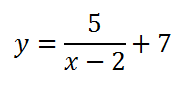
What is the horizontal asymptote? 
a)
x = 2
b)
x = 7
c)
y = 2
d)
y = 7
120.
What is the horizontal asymptote of the function given?
a)
y = 2
b)
x = 1
c)
x = 2
d)
y = -1
121.
What is the Vertical Asymptotes? 
a)
x= -5
b)
x= 5
c)
x= 6
d)
x= -6
122.
Which asymptotes are determined by looking at the denominator of a function? 
a)
vertical
b)
horizontal
c)
slant
d)
none
123.
What are the asymptotes?
a)
x=-1 y = -3
b)
x=1 y = -3
c)
x=-1 y =3
d)
x=1, y=3
124.
What is the horizontal asymptote of the function?
a)
y=0
b)
none
c)
y=1
125.
What is the name of this function?
a)
Parabola
b)
Rational Function 
c)
Ellipse 
d)
Cubic 
126.
What is the definition of an ASYMPTOTE?
a)
A curved line. 
b)
A line that only touches the origin. 
c)
A line that only lives on the first quadrant. 
d)
A line that a curve approaches, as it heads towards infinity. 
127.
What type of function is shown?
a)
cube root
b)
square root
c)
logarithm
d)
exponential
128.

Simplify:  x2+6x7x249Simplify:\ \ \frac{x^2+6x-7}{x^2-49}  

a)

x1x+7\frac{x-1}{x+7}  

b)

x+1x+7\frac{x+1}{x+7}  

c)

x1x7\frac{x-1}{x-7}  

d)

x+1x7\frac{x+1}{x-7}  

129.

Simplify:  x2+6xx2+3x18Simplify:\ \ \frac{x^2+6x}{x^2+3x-18}  

a)

xx+3\frac{x}{x+3}  

b)

xx3\frac{x}{x-3}  

c)

x+6x3\frac{x+6}{x-3}  

d)

xx+6\frac{x}{x+6}  

130.

Multiply and Simplify

a)

4(x+3)/(x+2),

b)

(x+2)/4(x+1)

c)

(x+2)/4(x+3),

d)

4(x+1)/(x+2),

131.

Multiply the Rational Expression

a)

A.

b)

B.

c)

C.

d)

D.

132.

Multiply the Rational Expression

a)

A

b)

B

c)

C

d)

D

133.
Simplify. 
a)
A
b)
B
c)
C
d)
D
134.

Divide the Rational Expression

a)

A

b)

B

c)

C

d)

D

135.
a)

2a2b6

b)

1/2a2b6

c)

b6/2a2

d)

2b6/a2

136.

Divide

a)

1/6

b)

x+10/ 6x+60

c)

x+8/ 6x+60

d)

(x+10)(x+8)/ 6x+60

137.
What are the restrictions of the following rational expression:
a)
x ≠ 0, 16
b)
x ≠ -4, 4
c)
x ≠ -16, 16
d)
x ≠ -¼, ¼
138.

What are the non-permissible value of this rational expression.

a)
0 and 2
b)
2 and 3
c)
0 and 1.5
d)
1.5 and -1.5
139.
a)

A.

b)

B.

c)

C.

d)

D.

140.

Simplify.

a)

A

b)

B

c)

C

d)

D

141.
Factor by grouping
x3 - 4x2 -4x + 16
a)
(x+4)(x+2)
b)
(x-4)(x2 -4) 
c)
(x+4)(x2 -4)
d)
(x-4)(x-2)
142.
Factor by grouping:
4p³+8p²+3p+6
a)
(2p²+3)(p+2)
b)
(2p²+6)(p+4)
c)
(4p²+3)(p+2)
d)
(4p²+8p)(3p+6)
143.
Factor by grouping:
5n³-10n²+3n-6
a)
(5n²+3)(n-2)
b)
(5n²-3)(n-2)
c)
(5n³+3)(n-2)
d)
10n(n²-6)
144.
What are the factors of
25x2 - 81?
a)
(5x - 9)(5x + 9)
b)
(5x - 9)(5x - 9)
c)
(5x + 9)(5x + 9)
d)
Cannot be factored
145.

Factor 4b5+4b3+16b2

a)

4b3(b4+b2+4b)

b)

4b3(b4+4b+5)

c)

4(b5+b3+4b2)

d)

4b2(b3+b+4)

146.
Factor completely.
k2 -2k - 24
a)
(k+4)(k-6)
b)
(k+4)(k+6)
c)
(k+6)(k-1)
d)
(k-4)(k+6)
147.
Factor completely:
 3x² + 5x - 12
a)
(3x + 4)(x-3)
b)
(3x - 4)(x + 3)
c)
(3x + 3)(x -4)
d)
(3x - 3)(x + 4)
148.
Classify by number of terms:
3x3 – 6x
a)
Monomial
b)
Binomial
c)
Trinomial
d)
4-Term Polynomial
149.

What is the coefficient of this term?

9x3

a)

None

b)

9

c)

3

d)

x

150.

Simplify this polynomial:

3x2 - x + 2 - 5x2 + 8x - 5

a)

8x2 + 9x + 7

b)

-2x2 + 7x - 3

c)

2x2 + 7x - 3

d)

5x2 - 3

151.
4k2(6k2 + 9kq - 5q2)
a)
24k2 + 36k3q - 20k2q2
b)
24k4 + 36kq - 20k2q2
c)
24k + 36k3q - 20k2q2
d)
24k + 36 kq - 20 k2q
152.
Simplify.
-2(x + 4) - 3(a - 6)
a)
-2x - 3a - 26
b)
-2x - 3a + 10
c)
-2x + 3a - 26
d)
-2x + 3a + 10
153.
Which equation below is a quadratic function translated left 4 units?
a)
y = x2 + 4
b)
y = (x + 4)2
c)
y = (x - 4)2
d)
y = 4x2
154.
Is this mapping a function or not a function? 
a)
Function
b)
Not a Function 
155.
a)
Function
b)
Not a Function
156.
A function...
a)
is a special type of relation
b)
passes the vertical line test
c)
can only have one y-value for each x-value
d)
all of the above statements are correct
157.
Find the inverse of y = 2x - 1.
a)
f-1(x) = (x+1)/2
b)
f-1(x) = 2x+1
c)
f-1(x) = x+3
d)
f-1(x) = x+1
158.
If a parent function has been reflected across the x-axis, then...
a)
a < 0
b)

b< 0

c)

d < 0

d)
c < 0
159.
Given f(x) = x2 - 3x + 2, evaluate f(-3).
a)
2
b)
6
c)
-5
d)
20
160.
Given f(x) = x2 +6x - 9, find x if f(x) = -14.
a)
x = -1
b)
x = -5 or -1
c)
x = 103
d)
x = 3
161.
Which of the following graphs is not a function?
a)

y = x + 2

b)
5x = y + 3
c)
y2 = 16 - x2
d)
y + 3 = x2 - x
162.
What is the domain of the graph y = (x - 2)2 + 3?
a)
{x ∈ R}
b)
{x ∈ R | x ≥ 3}
c)
{x ∈ R | x ≥ 0}
d)
{x ∈ R | x ≥ 1}
163.
What is the range of the graph y = -2(x + 1)2 + 6?
a)
{y ∈ R}
b)
{y ∈ R | y ≤ 6}
c)
{y ∈ R | y ≤ -1}
d)
{y ∈ R | y ≥ -1}
164.
Which of the following is not a transformation of y = -2f(x - 5) + 1 from y = f(x)?
a)
reflection along y-axis
b)

vertical dilation by factor of 2

c)
translation 1 unit up
d)
translation 5 units right
165.
Which of the following is not a transformation of y = ½(2x - 8)2 + 4 from y = x2?
a)

vertical dilation by a factor of ½

b)
translation 4 units up
c)

horizontal dilation by factor of ½

d)
translation 8 units right
166.
If f(x) = -2x + 6, evaluate f-1(0).
a)
3
b)
6
c)
2
d)
none of the above
167.
The point (3,-4) is on the graph y = -½f(-x + 3) - 1. Determine the original point on the graph y = f(x).
a)
(6,6)
b)
(-1,2)
c)
(3,-5)
d)
(0,6)
168.
Which equation below is a quadratic function translated left 4 units?
a)
y = x2 + 4
b)
y = (x + 4)2
c)
y = (x - 4)2
d)
y = 4x2
169.
If the blue is f(x)=x2, then the red must be
a)
g(x)=x2-5
b)
g(x)=x2+5
c)
g(x)=(x-5)2
d)
g(x)=(x+5)2
170.
Which equation shows a function that is translated left 4 and 7 up?
a)
y = |x + 4| + 7
b)
y = (x - 4)2 + 7
c)
y = (x + 7)2 - 4
d)
y = |x + 4| - 7
171.

What is the equation of this graph if the parent function was y = |x| to get the V shaped graph?

a)

f(x) = |x + 3|2 - 2

b)

f(x) = |x - 2|2 - 3

c)
f(x) = |x + 2| - 3
d)
f(x) = |x - 2| - 3
172.
Name the parent function.
a)
linear
b)
quadratic
c)
cube root
d)
cubic
173.
Describe the transformations.
a)
Translate Right 2, Down 4
b)
Translate Left 2, Down 4
c)
Translate Left 2, Up 4
d)
Translate Right 2, Up 4
174.
a)
horizontal shift to the right 4 and vertical shift down 2
b)
horizontal shift to the left 4 and vertical shift down 2
c)
horizontal shift to the right 4 and vertical shift up 2
d)
horizontal shift to the left 4 and vertical shift up 2
175.
What is the first step in finding the equation of the inverse of a function?
a)
get x by itself
b)
switch x and y
c)
solve for y
d)
write the function in inverse function notation
176.
What is the inverse of the function
f(x) = 2x + 4   ?
a)
f-1(x) = 4(x -2)
b)
f-1(x) = (x-4)/2
c)
f-1(x) = x/2 - 4
d)
f-1(x) = x/4 + 2
177.
If the equation of f(x) goes through (1, 4) and (4, 6), what points does f-1(x) go through?
a)
(1, 4) and (4, 6)
b)
(-4, -1) and (-6, -4)
c)
(-1, -4) and (-4, -6)
d)
(4, 1) and (6, 4)
178.
Are these functions inverses?
a)
Yes
b)
No
179.
are these inverse functions?
a)
no
b)
yes
c)
no way to tell
180.
For the function {(0,1), (1,-3), (2,-4), (-4,1)}, write the domain.
Remember:  Domain is x 
(x,y)
a)
D: {1, -3, -4,}
R: {0, 1, 2, -4}
b)
D:{0, 1, 2, -4}
R:{1, -3, -4}
c)
D:{0, 1, 2, 3, 4}
R:{1, -3, -4}
181.
What is the range of the following relation:
(9, -2) (4, 3)  ( 8, 10) ( -4, 8)
Range is the y values 
(x,y)
a)
-4, 4, 8, 9
b)
-2, 3, 8, 10
c)
(9, -2) ( 4, 3)
d)
(8, 10) (-4, 8)
182.
What is the range?
a)
{-3, -1, 2, 4}
b)
{0, 4, 7} 
c)
{0, 4, 4, 7}
d)
{7, 4, 0}
183.
What is the Domain of this linear function?
a)
-6 ≤ x ≤ 6
b)
0 ≤ x ≤ 7
c)
2 ≤ x ≤ 7
d)
No Solution
184.
What is the range?
a)
-7≤x≤6
b)
-7<x<6
c)
-8<y<2
d)
-8≤y≤2
185.
What is the range?
a)
-7≤x≤6
b)
-7<x<6
c)
-8<y<2
d)
-8≤y≤2
186.
What is the range of the function?
a)
[-1, +∞)
b)
(-1,1)
c)
[1.5, +∞)
d)
(-2, 2)
187.
What is the range? 
a)
[-∞, +∞]
b)
[-2, 2]
c)
(-∞, ∞)
d)
[0, 2]
188.
What is the range of the graph?
a)
-15 < y < ∞
b)
(-∞, ∞)
c)
(-15, ∞)
d)
[-15, ∞)
189.
What is the domain of the graph?
a)
{x| -∞ ≤ x ≤ ∞}
b)
(-∞,∞)
c)
-3 ≤ x ≤ 3
d)
-15 ≤ y ≤ 9
190.
What is x if
f(x) = -2?
a)
4
b)
0
c)
3
d)
8
191.
Given h(x) = 5 - 9x, find h(8). 
a)
h(8) = -360
b)
h(8) = -67
192.
What is f(1)?
a)
1
b)
5
c)
0
d)
4
193.

How would you write y = 2x - 3 in function notation?

a)

y = 2x-3

b)

f = 2x - 3

c)

f(x) = 2x-3

194.
Which ordered pair below would prevent this table from being a function?
a)
(10, 10)
b)
(2, 4)
c)
(6, 1)
d)
(-2, 0)
195.

If f(x) = -4x - 5 and g(x) = 3 - x,


what is g(-4) + f(1)?

a)

7

b)

-2

c)

-9

d)

-10

196.
The function h(t) represents the height in inches of a plant after t weeks. What does the notation h(4) = 5 mean?
a)
After 5 week the plant is 4 inches tall
b)
The plant grows at a rate of 5/4 inch per week
c)
After 4 weeks the plant is 5 inches tall
d)
The plant grows at a rate of 1 inch per week
197.

Use the function f(x)=3x12f\left(x\right)=3x-12  and  g(x)=(32)x+5g\left(x\right)=-\left(\frac{3}{2}\right)x+5  to find the value of  f(8)g(2)f\left(8\right)-g\left(-2\right)  


a)

4

b)

3

c)

-4

d)

6

198.

If f(x)=3x24x+5, f\left(x\right)=3x^2-4x+5,\  what would the function look like once you substitute in a 1 to find f(1)?

a)

f(x)=31241+5f\left(x\right)=31^2-41+5  

b)

f(1)=3x2(1)4x(1)+5f\left(1\right)=3x^2\left(1\right)-4x\left(1\right)+5  

c)

f(1)=3(1)24(1)+5f\left(1\right)=3\left(1\right)^2-4\left(1\right)+5  

199.

Here are two graphs representing function f and g. Select all statements that are true about function f and g.

a)

f(0) > g(0)

b)

There are two values of x where f(x) = g(x)

c)

f(-1) < g(-1)

d)

f(-3) > g(4)

200.

If the blue line is f(x), what does the red dotted line represent?

a)

f(x+1)

b)

f(x-1)

c)

f(x)+1

d)

f(x)-1

201.

If the blue line is f(x), what does the red dotted line represent?

a)

f(2x)

b)

f(0.5x)

c)

2f(x)

d)

f(x)÷2

202.

If the blue line is f(x), what does the red dotted line represent?

a)

f(2x)

b)

f(0.5x)

c)

2f(x)

d)

f(x)÷2

203.

If the blue line is f(x), what does the red dotted line represent?

a)

f(x+1)

b)

f(x-1)

c)

f(x)+1

d)

f(x)-1

204.

The blue line is f(x), which picture shows 3f(x)?

a)
b)
c)
d)
205.

The blue line is f(x), which picture shows f(x)÷3?

a)
b)
c)
d)
206.

The blue line is f(x), which picture shows f(3x)?

a)
b)
c)
d)
207.

The blue line is f(x), which picture shows f(x/3)?

a)
b)
c)
d)
208.

The blue line is f(x), which line is f(x+0.5)?

a)
b)
c)
d)
209.

The blue line is f(x), which line is f(-x)?

a)
b)
c)
d)
210.

The blue line is f(x), which line is -f(x)?

a)
b)
c)
d)
211.

The blue line is f(x), which line is f(-2x)?

a)
b)
c)
d)
212.

The blue line is f(x), which line is -2f(x)?

a)
b)
c)
d)
213.
Which equation below is a quadratic function translated left 4 units?
a)
y = x2 + 4
b)
y = (x + 4)2
c)
y = (x - 4)2
d)
y = 4x2
214.
If the blue is f(x)=x2, then the red must be
a)
g(x)=x2-5
b)
g(x)=x2+5
c)
g(x)=(x-5)2
d)
g(x)=(x+5)2
215.
Which equation shows a function that is translated left 4 and 7 up?
a)
y = |x + 4| + 7
b)
y = (x - 4)2 + 7
c)
y = (x + 7)2 - 4
d)
y = |x + 4| - 7
216.
What is the equation of this graph?
a)
f(x) = (x + 2)2 - 3
b)
f(x) = (x - 2)2 - 3
c)
f(x) = |x + 2| - 3
d)
f(x) = |x - 2| - 3
217.
What is the equation of the absolute value function?
a)
f(x)= |x+4|
b)
f(x)= |x-4|
c)
f(x)= |x| + 4
d)
f(x)= |x| - 4
218.
Tell how the function transformed from y =|x|
y = -2|x|
a)
Translated left 2 units
b)
Reflected over x-axis
c)
Stretched vertically and reflected over x-axis
d)
Compressed vertically and reflected over the x-axis
219.
Name the parent function.
a)
linear
b)
quadratic
c)
cube root
d)
cubic
220.
Describe the transformations of the absolute value equation.
a)
Flips to A shape, compresses wider, shifts right 1 unit
b)
Flips to A shape, compresses wider, shifts up 1 unit
c)
Flips to A shape, stretches more narrow, shifts right 1 unit
d)
Flips to A shape, stretches more narrow, shifts up 1 unit
221.
Describe the transformations.
a)
Translate Right 2, Down 4
b)
Translate Left 2, Down 4
c)
Translate Left 2, Up 4
d)
Translate Right 2, Up 4
222.
Which equation is shown on the graph?
a)
y = - (x + 4)2
b)
y = - (x - 4)2
c)
y = (x + 4)2
d)
y = -x2 - 4
223.
a)
horizontal shift to the right 4 and vertical shift down 2
b)
horizontal shift to the left 4 and vertical shift down 2
c)
horizontal shift to the right 4 and vertical shift up 2
d)
horizontal shift to the left 4 and vertical shift up 2
224.
What is the first step in finding the equation of the inverse of a function?
a)
get x by itself
b)
switch x and y
c)
solve for y
d)
write the function in inverse function notation
225.
What is the inverse of the function
f(x) = 2x + 4   ?
a)
f-1(x) = 4(x -2)
b)
f-1(x) = (x-4)/2
c)
f-1(x) = x/2 - 4
d)
f-1(x) = x/4 + 2
226.
Are these functions inverses of each other?
a)
Yes
b)
No
227.
If the equation of f(x) goes through (1, 4) and (4, 6), what points does f-1(x) go through?
a)
(1, 4) and (4, 6)
b)
(-4, -1) and (-6, -4)
c)
(-1, -4) and (-4, -6)
d)
(4, 1) and (6, 4)
228.
Are these functions inverses?
a)
Yes
b)
No
229.
Are the following inverses of each other?
a)
True
b)
False
230.
are these inverse functions?
a)
no
b)
yes
c)
no way to tell
231.
Will the inverse of this function be a function?
a)
Yes
b)
No
c)
No way to tell
232.
When finding the inverse of a relation, 
1st you replace f(x) with y
2nd switch the x's and y's
What do you do next?

a)
solve for y
b)
replace y with f-1(x)
c)
solve for x
d)
find the greatest common factor