
 Worksheets
Final Music Theory Exam Review (by Inigo)
Total questions: 65
Worksheet time: 1hrs 10mins

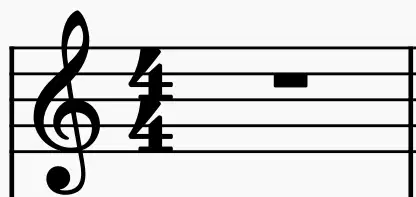
What rest is this?
(a)
Db (D flat) is an enharmonic note of __
Eb (E flat)
C# (C sharp)
F (natural)
D# (D sharp)
How can you tell what Major/Minor a piece is in?
Check the clef at the beginning of the piece and check the time signature
Check the time signature and key signature
Check the key signature and the last note in the piece
Ask the person(s) who wrote/covered the piece what major/minor it is in

What does the symbol above this note do?
Fermata: hold the note longer
Slur: smoothly connected with no gaps
Accent: play the note stronger with clear attack
Natural accidental: play the note in its natural pitch

Is this interval melodic or harmonic?
(a)
Connect the following intervals with their corresponding classification

Perfect 4th

Major 3rd

Perfect Octave

Minor 3rd
How many notes are in a one-octave chromatic scale (not counting the upper tonic note)?
7 notes
11 notes
13 notes
12 notes
Draw the interval C and E on this staff
Match the following tempi to their correct playing speeds
Largo
Slow and broad
Andante
At a walking pace
Moderato
Moderately, not too fast, not too slow
Maestoso
Majestically
Presto
Very fast
Which of these are compound time signatures?

Common time

9/8

3/2

12/8
Label the following (you do not need to specify what each thing is, just what kind of function is it)
Time signature
Clef
Articulation
Triplet
Staccato, Accent, Legato, and Pizzicato are all examples of what?
Chords
Enharmonics
Articulations
Dynamics
Piano, Forte, Mezzo-forte, and Fortissimo are all examples of what?
Instruments
Enharmonics
Articulations
Dynamics
Sharp, Flat, and Natural are all examples of what?
Instruments
Accidentals
Triplets
Rests
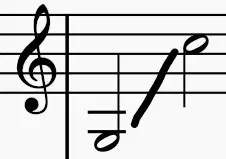
What vocal range is this?
Alto
Soprano
Baritone
Bass
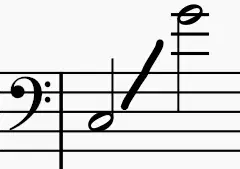
What vocal range is this?
Alto
Mezzo-soprano
Tenor
Bass
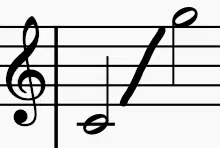
What vocal range is this?
Tenor
Soprano
Bass
Alto
How many flats/sharps are in C Major/A Minor?
4
2
0, it is natural
3
Match the following minor scales with their correct definiton
Natural minor
No notes played out of key signature
Harmonic minor
Raise the seventh degree by a half step
Melodic minor
Raise 6th & 7th, descending natural them
If I wanted to transpose a melody into another key, what would be the order I do it in?
Determine the key of the original example
Write the key signature of the new key
Work out the interval between the original and new keys
Transpose each note by that interval
If I wanted to transpose a melody by an interval, what would be the order I do it in?
Determine the key of the original example
Work out the interval between the original and new keys
Write the key signature of the new key
Transpose each note by that interval

Which of these are correct transpositions of this melody?
(hint: this one has been transposed into other keys)





Which is these is this piece being transposed down one octave?




Complete this Circle of Fifths (some of them have been done for you)
(all options with a lowercase "m" after the letter (and possible accidental) mean they are minor keys)
F#m
A
Cm
Eb
Gm
Bm
Am
Dm
Em
D
What is the order of sharps?
F#, C#, G#, D#, A#, E#
A#, B#, C#, D#, E#, F#
F#, C#, G#, A#, D#, E#
E#, A#, D#, G#, C#, F#
What is the order of flats?
i don't know
Fb, Cb, Gb, Db, Ab, Eb
Bb, Eb, Ab, Db, Gb, Cb
Bb, Ab, Eb, Gb, Db, Cb
What is the relative minor of C Major?
A Major
A Minor
F# Minor
E Minor
What is the relative major of B Minor?
B Major
Db Major
Gb Major
D Major
What is the relative minor of Eb Major?
C Major
Cb Major
C Minor
C# Minor
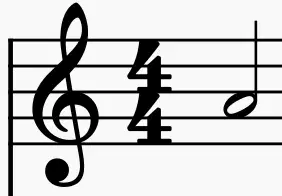
What is the value of this note? (how many beats?)
(a)
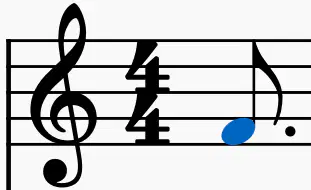
What is the value of this note?
Eighth note + Sixteenth note
Two eighth notes
Quarter note + Sixteenth note
Half note
True or False: You can transpose melodies from Major --> Minor or Minor --> Major
True or False: You can transpose melodies from Major --> Major or Minor --> Minor
How many sixteenth notes are in one half note?
4
8
16
12
How many sixteenth notes are in one whole note?
8
16
26
32
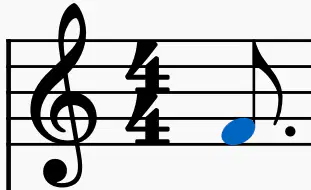
What does that dot next to the note do?
It means you have to attack the note strongly
It adds half of the value of the note to the note
It means you have to play it very short and detatched
It adds 1/4 of the value of the note to the note
Reorder the following notes from the smallest value ones to the highest value ones
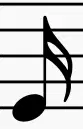
Sixteenth note
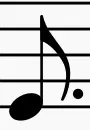
Dotted Eighth note
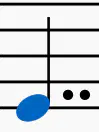
Double Dotted Quarter Note

Half note

Dotted Half note
Reorder the following rests from the smallest value ones to the highest value ones

Sixteenth rest
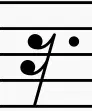
Dotted Sixteenth rest

Dotted Half rest
If my tempo is Andante, but I change to Vivace, what term will I use to return back to Andante speed?
Adagio
A Tempo
Rallentando
Accelerando
The term used for gradually speeding up the tempo
Accelerando
Presto
Legato
Ritenuto
Match the following terms used to change the tempo speed
Accelerando
Gradually becoming faster
Ritardando
Gradually becoming slower
Rallentando
Gradually becoming slower and broader
Ritenuto
Immediately slower, held back
A Tempo
Return to former speed
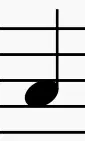
The American name for this note is a Quarter Note. What is the European name?
Marcato
Crochet
Quaver
Semibreve
What does the term 'Cantabile' mean?
Stressed, marked
Majestically
Sustained
In a singing style
What does the term 'Sostenuto' mean?
Stressed, marked
Majestically
Sustained
In a singing style
What does the term 'Leggiero' mean?
Always
Smooth & connected
Light and delicate
Little-by-little
What does the term 'Poco a poco' mean?
Always
Smooth & connected
Light and delicate
Little-by-little
What does the term 'Legato' mean?
Always
Smooth & connected
Light and delicate
Little-by-little
Match the following Italian terms to their corresponding meanings
Sempre
Always
Senza
Without
Poco
Little
Molto
Very much
Marcato
Marked, stressed
Forte


Marcato
Pizzicato

Staccato
Lento
Allegretto
Db = C#
E# = F (natural)

What does the term 'Staccato' mean?
(for bowed strings players) to pluck the string instead of bowing it
Short and detached
Smooth and connected
Majestically, glorious

How can you tell this piece has an Anacrusis?
Since there is a pickup measure which is leading into the music, and the final measure has fewer beats
Since there is a pickup measure which is leading into the music
Since the first bar only has three 1 and 1/2 beats in total, instead of having 4
Since the last bar has fewer beats
Which is these measures is correct?


Which is these measures is correct?
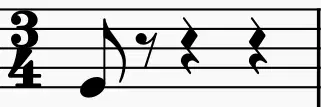
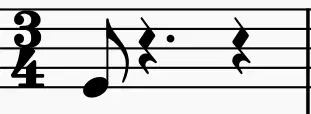
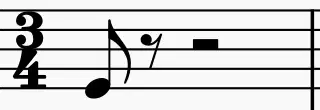
Which is these measures is correct?
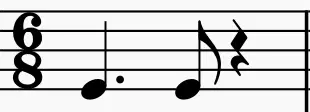
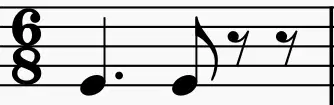
E# is an enharmonic note of __
F#
C Natural
F Natural
Fb
Più mosso means _______
Play faster (tempo)
Play slower (tempo)
Play out of the key
Play in the key
Meno mosso means _______
Play faster (tempo)
Play slower (tempo)
Play out of the key
Play in the key
Diatonic means ______
Play faster (tempo)
Play slower (tempo)
Not in the key
In the key
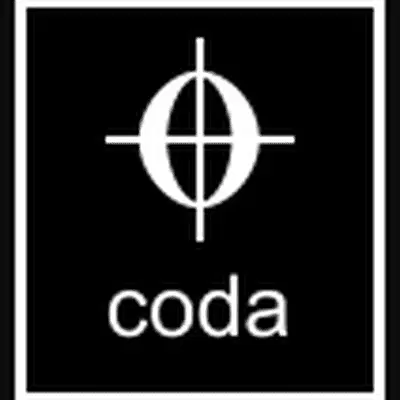
D.C. al Coda does what?
Go back to the sign, play until the "to Coda" play the Coda and finish
Go back to the start, play until the "to Coda" play the Coda and finish
Go back to the sign, play until the "Fine" and finish
Go back to the start, play until the "Fine" and finish
D.S. al coda does what?
Go back to the sign, play until the "to Coda" play the Coda and finish
Go back to the start, play until the "to Coda" play the Coda and finish
Go back to the sign, play until the "Fine" and finish
Go back to the start, play until the "Fine" and finish
D.S. al fine does what?
Go back to the sign, play until the "to Coda" play the Coda and finish
Go back to the start, play until the "to Coda" play the Coda and finish
Go back to the sign, play until the "Fine" and finish
Go back to the start, play until the "Fine" and finish
D.C. al fine does what?
Go back to the sign, play until the "to Coda" play the Coda and finish
Go back to the start, play until the "to Coda" play the Coda and finish
Go back to the sign, play until the "Fine" and finish
Go back to the start, play until the "Fine" and finish
What does D.C. (Da capo) mean?
Back to the sign
Back to the beginning
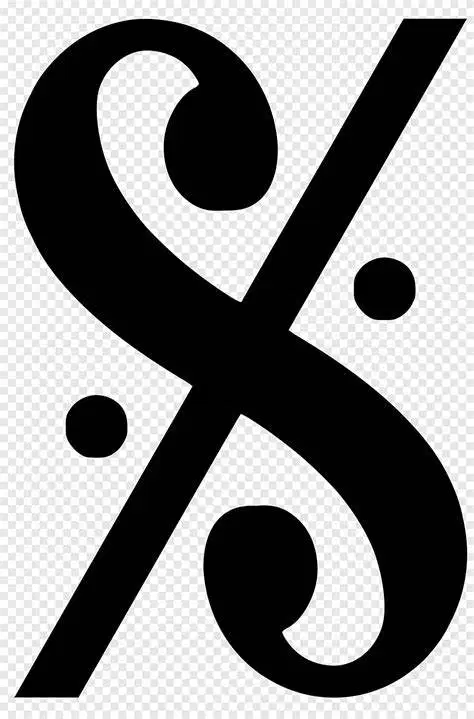
What does D.S. (Dal Segno) mean?
Back to the sign
Back to the beginning
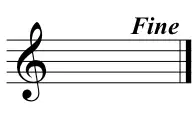
What does Fine mean?
Finish (end)
Beginning (start)

