wayground logo

Free Printable Worksheets

Font size

S
M
L
XL
Worksheets

Quarter Test Review

Total questions: 50

Worksheet time: 4hrs 1mins

Name
Class
Date
1.

Determine the inverse for the function:

P (x) = 2x2 + 1

a)

P-1(x) = x212\frac{x^2-1}{2}  

b)

P-1(x) = x2+12\frac{x^2+1}{2}  

c)

P-1(x) = x12\sqrt[]{\frac{x-1}{2}}  

d)

P-1(x) = x+12\sqrt[]{\frac{x+1}{2}}  

2.

Determine the inverse for the function:

R (x) = 2x + 1

a)

R-1(x) = x12\frac{x-1}{2}  

b)

R-1(x) = x+12\frac{x+1}{2}  

c)

R-1(x) = x3x-3  

d)

R-1(x) = x +3x\ +3  

3.

Solve the following exponential equation:
98x=27x39^{8-x}=27^{x-3}  

a)

x=5x=5  

b)

x=5x=-5  

c)

x=15x=\frac{1}{5}  

d)

x=15x=-\frac{1}{5}  

4.
Evaluate:
log416
a)
2
b)
4
c)
1/2
d)
-2
5.
Solve for x:
log8(x) = 2
a)
10
b)
128
c)
64
d)
82
6.

Jack invested $4800 in an account that earns 2.5% compounded continuously. What will the account balance be if he leaves the money in the account for 7 years? Round answer to the nearest cent (2 decimal places).

(a)  

7.

Evaluate log864Evaluate\ \log_864  


(a)  

8.

Evaluate log381Evaluate\ \log_381  


(a)  

9.
Match the graph with its equation
a)
y = log6(-x) + 1
b)
y = log6(x − 2) + 1
c)
y = log6(x + 2) - 1
d)
y = log(x-8) + 1
10.
What is the transformation?
a)
Vertical Translation up 2 and Horizontal translation right 1
b)
Vertical Translation down 2 and Horizontal Translation left 1
c)
Horizontal Translation left 2 and Vertical Translation up 1
d)
Horizontal Translation right 2 and Vertical Translation down 1
11.

How has the function 5(3)x+4-5\left(3\right)^x+4 been transformed from the parent function  5(3)x5\left(3\right)^x ? Choose ALL correct answers!

a)

Shifted up 4

b)

Shifted down 4

c)

Shifted down 5

d)

Reflection over the x-axis

e)

Reflection over the y-axis

12.

Exponential growth is  y=a(1+r)xy=a\left(1+r\right)^x  , and exponential decay is  y=a(1r)xy=a\left(1-r\right)^x  .


What does "y" represent?

a)

Initial amount

b)

Rate of growth or decay

c)

Time

d)

End amount

13.

Exponential growth is  y=a(1+r)xy=a\left(1+r\right)^x  , and exponential decay is  y=a(1r)xy=a\left(1-r\right)^x  .


What does "x" represent?

a)

Initial amount

b)

Rate of growth or decay

c)

Time

d)

End amount

14.

Exponential growth is  y=a(1+r)xy=a\left(1+r\right)^x  , and exponential decay is  y=a(1r)xy=a\left(1-r\right)^x  .


What does "r" represent?

a)

Initial amount

b)

Rate of growth or decay

c)

Time

d)

End amount

15.

The population of a town is 2500 and is decreasing at a rate of 3.5% per year. Use an exponential function to find the population of the town after 5 years.


Round to the nearest whole number (you can't have a fraction of a person).

(a)  

16.

what is the amplitude of
y = -3sin (7x) -2

a)
7
b)

-3

c)
3
d)
6
17.

Convert 60° to a radian measure.

a)

13π\frac{1}{3}\pi  

b)

16π\frac{1}{6}\pi  

c)

12π\frac{1}{2}\pi  

d)

π\pi  

18.

Convert 150° to a radian measure.

a)

56π\frac{5}{6}\pi  

b)

  65π\frac{6}{5}\pi  

c)

67π\frac{6}{7}\pi  

d)

54π\frac{5}{4}\pi  

19.

What is the degree of an angle with a radian measure of 110π\frac{1}{10}\pi  

a)

18°18\degree  

b)

22°22\degree  

c)

40°40\degree  

d)

15°15\degree  

20.

What is the degree of an angle with a radian measure of 56π\frac{5}{6}\pi  

a)

100°100\degree  

b)

150°150\degree  

c)

160°160\degree  

d)

115°115\degree  

21.
sin π/4
a)
√2∕2
b)
1/2
c)
√3/2
d)
0
22.
cos 4π/3
a)
-√3/2
b)
√3/2
c)
1/2
d)
-1/2
23.

Which of the following angles are co-terminal to 330o?

a)

-330o, 330o

b)

510o, -210o

c)

690o, -30o

d)

420o, -330o

24.

Which of the following angles are co-terminal to -75o?

a)

-365o, 75o

b)

285o, -435o

c)

105o, -255o

d)

425o, -335o

25.

Simplify using long division. 

(8b317b2b+2)÷(b2)\left(8b^3-17b^2-b+2\right)\div\left(b-2\right)  

a)

8b22b29b28b^2-2b-2-\frac{9}{b-2}  

b)

8b22b34b28b^2-2b-3-\frac{4}{b-2}  

c)

8b22b37b28b^2-2b-3-\frac{7}{b-2}  

d)

8b2b34b28b^2-b-3-\frac{4}{b-2}  

26.
a)

2x2 + 3x + 8 + -57/x-4

b)

2x2 - 13x - 56

c)

2x2 + 3x + 8 +7/x-4

d)

2x2 - 3x - 16 + -89/x-4

27.

Factor:

a)

(x5)(x2+5x+25)\left(x-5\right)\left(x^2+5x+25\right)  

b)

(x+5)(x25x+25)\left(x+5\right)\left(x^2-5x+25\right)  

c)

x5x-5  

d)

(x25x)(x5x+25)\left(x^2-5x\right)\left(x-5x+25\right)  

28.

Use the quadratic formula to solve 2x2 + 2x - 12.

a)

-2, 3

b)

2, 3

c)

2, -3

d)

-2, -3

29.

w2+7w+4=0w^2+7w+4=0  

a)

7±332\frac{-7\pm\sqrt{33}}{2}  

b)

7±652\frac{-7\pm\sqrt{65}}{2}  

c)

7±332\frac{7\pm\sqrt{33}}{2}  

d)

7±3112\frac{-7\pm3\sqrt{11}}{2}  

30.
Multiply
(4x+3)(2x-1)
a)
8x2-2x-3
b)
8x-3
c)
8x2+6x-3
d)
8x2+2x-3
31.
(5x+2)(x2-3x+6)
a)
5x3 - 17x2 +24x +12
b)
5x3 + 17x2 - 24x +12
c)
5x3 - 13x2 + 24x +12
d)
5x3 +13x2 - 24x - 12
32.
Write the equation of the polynomial function
zeros: 0, -2, 4
degree: 5   
0 has a multiplicity of 3
a)
f(x) = x3(x-2)(x+4)
b)
f(x) = x3(x+2)(x-4)
c)
f(x) = x2(x-2)(x+4)
d)
f(x) = x2(x+2)(x-4)
33.

What can we expect the end behavior to be on the graph of the function: f(x)=2x3x+5f\left(x\right)=2x^3-x+5  

a)

Rises on the left and right

b)

Rises on left, falls on right

c)

Falls on the left, rises on the right

d)

Falls on the left and right

34.

Find the x-intercept(s), if one exists.

a)

(1, 0)

b)

(-1, 0)

c)

(1, 0), (-1, 0)

d)

(0, 0), (1, 0)

35.
a)
a
b)
b
c)
c
d)
d
36.
a)
a
b)
b
c)
c
d)
d
37.
Find the least common denominator of the expression
a)
18
b)
6x
c)
3xy
d)
6xy
38.
a)
b)
c)
d)
39.
a)
b)
c)
d)
40.
What is/are the x-intercepts of this graph?
a)
(-2,0) and (2,0)
b)
(-2,0)
c)
(3,0)
d)
(2,0) and (3,0
41.
Which asymptote(s) are determined by looking at the denominator?
a)
vertical
b)
horizontal
c)
slant
d)
none
42.

What are the asymptotes?

a)

x = -2 and y = -1

b)

x = -2 and y = 1

c)

x = 2 and y = 1

d)

x = 2 and y = -1

43.

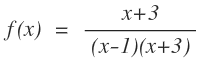
Find the vertical asymptotes and holes of the function.

a)

Holes: None;

VA: x = 1, -3

b)

Holes: x = -3;

VA: x = 1

c)

Holes: x = -3, 1

VA: None

d)

Holes: x = 1

VA: x = -3

44.
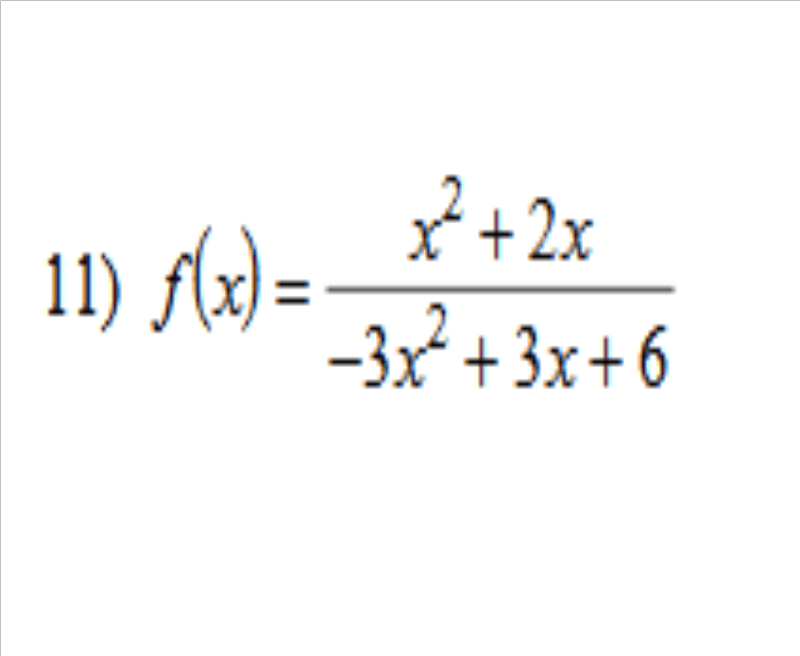
Find the horizontal asymptote.
a)
None
b)
y = 0
c)
y = -1/3
d)
y = -3
45.
What is the Vertical Asymptotes? 
a)
x= -5
b)
x= 5
c)
x= 6
d)
x= -6
46.
What is the hole?
a)
x= 4
b)
x= -4
c)
x= 5
d)
x= -5
47.
What is the horizontal asymptote to this function?
a)
y=4
b)
y=0
c)
y=-2
d)
y=1
48.
What is/are the vertical asymptote(s)?
a)
x=-2
b)
x=2 and x=3
c)
x=-3
d)
x=3
49.
What is the horizontal asymptote?
a)
y = -4
b)
y = 1
c)
x = 1
d)
y = -6
50.

Find the vertical asymptotes and holes of the function.

a)

Holes: None;

VA: x = 1, -3

b)

Holes: x = -3;

VA: x = 1

c)

Holes: x = -3, 1

VA: None

d)

Holes: x = 1

VA: x = -3