
NEW
Font size
 Worksheets
Physic Practice Exam
Total questions: 56
Worksheet time: 2hrs 32mins
Which best describes moment of inertia?
Which equation defines rotational kinetic energy?


The moment of inertia for a diver doing a flip is smallest when:
The diver is in a pike position (legs straight out, hands touching toes)
The diver is fully laid out (Body straight – arms at sides)
When the diver is in a tuck position. (knees to chest, arms around knees)
The diver performs in a wolf position (one leg extended straight out, other leg bent at the knee pointed in the opposite direction, arms at side)
In what direction should a given force be applied to an object to produce maximum
torque?
perpendicular to the lever arm
parallel to the lever arm
at some angle between 0° and 90° relative to the lever arm
at some angle between 90° and 180° relative to the lever arm
The moment of inertia for a rotating object depends on:
the mass of the object and its angular speed
The mass of the object and how the mass is distributed about the axis of rotation
the angular speed of an object
the mass of the object
Angular Momentum is the product of...
rotational inertia and linear velocity.
linear inertia and angular velocity.
linear momentum and angular velocity
rotational inertia and angular velocity.
The "power" of a machine measures...
The work it does
The force it produces
The rate of doing work
Its strength
What are the two factors that affect the momentum of an object?
speed and velocity
time and mass
distance and displacement
mass and velocity
Momentum is a ____________________ quantity
science
scalar
vector
energy
A track athlete throws a discus that has a momentum of 42kg*m/s into a field with a velocity of 21 m/s. What is the mass of the discus?
1 kg
2 kg
3 kg
4 kg
The Law of Conservation of Momentum states:
The total momentum before a collision is equal to the total momentum after a collision.
The total momentum before a collision is greater than the total momentum after a collision.
The total momentum before a collision is less than the total momentum after a collision.
The total momentum before a collision is not related to the total momentum after a collision.
The measure of the resistance of an object to changes in rotational motion. It depends on how mass is distributed about the axis of rotation
The product of a rotating object’s moment of inertia and
angular speed about some axis.
A quantity that measures the ability of a force to rotate
an object around some axis.
A collision in which two objects stick together and move
with a common velocity after colliding.
impulse momentum theorem
Acceleration directed toward the center of a circular path.
A girl rides an escalator that moves her upward at constant speed. As the girl rises, how do her gravitational potential energy and kinetic energy change?
A child applies a constant 20.-newton force along the handle of a wagon which makes a 25° angle with the horizontal. How much work does the child do in moving the wagon a horizontal distance of 4.0 meters?
What is the difference between inelastic and elastic collisions?
With Inelastic collision the objects stick together and with elastic collision they bounce off each other.
With elastic collision the objects stick together and with inelastic collision they bounce off each other.
What is the difference between scalar and vector quantities?
Scalar quantities are always negative. Whereas vector quantities are always positive
Vector quantities have only magnitude. Whereas scalar quantities have magnitude and direction
Which scenario has negative work being done?
When there is no displacement
In which situation is the work done equal to zero?
When the displacement is negative
How do you find work from a Force v Displacement graph?
The impulse experienced by a body is equivalent to the body’s change in
When should one use rotational kinematics equations to solve problems?
they should be used when angular acceleration is constant
they should be used when the angular speed is constant
they should be used when angular acceleration is variable
they should be used when tangential acceleration is variable
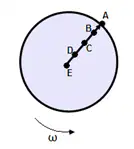
A solid disk with a radius R rotates at a constant rate ω. Which of the following points has the greater linear velocity?
Point A -on the edge of the disk
Point C-halfway between the center and the edge of the disk
Point E- at the center of the disk
Point D - just outside the center
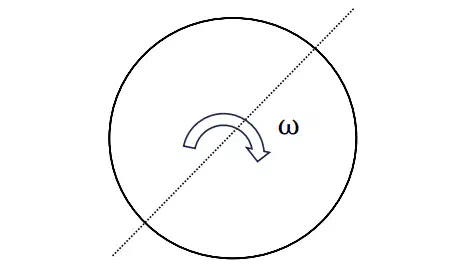
What is the angular momentum and direction of a 0.91 kg thin spherical shell moving 1.36 rad/s and with a radius of 0.67 m around its axis of symmetry. Given that I is 2/3 MR2.
Angular momentum is 0.37 kg m^2/s into the page
Angular momentum is 1.36 kg m^2/s into the page
Angular momentum is 0.68 kg m^2/s out of the page
Angular momentum is 0.91 kg m^2/s out of the page
Calculate the kinetic energy of a 6-kg object moving at 4.5 m/s.
Calculate the potential energy of a 6-kg object positioned 10 m above the ground.
588 J
300 J
When an object is in equilibrium, the object is __.
either at rest or moving with a constant velocity
At rest
Constant velocity
What is the weight of a 75 kg object on the surface of the earth?
735 N
A 20 N net force is applied to a 4 kg object as shown in the figure. Calculate the rate at which the object will accelerate.
Which describes mechanical energy?
Which describes gravitational potential energy?
What is the formula for gravitational potential energy?
What is the formula for kinetic energy?
What is the formula for torque?
Torque = Perpendicular Force x Distance
Which describes elastic potential energy?
What portion of a force is required to calculate the amount of work done on an object?
A kid pulls on a sled and applies a 40-N force at an angle of 35 degrees above the horizontal to move a sled 30 meters. How much work does the kid do?
983 J
If the speed of a moving object is doubled, the kinetic energy of the object is __.
A moderate force will break an egg. However, an egg dropped on the road usually breaks, while one dropped on the grass usually does not break. The egg dropped on the grass usually doesn't break because __.
the change in momentum is greater.
the change in momentum is less.
the time interval for stopping in less, so the force applied to the egg is smaller.
the time interval for stopping is greater, so the force applied to the egg is smaller.
A 8 kg bike is traveling east at 15 m/s. The brakes are applied and the bike is brought to rest in 2.0 seconds. Calculate the magnitude of the total impulse applied to the car to bring it to rest.
180 kg m/s
120 kg m/s
240 kg m/s
300 kg m/s
Which of the following angles equals 2pi rad?
If the angular velocity of an object changes from 3 rad/s to 1 rad/s in 2 seconds, what is the object's angular acceleration?
–1.5 rad/s2
–1 rad/s2
1 rad/s2
1.5 rad/s2
Convert 65.4° to rad.
What is the angular acceleration of a ball that starts at rest and increases its angular velocity uniformly to 6 rad/s in 5s?
A race car travels around a flat, horizontal, circular track. Which change would increase the maximum speed at which the race car could travel without sliding off the track.
Increase the coefficient of friction between the tires and the track
Increase the mass of the car
A skater who is spinning pulls her arms in and reduces her moment of inertia to one-fourth the original amount. What happens to her angular speed?
Her angular speed will increase by a factor of 2.
Her angular speed will increase by a factor of 4
Two cars, A and B, are initially at rest. Car A has a mass of 1000 kg, while car B has a mass of 1500 kg. Car A accelerates to the right with a velocity of 10 m/s. What is the final velocity of car B if the collision is perfectly elastic?
15 m/s
6.67 m/s

