
 Worksheets
Yr 10 Photography: End of Year Test
Total questions: 18
Worksheet time: 18mins
Leo is working on a school project using photo editing software. What is the primary purpose of using layers in his project?
To organise different elements of an image separately
To increase the file size of the image
To reduce the image resolution
To automatically enhance the image quality
Emily is working on a school project about the 1950s. Which of the following filters would she use to make an image appear as if it was taken in that era?
Sepia
Gaussian Blur
Sharpen
Noise Reduction
What does adjusting the brightness of an image affect?
The sharpness of the image
The lightness or darkness of the image
The colour saturation
The image resolution
Jacob is editing a photo and wants to draw a straight line. Which tool would he use?
Brush Tool
Line Tool
Pen Tool
Move Tool
When Benjamin is resizing an image for his school project, what does maintaining the aspect ratio ensure?
The image remains in its original colours
The image does not become distorted
The image resolution increases
The image file size decreases
Ava is editing a photo for her school project. Which tool is commonly used to add text to an image in editing software?
Brush Tool
Text Tool
Eraser Tool
Lasso Tool
During an art class, Isabella asked the teacher about Helen Sear's work. Helen Sear is known for her work in which field?
Sculpture
Photography
Painting
Architecture
During an art class, Priya and Leo discussed David Hockney's contributions. Which art forms did they mention?
Digital Art
Photography
Sculpture
Painting
During an art class, Matilda and Sophia were discussing famous artists. They wondered, Damien Hirst is best known for his work in which artistic medium?
Photography
Installation Art
Digital Art
Graphic Design
During a photography class, Henry increased the contrast in one of his images. What is the effect of increasing the contrast in an image?
It makes the image more blurry
It enhances the difference between light and dark areas
It changes the image to black and white
It reduces the image file size
In what order where these photographs taken?
Oldest to the left, newest to the right.


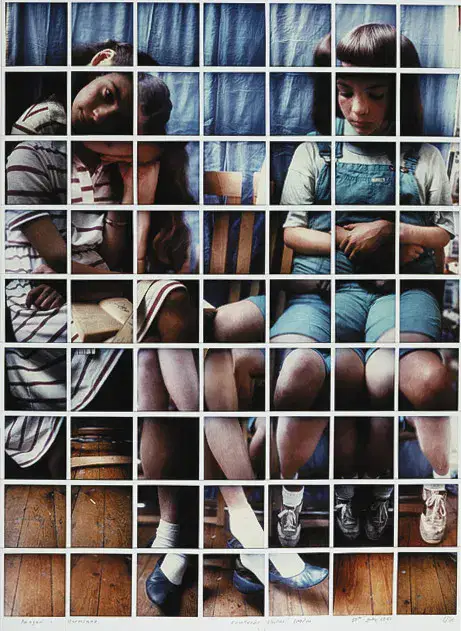
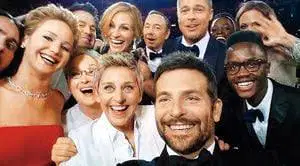
Match the following

Banksy

Henri Cartier-Bresson

David Hockney

Ansel Adams

Richard Avedon
Isla is editing a photo for her school project. What is the purpose of using the crop tool in image editing?
To change the image resolution
To remove unwanted parts of the image
To adjust the brightness of the image
To add text to the image
Emily is editing a photo and wants to make the colors more vibrant. What does adjusting the saturation of an image affect?
The sharpness of the image
The intensity of the colors
The lightness or darkness of the image
The image resolution
Developing the First Permanent Images
Photography, as we know it today, began in the early 1800s in France when inventor Joseph Nicéphore Niépce created a prototype of a photographic camera in 1816.1 He used a portable camera obscura to expose a pewter plate coated with bitumen to light. This is the first recorded image that did not fade quickly. He is credited for taking the oldest surviving photograph, dated from 1826, of a view from the window of his house.2
Niépce's success led to several other experiments and photography progressed very rapidly. Daguerreotypes, emulsion plates, and wet plates were developed almost simultaneously in the mid- to late-1800s.
With each type of emulsion, photographers experimented with different chemicals and techniques. The following are the three that were instrumental in the development of modern photography.
The Daguerreotype
Niépce's experiment led to a collaboration with Louis Jacques Mandé Daguerre. The result was the creation of the daguerreotype in 1837, defined as an image preserved as an object, or photograph, captured by an early photographic process.3 Here's roughly how this camera worked:
A copper plate was coated with silver and exposed to iodine vapor before it was exposed to light.
To create the image on the plate, the early daguerreotypes had to be exposed to light for up to 15 minutes.
The daguerreotype was very popular until it was replaced in the late 1850s by emulsion plates.
Emulsion Plates
Emulsion plates, or wet plates, were used between the 1830s and 1870s (before dry plates were invented in 1871).4 Wet plates were less expensive than daguerreotypes and required only two or three seconds of exposure time. This made them much more suited to portrait photographs, which was the most common use of photography at the time. Many photographs from the Civil War were produced on wet plates.
These wet plates used an emulsion process called the Collodion process, rather than a simple coating on the image plate. It was during this time that bellows were added to cameras to help with focusing.
Two common types of emulsion plates were the ambrotype and the tintype. Ambrotypes used a glass plate instead of the copper plate of the daguerreotypes. Tintypes used a tin plate. While these plates were much more sensitive to light, they had to be developed quickly. Photographers needed to have chemistry on hand and many traveled in wagons that doubled as a darkroom.
Dry Plates
By 1871, photography took another huge leap forward. Richard Maddox created dry plate photography, known as gelatin process photography, a technique nearly equal to wet plates in speed and quality but far more functional. In 1873, Charles Harper Bennett made even more improvements to the process for better photo quality.
These dry plates could be stored rather than made as needed. This allowed photographers much more freedom when and where they could take photographs. The process also allowed for smaller cameras that could be hand-held and became the precursor to the film roll process. As exposure times decreased, the first camera with a mechanical shutter was developed.
The Dawn of Roll Film
Until entrepreneur George Eastman started the Eastman Dry Plate Company in 1881 (which was reincorporated as Eastman Kodak Company in 1892), photography was only for professionals and the very privileged.
In 1888, Eastman debuted a flexible roll film that did not require constantly changing the solid plates. This allowed him to develop a self-contained box camera that held 100 film exposures. The camera had a small single lens with no focusing adjustment. The consumer would take pictures and send the camera back to the factory for the film to be developed and prints made, much like modern disposable cameras. The camera continued to evolve and innovate, eventually becoming more affordable and mass-produced in the 1940s, a few years after Eastman's death.
The Magic of Instant Images
The Polaroid camera, also known as Model 95, made its debut in 1948, created by inventor Edwin H. Land. The instant photograph became a huge hit thanks to a chemical process used to develop film inside the camera in less than a minute. Though the Polaroid camera was not cheap, the novelty remained popular from the 1960s to the 1970s.
Though the Polaroid camera and film all but vanished due to problems including the rise of digital photography and the bankruptcy and sale of the Polaroid Corporation around 2008, it has miraculously made a comeback through the Impossible Project, also known as Polaroid Original and now just Polaroid, which purchased the last Polaroid film factory in 2018. The company's mission is to preserve vintage Polaroid cameras and its artform while introducing new generations of the camera.
What did Niépce's success lead to in the mid- to late-1800s?
Daguerreotypes
Emulsion plates
Wet plates
Digital cameras
The Polaroid camera, invented by Edwin H. Land in 1948, popularized instant photography and has made a recent comeback through the Impossible Project. The Polaroid camera is known for its (a)
Richard Maddox's invention of dry plate photography in 1871 revolutionized the speed and quality of (a)
Which photographic techniques were instrumental in the development of modern photography?
The daguerreotype
Emulsion plates
Dry plates
All of the above
Who is credited with creating the first prototype camera in the early 1800s in France?
Louis Daguerre
George Eastman
Joseph Nicéphore Niépce
Ansel Adams
George Eastman's introduction of flexible roll film in 1888 made photography more accessible to the general (a)
In which order where the following discovered:
Joseph Nicéphore Niépce
Emulsion Plates - Louis Jacques Mandé Daguerre
Richard Maddox (Dry Plates)
Eastman Kodak Company
Edwin H. Land - Polaroid camera
Matilda is editing a photo and wants to remove blemishes or imperfections from the image. Which tool should she use?
Clone Stamp Tool
Gradient Tool
Magic Wand Tool
Crop Tool
Amelia is editing a photo for her school project. What does adjusting the hue of the image affect?
The sharpness of the image
The overall color tone of the image
The brightness of the image
The image resolution
Chloe is editing a photo and wants to select a specific area of the image based on color. Which of the following tools should she use?
Move Tool
Magic Wand Tool
Brush Tool
Pen Tool

