

wayground logo

Free Printable Worksheets

Font size

S
M
L
XL
Worksheets

ahuva final review naaleh

Total questions: 123

Worksheet time: 2hrs 19mins

Name
Class
Date
1.

How many valence electrons do element in group 18 have?

a)

1

b)

8, except Helium only has 2

c)

18

2.

How many valence electrons do element in group 14 have?

a)

1

b)

4

c)

14

3.

How many valence electrons does Lithium have?

a)

1

b)

2

c)

3

d)

4

4.

How many valence electrons does Helium have?

a)

1

b)

2

c)

4

d)

8

5.
What orbital shapes are found at the 2nd energy level
a)
s only
b)
s and p
c)
s, p, d and f
d)
p only
6.

How many electrons can 3p hold?

a)

1

b)

2

c)

6

d)

10

7.

How many electrons can inhabit the f subshell?

a)

6

b)

7

c)

10

d)

14

8.

Electrons fill the 3d orbital before the 4s orbital

a)

True

b)

False

9.
What atom matches this electron configuration?
1s22s22p63s23p64s23d10
a)
Zinc
b)
Copper
c)
Nickel
d)
Germanium
10.
What atom matches this electron configuration?
1s22s22p63s2
a)
Neon
b)
Magnesium
c)
Aluminum
d)
Potassium
11.
What electron configuration matches an oxygen atom?
a)
1s22s22p63s2, 3p64s23d104p5
b)
1s22s22p4
c)
1s22s22p6
d)
1s22s22p63s23p64s23d1
12.
What do you start electron configuration with?
a)
1s2
b)
1d10
c)
1f14
d)
1p6
13.
Which electron configuration belongs to Chlorine (Cl)?
a)
1s2s2p3s3p5
b)
1s2s2p3s3p6
c)
1s2s2p3s3p7
14.
What is incorrect about this orbital diagram?
a)
Both arrows in the 2p box should be pointing up
b)
There is nothing incorrect with this diagram
c)
In the there should only be 1 orbital in the first 2p box and one in the 2nd 2p box
d)
All the arrows should be pointing up.
15.
How many electrons can the d sublevel hold?
a)
14
b)
10
c)
2
d)
6
16.
What type of bond forms when electrons are transferred from one atom to another?
a)
ionic bond
b)
atomic bond
c)
covalent bond
d)
metallic bond
17.
Ionic bonds are between...
a)
Metal and Non-metal
b)
Non-metal and Non-metal
c)
Metal and Metal
18.

Ionic Bonding involves...

a)

the transfer of protons

b)

the transfer of neutrons

c)

the transfer of electrons

d)

none of these choices

19.
Ionic bonds form between metals and ____.
a)
metalloids
b)
metals
c)
nonmetals
20.
Ionic bonds happen because of the ____ of valence electrons.
a)
sharing
b)
transfer
21.
What two types of atoms make a covalent bond?
a)
2 Nonmetals
b)
1 Nonmetal and 1 Metal
c)
2 Metals
d)
2 Noble Gases
22.
Predict the bond that will form between Be and F.
a)
Ionic
b)
Covalent
23.
Predict the bond that will form between Se and Cl.
a)
Ionic
b)
Covalent
24.
Predict the bond that will form between Sr and S.
a)
Ionic
b)
Covalent
25.
Which of these is covalent?
a)
NaCl
b)
Pb(NO3)2
c)
CO2
d)
AlCl3
26.
How are covalent bonds explained?
a)
When one atom takes the other atom's electron
b)
When the atom shares an electron with an another atom
c)
When the two nucleus merge
d)
When the neutrons leave the nucleus
27.
With the ________ you must have 8 electrons on the outside ring.
a)
anions
b)
ionic bonds
c)
cations
d)
octet rule
28.
How are ionic bonds formed?
a)
Transfer of electrons
b)
Sharing of electrons
29.
How many electrons does each line indicate are shared?
a)
1
b)
2
c)
3
d)
4
30.

The electrons in a polar covalent molecule are shared...

a)

Evenly

b)

Unevenly

c)

Electrons are not shared

d)

None of the Above

31.

The electrons in a nonpolar covalent molecule are shared...

a)

Evenly

b)

Unevenly

c)

Electrons are not shared

d)

None of the Above

32.

What must the difference in electronegativity between two atoms be in order for the bond between them to be nonpolar covalent?

a)

less than 0.4

b)

greater than 1.7

c)

between 0.4 and 1.7

d)

exactly 0

33.

What is the difference in electronegativity for HBr?

a)

0.7

b)

1.9

c)

2.0

d)

2.8

34.

HBr has a difference in electronegativity of 0.7. Based on the table, what kind of bond is HF?

a)

Nonpolar covalent

b)

Polar covalent

c)

Ionic

35.
When two nonmetals do not share electrons evenly, the resulting covalent bond will be
a)
nonpolar
b)
polar
c)
ionic
d)
metallic
36.

When you have Br-Br, what is the polarity?

a)

Polar

b)

nonpolar

c)

Ionic

37.

When you have H-Cl, what is the polarity?

a)

nonpolar

b)

polar

c)

ionic

38.

When you have Li-O, what is the polarity?

a)

nonpolar

b)

polar

c)

ionic

39.

When you have Si-O, what is the polarity?

a)

nonpolar

b)

polar

c)

ionic

40.
Which of the following is the correct Lewis dot structure for the molecule fluorine (F2)?
a)
A
b)
B
c)
C
d)
D
41.

Which is the correct structure for NH3?

Pictures correspond with a-d.

a)

Option A.

b)

Option B.

c)

Option C.

d)

Option D.

42.

Which is the correct molecular structure for carbon dioxide CO2?

a)
b)
c)
d)
43.
Which of the following is an ionic bond?
a)
H3N
b)
CaCl2
c)
NO2
d)
SCl
44.

What is the correct Lewis Structure for the bond between Mg and Cl?

a)

A

b)

B

c)

C

d)

D

45.

What is the correct Lewis Structure and chemical formula for an ionic bond between Aluminum and Oxygen?

a)

A

b)

B

c)

C

d)

D

46.

Which of the following statements is true concerning acids and bases?

a)

acids and bases don't react with each other

b)

acids mixed with bases neutralize each other

c)

acids mixed with bases make stronger bases

d)

acids mixed with bases make stronger acids

47.

Neutral solutions have a pH of:

a)

0

b)

1

c)

7

d)

14

48.

Which is true?

a)

pH of less than 7 is basic; pH of more than 7 is acidic

b)

pH of less than 7 is acidic; pH of more than 7 is basic

49.

Vinegar, fruit juice, and cola are examples of:

a)

strong acids

b)

strong bases

c)

strong bases

d)

weak acids

50.

NaOH may be found in drain cleaners and as a component of soaps. Is NaOH an acid or a base?

a)

Acid

b)

Base

c)

Neither (Neutral)

51.

HCl is found in household products, including some toilet bowl cleaners. Is HCl an acid or a base?

a)

Acid

b)

Base

c)

Neither (Neutral)

52.

Ammonia is found in many household products, including window cleaner. What is the pH of ammonia?

a)

It's acidic.

b)

It's basic.

c)

It's neutral.

53.

Is pure water acidic, basic, or neutral?

a)

Acidic

b)

Basic

c)

Neutral

54.

Vinegar is an example of:

a)

An acid.

b)

A base.

c)

Neither an acid nor a base.

55.
Which of the following word pairs correctly completes the sentence below?
_______ are corrosive substances characterized as having a strong smell, a sour taste, and a _______.
a)
Acids; pH less than 7
b)
Acids; pH greater than 7
c)
Bases; pH greater than 7
d)
Bases; pH less than 7
56.
Holly has an unknown substance in a beaker. She wants to determine the relative pH of the unknown substance. She places a piece of blue litmus paper into the substance, and the litmus paper stays blue.
The substance in the beaker
a)
is a base.
b)
has a neutral pH.
c)
is an acid.
d)
does not have a pH.
57.
The pH of a solution is tested, and it is found to be a basic solution. Of the following choices, what could the pH have been?
a)
3
b)
9
c)
7
d)
5
58.
Human blood has a pH between 7.35 and 7.45. Which of the following best describes human blood?
a)
strongly acidic
b)
slightly acidic
c)
strongly basic
d)
slightly basic
59.
What would be considered the weakest base? 
a)
8
b)
14
c)
7.8
d)
11.6
60.
Many cleaning solutions are bases. Which of the following is a property of most bases?
a)
feels slippery
b)
white color
c)
can only be liquid
d)
tastes sour
61.
Acids react with
a)
water to produce bases and salts
b)
salts to produce bases and water
c)
neither bases, salts nor water
d)
bases to produce salts and water
62.

Solutions that have more OH– ions than H+ ions are

a)

acids

b)

bases

c)

enzymes

d)

neutral

63.

A scientist runs tests on an unknown substance. He finds that it is extremely corrosive. It produces H+ ions in solution. And, it has a pH of 1. What type of substance has he identified?

a)

weak acid

b)

strong acid

c)

weak base

d)

strong base

64.
A solution with a pH of 3.6 would be...
a)
Acid
b)
Base
c)
Neutral
d)
Acid and Base
65.

A substance that is 3 on the pH scale would be a(n):

a)

acid

b)

base

c)

neutral

d)

solute

66.
Which one of the following is an example of a base?
a)
orange juice
b)
dish soap
c)
vinegar
d)
lemons
67.
A substance that changes color when mixed with an acid or base is a(n) ___.
a)
indicator
b)
neutralizer
c)
corrosive
d)
electricity
68.
What color does litmus paper turn in the presence of an acid?
a)
blue
b)
black
c)
green
d)
red
69.
Bases are located where on the pH scale?
a)
any number can be a base
b)
below 7
c)
above 7
d)
number 7 is a base
70.

Taste bitter

a)

acids

b)

bases

c)

neutral

d)

pH paper

71.

Taste sour

a)

acids

b)

bases

c)

neutral

d)

pH scale

72.
What methods can you use to measure the pH of a solution?
a)
Observing color or clarity
b)
Measuring mass or volume
c)
Measuring density or electrical conductivity
d)
Using acid base-indicators or pH meters
73.
When dissolved in water, acids produce:
a)
bases
b)
salts
c)
hydrogen ions
d)
hydroxide ions
74.
Which type of ion does a base produce when it is dissolved in water?
a)
oxide
b)
oxygen
c)
hydrogen
d)
hydroxide
75.
What color does litmus paper turn in the presence of an acid?
a)
blue
b)
black
c)
green
d)
red
76.
Is HNO3 an acid or base?
a)
Acid
b)
Base
77.

A chemical reaction between an acid and a base, forming a salt and water is known as ____.

a)

ionization

b)

concentration

c)

neutralization

d)

animation

78.
What are the products to a neutralization reaction?
a)
H2 + Ionic Salt
b)
H2O + Ionic Salt
c)
H3O+ + Ionic Salt
d)
OH- + Ionic Salt
79.
Ca(OH)is an example of a(n)
a)
Acid
b)
Base
c)
Neutral
80.
HBr is an example of a(n)
a)
Acid
b)
Base
c)
Neutral
81.

To make a neutral solution, the concentrations of H+ ions compared to the concentration of OH- ions should be

a)

Greater

b)

Less than

c)

Equal

d)

none are correct

82.

equivalence point

a)

is the point at which the point at which moles of H+ ion from the acid equal moles of OH- ion from the base

b)

a buret is filled with the titrating solution of known concentrations

c)

is an ionic compound made up of a cation from a base and an ion from an acid

83.

a reaction in which an acid and a base in an aqueous solution react to produce a salt and water

a)

acid base indicator

b)

neutralization reaction

c)

titration

84.

titration

a)

a reaction in which an acid and a base in an aqueous solution react to produce a salt and water

b)

a method for determining the concentration of a solution by reacting a known volume of that solution with a solution of known concentration

c)

a buret is filled with the titrating solution of known concentration
85.

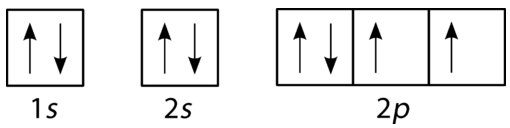
This orbital diagram represents:

a)

C

b)

B

c)

N

d)

O

86.

What charge does group 1 make?

a)

+1

b)

-1

c)

0

d)

+2

87.

What charge does group 2 make?

a)

+1

b)

-1

c)

-2

d)

+2

88.

What charge does group 13 usually make?

a)

+2

b)

-2

c)

+3

d)

-3

89.

What charge does group 15 usually make?

a)

+5

b)

-5

c)

+3

d)

-3

90.

What charge does group 17 make?

a)

+7

b)

-7

c)

+1

d)

-1

91.
What charge will an Oxygen ion have? 
a)

+1

b)

-1

c)

+2

d)

-2

92.
If an element has 3 valence electrons, what charge will likely form on its ion ?
a)
+3
b)
+5
c)
-3
d)
-5
93.

What is the charge of a sodium ion?

a)

+2

b)

+1

c)

-1

d)

-2

94.
Which of the following has a -3 charge?
a)

Boron

b)

Fluorine

c)

Nitrogen

d)

Neon

95.
charge of beryllium ion
a)

-2

b)

-1

c)

+1

d)

+2

96.

F ion has a charge of ________.

a)

-2

b)

-1

c)

+1

d)

+2

97.
The substances listed on the right side of a chemical equation are the
a)
Yields
b)
Reactants
c)
Products
d)
Precipitates
98.
The substances listed on the left side of a chemical equation are the
a)
Products
b)
Coefficients
c)
Precipitates
d)
Reactants
99.
How many Oxygen (O) atoms are in 2C2HO8Cl2
a)
2
b)
16
c)
8
d)
5
100.
How many Hydrogen (H) atoms are in NH3O5
a)
3
b)
4
c)
5
d)
1
101.
Which is the Law of Conservation of Matter?
a)
matter cannot be created or destroyed, it only changes form
b)
matter can be created but it cannot be destroyed, it never changes form
c)
matter can be destroyed but it cannot be created, it usually just changes form
d)
matter is an unproven theory created by Hans Geiger
102.
How many molecules of Carbon are in the following formula? 3C2H6
a)
3
b)
6
c)
12
d)
18
103.
Which of the following shows the correct way to balance the chemical equation?
Fe + O2 -> Fe2O3
a)
4Fe + 3O2 -> 2Fe2O3
b)
2 Fe + 3O2 -> Fe2O6
c)
4 Fe + O6 -> 2Fe2O3
d)
None of the options are correctly balanced.
104.
Which of the following reactions is balanced?
a)
2CH4 + O2 -> CO2 + H2O
b)
CH4 + 2O2 -> CO2 + H2O
c)
CH4 + 2O2 -> CO2 + 2H2O
d)
None of the chemical equations are balanced.
105.
Balance this equation...
HgO --> Hg + O2
a)
It is balanced 
b)
2HgO --> Hg + O2
c)
2HgO --> 2Hg + O2
d)
I don't know...Oh well!
106.
How many HCl molecules do you need to balance this equation? 
Mg +  __HCl --->  MgCl2 + H2
a)
1
b)
2
c)
3
d)
4
107.
Balance this equation.
_CF+ _Br-- _CBr+ _F2
a)
2,1,2,1
b)
1,2,2,1
c)
1,2,1,2
d)
2,2,2,2
108.
Which coefficients balance this equation:
NH3  +  O2 ---->   NO  + H2O
a)
2,3,5,6
b)
5,5,4,6
c)
4,6,4,5
d)
4,5,4,6
109.
Balance this equation.
_CH4 + _O--> _CO+ _H2O
a)
1,2,1,1
b)
2,1,2,1
c)
1,2,1,2
d)
0,2,0,2
110.
The red numbers in the image below represent ________
a)
subscripts
b)
coefficients
c)
I don't know, and don't want to try
d)
None of the answers are correct
111.
The blue numbers in the image below represent ________
a)
I don't know, and don't want to try
b)
coefficients
c)
subscripts
d)
none of the answers are correct
112.
If an element is diatomic it should have a subscript of___
a)
2, always
b)
2, only when it is by itself
c)
it shouldn't have a subscript, it should have a coefficent
113.

The elements that are yellow in this picture?

a)

metal

b)

nonmetal

114.

The elements that are blue in this picture?

a)

metal

b)

nonmetal

115.

Sulfur (on the right of the steps)

a)

metal

b)

nonmetal

116.

Sodium (on the left of the steps)

a)

metal

b)

nonmetal

117.

Hydrogen (the one circled)

a)

metal

b)

nonmetal

118.
Fe
a)

Metal

b)

Nonmetal

119.
O
a)

Metal

b)

Nonmetal

120.
Be
a)

Metal

b)

Nonmetal

121.
Ca
a)

Metal

b)

Nonmetal

122.
Li
a)

Metal

b)

Nonmetal

123.
N
a)

Metal

b)

Nonmetal
