
 Worksheets
Remedi IPA & Science
Total questions: 25
Worksheet time: 25mins

A person is standing in the middle of a boxcar on a train moving 100 km per hour. If the motion of the boxcar remains constant, where in the boxcar will the person most likely land after he jumps straight up?


Horizontal forces act on two boxes, initially at rest, as shown. The magnitude and direction are of the horizontal forces are also shown. What happens to Box X and Box Y as a result of the forces?
Box X starts moving, speeding up, and Box Y remains at rest
Box X starts moving at constant speed, and Box Y remains at rest
Box X starts moving at constant speed, and Box Y starts moving, speeding up
Box X starts moving, speeding up, and Box Y starts moving at a constant speed

Which lens represents the path light takes through a diverging lens?


what is the cause of the phenomenon?
Summation of light
Dispersion of light
Scattering of light
Reflection of light
Which of the following above is a Luminous and Non-Luminous light in consecutive order:
i. Sun
ii. Earth
iii. Moon
iv. Table
v. Lamp
vi. Mirror
vii. Television
I,ii,iii & iv,v,vi
I,iii,v & ii, iv,viii
I,v,vii & ii,iv,vi
Ii,iii,iv & v,vi,vii

The picture on the right is a sample of reflection. A and B is for the following:
Reflection, Incidence
In , out
Left , right
Incidence, reflection

Your eyes are ____________ lenses.
convex
concave
contact
all of the above
Which statement is true regarding what we see? When we see things, what we are really seeing is:
The light being absorbed by things
The light being refracted by things
The light being reflected from things
None of these

If you were to accidentally scratch the outermost part of your eye, which part would you damage?
The cornea
The lens
The retina
The pupil

What do the lens and cornea have in common?
They both send messages to the brain.
They can both change shape.
They both contain photoreceptive cells.
They both bend light into a focused beam.

How are rods different from cones?
Rods are sensitive to light, while cones can detect color.
Cones are sensitive to light, while rods can detect color.
Cones send images to the brain, while rods do not.
Rods send images to the brain, while cones do not.

What role does your brain play in the process of seeing?
It puts blurry images into focus.
It turns black-and-white images into color.
It flips upside-down images rightside-up.
It flips backwards images over so you see them the correct way.

What might happen if the lens of your eye became damaged?
Your eyes wouldn't be able to focus properly.
You wouldn't be able to see in color.
You wouldn't be able to see at night.
All the images you saw would be upside-down.

The ray that bounces off the mirror.
Angle of Reflection
Incidience Ray
Reflected Ray
Angle of Reflection
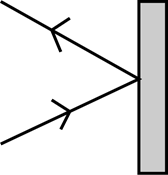
In the illustration, the light ray striking the object is-

Given that the angle of incidence = 30 degrees
Which is the correct diagam?
A
B
C
D
Can sound travel in vacuum? Why?
It can travel in vacuum, because no particles are in vacuum
It can not travel in vacuum, because no particles are in vacuum
It can not travel in vacuum, because there are only air particles in the vacuum
It can travel in vacuum, because there are only air particles in the vacuum

Which one is an amplitude?
A
B
C
D

The red arrow indicates how many wave?
1
1.25
1.5
2
Which one is true?
Increasing frequency will increase pitch
Increasing frequency will increase loudness
Increasing frequency will increase loudness
Increasing frequency will decrease pitch

Which one is true?
P is quieter than Q
Q has higher pitch than P
Q has lower pitch than P
P is louder than Q

Which sound have the same pitch?
A & B
A & C
B & C
Which sound have the same frequency?
A & B
A & C
B & C

