
 Worksheets
End of term Exam
Total questions: 63
Worksheet time: 43mins
What is the basic unit of the nervous system?
Synapse
Neuron
Dendrite
Axon
What is the function of the cochlea in the ear?
Produce insulin
Convert sound vibrations into electrical signals
Detect light waves
Regulate body temperature
Which part of the eye controls the amount of light entering the eye?
retina
cornea
iris
pupil
Which planet is known as the 'Red Planet'?
Jupiter
Venus
Saturn
Mars
What is the largest planet in our solar system?
Saturn
Jupiter
Neptune
Mars
Which extreme survivor is known for its ability to survive in extreme heat?
polar bear
desert fox
camel
penguin
What is the process of an organism adapting to its environment over time?
Genetic drift
Evolution
Mutation
Natural selection
What is the function of the eardrum?
Transmit sound vibrations to the middle ear
Regulate body temperature
Store excess sound waves
Detect light intensity
Which part of the eye is responsible for focusing light onto the retina?
lens
vitreous humor
cornea
iris
In genetics, what is the term for the physical characteristics of an organism?
phenotype
allele
heredity
genotype
The genotype for a yellow plant is...


Define sound

Why does a camel have a hump?
to keep the camel's body from the hot sand.
to stores fat when there's no food or water.


Which is the hottest planet?
Venus
Mercury
Uranus
Neptune
What is the biggest planet?
Neptune
Jupiter
Mars
What are the outer planets made of?
Helium
Ice
Rock
Gases

What are the outer planets?
Select ALL that apply.
Mars
Jupiter
Saturn
Uranus
Neptune

_________ is the planet that takes the shortest time to revolve around the sun.
Neptune
Mars
Earth
Mercury

What planet is known as the red planet because of its red looking surface?
Earth
Saturn
Uranus
Mars

What is the only planet that supports life?
Mars
Neptune
Earth
Saturn

What planet is the same size as earth?
Pluto
Mars
Saturn
Venus

What planet is closest to the sun?
Mercury
Venus
Earth
Neptune

What are the Inner planets?
Select ALL that apply.
Mars
Venus
Mercury
Earth
Saturn
The ____ are the four planets closest to the Sun
outer planets
gas giants
inner planets
larger
This part of the body gives us our sense of hearing and balance.
nose
tongue
ear
skin
It is the coiled tube which is shaped like the shell of snail.
cochlea
pinna
auditory canal
hammer
What does the eardrum do as it receives sound?
it starts to vibrate
it does nothing
it bursts
What is an adaptation?
A trait that increases the fitness of an organism.
A trait that an organism acquires without genetic influence.
A choice made by humans about what organisms breed for advantageous traits.
Fish breathing through gill under water is considered ...........
Structural adaptations
Physiological adaptations
Behavioral adaptations
............ is when an organism develops a body feature that helps it to survive
Structural adaptation
Behavioral adaptation
Physiological adaptation

Behavioral Adapation
Physical Adapation
Both

Behavioral Adapation
Physical Adapation
Both

Behavioral Adapation
Physical Adapation
Both

Behavioral Adapation
Physical Adapation
Both
How are birds and reptiles alike or the same?
Both have feathers
Both have beaks
Both have scales
Both lay eggs
A living thing that can move
animal
desk
book
chair


This class has hair or fur and is the ONLY vertebrate that feed milk to their young.
Fish
Amphibians
Insects
Mammals

What is a carnivore?
an animal that gets energy by eating other animals
An animal that gets energy by eating only plants
an animal that gets energy by eating both plants and animals

What is a herbivore?
an animal that gets energy from eating other animals
an organism that gets energy from eating only plants
an animal that gets energy by eating both plants and other animals

An animal that hunts other animals for food is a ___________
herbivore
predator
prey
omnivore
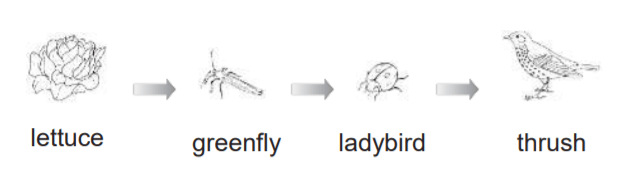
Who is the producer?
lettuce
greenfly
ladybird
thrush

Arrows in a food web represent...
eating
sunlight
energy
matter

Producers are ...
plants
able to do photosynthesis
also called autotrophs
all of these are true

Decomposers get energy from...
the sun
eating plants
eating animals
dead things and waste

The original source of energy for a food web is...
plants
sun
producers
decomposers

