
 Worksheets
Restriction Enzymes
Total questions: 15
Worksheet time: 8mins

1. If the recognition sequence of the restriction enzyme HindIII is AAGCTT, then how many covalent bonds will be broken by the enzyme in the following DNA molecule?
1
2
3
4
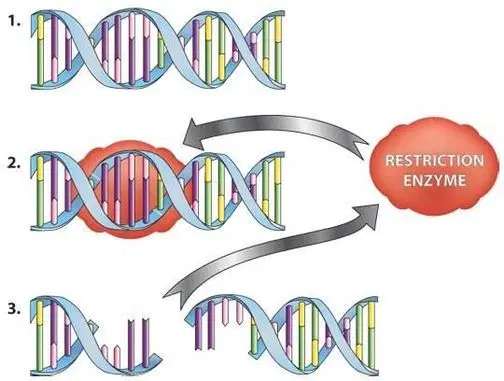
Who discovered Restriction Enzymes?
a).Watson and Crick
b).Arber, Nathan, Linn
c).Jacob and Monod
d).Beadle and Tatum

1. The DNA base sequences recognized by Endonuclease are called
a). Restriction Site
b). Recognition Site
c). Fragmentation Site
d). cutting Site
The sequence that restriction enzymes recognize contains how many bases?
a).1
b). 3
c).6
d).12

Which was the first Restriction Enzyme discovered ?
a).HindII
b).EcoRI
c).BamHI
d).HindIII

How do we name restriction Enzymes ?
a).First letter in Cap for Genus, next two letter in small for species, next one letter for strain and roman numeral for order of discovery
b). First two letter in Cap for Genus, next one letter in small for species, next one letter for strain and English numeral for order of discovery
c). First two letter in Cap for Genus, next one letter in capital for species, next one letter for strain and roman numeral for order of discovery
d). First two letter in Cap for Genus, next one letter in small for species, next one letter for strain and roman numeral for order of discovery
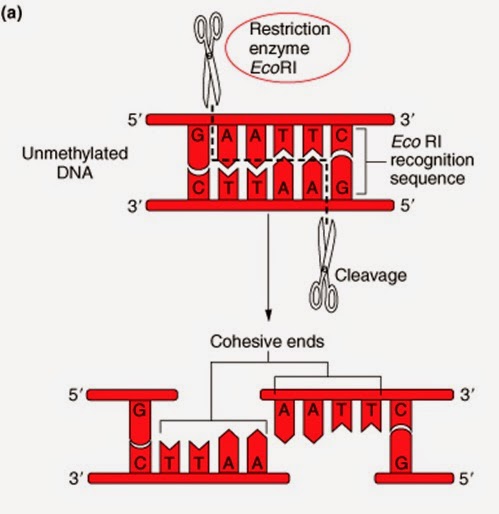
The recognition sites for restriction enzymes are:
a). Tautomer
b). Palindrome
c). Metamere
d). Acronym

Restriction Enzymes are isolated from:
a). Protozoa
b). Bacteria
c). Virus
d). Fungi
Restriction Enzymes were primarily used as:
a).Defence by Protozoa against antibiotics
b).Tool by Virus to cleave Bacterial genome
c)Defence by Bacteria against bacteriophages viruses
d).All of the above
Restriction enzymes belong to class of enzymes:
a).Peptidase
b).Amylases
c).Lipases
d).Nucleases
What is the function of restriction enzymes in molecular biology?
a) To synthesize DNA
b) To degrade RNA
c) To cut DNA at specific sequences
d) To regulate gene expression
Which of the following is NOT a type of restriction enzyme?
a) Methyltransferase
b) Ligase
c) Endonuclease
d) Exonuclease
What is the significance of palindromic sequences in the context of restriction enzymes?
a) They are recognized by restriction enzymes
b) They are involved in DNA replication
c) They are used in protein synthesis
d) They are found in RNA molecules
What is the role of restriction enzymes in genetic engineering?
a) To amplify DNA sequences
b) To insert foreign DNA into plasmids
c) To transcribe mRNA
d) To degrade proteins
How do restriction enzymes recognize their specific DNA sequences?
a) By binding to methylated bases
b) By forming hydrogen bonds with the DNA
c) By scanning the entire DNA strand
d) By matching base pairs in the recognition site

