
 Worksheets
P4 Electricity and Circuits Quiz
Total questions: 39
Worksheet time: 20mins
What is the unit of electric current?
Volt (V)
Ohm (Ω)
Ampere (A)
Coulomb (C)
In a circuit diagram, current flows from the positive terminal of a cell or battery to the negative terminal. This is known as:
Direct current
Alternating current
Conventional current
Reverse current
What is the formula for potential difference (V)?
V = IR
V = I/R
V = R/I
V = I^2R
What happens to an atom when electrons are removed from it?
It becomes negatively charged
It becomes positively charged
It remains neutral
It becomes an ion
What is the unit of resistance?
Volt (V)
Ampere (A)
Ohm (Ω)
Coulomb (C)
Which of the following is a good conductor of electricity?
Plastic
Rubber
Metal
Wood
In a series circuit, if one component stops working, what happens to the whole circuit?
The whole circuit stops working
The other components continue to work
The current increases
The voltage increases
In a parallel circuit, what happens if one branch stops working?
The whole circuit stops working
The other branches will continue to work
The current in the whole circuit stops
The voltage in the whole circuit stops
What is the relationship between current and potential difference in an ohmic conductor?
Current is inversely proportional to potential difference
Current is directly proportional to potential difference
Current is independent of potential difference
Current is equal to potential difference
What is electric current?
Rate of flow of charge
Amount of charge stored
Voltage across a component
Resistance in a circuit
What units are charge, current, and time measured in?
Volts (V), ohms (Ω), seconds (s)
Coulombs (C), amperes (A), seconds (s)
Joules (J), watts (W), hours (h)
Newtons (N), meters (m), seconds (s)
What is the same at all points when charge flows in a closed loop?
Voltage
Resistance
Current
Power
What must there be in a closed circuit so that electrical charge can flow?
Source of potential difference (p.d.)
High resistance
Low temperature
Large capacitance
Which two factors does current depend on and what are their units?
Voltage in volts (V), power in watts (W)
Resistance in ohms (Ω), p.d. in volts (V)
Capacitance in farads (F), inductance in henrys (H)
Energy in joules (J), charge in coulombs (C)
What happens to the current if the resistance is increased but the p.d. stays the same?
Current increases
Current decreases
Current remains the same
Current fluctuates
What is an ohmic conductor?
Conductor where current is directly proportional to the voltage so resistance is constant (at constant temperature)
Conductor where resistance increases with temperature
Conductor where current is inversely proportional to voltage
Conductor where resistance decreases with temperature
What happens to the resistance of a filament lamp as its temperature increases?
Resistance decreases
Resistance remains the same
Resistance increases
Resistance fluctuates
What happens to the resistance of a thermistor as its temperature increases?
Resistance increases
Resistance remains the same
Resistance decreases
Resistance fluctuates
What happens to the resistance of a light-dependent resistor when light intensity increases?
Resistance increases
Resistance remains the same
Resistance decreases
Resistance fluctuates
What are the main features of a series circuit?
Same current through each component, total p.d. of power supply is shared between components, total resistance of all components is the sum of the resistance of each component
Same voltage across each component, total current is the sum of the currents in each branch
Total resistance is less than the smallest individual resistor
Power supply is shared equally among all components
What are the main features of a parallel circuit?
Same current through each component, total p.d. of power supply is shared between components
p.d. across each branch is the same, total current through circuit is the sum of the currents in each branch – total resistance of all resistors is less than the resistance of the smallest individual resistor
Total resistance is the sum of the resistance of each component
Power supply is shared equally among all components
Where in a circuit is an ammeter added?
In parallel
In series
How many joules are in 1 kJ?
10
100
1000
10,000

What is this circuit component?
Fixed resistor
Variable resistor
Thermistor
LDR

Calculate the charge and give the unit when a current of 0.15 A flow around the circuit for 20 seconds.
133.33 C
1.5 C
0.0075 C
3 C

Calculate the voltage across the 8Ω resistor.
4 V
16 V
9 V
4.5 V

Based on the graph, which of the following would be true regarding the relationship of voltage and current?
As voltage increases, current decreases.
Voltage will not affect current.
As voltage decreases, current increases.
As voltage increases, current also increases.
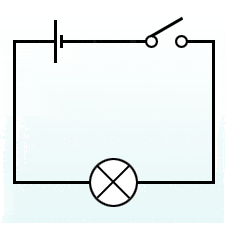
What does a voltmeter measure?
potential difference
resistance
charge
current


A resistor has a potential difference of 10V across it and a current of 2A flowing through it. What is the resistance of the resistor?
20Ω
5Ω
200Ω
0.2Ω
What is the unit of electric current?
B
C
D
A
If you INCREASE RESISTANCE, what happens to CURRENT?
It decreases
It increases
It stays the same
A 4 ohm resistor is replaced with a 2 ohm resistor. What happens to the current in the circuit?
It halves
It triples
It doubles
It quadruples

What is this symbol?
Cell
Switch
Bulb
2 cell battery

Cell
Wire
Resistor
Variable Resistor

Motor
Resitor
Ammeter
Variable Resistor

