
 Worksheets
Topic 2 Vocabulary Quiz
Total questions: 18
Worksheet time: 16mins
Hey Anika, Daniel, and Elijah! Can you figure out what compatible numbers are?
Numbers that are difficult to add, subtract, multiply, or divide
Numbers that are easy to add, subtract, multiply, or divide
Numbers that are only used in subtraction
Numbers that are only used in multiplication
Hey Harper, Ava, and Elijah! Can you figure out what the associative property of addition states?
The sum of two numbers is always greater than the product
The sum of three or more numbers is the same, even when the grouping of addends is changed
The difference between two numbers is always positive
The product of two numbers is always greater than their sum
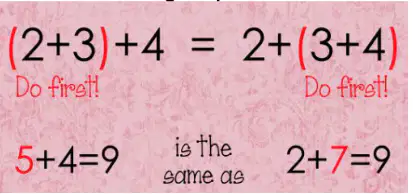
Maya, Nora, and Isla are playing a math game. Which of the following is an example of the associative property of addition?
(2+3)+4 = 2+(3+4)
(2-3)+4 = 2-(3+4)
(2*3)+4 = 2*(3+4)
(2/3)+4 = 2/(3+4)

Hey class! Scarlett and Benjamin are having a debate. Scarlett says that the order of numbers in an addition expression can be changed without changing the sum. What does the commutative property of addition state?
The sum of numbers changes when the order is changed.
The order of numbers in an addition expression can be changed without changing the sum.
The product of numbers changes when the order is changed.
The difference of numbers changes when the order is changed.
Charlotte and Avery are playing a math game. Can you help them figure out which of the following is an example of the commutative property of addition?
5 + 12 = 12 - 5
5 + 12 = 12 + 5
5 - 12 = 12 - 5
Michael and Hannah are solving a math puzzle. What does the term "compensation" mean in mathematics?
Keeping the numbers the same to make the calculation harder.
Adjusting/changing one or both numbers to make them "friendlier" numbers to calculate to solve.
Changing the operation to make the calculation harder.
Ignoring the numbers to make the calculation easier.
Hey math whizzes! Oliver, Aiden, and Henry are having a debate. Can you help them out? What does the term "annex" mean in mathematics?
To subtract numbers
To add more numbers (usually 0's) to an original number
To multiply numbers
To divide numbers
Hey math wizards! Aiden, Abigail, and Kai are solving problems. Can you help them figure out which of the following is an example of "annexing" zeros in their math problem?
45.6 + 3.2
64.700 - 8.382
12 x 4
100 ÷ 5
Grace and Jackson are having a friendly math duel. What is "mental math"?
A method to write down math problems
A group of skills that allow you to do math in your head
A way to use a calculator
A technique to draw math symbols
Nora and Ethan are at the mall. When might they use mental math in everyday life?
When writing a letter
When shopping to make sure they have enough money
When drawing a picture
When reading a book
Benjamin and Anika are playing a math game. Can you help them figure out what an inverse operation is?
The same operation repeated twice
The opposite operation; one that undoes the previous operation
An operation that adds two numbers
An operation that multiplies two numbers
Harper and Liam are solving the math problem, 2 + 3 = 5. Which equation below can help them figure out that their answer is correct by using an inverse operation?
2 + 3 = 5
5 - 3 = 2
2 x 3 = 6
6 ÷ 2 = 3
Ethan and Evelyn are having a math debate! Can you help them figure out: What is the definition of an expression in mathematics?
A math statement with an equal sign
A math statement with at least two different numbers and at least one operation. It does not have an equal sign
A math statement with only one number
A math statement with only one operation
Rohan and Elijah are solving math puzzles. Can you help them figure out which of the following is an example of an expression?
4 + 5 = 9
4 + 5 x 3
4 = 5 + 3
4 x 5 = 20
The property that says 2+3 is equivalent to 3+2
distributive
commutative
associative
Which of the following is an example of the associative property of addition?
9 +(8+7)=(9+8)+7
(4+2+3)=4+(2+3)
3×(4×6)=(3×4)×6
4×1=4
3 + (15 + 4) = (3 + 15) + 4
13 + 9 + 6 = 9 + 13 + 6
Commutative
Associative
Identity
Not Equivalent

