
 Worksheets
Final History 10
Total questions: 152
Worksheet time: 1hrs 17mins
Which invention played a crucial role in powering machinery and factories during the First Industrial Revolution?
Steam engine
Printing press
Telescope
Compass
Which technological change did not occur during the Second Industrial Revolution?
Development of the electric light bulb
Invention of the telephone
Introduction of the steam engine
Advancements in steel production
Alfred Nobel, a Swedish inventor, is best known for inventing:
Dynamite
Telephone
Steam engine
Printing press
Who invented the first battery, which was a significant development in the history of electricity?
Nikola Tesla
Thomas Edison
James Watt
Alessandro Volta
What was a major effect of the Second Industrial Revolution on the labor market?
Decrease in factory jobs
Increase in agricultural employment
Growth of urban factories and mass production
Decline in population growth
Which of the following changes in daily life was a significant impact of the 2nd Industrial Revolution?
Exploration of new continents
Shift from rural agriculture to urban industrialization
Development of the printing press
Invention of the steam engine
What do you call a coordinated work stoppage by employees to protest against employers during the 2nd Industrial Revolution?
Protest
Boycott
Strike
Negotiation
What is a labor union?
A group of workers organizing to negotiate better wages and working conditions
A government agency regulating industrial safety
A company that specializes in shipping goods internationally
A political party advocating for worker rights
What type of family structure became more common during the Second Industrial Revolution, as people moved to urban areas for industrial jobs?
Extended Family
Nuclear Family
Single-parent Family
Blended Family
During the Second Industrial Revolution, what were the traditional gender roles of the mother and father primarily defined as?
Both worked in factories
Mother stayed home, father worked outside
Father stayed home, mother worked outside
Both managed household chores equally
During the Second Industrial Revolution, which areas did women primarily struggle to gain rights in?
Business Ownership, Legal Representation, Military Service, Suffrage
Employment, Housing, Immigration, Health
Education, Divorce, Property Laws, Vote
Environmental Protection, Cultural Heritage, International Relations, Technology
In 1881, high school education in the United States began requiring students to learn which subjects?
Music and Physical Education, Sociology, Computer Science
Physics and Engineering, Geography, Economics
Biology and Chemistry, Literature, Art
Latin and Greek, History, Mathematics
During the Second Industrial Revolution, what was a common belief about boys and girls in regards to sciences and mathematics education?
Boys were favored for learning more, while girls were considered unnecessary and not suited for sciences and mathematics
Girls were taught basic sciences and mathematics, while boys received advanced education
Girls excelled more in sciences and mathematics, while boys focused on other subjects
Both boys and girls were equally encouraged to study sciences and mathematics
How did the Bessemer process change the U.S.?
It made steel harder to make
It let steel be made cheaper to build more railroads.
It made coal easier to find
It did not change the U.S.
Which of these is an invention from the 2nd Industrial Revolution
Boat
Cell Phone
Lightbulb
Refrigerator
How did the assembly line impact the U.S.?
It did not impact the U.S.
It made Henry Ford rich
It assembled new toys.
It let factories create goods faster.
In the 2nd Industrial Revolution, what new industries developed?
Textiles, railroads, and dirt roads
Internet, web design and IPhones
Psychoanalysis and new products
Steel, electricity, and oil
Labor Unions helped workers get better pay, better hours, and safer working conditions
True
False

Which of the following was Thomas Edison's most important invention
electric lightbulb
vacuum cleaner
instant camera
circuit breaker
Child labor laws said children in factories had to be at least this old to work
12
18
8
21
Who invented the electric motor (dynamo)?
Thomas Edison
Nikola Tesla
Michael Faraday
Alexander Graham Bell
What does nationalism mean?
Loyalty to one's local area
Pride in one's cultural background
Belief in worldwide unity
Devotion to one's nation and its interests
What is imperialism?
A philosophy promoting isolationism
A system of government based on religious principles
The desire to expand and control territories
A belief in equality among nations
The Scramble for Africa involved the expansion and colonization efforts of which seven Western European powers?
China, Japan, Korea, Vietnam, Thailand, India, Indonesia
Britain, France, Germany, Italy, Spain, Portugal, Belgium
United States, Canada, Australia, New Zealand, South Africa, Argentina, Brazil
Russia, Austria-Hungary, Ottoman Empire, Bulgaria, Serbia, Romania, Greece
In 1870, only 10% of Africa was under European control. By 1914, nearly 90% had been colonized, leaving only Liberia and Ethiopia fully sovereign. This rapid colonization was primarily driven by
Economic competition among European powers
Religious missionary efforts
African resistance movements
Technological advancements in transportation
Britain sought profitable markets in India, Malaya, Australia, and New Zealand. Additionally, to control the water route between East and West, Britain focused on
Panama Canal
Cape Horn
Strait of Gibraltar
Suez Canal
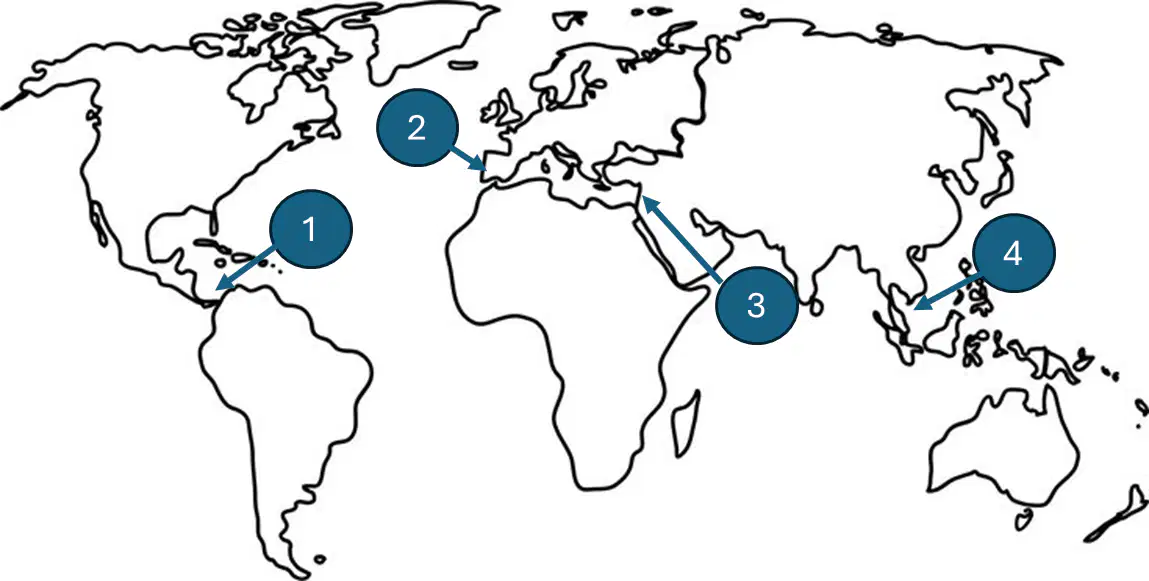
Where is Suez Canal located?
1
2
3
4
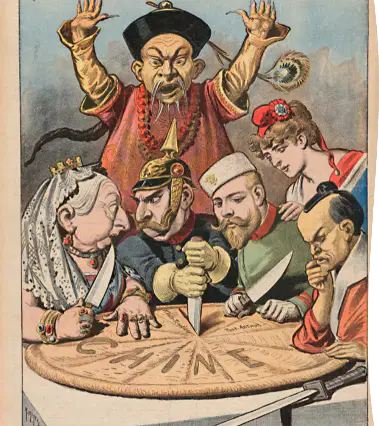
In the comic, the Great Powers dividing China from left to right are which countries?
USA, China, Australia, Canada, India
Britain, Germany, Russia, France, Japan
Spain, Italy, Netherlands, Switzerland, Sweden
Korea, Vietnam, Thailand, Indonesia, Philippines
Opium War was a war between which two countries?
China and Japan
China and the United States
China and Britain
China and Russia
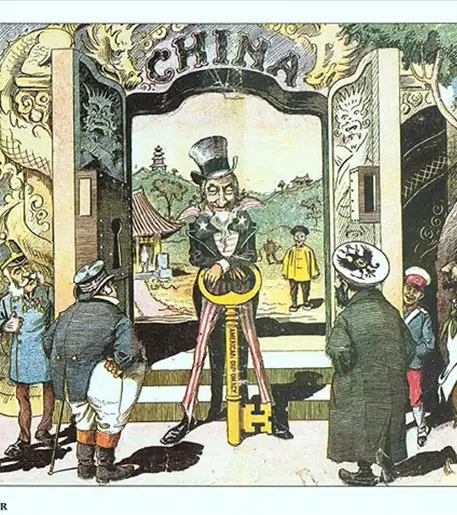
In the picture, which country is holding the key?
China
Britain
Japan
USA
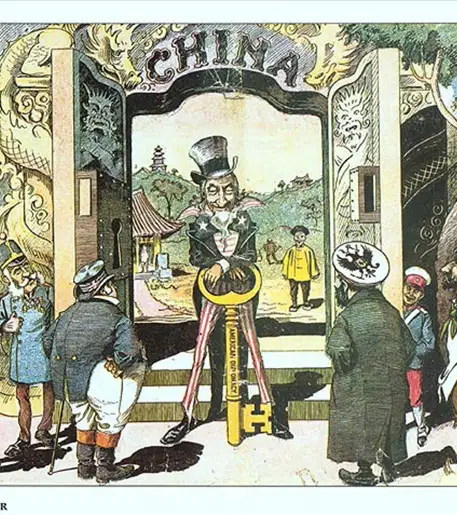
Which policy did the country in the picture propose to ensure access to China's resources and markets for all nations?
Open Door Policy
Washington Policy
Japan Doctrine
Global Access Initiative
The phrase "When the red lanterns shine, the world laughs; first kill the foreigners, then destroy their religion" is associated with which group during the late Qing Dynasty?
Qing officials
Kuomintang
Taiping Rebels
Boxers
Boxers group in China was primarily a response to:
Foreign interference and imperialism
Domestic political reforms
Natural disasters
Religious persecution
Which issue contributed to causing the First Sino-Japanese War?
The Opium Trade
The Korean Peninsula
The Boxer Rebellion
The Treaty of Nanjing
As a result of the First Sino-Japanese War, Japan gained which territories?
Philippines and Indonesia
Manchuria and Mongolia
Vietnam and Laos
Korea and Taiwan
The Chinese Hundred Days' Reform aimed to modernize China by:
Promoting agricultural reforms
Expanding territorial boundaries
Strengthening cultural traditions
Reforming the civil service exam, streamlining government, and developing new industries
During the Chinese Hundred Days' Reform, Empress Cixi and her conservative allies opposed the reforms primarily because they:
Favored Western influence
Threatened their political power
Promoted economic equality
Strengthened military alliances
The First Sino-Japanese War resulted from competition between China and Japan to establish control over
Shanghai
Korea
Manchuria
Taiwan
Who is often referred to as the Father of Modern China?
Mao Zedong
Sun Yat-sen
Chiang Kai-shek
Deng Xiaoping
Who is the father of the communist party in China?
Mao Zedong
Sun Yat-sen
Chiang Kai-shek
Deng Xiaoping
Which option is incorrect regarding Sun Yat-sen's Three Principles of the People?
Livelihood
Democracy
Nationalism
Isolationism
“The first principle was nationalism, or freeing China from foreign domination. The second was democracy, or representative government. The third was livelihood, or economic security for all Chinese. Who established the principles described in the text?
formation of a constitutional monarchy; Mutsuhito
establishment of a republic; Sun Yixian
adoption of Western ideas; Ci X
continuation of Confucian traditions; Guang Xu
The 1911 Revolution, which overthrew the Qing Dynasty’s 200-year rule, is also known as
Ming Revolution
Tang Revolution
Xinhai Revolution
Song Revolution
Xinhai Revolution leader?
Mao Zedong
Sun Yat-sen
Chiang Kai-shek
Deng Xiaoping
The period marked by the end of feudalism and the beginning of Japan's modernization, under Emperor Meiji, is known as the:
Taisho Era
Edo Period
Meiji Restoration
Showa Era
The young emperor began a long reign known as the Meiji Restoration. This period, which lasted from 1868 to 1912, was a major turning point in Japanese history. The Meiji reformers, who ruled in the emperor’s name, were determined to strengthen Japan. Their goal was summarized in their motto, ‘A rich country, a strong military.’ The emperor supported and embodied the reforms.”
Which action did Japan’s leaders take to fulfill the goals described in this text?
Limiting contact with foreign traders
Sending representatives to report on Western technology
giving the shogun greater military power
signing unequal treaties with Western powers
Which event directly led to the beginning of the Meiji Restoration?
Perry's Expedition
Treaty of Kanagawa
Boshin War
Arrival of Commodore Perry
Which of the following was a major goal of the Meiji Restoration?
Restore power to the shogunate
Modernize and industrialize Japan
Expand Japan's territories in Asia
Restore traditional Japanese arts
Who was the Emperor of Japan during the Meiji Restoration?
Emperor Meiji
Emperor Komei
Emperor Taisho
Emperor Showa
Which factors contributed to the cause of World War I?
Militarism and Arms Race
Nationalism
Economic and Imperial Rivalry
All of the above
Which countries formed the Triple Alliance during World War I?
Germany, Austria-Hungary, Italy
Germany, Russia, France
Britain, France, Russia
Austria-Hungary, Ottoman Empire, Bulgaria
The Triple Alliance during World War I, also known as:
The Axis Powers
The Entente Powers
The Allied Powers
The Central Powers
The countries that formed the Triple Entente during World War I were:
France, Russia, United Kingdom
Germany, Austria-Hungary, Italy
United States, Japan, Britain
Russia, Ottoman Empire, Bulgaria
The outbreak of World War I was primarily triggered by:
The assassination of Archduke Franz Ferdinand of Austria-Hungary
The signing of the Treaty of Versailles
The rise of fascism in Italy
The Russian Revolution
The Schlieffen Plan, developed by Germany during World War I, aimed to:
Establish a defensive line against British forces
Quickly defeat France to avoid a two-front war with France and Russia
Encourage British neutrality in the war
Initiate peace negotiations with Austria-Hungary
What does "Western Front War" refer to during World War I?
The conflict between Germany and Russia
The fighting between Italy and Austria-Hungary
The battles between Germany and the Allies in France and Belgium.
The naval warfare between Britain and Germany
Which type of military technology played the largest role in creating the long stalemate on the Western Front?
U-boats
zeppelins
Airplanes
machine guns
What does "Eastern Front War" refer to during World War I?
The conflict between Germany and Russia.
The fighting between Italy and Austria-Hungary.
The battles between Germany and the Allies in France and Belgium.
he naval warfare between Britain and Germany
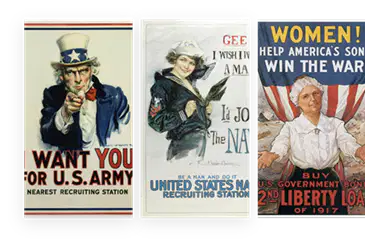
What do the following images primarily represent?
Military tactics
Historical events
Propaganda
Cultural symbols
How did World War I change society?
Factories switched to producing war equipment.
The economy experienced a boom.
Social equality increased.
he education system was reformed.
What were two significant events that led to the U.S. entry into World War I?
The sinking of the Lusitania and the Zimmerman Telegram
The Battle of Verdun and the Treaty of Versailles
The Russian Revolution and the Treaty of Brest-Litovsk
The Treaty of Portsmouth and the assassination of Archduke Franz Ferdinand.
What was the Zimmerman Telegram?
A diplomatic note from the United States to Germany demanding the cessation of unrestricted submarine warfare.
A communication between France and Britain discussing their war strategies
A message from Russia to Germany proposing a ceasefire.
A secret telegram sent by Germany to Mexico in 1917, proposing a military alliance against the United States.
Which event in Germany during World War I indirectly led to Germany's surrender and the end of the war?
The signing of the Treaty of Versailles
The Russian Revolution
The German Revolution
The signing of the Armistice of Compiegne
What happened when the German Emperor, Wilhelm II, was forced to quit?
Germany declared war on the United States
The Weimar Republic was established
The German Empire expanded its territory
The Treaty of Versailles was signed
Which treaty placed blame on Germany, demanded reparations, and limited its military?
Treaty of Brest-Litovsk
Treaty of Trianon
Treaty of Versailles
Treaty of Saint-Germain
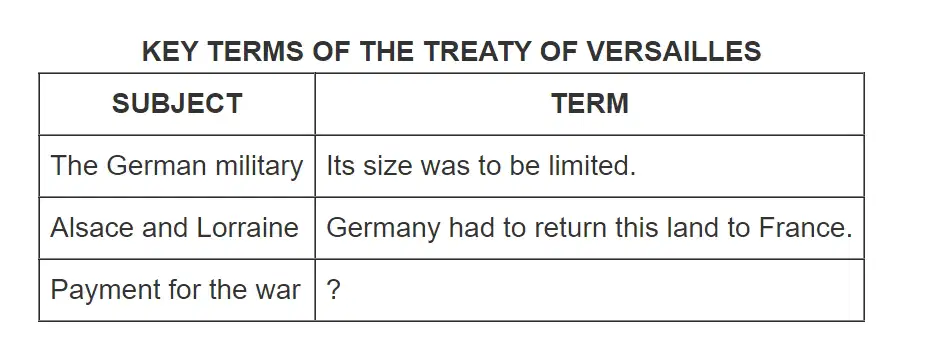
Choose the answer to complete the table listing terms of the Treaty of Versailles
France was forced to pay for the war.
All sides were forced to pay equally
Germany was forced to pay for the war.
No one need to pay for the war
What was a cause of the February Revolution in Russia?
Successes on the Eastern Front
Economic hardship and food shortages
Industrial prosperity
Increased political freedoms
What sparked the February Revolution in Russia?
Successful military campaigns
Industrial growth
Increased political reforms
Protests in Petrograd led by women textile workers due to food shortages and World War I
What were the demands of the protesters during the February Revolution in Russia?
Greater military funding
Economic sanctions
Political reforms and an end to food shortages
Bread, an end to World War I, and the Tsar's abdication
Who established the Provisional Government in Russia during the February Revolution?
The Tsar
The Bolsheviks
Members of the Duma (Russian parliament)
The military
After the February Revolution in Russia, which party became increasingly popular among urban workers and soldiers?
The Mensheviks
The Socialist Revolutionaries
The Bolsheviks
The Constitutional Democrats (Kadets)
Under whose leadership did the Bolshevik Party seek to overthrow the Provisional Government?
Vladimir Lenin
Leon Trotsky
Joseph Stalin
Alexander Kerensky
What did the Bolsheviks promise when they established a Soviet government?
Peace, land, and bread
Military conquest
Cultural reforms
Religious freedom
Which Revolution led to the Russian Civil War (1917-1923)?
February Revolution
October Revolution
December Revolution
January Revolution
Formation of the USSR in 1922 brought together which countries?
Russia
Ukraine
Belarus
All of the above
After Lenin died in 1924, who eventually took over?
Leon Trotsky
Joseph Stalin
Nikita Khrushchev
Mikhail Gorbachev
During the Soviet Union’s Great Purge (1936-1938), under whose leadership did the country's regime kill millions and send many to labor camps to eliminate threats?
Leon Trotsky
Joseph Stalin
Vladimir Lenin
Nikita Khrushchev
The period between World War I (1914-1918) and World War II (1939-1945) is also known as?
The Industrial Revolution
The Renaissance
The Interwar Period
The Cold War
During the period between WWI and WWII, Germany's new government struggled with economic issues and political chaos under which government?
The Weimar Republic
The Third Reich
The Habsburg Monarchy
The Provisional Government
How would you classify the Nazi party politically?
Left-wing
Right-wing
Centrist
Libertarian
How would you classify the Soviet party politically?
Left-wing
Right-wing
Centrist
Authoritarian
How would you classify the United States politically?
Left-wing
Right-wing
Centrist
Authoritarian
How would you classify the communist politically?
Left-wing
Right-wing
Centrist
Authoritarian
Who was the dictator during the rise of totalitarianism in Italy between WWI and WWII?
Benito Mussolini
Adolf Hitler
Joseph Stalin
Francisco Franco
Who was the dictator during the rise of totalitarianism in Spain between WWI and WWII?
Benito Mussolini
Adolf Hitler
Joseph Stalin
Francisco Franco
Who was the dictator during the rise of totalitarianism in the Soviet Union between WWI and WWII?
Benito Mussolini
Adolf Hitler
Joseph Stalin
Francisco Franco
Why did agricultural prices in the United States fall rapidly after World War I?
Weather changes caused crop failures
Decreased demand and overproduction
Advances in agricultural technology increased productivity
Government imposed price controls
Before the Great Depression, by 1929, what were many Americans invested in?
Real estate
Gold
The stock market
Government bonds
What factors helped drive the economic boom of the 1920s before the Great Depression?
Increased consumer spending due to buying in installments
Strict government regulations
Decreased production efficiency
Agricultural surpluses
What is "trickle-down economics?
A strategy to eliminate taxes for middle-income earners
A theory that economic benefits for the wealthy will eventually benefit those lower down the economic ladder
A policy aimed at increasing government spending
A theory advocating for direct cash transfers to the poorest in society
Before the Great Depression, how was wealth distribution among classes in the United States?
Unequal Wealth Distribution
Equal Wealth Distribution
No Wealth Distribution
Inverted Wealth Distribution
The Great Depression began with which event?
Stock Market Crash of 1929
World War I
Signing of the Treaty of Versailles
Assassination of Archduke Franz Ferdinand
What was the Hawley-Smoot Tariff Act of 1930?
Legislation aimed at reducing taxes on imports
A law intended to increase international trade agreements
Tariffs imposed to protect American industries and farmers
A policy to encourage foreign investment in the United States
What happened to the US economy after the Hawley-Smoot Tariff Act of 1930?
Economic growth and increased international trade
Decline in international trade and worsening of the Great Depression
Stabilization of the stock market
Rise in foreign investments
Who helped end the Great Depression?
Franklin D. Roosevelt
Herbert Hoover
Calvin Coolidge
Woodrow Wilson
How did New Deal programs help end the Great Depression?
By reducing government spending
By increasing taxes on businesses
By providing jobs, relief, and economic stimulus
By promoting isolationist policies
After World War I, Britain faced economic difficulties, including:
High inflation and rapid economic growth
Low unemployment and stable economic recovery
High unemployment and slow economic recovery
Decreased taxation and increased government spending
After World War I, countries in the British Empire sought more independence. What organization did the British establish in response?
Commonwealth of Nations
League of Nations
United Nations
European Union
Which countries are members of the Commonwealth of Nations?
Former British colonies and current dependencies
Members of the European Union
Countries in North America
Asian countries
What is a common characteristic among members of the Commonwealth of Nations?
Shared currency
English as an official language
Common legal system
Recognition of the British monarch as symbolic head
The May Fourth Movement in China was primarily a response to
Economic hardships caused by World War I
Political corruption and foreign imperialism
Cultural conservatism and traditional values
Environmental degradation in urban areas
The movement on May 4, 1919, began with
Student demonstrations in Beijing
Military action against warlords
Religious protests in rural areas
Worker strikes in industrial cities
What led to the Second Sino-Japanese War in 1937?
Chinese expansionist policies
Japanese invasion of Manchuria
Soviet aggression in Northeast Asia
Korean Peninsula territorial disputes
What happened at the Marco Polo Bridge incident?
A diplomatic meeting between China and Japan
A military clash between Chinese and Japanese forces
A trade negotiation between China and Europe
A cultural exchange event
During the Second Sino-Japanese War, which were the two most important parties in China?
Chinese Nationalist Party (Kuomintang) and Chinese Communist Party
Chinese Communist Party and Warlords
Chinese Nationalist Party (Kuomintang) and British Colonists
Chinese Communist Party and Soviet Union
The formation of the Axis Powers in World War II included which countries?
United States, Soviet Union, and China
Germany, Italy, and Japan
France, Britain, and Canada
Australia, India, and New Zealand
Germany and Italy formed the Axis Powers in World War II, also known as the:
Rome-Tokyo Axis
Berlin-Moscow Axis
Rome-Berlin Axis
Berlin-London Axis
Which of the following was a reason for the formation of the Axis between Germany and Italy?
Economic alliances
Military convenience
Ideological similarity: Fascism and Nazism
Shared colonial ambitions
What is the Molotov-Ribbentrop Pact?
A military alliance between the United States and the Soviet Union
A peace treaty between Germany and France
A non-aggression pact between Nazi Germany and the Soviet Union
An economic agreement between Japan and Germany
According to the Molotov-Ribbentrop Pact, which country was to be divided between Germany and the Soviet Union?
Czechoslovakia
Poland
Hungary
Romania
What event marked the beginning of World War II?
Signing of the Molotov-Ribbentrop Pact
Germany's invasion of France
Germany's invasion of Poland
United States declaring war
What countries were part of the formation of the Allied Powers during World War II?
Germany, Italy, and Japan
United States, Soviet Union, and China
France, Britain, and China
Australia, India, and New Zealand
Why did Japan join the Axis Powers?
Economic alliances
Military convenience
Ideological similarity
Strategic expansion and resources
Blitzkrieg, also known as Lightning War, refers to:
The German invasion of Poland
The bombing of Pearl Harbor
A rapid and intense military strategy used by Germany
The Allied invasion of Normandy
During Blitzkrieg, which led to the occupation of Denmark, Norway, Belgium, the Netherlands, and France, how long did it take for France to surrender to Germany?
Two weeks
Almost a year
Almost two months
Almost 6 months
What was the name of Germany's invasion of the Soviet Union and the opening of the WWII Eastern Front?
Operation Overlord
Operation Barbarossa
Operation Market Garden
Operation Torch
What did the Soviet Union do after Operation Barbarossa?
Joined the Axis Powers
Declared neutrality
Joined the Allies and declared war on Germany
Signed a non-aggression pact with Japan
Where is Pearl Harbor located?
Hawaii, United States
Tokyo, Japan
Berlin, Germany
California, United States
After Japan attacked Pearl Harbor, what did the United States do?
Started bombing Japan's mainland
Declared war on Germany
Declared war on Italy
Declared war on Japan
The Battle of Midway during World War II is considered a:
Decisive victory for Japan
Stalemate
Turning point in the war
Tactical retreat
The Battle of Midway during World War II was fought between:
United States and Japan
United Kingdom and Germany
Japan and China
United States and Germany
The Battle of Guadalcanal during World War II marked:
The first major offensive by Axis forces against the Allies.
The first major offensive by Allied forces against the Empire of Japan.
A decisive victory for Germany in the Pacific theater.
The first use of nuclear weapons in warfare.
The Battle of Stalingrad during World War II was fought between:
Germany and the Soviet Union
Japan and the United States
Germany and France
Italy and the United Kingdom
Which battle was the largest and most costly city battle in military history during World War II?
Battle of Berlin
Battle of Stalingrad
Battle of Moscow
Battle of Leningrad
D-Day, also known as the Normandy Landing, took place in which country?
Italy
United Kingdom
Germany
France
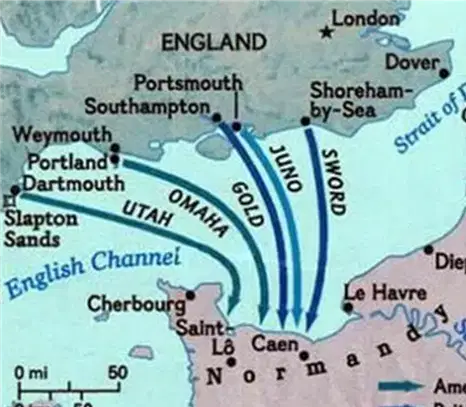
Which D-Day beach landing was primarily designated for American forces?
Sword and Juno
Juno and Omaha
Gold and Utah
Omaha and Utah
Which event opened a second front in Western Europe during World War II?
Operation Overlord (D-Day)
Battle of Stalingrad
Battle of El Alamein
Invasion of Sicily
In the Battle of Berlin, which country's forces captured Berlin, and Hitler committed suicide?
United States
Soviet Union
United Kingdom
Germany
Which battle caused Germany's surrender, marking the end of the war in Europe?
Battle of Stalingrad
Battle of the Bulge
Battle of Berlin
Battle of Normandy
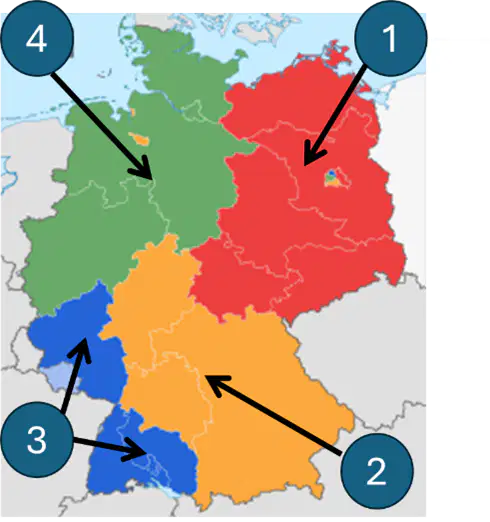
After Germany surrender, it was split into four occupation zones managed by the United States, the United Kingdom, France, and the Soviet Union. Which country occupied Zone 1?
United States
United Kingdom
France
Soviet Union
After Germany surrender, it was split into four occupation zones managed by the United States, the United Kingdom, France, and the Soviet Union. Which country occupied Zone 2?
United States
United Kingdom
France
Soviet Union
After Germany surrender, it was split into four occupation zones managed by the United States, the United Kingdom, France, and the Soviet Union. Which country occupied Zone 3?
United States
United Kingdom
France
Soviet Union
After Germany surrender, it was split into four occupation zones managed by the United States, the United Kingdom, France, and the Soviet Union. Which country occupied Zone 4?
United States
United Kingdom
France
Soviet Union
After World War II, Germany was divided into:
East Germany and West Germany
North Germany and South Germany
Free Germany and Close Germany
East Prussia and West Prussia
After WWII, what was the name of East Germany?
German Confederation
Federal Republic of Germany
German Empire
German Democratic Republic
After WWII, what was the name of West Germany?
German Confederation
Federal Republic of Germany
German Empire
German Democratic Republic
The United States dropped atomic bombs on which Japanese cities?
Tokyo and Hiroshima
Kyoto and Yokohama
Hiroshima and Nagasaki
Nagasaki and Okinawa
Why did the US drop atomic bombs on Japan?
To prevent mass casualties resulting from the planned invasion of the Japanese mainland
To test the destructive power of nuclear weapons
To weaken Japan's economy
To start the plan called Operation Downfall, a planned attack on the Germany
The punishments for Japan included territorial changes and loss of overseas territories. Which territories were affected?
Philippines, Okinawa, Taiwan
Korea, Taiwan, the Kuril Islands, and various Pacific islands
Gum, Hawaii, Okinawa, the Kuril Islands
Korea, Hawaii, Okinawa, Philippines, Cebu
Japan was placed under Allied occupation, primarily led by
China
Soviet Union
United Kingdom
United States
WWII started in 1939...when did it end?
1943
1944
1945
1946
Why did Germans look up to Hitler?
Because he was a wise businessman
Because they were scared of him
Because he promised to make Germany powerful
Because he wanted to create peace in the world
What group of people were targeted by the Nazis (Germans)?
Jews
French
Americans
Italians

Who was the leader of Great Britain during WW II?
Chruchhill
Hitler
Stalin
Roosevelt
This is the name remembered for the Allied attack on France on June 6, 1944.
Operation Dumbo Drop
Operation Torch
D-Day
Omaha
The defense of which Russian city marked a turning point on the Eastern Front of World War II?
Leningrad
Moscow
Odessa
Stalingrad
The _________ was the secret project in the United States that developed the atomic bomb.
The New York Project
The Manhattan Project
The Atom Splitting Project
The Nuclear Project

