
 Worksheets
6035- sanitation part 1
Total questions: 71
Worksheet time: 36mins
What does BS EN 12056 pertain to?
Workmanship on building sites
Gravity drainage systems – installation and testing
Water supply regulations
Electrical installations
Which standard covers workmanship on building sites?
BS EN 12056
BS 8000: pt13
The Water Supply (water fittings) Regulations 1999
BS 7671
What is the purpose of The Water Supply (water fittings) Regulations 1999?
To ensure proper electrical installations
To regulate the use of building materials
To prevent backflow contamination and wastage of water
To manage the installation of gas pipelines
What are the two main purposes of sanitary appliances?
To maintain personal hygiene and remove human waste
To cook food and clean dishes
To store food and wash clothes
To heat water and cool air
Where is the water generally removed to when using appliances for washing, bathing, and showering?
To the soil stack or sometimes a gulley
To the kitchen sink
To the garden
To the attic
What is the purpose of removing waste to the soil stack?
To dispose of the waste in the foul sewer
To recycle the waste
To store the waste for later use
To evaporate the waste
Which of the following is considered a main appliance in a bathroom?
Refrigerator
Toilet (WC)
Microwave
Dishwasher
Which of the following is NOT listed as a main appliance in the provided material?
Urinal
Bidet
Washing machine
Shower cubicles/trays
Which appliance is used for washing hands and face?
Sink
Bath
Urinal
Bidet
Which appliance is specifically designed for personal hygiene and is often found in European bathrooms?
Toilet (WC)
Urinal
Bidet
Wash basin
Which of the following materials is fired from clay and is hygienic?
Stainless steel
Vitreous china
Plastic
Wood
Which material is resistant to acid and alkali?
Stainless steel
Plastic
Vitreous china
Wood
Which material is commonly used in public areas and is resistant to vandalism?
Vitreous china
Plastic
Stainless steel
Wood
Which of the following appliances can be made from both vitreous china and stainless steel?
Kitchen sinks
Bidets
WC pans
Urinals
Which material conforms to the Department of Health specification?
Vitreous china
Plastic
Stainless steel
Wood
Which material is described as "Made from clay, robust but porous, and needs glazing"?
High impact plastic
Acrylic
Fireclay
Ceramic
What type of appliances are made from high impact plastic?
Belfast, London, and Butler sinks
WC seats, WC cisterns, and bath panels
Baths, bath panels, wash basins, and shower trays
Urinals and WC pans
Which material is vacuum moulded, easily scratched and damaged, and needs reinforcing?
Fireclay
High impact plastic
Acrylic
Ceramic
Which of the following is NOT an appliance made from fireclay?
Belfast sinks
Urinals
WC seats
WC pans
Which material is described as lightweight and warm to touch?
Fireclay
High impact plastic
Acrylic
Ceramic
Which material is described as "Very robust, Very heavy, Cold to touch, Traditional"?
Porcelain enamelled pressed steel
Enameled cast iron
Stainless steel
Plastic
Which material is used for both baths and wash basins?
Enameled cast iron
Porcelain enamelled pressed steel
Stainless steel
Plastic
Which material is described as "Rigid but light, Robust, Easily damaged"?
Enameled cast iron
Porcelain enamelled pressed steel
Stainless steel
Plastic
Which material is only used for baths according to the table?
Porcelain enamelled pressed steel
Enameled cast iron
Stainless steel
Plastic
What does WC stand for?
Water closet
Water chamber
Waste container
Waste closet
Which of the following is NOT a type of WC pan?
Washdown
Single trap siphonic
Double trap siphonic
Triple trap siphonic
What are the components of a WC?
A WC pan and a flushing cistern
A WC pan and a water tank
A flushing cistern and a water tank
A WC pan and a waste container
What is the most common type of WC in the UK?
Washdown
Siphonic
Pressure-assisted
Vacuum-assisted
What is the purpose of the force of the water flush and volume of water delivered to the pan in a washdown WC?
To reduce water usage
To clear the contents
To increase water pressure
To prevent leaks
What is the size of the integral water seal in the trap of a washdown WC?
25mm
50mm
75mm
100mm
What are two key features of a washdown WC?
Low water usage and high pressure
Efficient clearance and easy cleaning
High water usage and complex maintenance
Low clearance and difficult cleaning
What does the flush create in a single trap siphonic toilet to help clear the pan?
Positive pressure
Negative pressure
High temperature
Low temperature
In what situation is a single trap siphonic toilet typically installed?
As a new installation
As a direct replacement
In commercial buildings only
In residential buildings only
What happens to the flow of water when a single trap siphonic toilet is flushed?
It is unrestricted
It is heated
It is restricted
It is cooled
What is created when water is forced through a restricted trap neck in a single trap siphonic toilet?
High pressure
Low pressure
Vacuum
Overflow
What is a characteristic of the double trap siphonic toilet?
It is very common in the UK.
It is inefficient and noisy in operation.
It is fitted with a pressure reducing valve (aspirator).
It does not create a vacuum when flushed.
What happens when a double trap siphonic toilet is flushed?
Water is released directly into the bowl.
A vacuum is created between the two traps.
The contents are pushed through the traps by pressure.
The water level in the cistern rises.
Which of the following is NOT one of the five different styles of WCs?
Close coupled
Low level
High level
Floor mounted
What does "Back to wall (concealed)" refer to in the context of WC styles?
A type of WC that is mounted on the wall
A type of WC where the cistern is hidden within the wall
A type of WC that is placed on the floor
A type of WC with a high-level cistern
Which style of WC is mounted on the wall?
Close coupled
Low level
Wall hung
High level
What is used to bolt the cistern to the back of the WC pan in a close coupled toilet?
Butterfly clip
Wing nut
Rubber washer
Metal washer
What holds the watertight seal between the cistern and the pan in a close coupled toilet?
Metal washer
Rubber sealing washer (doughnut)
Brass bolts
Butterfly clip
What is the function of the butterfly clip in a close coupled toilet?
To hold the siphon in position
To create a watertight seal
To bolt the cistern to the pan
To secure the rubber washer
Where is the cistern screwed in a low-level toilet?
To the floor
To the wall above the pan
To the ceiling
To the side of the pan
How high is the base of the cistern from ground level in a low-level toilet?
0.5 meters
1 meter
1.5 meters
2 meters
What is the diameter of the flush pipe in a low-level toilet?
25mm
32mm
40mm
50mm
How is the flush pipe held in place in a low-level toilet?
By a metal clamp
By a rubber bush
By a plastic clip
By a screw
How is a low-level toilet flushed?
By a foot pedal
By a handle or push buttons
By a remote control
By a lever
Where is the cistern screwed in a high-level toilet?
To the floor
To the wall above the pan
To the ceiling
To the side of the pan
How high is the base of the cistern from the ground level in a high-level toilet?
1 metre
1.5 metres
2 metres
2.5 metres
What is the diameter of the flush pipe in a high-level toilet?
20mm
30mm
40mm
50mm
What holds the flush pipe in place in a high-level toilet?
Metal clamp
Rubber bush
Plastic clip
Adhesive tape
What might be required to be installed in a high-level toilet?
Water heater
Flow restrictor
Extra tank
Pressure valve
How is a high-level toilet flushed?
By pressing a button
By pulling a chain
By stepping on a pedal
By turning a knob
Why is the "Back to wall" toilet style popular?
It is cheaper than other styles.
The cistern is completely concealed from view.
It is easier to install.
It uses less water.
Where is the WC pan situated in the "Back to wall" toilet style?
Behind the panel.
Above the cistern.
Just in front of the panel.
Next to the sink.
How are "Back to wall" toilets typically flushed?
By pulling a chain.
By a wall mounted handle, button, or sensor.
By stepping on a pedal.
By using a remote control.
What is a potential requirement for installing a wall-hung toilet?
A. A supporting bracket located behind the wall
B. A floor-mounted handle
C. A visible cistern
D. A ceiling-mounted sensor
What is one advantage of a wall-hung toilet?
A. It is easier to clean the floor area
B. It has a larger cistern
C. It requires no maintenance
D. It is cheaper to install
Where is the cistern of a wall-hung toilet typically located?
A. Behind a panel
B. Under the floor
C. Above the ceiling
D. Inside the toilet bowl
How are wall-hung toilets typically flushed?
A. By a wall-mounted handle, button, or sensor
B. By a floor pedal
C. By a remote control
D. By a ceiling-mounted switch
What is the traditional way to flush a toilet?
By using a pump
By siphonic action
By gravity alone
By manual pouring
What does siphonic action involve in the context of flushing a toilet?
Using a pump to move water
Discharging water from one vessel to a lower vessel using atmospheric pressure and the properties of water
Using gravity to move water
Manually pouring water from one vessel to another
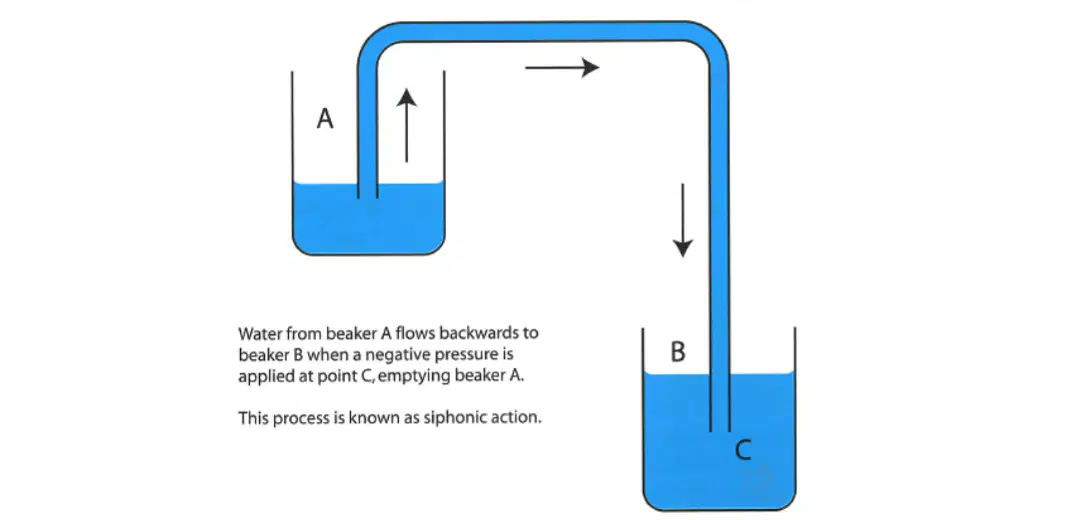
What happens when a negative pressure is applied at point C in the diagram?
Water flows from beaker B to beaker A
Water remains in beaker A
Water flows from beaker A to beaker B
Water evaporates
What is the function of the link pin in a WC siphon system?
It connects the flushing handle to the siphon.
It connects the siphon to the water supply.
It connects the diaphragm to the plunger.
It connects the cistern to the siphon bell.
What happens when the flushing handle is pushed down in a WC siphon system?
It lifts the diaphragm.
It lifts the pin.
It lowers the siphon.
It stops the siphonic action.
What starts the siphonic action in a WC siphon system?
The introduction of air.
The lowering of the siphon.
The lifting of a column of water over the top of the siphon.
The connection of the siphon to the water supply.
When does the siphonic action in a WC siphon system stop?
When the handle is pushed down.
When the pin is lifted.
When air is introduced.
When the diaphragm is lowered.
Why is it important to install the correct sized siphon in a WC system?
To match the size of the flushing handle.
To suit the size of the cistern.
To ensure the diaphragm functions properly.
To prevent the introduction of air.
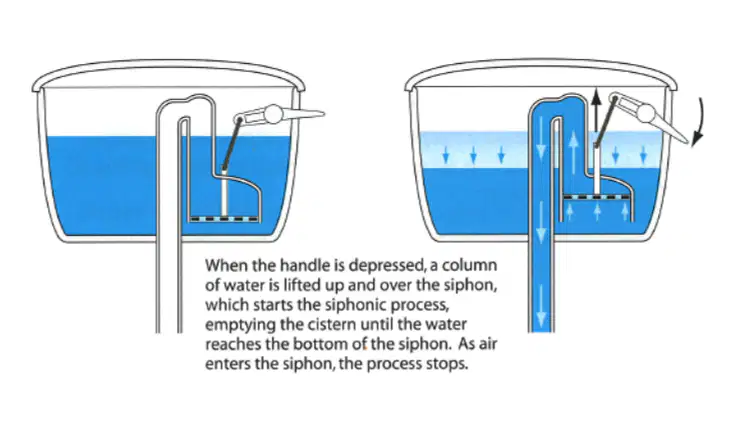
What initiates the siphonic process in a toilet cistern?
Pulling the handle up
Depressing the handle
Turning a knob
Pressing a button
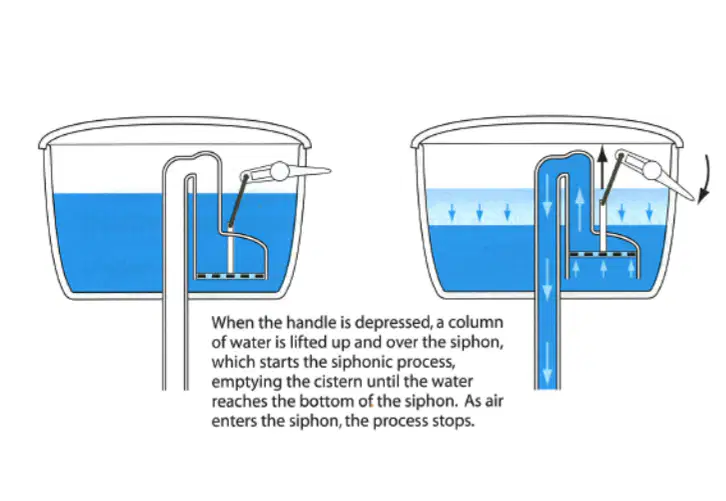
What happens when air enters the siphon in a toilet cistern?
The water level rises
The siphonic process stops
The water starts to boil
The siphonic process speeds up

