
Font size
 Worksheets
AEF 2024 US Chapter 11 Review
Total questions: 100
Worksheet time: 2hrs 0mins
Match the following leaders to the countries they ruled or governed in
Adolf Hitler
Germany
Benito Mussolini
Italy
Franklin D. Roosevelt
United States
Hideki Tojo
Japan
Winston Churchill
Great Britain
Founded Italy's Fascist Party
Adolf Hitler
Joseph Stalin
Benito Mussolini
Franklin Roosvelt
Following World War I, who rose to power and ruled as a dictator in Germany?
Adolf Hitler
Benito Mussolini
Joseph Stalin
Winston Churchill

Which event started World War II?
Japan’s attack on Pearl Harbor
Japan’s attack on San Francisco
Germany’s attack on Poland
Germany sinking the USS Essex

Who was the leader of Russia during World War II?
Mussolini
Stalin
Roosevelt (FDR)
Hitler

Operation Torch
Operation Overlord (D-Day)
Operation Husky
Operation Avalanche
US elects Roosevelt PresidentJapan attacks Pearl Harbor
Germany rearms the Rhineland
Germany invades Poland
WWII Officially began
Japan attacks Pearl Harbor
On August 6, 1945 where was the 1st atomic bomb dropped?
Nagasaki
Beijing
Hiroshima
Berlin
Which president ordered the atomic bomb?
FDR
Truman
Stalin
Churchill
Pearl Harbor happened in what country and/or state?
Hawaii
Japan
Phillipines
Midway

The persons pictured were the World War II leaders of the
Axis Powers
League of Nations
The Allies
Central Powers

What happened as a result of the event in the newspaper article?
United States declared war on Japan
United States remained neutral
Japan captured and took control of Hawaii
Germany declared war on Japan

The persons in the pictures were World War II leaders of the
League of Nations
Axis Powers
The Allies
Central Powers

The systematic attempt to rid Europe of all Jews during
World War II was called
the Progressive Movement
Internment camps
the Marshall Plan
the Holocaust


What term below coincides with the cartoon seen here?
The United Nations
The Non-Aggression Pact
The Atlantic Charter
The League of Nations

Which of the following conclusions can be made based on the poster above?
A. Jewish people in Germany were more likely to enlist in the military.
B. The Nazis blamed Aryan businessmen for the start of World War II.
C. Most Germans supported the actions that led to the start of World War II.
D. Nazis used propaganda to blame Jews for the war and justify the Holocaust.

Which of the following describes the most significant consequence of Germany invading the Soviet Union?
A. New military equipment was developed to meet the demand of a continuously escalating conflict.
B. Germany became engaged in a two-front war and provided an opportunity for Soviet territory to expand.
C. British and American forces were significantly weakened by having to divide troops in the East and West.
D. German forces became less vulnerable to attack and made it clear that they were capable of dominating Europe.

Why did the Allies attack through Normandy beach (D-Day)
to enter Western Europe and corner Hitler
to enter Eastern Asia and corner Hitler
to eliminate Stalin
to help the Nazi Army
Which of these was a group of people targeted during the Holocaust? (Multiple answer question be careful)
Jewish
Homosexuals
Leading Intellectuals
Disabled
The act of giving in to an aggressor is known as what?
Appeasement
Holocaust
Blitzkrieg
Non-Aggression Pact
Germany used this type of warfare to overwhelm Poland, The Netherlands, Denmark, and France.
Blitzkrieg
The Blitz
Total War
Island Hopping
He was leader of Great Britain during WWII.
Roosevelt
Stalin
Hitler
Churchill
The British evacuated 300,000 troops from this city, saving them from the Nazi army.
Dunkirk
Normandy
Hamburg
Berlin
The Nazis heavily bombed British cities, including London, in an event known as what?
The Blitz
Blitzkreig
Operation Barbarossa
D-Day
In 1941, the Nazis invaded this country, breaking their Non-Aggression Pact.
Soviet Union
Great Britain
Italy
United States
He was the leader of the United States during (most of) WWII.
Franklin D. Roosevelt
Winston Churchill
Adolf Hitler
Benito Mussolini
The Soviets defeated the Nazis at this battle, a turning point in the war in Estern Europe.
Stalingrad
Midway
El Alamein
Battle of the Bulge
The US strategy in the Pacific to get close to Japan was called what?
Island Hopping
D-Day
Total War
Scorched Earth Policy
The Allies invasion of France on June 6, 1944 is known as what?
D-Day
Operation Sea Lion
Battle of the Bulge
Invasion Day
What was Hitler's costliest mistake?
the Anschluss
the attack against Great Britain
the invasion of the Soviet Union
the alliance with Japan
Germany's battle tactic of quickly overwhelming the opposition is referred to as
kamikaze
blitzkrieg
island-hopping
total war

Which country is highlighted on the map?
France
Great Britain
Italy
Germany

Which of the following countries is highlighted on the map?
Russia
Spain
Great Britain
Japan

What was the Holocaust?
The death of millions of Russian peasants following the seizure of their farms by dictator Joseph Stalin
The period of time when Japanese-Americans were forced to live in U.S. interment camps during WWII
The destruction of Hiroshima and Nagasaki, including innocent citizens
The extermination of 6 million Jews in Nazi concentration camps

Which of the following countries is highlighted on the map?
Russia
Italy
Great Britain
France

Which of the following countries is highlighted on the map?
Russia
Spain
Great Britain
France

Which country struggled economically in the 1920s because of the Treaty of Versailles?
USA
Germany
Italy
France

Which type of government is ruled by a dictator and practices extreme militarism and nationalism?
Republic
Democracy
Fascism
Communism

Hitler and the Nazis persecuted (punished) the __________, because the Nazis believed the Aryans (white Germans) were a superior race.
British
Americans
Jews
Muslims

When Germany started invading nearby lands, how did France and Britain react?
Tried to keep peace with an appeasement
Threatened to attack Germany
Declared war
Helped Germany conquer new lands

What country did Germany invade that caused Britain and France to declare war on Germany?
Spain
Austria
Poland
USA

What was America's plan at the beginning of the war?
to declare war on Germany
to help the Allies by sending troops
isolationism
to declare war on France

Why is Japan invading and conquering many lands in Asia?
need more natural resources
wanted to take back lands lost in the past
help other countries fight for independence
What was Germany like after World War I?
*Choose all that apply*
Germany's economy rebounded and the country quickly recovered.
Germany was in severe debt from the Versailles Treaty.
Germans were blamed entirely in Europe for the war.
Germany's political system was weakened leaving it open to the rise of a dictator.
Which of the following best describes Japan prior to World War II?
Japan was a peaceful and industrial country looking to maintain positive relationships with other countries.
Japan wanted to make alliance with as many countries as possible.
Japan wanted to isolate themselves from other countries entirely.
Japan's ideas of racial superiority and extreme military aggression was a combination that would spark conflict.
Hitler came to power in Germany after World War I because...
He killed government officials.
He was nationalistic about Germany and rebuilt their military to stimulate the economy.
He made alliances with European countries to forgive Germany.
He was elected by the people of Germany.
What is appeasement?
Giving into demands to prevent going to war.
Starting war with another country.
Forcing countries to pay back their debts.
Removing dictators from power.
The "Peace in Our Time" speech by Prime Minister Neville Chamberlain is about
Alliances in Europe.
U.S. involvement in World War I.
The Versailles Treaty.
The Munich Agreement.
What was the Munich Agreement?
An agreement to stop Hitler from taking over other countries in Europe.
An agreement made in Europe to appease Adolf Hitler and Germany by allowing him to takeover Sudetenland.
An agreement with the United States to fight Germany.
An agreement to reform alliances from World War I.
A form of Totalitarianism that emphasizes nationalism, conformity and violence.
Fascism
Communism
Totalitarianism
Chamberlin

Europeans allowing Italy and Germany to expand militarily and grab territory was called-
"Appeasement"
"Reconciliation"
"Reparation"
"Regret"

Which of the following contributed directly to the rise of European Dictators?
"Treaty of Paris"
"Treaty of Versailles"
"League of Nations Charter"
"European Appeasement"
Near the end of WWII, what country did the United States military drop atomic bombs on?
China
Germany
Japan
The Soviet Union
Near the end of the Second World War, what cities did the United States drop atomic bombs?
Pearl Harbor and Hiroshima
Pearl Harbor and Nagasaki
Niroshima and Hagasaki
Hiroshima and Nagasaki

Holocaust Trials
WW2 Trials
True or false: The Soviet Union had 9,000,000 military deaths, which was way more than the U.S. had.
True
False
True or false: The U.S. spent $341 billion on WWII, more than anyone else did.
True
False
True or false: The U.S. has been the first AND only country that has dropped an atomic bomb on another country.
True
False
True or false: The U.S. became fearful when they thought about which countries would create atomic bombs next.
True
False

Which of the following was a key decision made at the Yalta Conference in Feb. 1945?
to begin a two front war with the D-Day invasion
the division of Germany into four zones of occupation (French, British, American, Soviet)
the decision to drop the atomic bomb on Japan
picking a new name for Germany
Japan surrendered in August 1945 because the United States
Captured the islands of Iwo Jima and Okinawa.
Dropped atomic bombs on Hiroshima and Nagasaki.
Threatened to use the atomic bomb.
Took Tokyo, the Japanese capital.

Who was the leader who led the Soviet Union to victory during WWII?
Vladimir Lenin
Josef Stalin
Leonid Brezhnev
Nikita Khrushchev
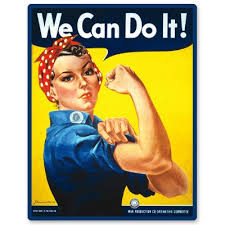
Who is this a image of and what did she a symbol of .....
June the Fighter symbol of women's suffrage
Susan the solider symbol of women working on airplanes
Rosie the Riveter symbol of women working in factories during the war.

Which two cities were attacked with atomic bombs by the United States?
Nagasaki & Hiroshima
Tokyo & Kyoto
Tokyo & Yokohama
Osaka & Kyoto
What industry manufactured about 1/3 of military equipment during WWII
steel industry
ship-industry
intercultural sector
automobile industry
Why was the Battle of the Bulge important to the end of WWII in Europe?
It was the U.S. last attempt to gain control of Stalin.
It was Hitler's last attempt to gain control.
It was the last battle Hitler won.
It was the start of WWII.
What is the Battle of the Bulge
An old guy worried about getting fat.
A German word meaning "lightening war"
The dropping of the Atomic Bomb
A month long battle in which the allies turned back the Germans.
One problem that the U.S army intelligence had during the war
The enemy was decoding our messages
The enemy was too smart for us
They didn't feel like working
The ____________________ spoke in secret codes and the enemies could not understand them.
Navajo Code Talkers
WASPs
British
president
What was the government act that sent Japanese Americans to the internment camps?
Executive Order 255
Executive Order 9066
Executive Order 99
Defcon 4
Japanese Americans were interned as a result of what major event?
Germany invading Poland
Pearl Harbor
The Appeasement Policy
the death of Franklin Roosevelt
Where was Iwo jima?
South of Japan
Japan
Usa
Italy
Why did the Americans want Iwo Jima
They wanted it for supplies
They wanted it for the US
It was the key stepping stone to invading japan
They wanted there food
Treaty of Versailles is signed
Attack on Pearl Harbor
DDay
Battle of the Bulge
Iwo Jima
Which group of Native Americans created a code that was never broken during WWII?
Navajo
Apache
Sioux
Iroquois
The US strategy used in the Pacific was called
(a)
The (a) showed American forces in the Pacific the (b) of their enemy, the (c) .

This famous image is from which battle of the Pacific Theater?
Battle of Guadalcanal
Battle of Okinawa
Battle of Midway
Battle of Iwo Jima
The Nuremberg Laws (a) the rights of (b) Germans, and legalized antisemitism.
Which battle halted the Japanese advance across the Pacific, and kept the Japanese from gaining an strategic location from which to launch an attack on Hawaii or the US west coast?
Battle of Okinawa
Battle of Midway
Bataan Death March
Battle of Guadalcanal
Battle of Iwo Jima
Allied victory here put mainland Japan within range of Allied bombers
Battle of Okinawa
Last major battle in the Pacific Theater
Battle of Midway
Major turning point in the Pacific Theater
United States
Franklin D Roosevelt
Britain
Winston Churchill
Soviet Union
Joseph Stalin
Italy
Benito Mussolini
Japan
Hideki Tojo
What was Japan's main defence system on Iwo Jima?
having a large naval battle on the island then fighting on land
defending the beach to the last man
underground cave systems
Using civilian forces
Despite heavy bombardment from American bombs and artillery, the Japanese suffered little damage and were ready to defend Iwo Jima against the American attack.
True
False
Associated Press photographer Joe Rosenthal took the iconic photo of six Marines raising the U.S. flag on top of which Iwo Jima mountain?
Battle Mountain
Mount Tapotchau
Mount Suribachi
Mount Rausu


Last major “offensive” for Germany & their defeat set up the Allied capture of Germany
Battle of the Bulge
Stalingrad
2nd Battle of El Alamein
Normandy Landings
Largest amphibious landing ever; Allowed Allies to open a 2nd front against the Axis powers
Battle of the Bulge
Stalingrad
Dunkirk
Normandy (Operation Overlord)
Major Soviet Union victory & turning point for the Eastern Front of WWII
El Alamein
Battle of the Bulge
Normandy Invasion
Stalingrad
1st major victory for British forces in Egypt; Led to invasion of Italy by Allies
El Alamein
Dunkirk
Battle of the Bulge
Stalingrad
Code name for the project to develop the 1st Atomic bomb:
Brooklyn Project
Manhattan Project
Los Alamos Project
Chicago Project
Lead scientist for the Manhattan Project:
Albert Einstein
Enrico Fermi
Leslie Groves
Robert Oppenheimer

