
 Worksheets
2025-2026 US Government Final
Total questions: 100
Worksheet time: 1hrs 20mins
What is government?
the services provided a community, such as police protection, fire protection, and public health programs
the laws that protect peoples’ rights and ensure the safety of a state's citizens
the institution through which a society makes and enforces its public policies
the process by which public officials are elected to and removed from office
Which of the following is the best definition of the public policies of a government?
everything a government decides to do
everything a government does related to public services
everything a government does to collect taxes
everything a government decides to do regarding foreign affairs
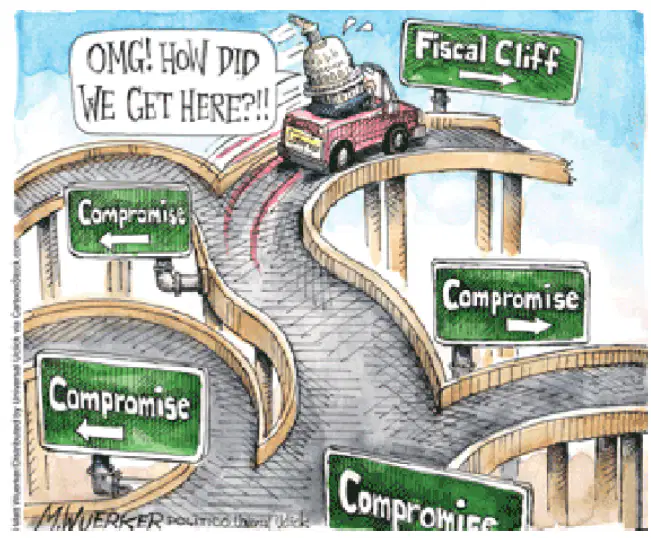
Which statement BEST expresses the meaning of the cartoon?
Different groups may have different ideas, but compromise is vital to a successful democracy.
In a democracy, different ideas and approaches help make the government work better.
A democracy requires a balance between domestic policies and foreign policies.
In a democracy, the branches of government will always have different ideas about running the country.
A government ruled by a dictator is a form of
indirect democracy.
direct democracy.
autocracy.
oligarchy.

Which of the following concepts is being expressed in this painting?
the divine right of kings
oligarchy
direct democracy
the social contract
Winston Churchill’s statement “it has been said that democracy is the worst form of government except all those other forms that have been tried from time to time” means that:
Democracy has many flaws, but it is better than any other form of government that has been tried.
Democracy is the perfect form of government with no flaws.
All forms of government are equally effective.
Other forms of government are superior to democracy.
Read this excerpt from the Connecticut royal charter. ". . . there shall be One Governor, One Deputy-Governor, and Twelve Assistants, to be from time to Time constituted, elected and chosen out of the Freemen...which said Officers shall apply themselves to take Care for the best disposing and ordering of the general Business and affairs of and concerning the Land . . . and the Government of the People thereof . . ." —Charter of Connecticut, 1662 To which aspect of government does this excerpt apply?
the means by which taxes would be levied in the colony
the means by which government leaders would be chosen
the time table by which the colony’s government would meet
the methods by which the colony would defend itself

What was the compromise’s other main feature?
In the Senate, the States would be represented equally. In the House, the States would be represented based on size of territory.
In the Senate, the States would be represented based on territory. In the House, the States would be represented equally.
In the Senate, the States would be represented equally. In the House, the States would be represented based on population.
In the Senate, the States would be represented based on population. In the House, the States would be represented based on the size of their economies.
The British saw the Second Continental Congress as an "unlawful assembly" because:
it was not authorized by the British government.
it was supported by King George III.
it was formed to support British rule.
it was a legal body under British law.
The dispute over representation in Congress was resolved by which compromise?
The Connecticut Compromise
The Missouri Compromise
The Three-Fifths Compromise
The New Jersey Compromise
What specific constitutional principle was Alexander Hamilton referring to in this quotation?
“It therefore belongs to [the courts] to decide . . . the meaning of any particular act proceeding from the legislative body.” —Alexander Hamilton, Federalist No. 78, 1788
the power to veto acts of Congress
the authority to interpret laws
the right to form a federal court system
the system of checks and balances
Which of the constitutional principles listed was Madison describing and defending in the quotation below?
“In the compound republic of America, the power . . . is first divided between two distinct governments. . . . The different governments will control each other, at the same time that each will be controlled by itself.” —James Madison, Federalist No. 51, 1788
popular sovereignty
checks and balances
federalism
judicial review
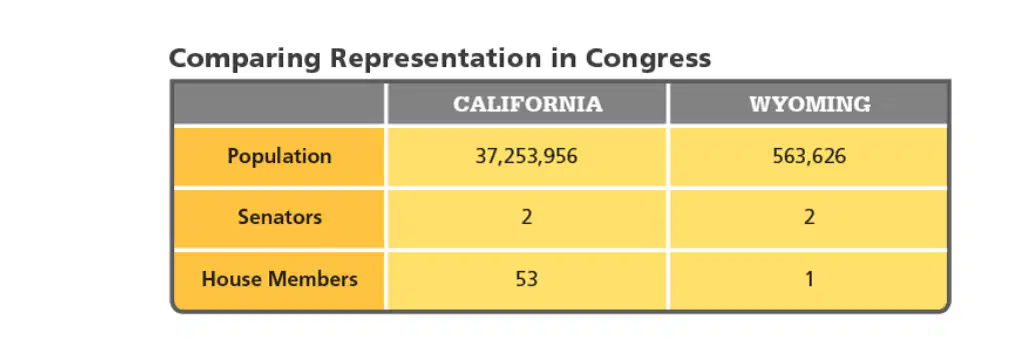
What idea embodied in the Constitution is demonstrated by how California and Wyoming are represented in Congress?
The most populous States have the most power in both houses of Congress.
Representation in both houses of Congress is the same for all States, large and small.
The bicameral legislature creates equal representation in the Senate, but population-based representation in the House.
The bicameral legislature determines that large States have a cap on how many representatives they can have in both houses of Congress.
Which of the following is NOT a check available to the legislative branch?
creating a new federal district court
declaring an executive act to be unconstitutional
rejecting a treaty
passing a bill that has been rejected by the President
The principle of popular sovereignty is based on the belief that
the government must be run by officials who are appointed to office by their predecessors.
the government gets its power from the people and can exist only with their consent.
the people have the authority to declare any federal or State law unconstitutional by voting on it.
the people do not have to obey any laws with which they disagree.
Which of the following is an example of checks and balances at work?
The people choose not to re-elect a President whose policies they dislike.
The Federal Government passes a law that overrides similar laws in several States.
A bill passed by the House is vetoed by the Senate.
Congress removes from the bench a federal judge who has accepted a bribe.
Which of the following statements BEST describes the cause and effect of the 15th Amendment?
It was passed as a result of the Union’s victory in the Civil War, and extended the right to vote to male African Americans.
It took away citizenship from those who had fought for the Confederacy, and was passed as a result of the Union’s victory in the Civil War.
It gave citizenship to African Americans and was passed as a result of a campaign led by President Roosevelt.
It limited the number of terms a President could serve and was passed as a result of a speech made by President Abraham Lincoln.
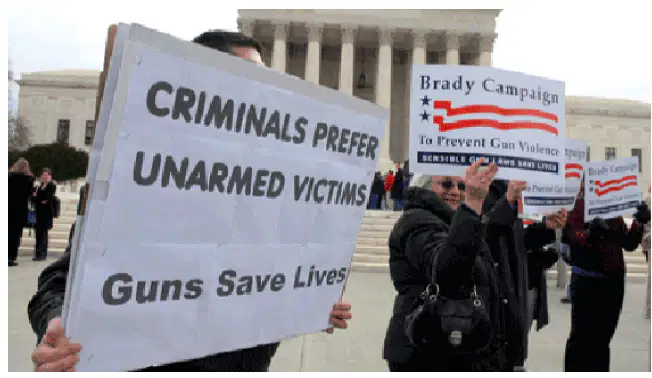
To which amendment in the Bill of Rights are these protests related?
First Amendment
Second Amendment
Third Amendment
Fifth Amendment
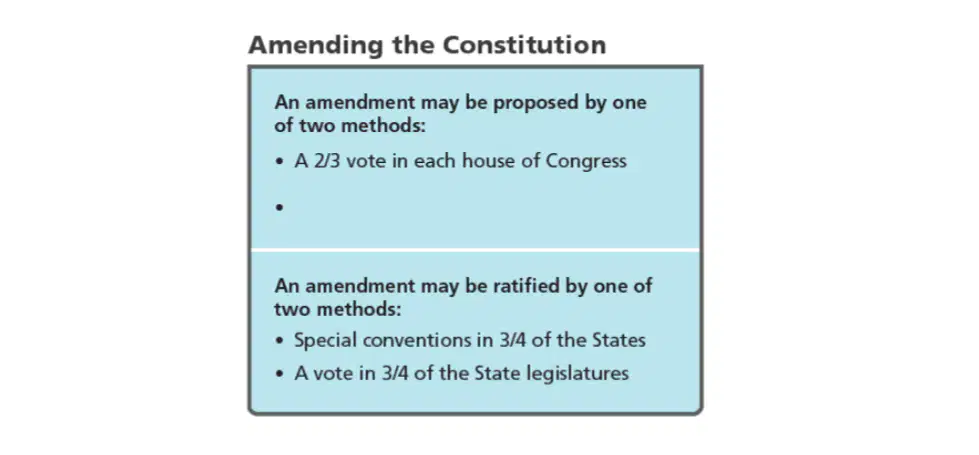
Which of the following statements supplies the information on proposing an amendment that is missing from the chart?
A Supreme Court ruling that calls for an amendment to make a federal law constitutional.
A vote by at least 3/4 of the State legislatures meeting independently at the request of the public.
An executive order issued by the President and then approved by both houses of Congress.
A national convention called by Congress at the request of 2/3 of the State legislatures.
Under which of the following scenarios would your 5th Amendment rights be violated?
Local authorities refused to let you write a letter to the mayor complaining about his or her policies.
The police entered your house and began to look for evidence without a warrant because they suspected you of a crime.
You were found innocent of a crime but later charged again with that crime and forced to give evidence that made you seem guilty.
You were told that you were ineligible to run for school president because of your religious beliefs.

The first three Amendments listed have which of the following in common?
Protecting the rights of individuals in the court system
Clarifying rights listed earlier in the Constitution
Outlining procedures in a court of law
Determining the differences between State and federal courts
Read this text excerpt about senatorial courtesy. Which explanation describes the underlying justification that validates this practice?
“The Senate will approve only those presidential appointees, such as a federal judge or a United States marshal, who are acceptable to the senator or senators of the President’s party from the State involved.”
It is written into the U.S. Constitution in Article I, which describes the powers of the legislative branch.
It is an example of an unwritten rule, or custom, that is closely followed in the Senate.
It an example of a rule added to the Constitution by an amendment, in this case the 17th Amendment.
It is one of many powers that Congress has granted to itself using the implied powers clause.
Based on the reasoning Chief Justice John Marshall uses in the excerpt below, what choice best describes the decision he made in the McCulloch v. Maryland case?
“[T]he states have no power . . . to retard, impede, burden, or in any manner control, the operations of the constitutional laws enacted by Congress.”
—Chief Justice John Marshall, McCulloch v. Maryland, 1819
He decided that Congress did not have the authority to create a law that conflicted with State law.
He decided that federal law could not be challenged by State law.
He decided that State law took precedent over the federal law passed by Congress.
He declared that the Supreme Court lacked the authority to settle a dispute between State and federal law.
Use the quote from the text about reserved powers to determine which of the following examples is a reserved power possessed only by State governments.
“The reserved powers are those powers that the Constitution does not grant to the National Government and does not, at the same time, deny to the States.”
the right to grant patents and copyrights to inventors and authors
the authority to seize public property
the ability to forbid people under 18 to marry without parental consent
the power to tax other State governments
Tariffs are taxes on foreign imports. In our federal system, the power to levy tariffs is a power
granted exclusively to the Federal Government by the Constitution.
assumed by the Federal Government.
shared by both the State and Federal Government concurrently.
denied to the Federal Government and reserved to the States.
An explicitly denied power is a power banned outright by the Constitution. An implicitly denied power is a power banned, but not directly mentioned in the Constitution. Which of the following powers is implicitly denied to the Federal Government?
Levy taxes on imports
Acquire territory
Establish marriage and divorce laws
Regulate immigration
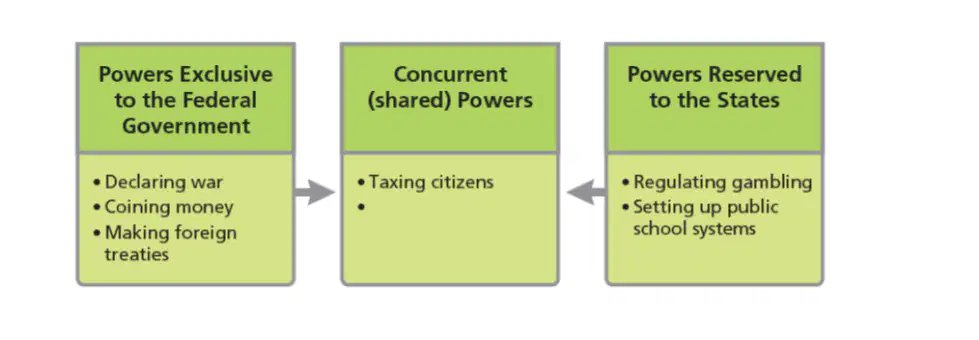
Which of the following powers is a concurrent power shared by both the federal and State governments that is missing from the chart?
Regulating interstate trade
Licensing professionals such as doctors
Seizing property without payment
Setting punishments for crimes
Local governments get their authority from
the Federal Government.
the State governments.
the local citizens.
the cooperation of the Federal and State governments.
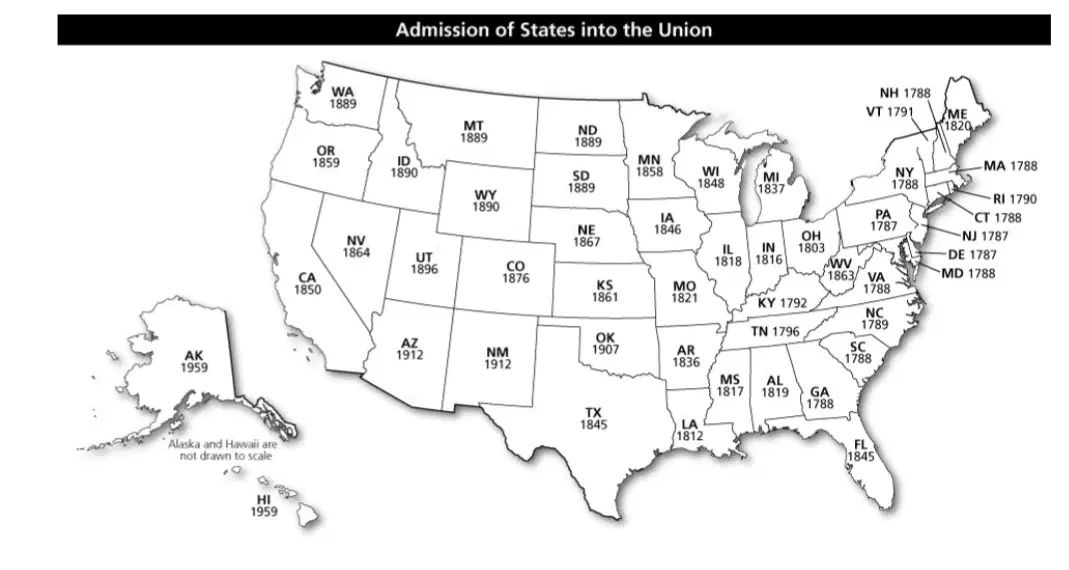
The map shows the years that various states were admitted into the Union. Which of the following statements best describes the pattern of how States were admitted into the Union?
No two States were ever admitted to the Union in the same year.
The original 13 colonies were the only States admitted to the Union in the 1700s.
The States on the west coast were the last ones admitted to the Union.
The last States in the continental United States were admitted in the 1900s.
To which one of the listed situations would the protections of the Full Faith and Credit Clause apply?
“Full Faith and Credit shall be given in each State to the public Acts, Records, and judicial Proceedings of every other State.”
—Article IV, Section 1
A man taking a trip wants his driver’s license from one State to be accepted as proper identification in another State.
A policeman crosses into another State and issues a speeding ticket to a driver in that State.
A man commits a crime in his home State and flees to another State because he knows he will not be prosecuted there.
A student living out-of-state expects to pay the same amount of tuition at a public university as in-state residents pay.
What name is commonly given to this quote from the Constitution?
“A Person charged in any State with Treason, Felony, or other Crime, who shall flee from Justice, and be found in another State, shall on Demand of the executive Authority of the State from which he fled, be delivered up, to be removed to the State having Jurisdiction of the Crime.” —Article IV, Section 2
the Full Faith and Credit Clause
the Extradition Clause
the Privileges and Immunities Clause
the Domestic Violence Clause
States that joined the Union after the original 13 colonies
were instructed to model their governments on the governments of those original States.
were required to wait for 15 years before they could elect Senators to represent their State.
agreed to a follow a common set of local laws and polices established by the Northwest Ordinance.
immediately received the same congressional status and constitutional rights as the original States.
What limit does the Constitution place on the ability of the U.S. government to add new States to the Union?
An area must be a U.S. territory for at least 15 years and have a written constitution before it can apply for statehood.
The Supreme Court must approve the proposed constitution of any new State before it can be accepted.
Congress cannot take territory from an existing State to create a new State without the permission of the original State’s legislature.
The President cannot become involved in any way with the decision to accept a new State into the Union.
The existence of the federal district courts is evidence of which of the following?
the way that basic legislation has added to the meaning of the Constitution
the process of amending the Constitution
the way that executive agreements have added to the basic structure of the Federal Government
the functioning of the U.S. federal system of government
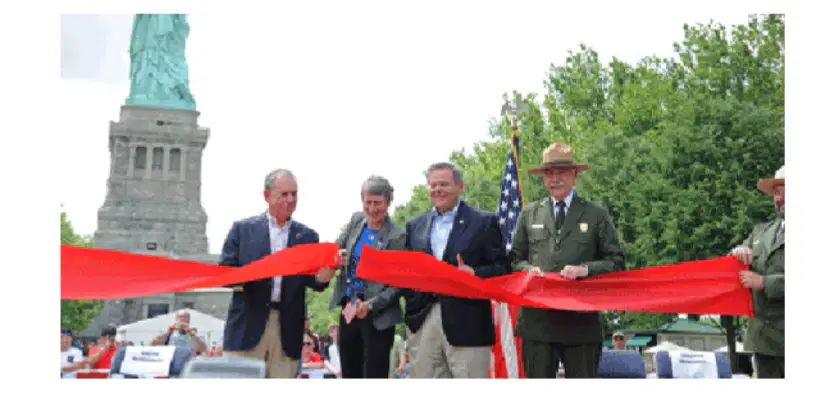
Members of Congress wear many different hats and play many roles during the course of their work. An important role while spending time in their home districts is that of
legislator.
federal employees.
committee member.
constituent servant.
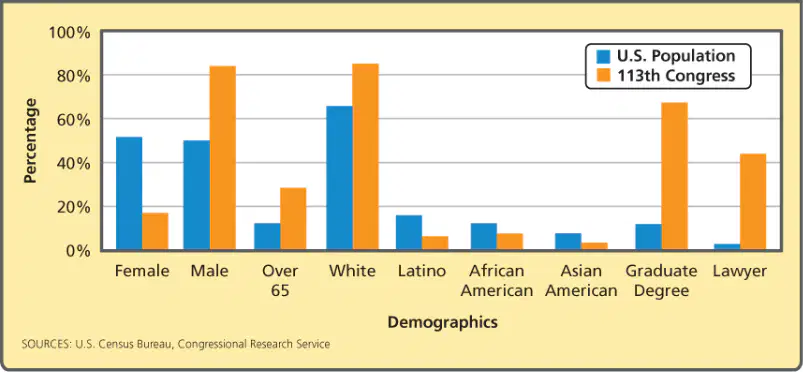
Use the chart to choose the answer that BEST completes the sentence. How Representative is Congress? (Chart comparing U.S. Population and 113th Congress by demographics: Female, Male, Over 65, White, Latino, African American, Asian American, Graduate Degree, Lawyer) Representation in Congress is closest to the general population in terms of
education.
ethnicity.
gender.
profession.
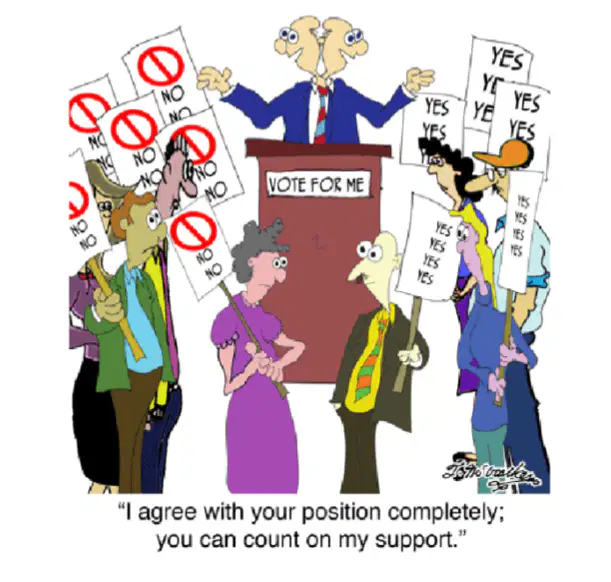
What does this political cartoon suggest about congressional elections in the United States?
Candidates are required to give consideration to both sides of issues.
Candidates mostly tell the public whatever they think constituents want to hear.
Voters make it impossible for candidates to make up their minds on important issues.
Voters unfairly force candidates to take a stand on issues they might not be ready to address.
If representatives in the House wish to adjourn a session for more than three days, they must seek approval from
the judicial branch.
the executive branch.
members of the Senate.
their constituents.
Read this quotation from the Constitution. “The House of Representatives shall be composed of Members chosen every second Year by the People of the several States, and the Electors in each State shall have the Qualifications requisite for Electors of the most numerous Branch of the State Legislature.” —Article I, Section 2, Clause 1. This quotation relates to
the apportionment in the House.
the length of a session in Congress.
the length of service for a representative.
the establishment of the Electoral College.
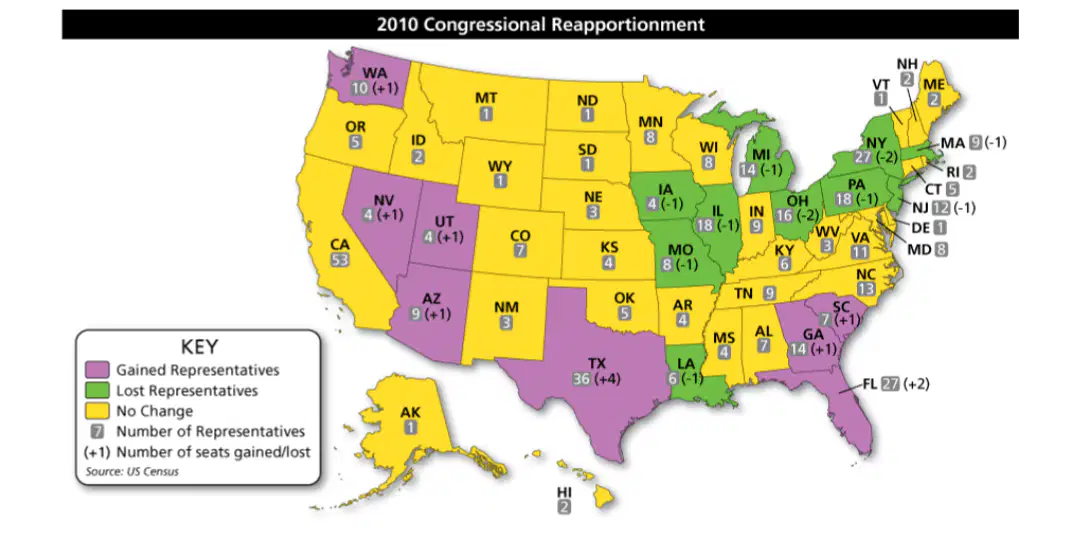
What does this map suggest about regional population change?
The Midwest has experienced little change in population.
The North, both west and east, has experienced a dramatic rise in population.
The Southeast has experienced a slight decline in population.
The South, both west and east, has experienced a slight rise in population.
Read this excerpt from the text. “. . . several States used the general ticket system. Under that arrangement, all of the State’s seats were filled at-large—that is, elected from the State as a whole, rather than from particular districts. Every voter could vote for a candidate for each one of the State’s seats in the House.” What is one possible ramification of this system to elect representatives?
It could result in gerrymandering, which creates districts with very odd shapes.
It could result in the House becoming too large, which would make it unwieldy and ineffective.
A party with even a small majority could control all of the State’s seats in the House.
A minority party could have greater control over House seats than the party in the majority.
Read this quotation from the Constitution. “The Congress shall have Power To lay and collect Taxes, Duties, Imposts and Excises, to pay the Debts and provide for the common Defence and general Welfare of the United States; but all Duties, Imposts and Excises shall be uniform throughout the United States; To borrow Money on the credit of the United States; To regulate Commerce with foreign Nations, and among the several States, and with the Indian Tribes; . . .” —Article I, Section 8. This section of the Constitution falls under expressed powers related to
the subject of bankruptcy.
territories and other areas.
trade and borrowing.
the role of Congress in foreign policy.
The BEST way to understand the expressed powers of Congress is to
study the ways Congress has exercised its powers.
study statements made by the executive branch.
read a description of the powers in the Constitution.
read about the powers that other sovereign nations have.
Read this excerpt from the text about the borrowing power of Congress. “Congress has put a statutory ceiling on the public debt, however. The public debt is all of the money borrowed by the Federal Government over the years and not yet repaid, plus the accumulated interest on that money. That legal ceiling has never amounted to much more than a political gesture, however. Congress regularly raises the limit whenever the debt threatens to overtake it. The public debt is approximately $16 trillion.” What is the BEST explanation of the debt ceiling?
It is an unreachable goal for lowering debt within the Federal Government.
It primarily relates to money that Congress will borrow and pay in the future.
It is an arbitrary limit that has no relation to the amount of money Congress currently owes.
It can be moved by Congress whenever it seems politically necessary.
Which statement BEST characterizes the implied powers of the Federal Government?
They are explicitly given to Congress in the United States Constitution.
They are sensible assumptions that are made based on the expressed powers.
They are part of the amendments that have been added to the Constitution since 1789.
They are the consequences of making the American government federal in form.
Read this excerpt from the U.S. Constitution. "To make all Laws which shall be necessary and proper for carrying into Execution the foregoing Powers, and all other Powers vested by this Constitution in the Government of the United States, or in any Department or Officer thereof." —Article I, Section 8, Clause 18 This article of the Constitution allows Congress to
influence how the judicial branch interprets laws.
interpret its expressed powers broadly.
protect itself from overreach by the executive branch.
check the power of the other branches of government.
Choose the answer that BEST completes the sentence.
The 2009 government bailout of automotive companies was an example of
the implied powers of State governments.
the expressed powers of State governments.
the implied powers of the Federal Government.
the expressed powers of the Federal Government.
What is the significance of the Supreme Court’s decision in the Gibbons v. Ogden case?
It limited Congress’s ability to regulate interstate and international trade.
It shaped how the Necessary and Proper Clause has been interpreted since 1819.
It resulted in the creation of a new statute that became known as the Commerce Clause.
It resulted in an expansive interpretation of the Commerce Clause.
“The Senate will turn down such a presidential appointment if it is opposed by a senator of the President’s party from the State involved. The Senate’s observance of this unwritten rule has a significant impact on the President’s exercise of the power of appointment; in effect, this rule means that some senators virtually dictate certain presidential appointments.”
This excerpt from the text refers to
the impeachment process.
congressional hearings.
senatorial courtesy.
the seniority rule.
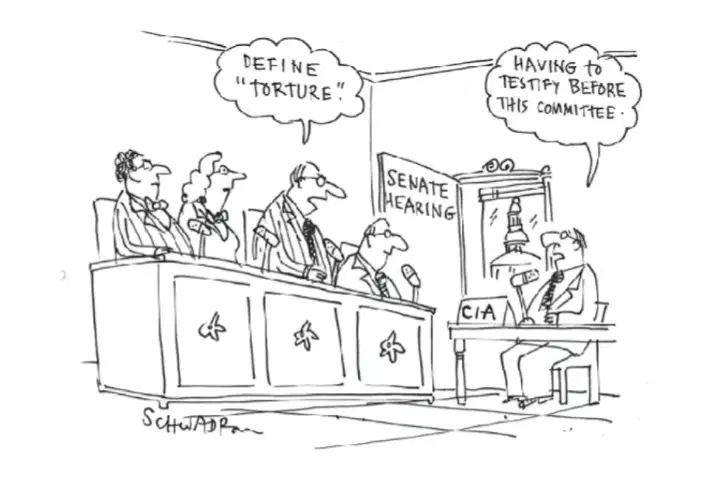
Use the cartoon to choose the answer that best completes the sentence. This political cartoon suggests that Senate investigations
would be less painful if they were handled by standing committees instead.
should only be undertaken in matters related to national security.
are not worth the time they require and the hardships they create.
are so rigorous and thorough that the process can be painful.
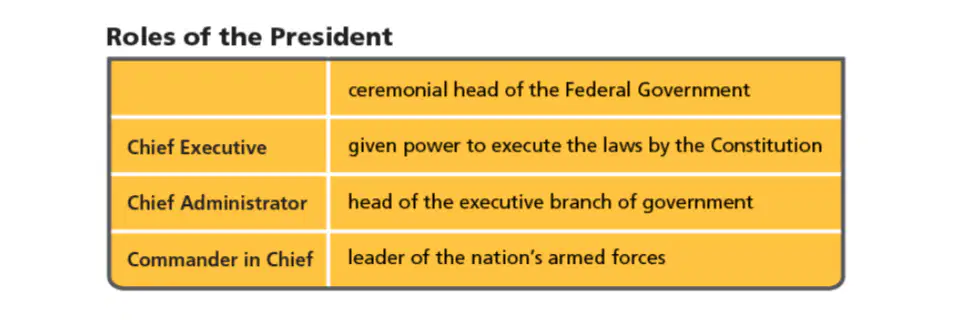
Multiple Choice—Identify the choice that best completes the statement or answers the question. Choose the answer that BEST completes the chart about the roles of the President of the United States.
Chief of Party
Chief of State
Chief Legislator
Chief Economist
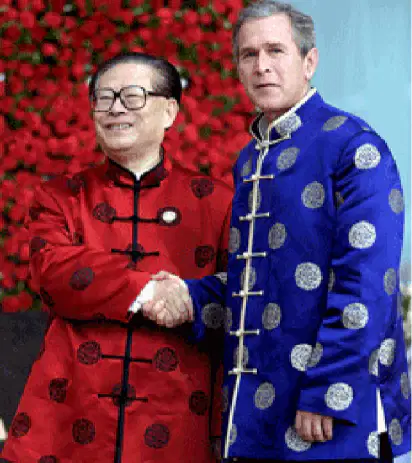
Use the photo to answer the question. Which presidential role does this photo illustrate?
chief citizen
chief of party
chief diplomat
commander in chief
Read this excerpt from the text:
“The President is expected to be ‘the representative of all the people.’ He or she is expected to take the high road and champion the public interest against the many different and competing private interests. ‘The presidency,’ said Franklin Roosevelt, ‘is not merely an administrative office. That is the least of it. It is, preeminently, a place of moral leadership.’
To which presidential role does this text excerpt refer?
commander in chief
chief economist
chief citizen
chief of party
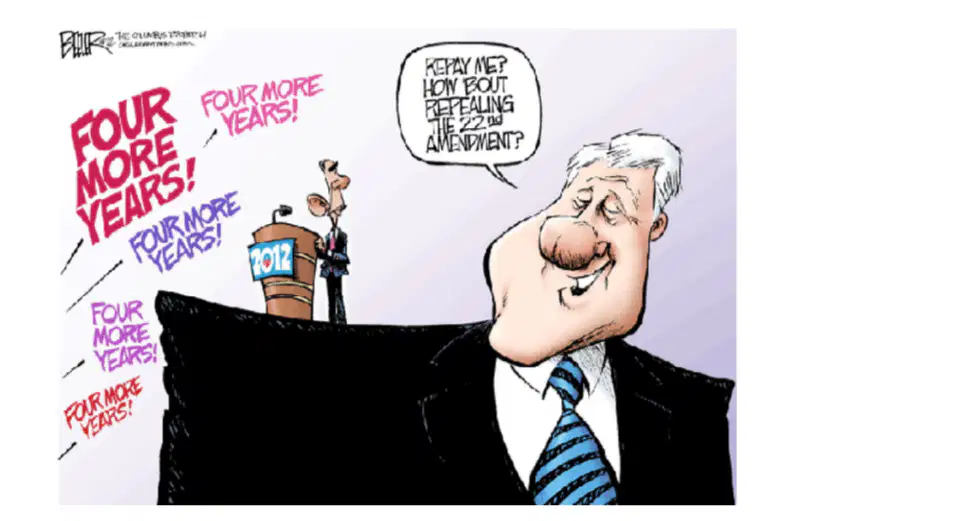
Former President Bill Clinton was very helpful to President Obama during his 2012 campaign for reelection. Why does the cartoonist say that the President can repay Clinton for his help by repealing the 22nd Amendment?
Repealing the 22nd Amendment would repay Clinton because it would raise his salary.
Repealing the 22nd Amendment would repay Clinton because he could help President Obama in the next four years.
Repealing the 22nd Amendment would repay Clinton because it would enable him to serve in the Cabinet.
Repealing the 22nd Amendment would repay Clinton because it would allow him to run for President a third time.
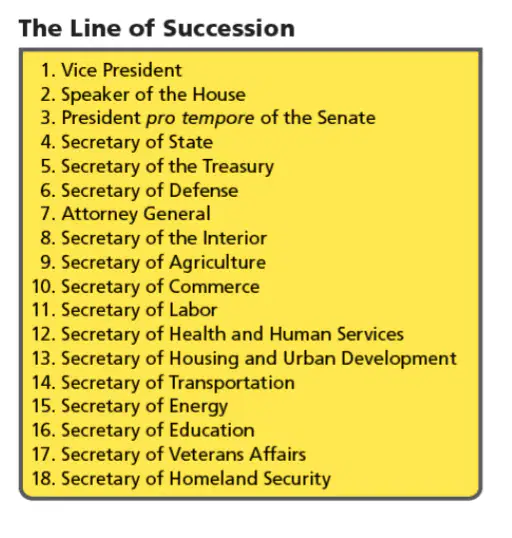
Use the chart to answer the question. If the President, Vice President, and leaders of Congress were all unable to hold office, who would assume the office of President?
the Attorney General
the Secretary of State
the Secretary of Defense
the Secretary of Homeland Security
Read this excerpt from the text:
“Sections 3 and 4 of the 25th Amendment fill the disability gap. . . . The Vice President is to become Acting President if (1) the President informs Congress, in writing, ‘that he is unable to discharge the powers and duties of his office,’ or (2) the Vice President and a majority of the members of the Cabinet inform Congress, in writing, that the President is so incapacitated. The President may resume the powers and duties of the office by informing Congress by ‘written declaration’ that no inability exists. However, the Vice President and a majority of the Cabinet may challenge the President on this score. If they do, Congress has 21 days in which to decide the matter.”
What is the MOST LIKELY reason the amendment requires notifications to be in writing?
A written record proves the process has been carried out legally.
The ability to write proves the President is able to resume his or her duties.
A written record makes it easier to challenge someone’s claim.
A written record prevents a Vice President from challenging a President’s claim to office.
Vice President Thomas Marshall once told the following story of two brothers: “One ran away to sea; the other was elected Vice President. And nothing was heard of either of them again.” Which of the following BEST expresses the meaning of this story?
Being Vice President is a dead-end job that dooms a person to obscurity.
Vice Presidents are rarely seen because of the high security surrounding the office.
Being Vice President is a high-profile job that keeps a person constantly busy.
Vice Presidents are rarely heard from because they must travel constantly.
President Dwight Eisenhower said, “Even if [Vice President] Nixon and I were not good friends, I would still have him in every important conference of government, so that if the Grim Reaper [death] would find it time to remove me from the scene, he is ready to slip in without any interruption.” Why is this remark important in the history of the evolving role of the Vice President?
It marked a realization that the Vice President might have to assume the presidency at any time.
It marked the first time a President openly discussed the role of the Vice President.
It marked the beginning of Richard Nixon's rise to national prominence.
It marked the beginning of a shift in how the office of Vice President was seen.
Which of these First Ladies represents the traditional behind-the-scenes role long played by Presidents’ wives?
Jacqueline Kennedy
Michelle Obama
Abigail Adams
Edith Wilson
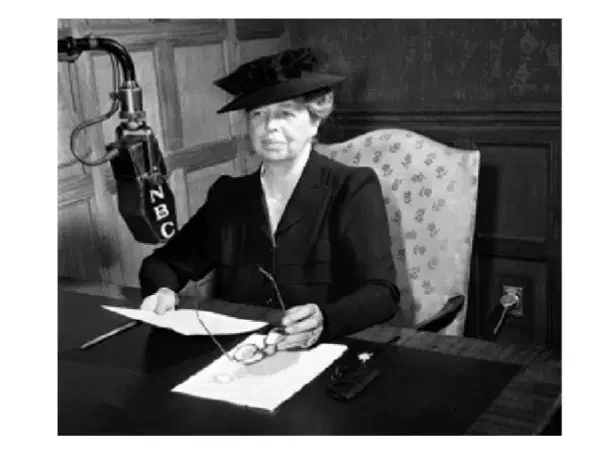
How does this photo of Eleanor Roosevelt represent a modern, expanded role for First Ladies?
She’s working behind the scenes to advance her husband’s agenda.
She’s taking an active role by giving a radio speech.
She’s taking an active role by being photographed.
She’s acting on her husband’s behalf when he’s unable to do so.
Which of the following describes the actions of a President who subscribes to the stewardship theory of presidential leadership?
President James Buchanan supports the entry of Kansas into the Union as a slave State, but Kansans vote to be admitted as a free State.
President Benjamin Harrison signs the Sherman Antitrust Act in 1890 after it is passed by Congress, in an effort to prevent unfair business practices.
President Woodrow Wilson gives a speech before Congress in 1918 in support of granting women the right to vote.
President Lyndon Johnson engineers a congressional resolution giving him nearly unlimited control over American actions in Vietnam.
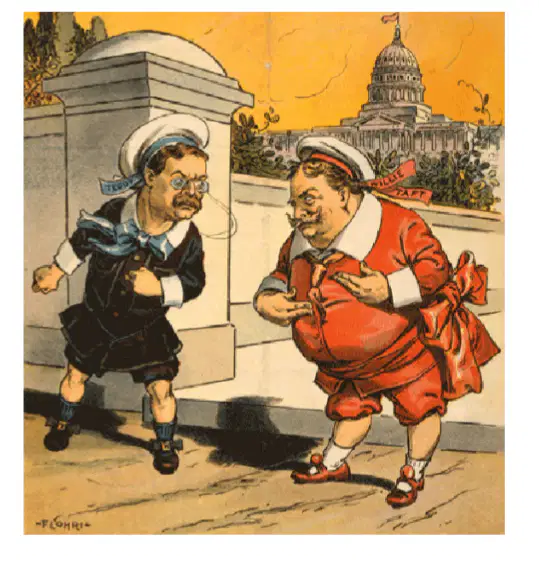
Which is the MOST LIKELY reason that the cartoonist has dressed the characters in this cartoon in this way?
to show that they are too young to be holding public office
to show that they are behaving immaturely by arguing about everything
to show that they both have taken the stewardship approach to the presidency
to show that they both have taken the Whig approach to the presidency
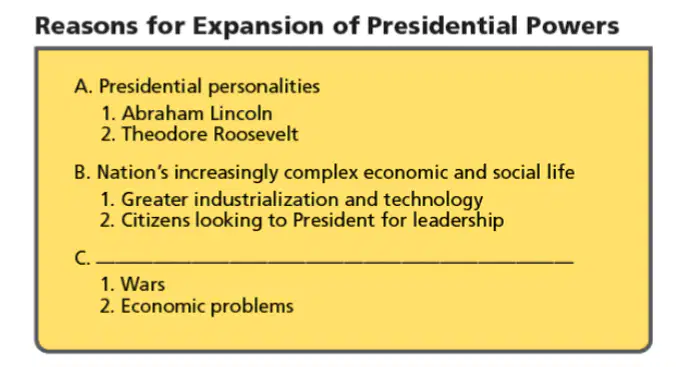
Study the outline to answer the question. Reasons for Expansion of Presidential Powers A. Presidential personalities 1. Abraham Lincoln 2. Theodore Roosevelt B. Nation’s increasingly complex economic and social life 1. Greater industrialization and technology 2. Citizens looking to President for leadership C. ______________________________ 1. Wars 2. Economic problems Which of the following headings most accurately completes the outline?
Greater role of Vice President
National crises
Checks and balances
Political parties
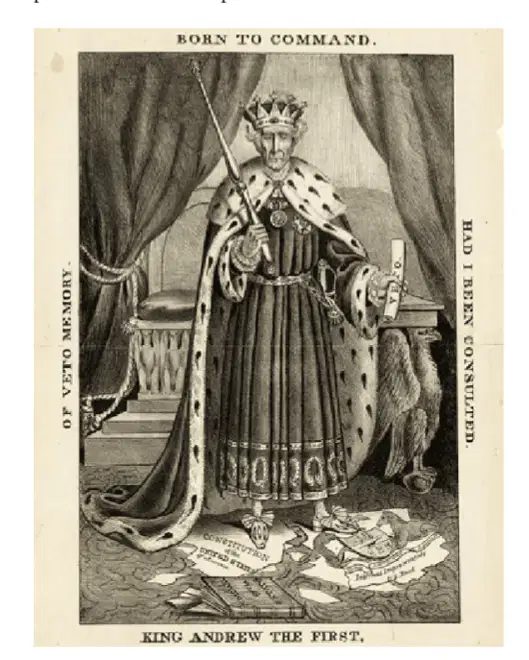
This cartoon uses the label "Born to command" to describe President Jackson's approach to the presidency. Which of the following labels might be used to describe a President who subscribes to the Whig theory of presidential leadership?
"Born to serve only one term"
"Born to trample on the Constitution"
"Born to imitate President Roosevelt"
"Born to follow Congress's lead"
Read this excerpt from the text: “Many laws that Congress enacts are written in fairly broad terms. Congress sets out the basic policies and standards to be followed. The specific details—much of the fine print necessary to the actual, day-to-day administration of the law—are usually left to be worked out by the executive branch.” This describes the use of which presidential power?
the power to grant clemency
the power of executive privilege
the power to execute the law
the power of appointment and removal
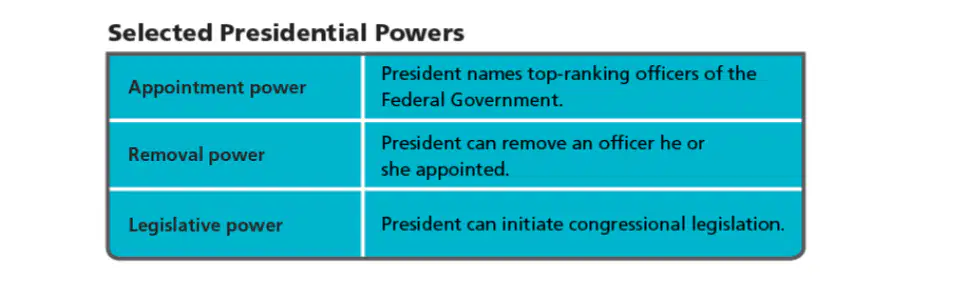
Use the information in the chart to answer the question. Selected Presidential Powers: Appointment power — President names top‑ranking officers of the Federal Government. Removal power — President can remove an officer he or she appointed. Legislative power — President can initiate congressional legislation. Which of the presidential powers listed on the chart blurs the separation of powers between branches of the government?
appointment power
removal power
legislative power
none of the powers
In the 1960s, President John F. Kennedy directed his military adviser, General Maxwell Taylor, to refuse to testify before a congressional committee examining the Bay of Pigs affair. This is an example of the use of which presidential power?
executive privilege
ordinance power
veto power
pardoning power
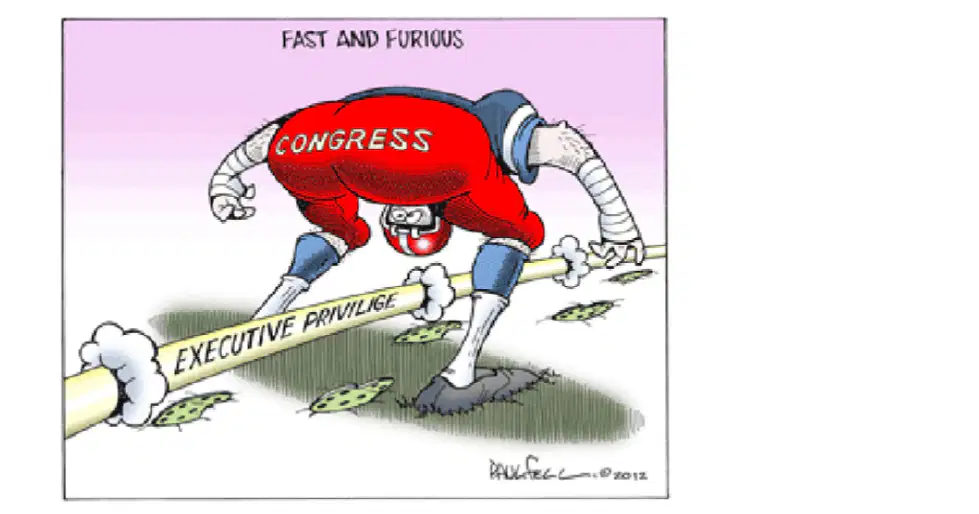
Which statement about this cartoon about executive privilege is MOST accurate?
It suggests that executive privilege allows the President to do things to which Congress might object.
It suggests that executive privilege has divided Congress so much that it is no longer a check on the executive branch.
It is against executive privilege because the same power is not given to Congress.
It favors executive privilege because the President knows the needs of the country better than Congress does.
Which statement regarding treaties is TRUE?
It is easier to get Congress to approve a treaty than to pass a joint resolution.
The most famous treaty approved by Congress was the Treaty of Versailles ending World War I.
Treaties have the same legal standing as acts of Congress.
The President must obtain Senate consent before negotiating a treaty.
Predict which of the following a President might consider before negotiating a treaty with the leader of another country.
Will my successor support the treaty?
Will at least 67 senators support the treaty?
Will Congress ratify the treaty?
Will my Cabinet support the treaty?

Based on the cartoon about the Treaty of Versailles and the information in the text, which of the following is TRUE?
The Senate proposed major revisions to the treaty.
President Wilson was pleased with the Senate's decision regarding the treaty.
The treaty was in bad shape by the time it reached the Senate.
The approval process is the best way to arrive at a treaty that is acceptable to everyone.
In 1973, Congress overrode President Nixon's veto of the War Powers Resolution. What conclusion can be drawn based on this fact?
The President's action was based on public opinion regarding the resolution.
Support for the resolution was overwhelming in both houses of Congress.
The President was certain that the Supreme Court would find the resolution to be unconstitutional.
The Senate did not have the necessary two‑thirds vote to approve the resolution.
In January 2013, the United States officially recognized the government of Somalia for the first time since 1991. Which of the following is one reason for this action?
to show that the U.S. believes Somalia has completed its journey to democracy
to make it impossible for Somalia to declare war on the U.S.
to reward Somalia's progress and help it to continue on the path to democracy
to pave the way for the signing of a treaty between the two countries
Although Congress has not declared war since World War II, the United States has used military force on many occasions since then. What is one explanation for this fact?
The President has used military force without authorization from Congress.
Congress has authorized the use of military force without the support of the President.
The President has used executive privilege to authorize the use of military force.
Congress has enacted joint resolutions to authorize the President to use military force.
Read this excerpt from the War Powers Resolution of 1973:
"It is the purpose of this joint resolution to fulfill the intent of the framers of the Constitution of the United States and insure that the collective judgment of both the Congress and the President will apply to the introduction of United States Armed Forces into hostilities, or into situations where imminent involvement in hostilities is clearly indicated by the circumstances, and to the continued use of such forces in hostilities or in such situations."
What is the MOST LIKELY reason that members of Congress passed this resolution?
They wished to allow the President to initiate military force without consulting Congress.
They hoped to convince the American people to continue to support the use of force in Vietnam.
They feared that other countries would view the United States as weak without such a resolution.
They believed that the President was blurring the separation of powers established by the Constitution.
What amendment grants people the freedom of speech, press, religion, and assembly?
Amendment 1
Amendment 9
Amendment 5
What amendment grants the right for people to bear arms?
Amendment 6
Amendment 3
Amendment 2
Which amendment forbids soldiers from taking over your home?
Amendment 12
Amendment 3
Amendment 1
Which amendment requires a warrant for a search and seizure?
Amendment 2
Amendment 6
Amendment 4
Which amendment says that you cannot be incriminated by the government without proof?
Amendment 5
Amendment 10
Amendment 8
Which amendment grants the right to a speedy and fair trial?
Amendment 7
Amendment 3
Amendment 6
Which amendment grants the right to a trial by jury?
Amendment 7
Amendment 3
Amendment 2
Which amendment forbids cruel or unusual punishments?
Amendment 12
Amendment 4
Amendment 8
Which amendment says that people retain certain rights?
Amendment 6
Amendment 10
Amendment 9
Which amendment protects the people and states from an all powerful federal government?
Amendment 10
Amendment 3
Amendment 8
This ruling explicitly outlawed racial segregation of public education facilities (legal establishment of separate government-run schools for blacks and whites), ruling so on the grounds that the doctrine of "separate but equal" public education could never truly provide black Americans with facilities of the same standards available to white Americans
Brown vs Board of Ed
Escobedo vs ILL
Dred Scott vs Sanford
Gregg vs Georgia
This ruling said that people of African descent, whether or not they were slaves, could never be citizens of the United States, and that Congress had no authority to prohibit slavery in federal territories.
Brown vs Board of Ed
Gibbons v. Ogden
Furman v. Georgia
Dred Scott v. Sandford
This ruling affirmed the government’s decision regarding the Japanese American Internment during World War II and found that it was not unconstitutional.
McCulloch v. Maryland, 1819
Mapp v. Ohio, 1961
Marbury v. Madison, 1803
Korematsu v. United States, 1944
This ruling held that evidence obtained in violation of the Fourth Amendment protection against "unreasonable searches and seizures" must be excluded from criminal prosecutions in state courts, as well as federal courts.
Mapp v. Ohio, 1961
Miranda v. Arizona, 1966
McCulloch v. Maryland, 1819
Marbury v. Madison, 1803
This landmark ruling held that basis for the exercise of judicial review of Federal statutes by the United States Supreme Court under Article Three of the United States Constitution is legal.
McCulloch v. Maryland, 1819
Marbury v. Madison, 1803
Miranda v. Arizona, 1966
New Jersey v. TLO, 1985
This fundamental case established the following two principles: that the Constitution grants to Congress implied powers for implementing the Constitution's express powers, in order to create a functional national government, and that state action may not impede valid constitutional exercises of power by the Federal government.
Miranda v. Arizona, 1966
New Jersey v. TLO, 1985
McCulloch v. Maryland, 1819
Plessy v. Ferguson, 1896
This ruling held held that criminal suspects must be informed of their right to consult with an attorney and of their right against self-incrimination prior to questioning by police.
Regents of California v. Bakke, 1978
Plessy v. Ferguson, 1896
New Jersey v. TLO, 1985
Miranda v. Arizona, 1966
The Supreme Court ruled that the "separate but equal" provision of the Louisiana law was constitutional. The case established this principle of segregation until it was overturned in 1954.
Regents of California v. Bakke, 1978
Roe v. Wade, 1973
Plessy v. Ferguson, 1896
Tinker v. Des Moines School District, 1969
A constitutional right to an abortion is established, though the court laid down a trimester criteria in determining whether states can impose restrictions
Regents of California v. Bakke,
Roe v. Wade, 1973
Tinker v. Des Moines School District, 1969
Texas v. Johnson, 1991
This ruling invalidated prohibitions on desecrating the American flag in force in 48 of the 50 states. Justice William
Brennan wrote for a five-justice majority in holding that the defendant's act of flag burning was protected speech under the first amendment.
Regents of California v. Bakke,
Roe v. Wade, 1973
Tinker v. Des Moines School District, 1969
Texas v. Johnson, 1991
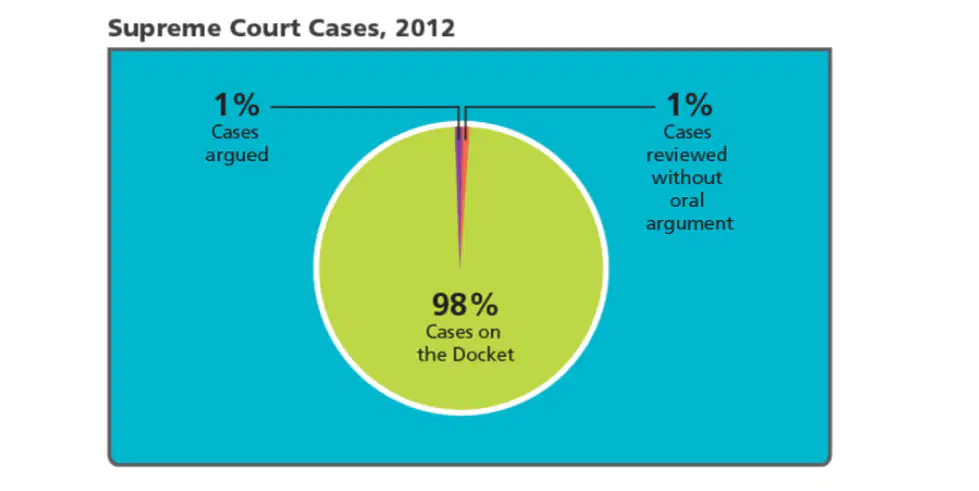
Use the pie graph to answer the question.
What conclusion could be drawn regarding cases appealed to the Supreme Court in the year 2012?
The Supreme Court accepted almost all of the cases that were brought to it.
Since it dealt only with cases involving constitutionality, the Supreme Court ruled on just a handful of cases.
Many cases were appealed to the Supreme Court, but it could only deal with a few of them.
The Supreme Court used three different methods with which to rule upon a case.
What argument was the author of this statement, John Marshall, making about how the Federal Government should function?
“It is emphatically the province and duty of the Judicial Department to say what the law is.” —John Marshall, Marbury v. Madison, Opinion of the Court
The judicial branch of the Federal Government should have the power to make laws.
The judicial branch of the Federal Government should have power to interpret laws.
The judicial branch has the sole authority to establish a federal court system.
Only the laws created by the Federal Government, and approved by the Court, have any authority in the federal system.
Identify the case over which the U.S. Supreme Court would exercise original jurisdiction.
a shipwreck occurs in the coastal waters of the United States
a government employee sues the government agency that employs her
a citizen brings a 1st Amendment case against his State government
a State agency brings a lawsuit against an agency in another State
Read this excerpt from the text and answer the question:
“William Marbury had been appointed a Justice of the Peace for the District of Columbia. The Senate had promptly confirmed his appointment, and late on the night of March 3, 1801, President Adams signed the commissions of office for Marbury and a number of other new judges. The next day, Jefferson became President . . .”
How did President Jefferson respond to the situation?
He blamed President Adams for not delivering Marbury’s commission and ordered it delivered immediately.
He used his presidential authority to declare that Marbury’s commission was null and void.
He ordered his Secretary of State not to deliver Marbury’s commission, blocking Marbury from becoming a judge.
He asked the leader of the Senate to revoke Marbury’s appointment and remove his commission.

Identify steps two and three that are missing from the diagram
2. The citizen is indicted by a grand jury. 3. The citizen is tried by a petit jury.
2. The citizen’s plea is heard by a commission. 3. The citizen is tried by a tribunal.
2. The citizen is charged by a grand jury. 3. The citizen is sentenced by a judge.
2. The citizen is tried by a petit jury. 3. The citizen appeals the decision.

