
 Worksheets
Mid Term Review
Total questions: 96
Worksheet time: 1hrs 10mins
Meteorology is the study of the changes of the Earth's . . .
Lithosphere
Asthenosphere
Atmosphere
Hydrosphere
Any energy coming from the Sun is called . . .
Insolation
Insulation
Convection
Interpretation
What is the relative humidity if the dry bulb temperature is 160C and the wet bulb temperature is 100C?
45%
33%
14%
4%
Which graph best shows the general relationship between altitude and air pressure?


Which process primarily transfers heat by moving air?
conduction
convection
radiation
transpiration
In what layer of the atmosphere do we live in?
Exosphere
Mesosphere
Troposphere
Stratosphere
As altitude increases, what happens to the atmosphere pressure?
It decreases.
It increases.
It becomes cold.
It becomes hot.
What is the makeup of Earth's atmosphere?
78% nitrogen, 20% oxygen, and 2% other gases.
72% nitrogen, 20% oxygen, and 8% other gases.
2% nitrogen, 20% oxygen, and 78% other gases.
14% nitrogen, 80% oxygen, and 6% other gases.
Why does land and water absorb and lose heat at different rates?
Water heats up and cools down more quickly than land.
Land heats up and cools down more slowly than water.
Land heats up and cools down more quickly than water.
Water heats up and cools down more slowly than land.
Warm air rising at the equator and cold air sinking at the poles is an example of ___________.
radiation
conduction
convection


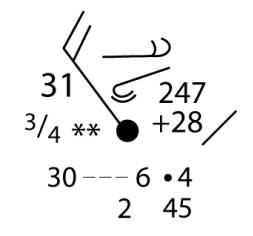
What is the dew point at this station?
75 degrees
61 degrees
987 degrees
11 degrees


Which Model states that the sun is the center of the solar system?
Geocentric
Heliocentric
Big Bang
Star Life Cycle
Which model states that the sun, planets, and moons revolve around the earth
Geocentric
Heliocentric
Big Bang
Star Cycle
Why do we have seasons on earth?
The earths tilt allows more or less sunlight on earth depending on the time of year.
The distance between the sun and earth change throughout the year
The suns temperature increases throughout the year
The Earths rotation changes speed depending on the month of the year.
What is it called when the Earth blocks the moon?
Solar eclipse
Lunar eclipse
What is it called when the moon blocks the sun?
Solar eclipse
Lunar eclipse

Kepler's First Law states
objects attract other objects with a force that is directly proportional to the product of their masses
the square of the ratio of the periods of any two planets revolving around the Sun is equal to the cube of the ratio of their average distance from the Sun
An imaginary line joining a planet and the sun sweeps out an equal area of space in equal amounts of time.
Planets move about the Sun in an elliptical orbit with the Sun at one of the foci.
The surface of the sun is called ______________________.
photosphere
chromosphere
sunspots
flares
If something that makes light is moving away from you, it spreads the wavelengths of light out. This application of the Doppler effect is known as ___.
blue shift
green shift
red shift
black shift


The map below shows a portion of Earth's system of latitude and longitude and five surface locations labeled A, B, C, D, and X.
At which location will noon next occur?
A
B
C
D

The diagram below represents a view of Earth from above the North Pole. Points A and B represent locations on Earth's surface.
Locations A and B have the same
latitude and local time
latitude and elevation
longitude and local time
longitude and elevation
The altitude of Polaris measured by an observer at the Tropic of Cancer is
15°
23.5°
66.5°
90°
Which statement best explains why stars viewed from the Northern Hemisphere appear to revolve around Polaris?
Polaris rotates on its axis
Earth rotates on its axis
Polaris revolves around Earth
Earth revolves around Polaris

The map below shows four major time zones of the United States. The dashed lines represent meridians of longitude. The locations of New York City and Denver are shown.
What is the time in New York City when it is noon in Denver?
10 am
2 pm
3 pm
noon
Which New York State city is located at 42°39' N 73°45' W?
Buffalo
Albany
Ithaca
Plattsburgh
What is the approximate altitude of Polaris at Syracuse, New York?
43°
47°
76°
90°
If an observer on Earth views Polaris on the horizon, the observer is located at the
equator (0°)
North Pole (90° N)
Tropic of Cancer (23.5° N)
Tropic of Capricorn (23.5° S)
At which New York State location would an observer measure the highest altitude of Polaris?
New York City
Slide Mountain
Niagara Falls
Plattsburgh
Compared to the weight of a person at the North Pole, the weight of the same person at the Equator would be
slightly less, because the person is farther from the center of Earth
slightly less, because the person is closer to the center of Earth
slightly more, because the person is farther from the center of Earth
slightly more, because the person is closer to the center of Earth
The best evidence that the Earth has a spherical shape is provided by
photographs of the Earth taken from space satellites
the amount of daylight received at the North Pole on June 21
the changing orbital speed of the Earth in its orbit around the Sun
the cyclic change of seasons
An observer watching a sailing ship at sea notes that the ship appears to be "sinking" as it moves away. Which statement best explains this observation?
The surface of the ocean has depressions.
The Earth has a curved surface.
The Earth is rotating.
The Earth is revolving.
At which location will the highest altitude of the star Polaris be observed?
Equator
Tropic of Cancer
Arctic Circle
central New York State
As a ship crosses the Prime Meridian, the altitude of Polaris measured from the ship is 50°. What is the ship’s location?
0° latitude 50° east longitude
0° latitude 50° west longitude
50° north latitude 0° longitude
50° south latitude 0° longitude
On April 21, the altitude of Polaris, as viewed from a location in New York State, was measured as 41.3°. What will the altitude of Polaris be when viewed one month later, on May 21, from the same location?
23.5°
41.3°
66.7°
90°

The map below shows three locations, labeled A, X, and B, on Earth's surface.
Which table correctly indicates the solar times at locations A and B when it is 12 noon at location X?


The photograph was taken by aiming a camera at a portion of the night sky above a New York State location and leaving the camera's shutter open for a period of time to record star trails.
During the time exposure of the photograph, the stars appear to have moved through an arc of 120°. How many hours did this time exposure take?
5h
8h
12h
15h

The photograph was taken by aiming a camera at a portion of the night sky above a New York State location and leaving the camera's shutter open for a period of time to record star trails.
Which celestial object is shown in the photograph near the center of the star trails?
the Sun
the Moon
Sirius
Polaris
From Utica, New York, Polaris is observed at an altitude of approximately
43°
47°
75°
90°

The diagram below shows latitude measurements every 10 degrees and longitude measurements every 15 degrees.
What is the latitude and longitude of point X?
40° S 45° E
50° N 45° W
60° S 30° W
75° N 30° E

The diagram below shows an observer on Earth viewing the star Polaris. What is the observer's latitude?
38° N
38° S
52° N
52° S

Base your answer on the world map below. Letters A through D represent locations on Earth's surface.
At which location could an observer not see Polaris in the night sky at any time during the year?
A
B
C
D

Points X, Y, and Z are locations on the map. Elevations are expressed in meters.
What is the elevation of point Z?
190 m
220 m
240 m
250 m

Points X, Y, and Z are locations on the map. Elevations are expressed in meters.
Mill River generally flows toward the _______________________ .
southeast
southwest
northeast
northwest
The Earth's actual shape is most correctly described as
a circle
a perfect sphere
an oblate sphere
an eccentric ellipse

Point X is a location on the topographic map below. Elevations are measured in meters.
What is a possible elevation, in meters, of point X?
55
57
68
70

A topographic map of Mt. Rainier in Washington State is shown below.
What is the contour interval of the map?
20 ft
40 ft
100 ft
200 ft

Base your answer on the contour map of an island below. Points A through G represent locations on the island. Elevations are in meters.
Which two points have the same elevation?
G and F
B and D
C and D
G and C

Base your answer on the contour map of an island below. Points A through G represent locations on the island. Elevations are in meters.
What is the contour interval for this map?
10 m
15 m
20 m
25 m

Base your answer on the contour map of an island below. Points A through G represent locations on the island. Elevations are in meters.
In which direction does the Cinder River flow?
southeast
southwest
northwest
northeast

Base your answer on the contour map of an island below. Points A through G represent locations on the island. Elevations are in meters.
Which point is located on the steepest slope?
F
B
C
D

The diagrams show the steps used to determine the amount of heat held by equal masses of iron, copper, lead, and granite.
Which substance has the highest specific heat? (Page 1 ESRT)
Copper
Granite
Iron
Lead

The greatest duration of insolation in Jamestown occurs when the Sun appears to travel along path
A
B
C
D
A person in the eastern United States worked outdoors in sunlight for several hours on a day in July. Which type of clothing should the person have worn to absorb the least electromagnetic radiation?
Dark Colored with a Rough Surface
Dark Colored with a Smooth Surface
Light Colored with a Rough Surface
Light Colored with a Smooth Surface

The block diagrams show a 3D view of the topographic maps directly above them. Elevations are measured in feet.
Which contour interval is used on both topographic maps?
10 ft
20 ft
30 ft
40 ft

The diagram represents the Moon at four positions, labeled A, B, C, and D, in its orbit around Earth.
Approximately how many days (d) does it take for the Moon to move from the phase shown at position A to the full-Moon phase?
7.4 days
14.7 days
27.3 days
29.5 days
Why is the surface of Mercury covered with meteor impact craters, while Earth’s surface has relatively few craters?
Mercury is larger than Earth, so it gets hit with more meteors.
Mercury is an older planet, so it has a longer history of meteor impacts.
Earth’s less dense water surface attracts fewer meteors.
Earth’s hydrosphere and atmosphere destroyed or buried most meteor impact sites.

